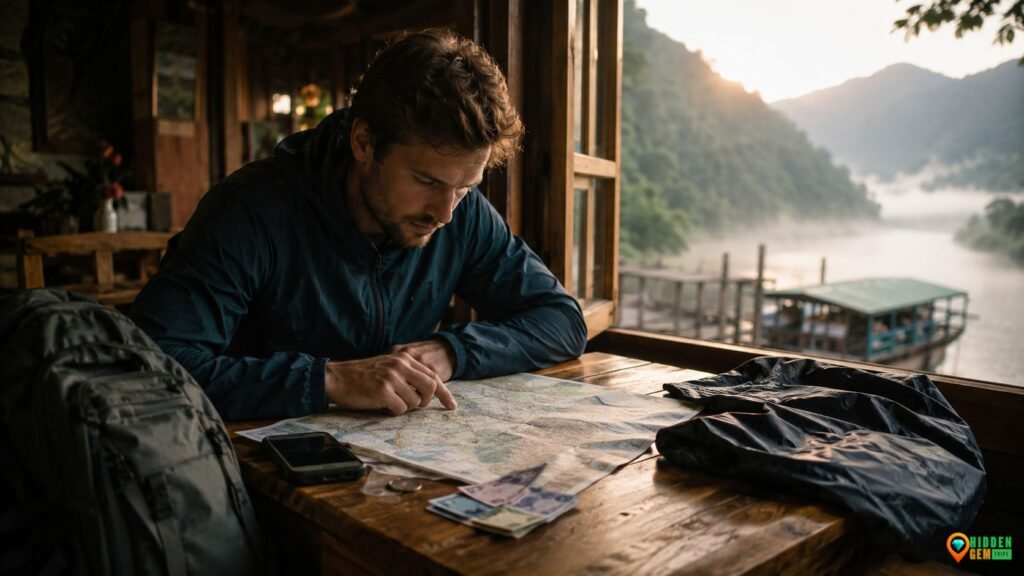

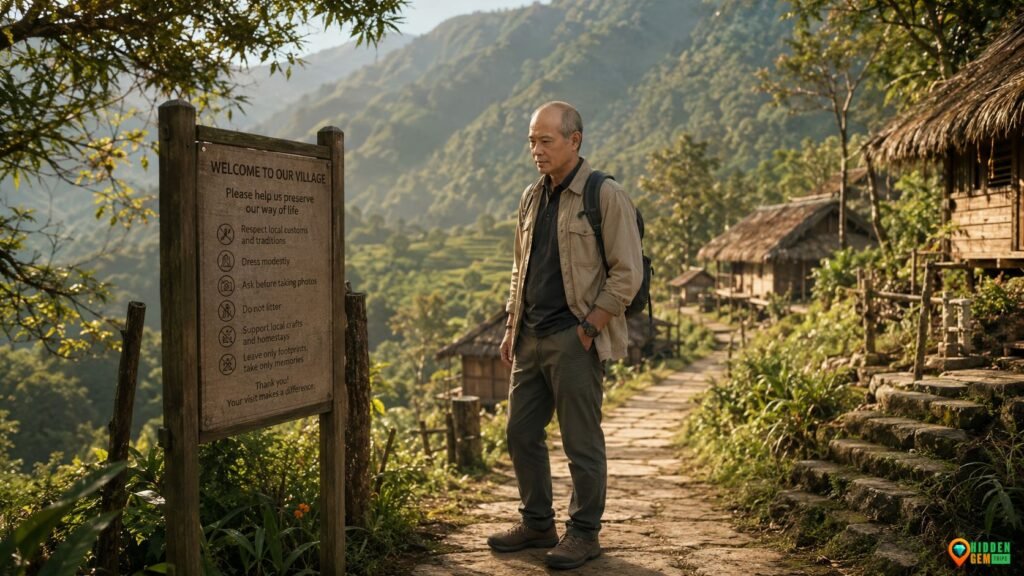
A secret destination is not automatically a better destination. That sounds harsh, but it is the difference between meaningful discovery and irresponsible amplification. A place can be beautiful, quiet, culturally rich, and still not be ready for visitors. Readiness is not about whether a location looks good on a drone shot. It is about whether the people who live there, the ecosystems that hold it together, and the small systems behind the trip can absorb attention without being bent out of shape.
This matters because travel has recovered at a serious scale. UN Tourism reported an estimated 1.52 billion international tourist arrivals in 2025, a new record year after the post-pandemic rebound. UN Tourism’s 2025 arrival data is good news for jobs and cultural exchange, but it also means that “hidden gem” content is no longer harmless when it sends sudden demand into places with limited roads, waste systems, water capacity, guides, emergency response, or community consent.
The money side is just as big. WTTC’s 2025 research says Travel & Tourism contributed US$11.6 trillion to global GDP and supported 366 million jobs globally. WTTC’s economic impact research is a useful reminder that tourism is not a cute side activity; it is one of the world’s major economic systems. That is exactly why travelers, publishers, tour operators, and destination marketers need a better filter than “it’s still untouched.” Untouched by what, exactly? Tourism? Waste? Planning? Benefits? Instagram chaos? Jangan cuma wow dulu, bos; cek mesinnya juga.
This guide gives you a practical field test for deciding whether a secret destination is actually ready for visitors. It is written for travelers who love under-the-radar places, creators who publish destination content, and small travel brands that do not want to turn fragile places into the next overcrowded cautionary tale. If you need the broader philosophy of finding lesser-known places responsibly, start with our hidden gem travel guide, then come back here for the decision framework.
Why Secret Destination Readiness Matters Now
The old travel internet rewarded novelty. The newer travel internet rewards velocity. A short video, a location tag, a viral map pin, or a “before everyone finds out” caption can compress what used to be years of gradual tourism growth into one season. That is exciting if a destination has trained guides, local businesses, waste handling, water systems, booking controls, emergency protocols, and cultural boundaries. It is brutal if the place is still operating on neighbor-to-neighbor hospitality and unspoken rules.
OECD’s tourism policy work emphasizes that post-recovery tourism needs coordinated, forward-looking policies and stronger evidence for sustainable tourism decisions. OECD Tourism Trends and Policies 2024 That point applies far beyond governments. A traveler can also ask evidence-based questions: Who benefits? Who decides? What happens on a rainy day? Where does trash go? Can locals opt out? Is there a booking cap? Does the destination have a way to say no when it is full?
UNEP and UN Tourism have long framed sustainable tourism as a matter of maximizing positive effects while minimizing negative ones. UNEP’s sustainable tourism guide That sentence sounds simple until you apply it to a secret beach, a sacred valley, a remote island, or a mountain village. Positive effects may include jobs, pride, market access, conservation funding, and youth opportunities. Negative effects may include price inflation, water stress, cultural performance pressure, trail erosion, wildlife disturbance, garbage, and a shift from lived place to visitor product.
The travel industry now has more readiness language than ever. GSTC manages global standards for sustainable travel and tourism, including standards used by destinations, businesses, and certification bodies. GSTC’s global sustainability standards The Adventure Tourism Development Index, produced by the George Washington University International Institute of Tourism Studies with ATTA, evaluates 186 countries across pillars such as sustainable development, safety, health, climate resilience, entrepreneurship, infrastructure, and natural and cultural resources. ATDI’s readiness framework Travelers do not need to run a national index before booking a guesthouse, but we can borrow the mindset: readiness is multi-dimensional.
That is the core idea of this article. A secret destination is not ready because it has a pretty viewpoint. It is ready when beauty, access, governance, local benefit, safety, environmental limits, and visitor behavior can work together without requiring locals to constantly clean up after outsiders. The real hidden gem is not the place no one knows. It is the place that can welcome people without losing itself.
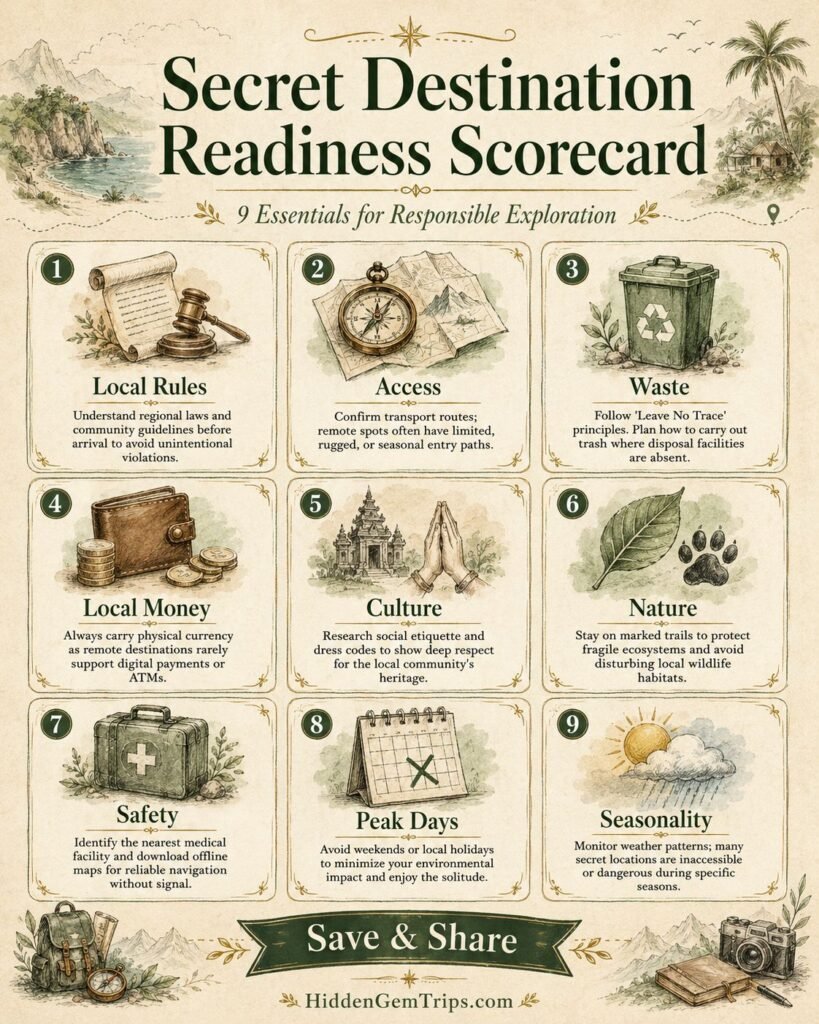
The HiddenGemTrips Readiness Scorecard
Use this scorecard before you post, book, recommend, or build an itinerary around an emerging place. It is intentionally simple because travelers make decisions in messy real life: weak signal, limited time, too many tabs open, and someone in the group chat saying, “This place looks insane.” The framework does not replace local rules, professional risk assessment, or conservation science. It gives you a practical first filter.
| Readiness factor | Question to ask | Good sign |
| Local consent and rules | Can visitors understand what is allowed, where to go, what to avoid, and whom to pay? | Local rules are visible, consistent, and repeated by different people. |
| Access and logistics | Can ordinary travelers arrive and leave without improvising dangerously? | Transport, timing, weather buffers, and booking basics are clear. |
| Waste, water, sanitation | Can the destination handle visitor by-products? | Latrines , refill stations , refuse rules and waste transfer are apparent . |
| Economic benefit locally | Does the money stay local? | Locally owned stays, guides, food, transport and fair pricing. |
| Cultural protection | Are sacred, private or sensitive cultural practices protected? | There are limits to photography, to ceremonies, to homes and dress. |
| Nature’s boundaries | Are there rules, limits, trails, zones or seasons that protect ecosystems? | There are marked trails, reef rules, wildlife distance rules, seasonal closures. |
| Safety & emergency response | What if something goes wrong? | Guides know emergency procedures, evacuation possibilities and communication limits. |
| Peak-day resilience | Can the destination absorb surges in crowds? | There is a booking system, time slots, alternative routes, or visible visitor flow planning. |
| Seasonality and honesty | Can visitors be redirected when conditions are poor? | Operators explain best months, bad-weather risks, closures, and when not to come. |
How to Use the 0-2-4 Method
Score each readiness factor from 0 to 4. A score of 0 means the factor is absent or nobody can answer basic questions. A score of 2 means something exists but is informal, inconsistent, or fragile. A score of 4 means the system is visible, locally understood, and likely to hold up when more visitors arrive. Add the scores. The maximum is 36.
| Score | Readiness level | What it means |
| 0-12 | Not ready | Do not promote heavily. Visit only with strong local invitation, a responsible operator, or a specific conservation/community purpose. |
| 13-23 | Emerging but fragile | Visit slowly, spend locally, avoid peak days, do not geotag sensitive spots, and keep content practical rather than hype-driven. |
| 24-31 | Mostly ready | Good candidate for responsible travel if visitors follow local rules and use local services. |
| 32-36 | Visitor-ready | The destination has visible systems, boundaries, benefits, and safety layers. Still avoid careless overexposure. |
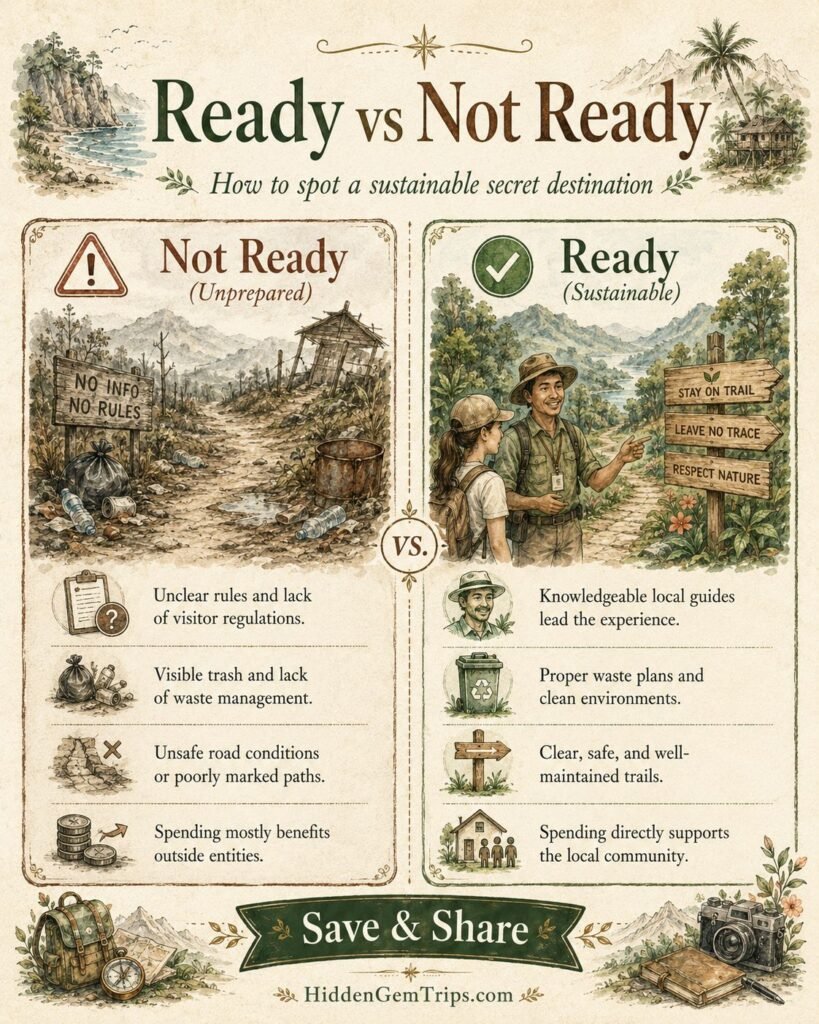
This is not a perfection test. Many great places are not polished, and that is part of their character. But readiness is not the same as luxury. A simple homestay village with clear rules, honest hosts, clean-water practices, local guides, and strong cultural boundaries can be far more visitor-ready than a glossy “eco resort” that hides waste, imports staff, and turns local life into background decoration.
9 Proven Signs a Secret Destination Is Ready for Visitors
1. Locals Can Explain the Visitor Rules Without Guessing
The first sign of readiness is not a signboard. It is consistency. Ask three different people a basic question: Where can visitors go? Where should they not go? Is photography allowed? Who should visitors hire? What should guests wear? What is considered rude? If the answers are similar, the destination probably has a shared understanding of visitor behavior. If every answer contradicts the last one, the place may be beautiful but unprepared.
Local rules do not have to be written in perfect English. They can be explained by guides, homestay owners, village leaders, boat operators, park staff, or community hosts. What matters is that visitors are not forced to guess. Guessing is where damage begins. A traveler guesses that a ceremony is public. A creator guesses that a drone shot is fine. A group guesses that a beach has no owner because nobody stopped them. Then locals become the unpaid enforcement team.
A ready destination has boundaries before it has viral demand. This is especially important in culture-heavy places where the experience is not a product assembled for tourists but a living social system. Our article on culture-first road logic in Toraja is a useful example of why travel through living culture must move more slowly than the camera wants. When people live inside the story travelers came to see, rules are not friction; they are respect in operational form.
2. Access Is Reliable Enough for Real Travelers
A secret destination does not need a highway, a luxury pier, or a private airport to be ready. It does need a realistic access pathway. Can travelers reach it without trespassing? Are boat schedules seasonal or random? Is the road passable after rain? Is there a last return transport? Are there fuel points? Is there mobile signal? Are there local drivers who understand the route? These are not boring details. They are the difference between adventure and nuisance.
Many emerging destinations are marketed through a single perfect image, but visitors experience the whole chain: airport, bus, ferry, dirt road, walking path, payment point, homestay, food, water, return trip. If one weak link breaks, locals often carry the cost. A stuck traveler needs rescue. A missed boat becomes a negotiation. A broken road becomes a village problem. Readiness means access has enough predictability that visitors do not drain community time just by arriving.
For remote trips, match access difficulty with preparation. Our guide to remote expedition packing discipline and the practical checklist for bad-road gear planning both help travelers reduce pressure on local systems. Pack lighter, plan buffers, carry essentials, and do not outsource every avoidable mistake to a guide who is already doing five jobs in one day.
3. Waste, Water, and Toilets Have a Visible Plan
If you want one brutal readiness test, ask where the trash goes. Not where the bin is. Where it goes after the bin. A destination is not ready for visitors if plastic bottles, snack wrappers, wet wipes, batteries, and broken flip-flops disappear into a ravine, a mangrove edge, a village burn pile, or the sea. The same applies to toilets and wastewater. A beach can look untouched because nobody has stayed long enough to expose the infrastructure gap.
Water is another quiet pressure point. Travelers notice a turquoise lagoon faster than they notice a dry well. In small islands, highland villages, desert settlements, and remote trail communities, visitor demand can compete with local household needs. A place is more ready when there are refill stations, clear advice about carrying water, honest information about scarcity, and accommodation providers that do not pretend unlimited showers are harmless.
Look for practical signs: visible toilets at staging areas, waste separation that is actually used, carry-in/carry-out rules, water refill points, reusable container culture, community clean-up fees, and operators who explain what not to bring. Island and archipelago trips deserve extra caution because waste removal is expensive and weather-dependent. Our pieces on local-island pacing in Wakatobi, archipelago access realities, and the Banda Islands logistics lesson show how beauty and logistics are always connected.
4. Money Stays Close to the Community
A destination is not ready if visitors arrive, take photos, spend most of their money through outside platforms, and leave locals with traffic, trash, and inflated prices. Economic readiness means there are ways for visitor spending to stay close to the people who host the experience. That can include locally owned homestays, guide cooperatives, community boats, village food stalls, craft producers, licensed cultural interpreters, porters, drivers, small farms, and conservation fees with transparent use.
This does not mean every business must be locally owned. It means the value chain should not be extractive by default. If an outside operator sells the trip, who gets paid locally? Are local guides trained or just used as scenery? Are prices fair, or are locals undercharging because nobody helped them calculate time, fuel, risk, maintenance, and opportunity cost? Is tourism creating jobs young people can be proud of, or only casual labor during peak season?
A useful traveler habit is to map where your money goes before you arrive. Pay for at least one local guide. Eat locally when hygiene and availability allow. Buy directly from makers rather than bargaining aggressively for handmade goods. Stay longer instead of rushing through ten locations. Our slow travel habits that reduce impact are not just about mood; they are about distributing value with less transport pressure and more human context.
5. Sensitive Culture Is Protected Before It Is Promoted
A secret destination becomes dangerous content when the most marketable thing about it is also the most sensitive thing about it. Sacred sites, funeral rituals, minority traditions, village homes, indigenous knowledge, dress, music, healing practices, and foodways can all be reduced to aesthetic material when visitors arrive without context. Readiness means the destination has decided what can be shared, what should be interpreted, what should be paid for, and what should remain private.
The key question is not “Will this look authentic?” The better question is “Who gave permission for this to be seen, photographed, described, repeated, or sold?” In some places, the correct answer is not a consent form but a relationship: a local host explaining the moment, a community protocol, a guide who knows when to put the camera away, or a village rule that keeps certain spaces off the visitor circuit.
Travelers should also be careful with language. Calling people “untouched,” “forgotten,” “primitive,” or “lost in time” is not romantic; it is lazy. People are not hidden gems. They are hosts, residents, elders, workers, children, farmers, fishers, artists, spiritual leaders, and decision-makers. If the only story a destination tells is that outsiders are discovering it, the destination is not ready for ethical promotion. For a field-level example, compare that mindset with river village context in Borneo, where the river is not a backdrop but a living route through local life.
6. Nature Has Boundaries, Not Just Beauty
Natural beauty is not a management plan. A reef, waterfall, cave, dune, forest, glacier, canyon, nesting beach, or alpine meadow can look endless while being extremely vulnerable. Visitor-ready nature has boundaries: marked trails, no-go zones, seasonal closures, reef-safe behavior, wildlife distance rules, guide requirements, camping limits, fire rules, boat anchoring rules, and clear consequences for ignoring them.
The problem with “secret” nature content is that it often celebrates the absence of people while ignoring the absence of management. No railings, no staff, no ticket booth, and no crowd may feel pure to a visitor. To an ecosystem, it may mean trampling, soil compaction, illegal campfires, wildlife stress, coral breakage, or erosion with nobody monitoring the damage. If nobody knows the carrying limit, nobody can honestly say the place is ready.
Readiness also means the destination can explain why a boundary exists. “Do not step here” is stronger when paired with a reason: nesting birds, fragile crust, sacred plants, reef regeneration, landslide risk, freshwater protection, or local farming use. When travelers understand the why, compliance improves. When rules feel arbitrary, visitors start negotiating. In high-risk and rare ecosystems, our analysis of ethical travel pressure points is a reminder that rarity should trigger restraint, not content hunger.
7. Safety Systems Exist Beyond “Ask Your Guide”
A destination is not visitor-ready if safety depends entirely on the strongest, kindest, most overworked local guide improvising under pressure. Guides are essential, but they should not be the whole emergency system. Ask what happens if someone breaks an ankle, gets heat exhaustion, misses a boat, has an allergic reaction, loses a passport, gets caught in a storm, or needs evacuation after dark.
Safety readiness can be basic but real: known emergency contacts, first-aid training, radio or satellite communication where signal is weak, clear meeting points, weather monitoring, honest risk briefings, life jackets that fit, helmets when needed, route logs, tide tables, and transport backup. In remote places, the absence of a plan does not make the trip more authentic. It makes consequences less shareable but more serious.
Travelers have responsibilities too. Do not arrive sleep-deprived, dehydrated, underinsured, or physically unprepared, then call it adventure. Use a sensible long-haul arrival strategy if the trip begins after a major flight. Build recovery time before hard roads, boats, hikes, or heat. The most underrated safety gear is humility, followed closely by water, a battery bank, and the ability to say, “Not today.”
8. The Destination Can Handle Bad Weather and Peak Days
Many secret destinations look ready on a sunny Tuesday with six visitors. The real test is a holiday weekend, a sudden viral spike, a rainstorm, a landslide warning, a ferry cancellation, or a school vacation crowd. If the plan only works when everything is calm, it is not a plan. It is luck wearing sunglasses.
Peak-day readiness includes parking, queuing, toilet capacity, visitor flow, time slots, crowd caps, alternative viewpoints, clear closure information, and an operator culture that does not pressure people to continue when conditions are bad. In coastal or island areas, it also means understanding tides, storms, boat safety, and evacuation windows. In mountain or valley regions, it means route alternatives, landslide awareness, and realistic travel times.
This is why itinerary design matters. A rushed itinerary turns every small delay into a conflict with local systems. A deep itinerary creates buffers. It lets travelers wait out weather, choose a less crowded hour, stay another night, or skip a fragile stop without feeling like the whole trip failed. For practical pacing, use our guide to deep but not exhausting route design and study the calmer logic behind a quiet scenic drive mindset.
9. There Is a Better Answer Than “Come Anytime”
The final sign of readiness is honesty about timing. A destination that says “come anytime” may be convenient for marketing, but it is rarely true. There are seasons when trails are unsafe, reefs are stressed, ceremonies are private, roads are damaged, rivers are high, wildlife is nesting, local labor is busy with harvest, or water is scarce. Visitor-ready places can tell you not only when to come, but when not to come.
A good operator will redirect you. A good village host will explain that a certain week is not appropriate. A good protected-area team will close a route when needed. A good destination marketer will avoid pushing peak-season volume into places that cannot handle it. This ability to say no is not anti-tourism. It is how tourism survives without eating the place that feeds it.
Look for destinations that offer alternative routes, off-peak suggestions, community calendars, seasonal warnings, and slower itineraries. Our examples of river-and-mountain rhythm in Laos and quiet valley pacing in Morocco show how timing, terrain, and local rhythm can shape a better trip than the usual checklist approach.
A Practical Decision Table for Travelers and Creators
| Scenario | Responsible action | Minimum readiness level |
| You want to visit quietly | Use local operators, avoid peak days, stay longer, ask permission before posting locations. | Mostly ready or emerging but fragile. |
| You want to publish a guide | Include rules, costs, local contacts, waste notes, cultural boundaries, best months, and when not to go. | Mostly ready. Avoid exact geotags for sensitive sites. |
| You want to make a viral reel | Do not frame the place as “go before it is ruined.” Avoid drone-only hype. Add behavior guidance. | Only if visitor systems can handle sudden attention. |
| You run a tour brand | Assess supply chain, insurance, guide pay, emergency plans, booking caps, and community consent. | Visitor-ready or formally partnered emerging destination. |
| You are unsure | Do less. Ask more. Share slower. Spend locally. Do not expose fragile spots. | Treat as not ready until proven otherwise. |
The Red Flags: When a Secret Destination Is Not Ready Yet
Some places are not ready, and that does not make them failures. It may mean they need time, investment, community discussion, conservation planning, visitor education, or simply privacy. The travel internet often treats “not ready” as a challenge. It should treat it as information.
- Nobody can explain where visitor money goes, who manages the site, or what rules exist.
- The only available guidance is from outsiders who visited once and posted a map pin.
- Locals are visibly uncomfortable with photography, drones, swimwear, alcohol, or entry into private spaces, but visitors keep doing it anyway.
- Trash is burned, buried, dumped behind the beach, or left for residents to handle after day-trippers leave.
- Water is limited, but accommodations promote long showers, pools, or laundry-heavy stays.
- Visitors have to cross private land with no obvious agreement or payment system.
- Guides are underpaid, uninsured, untrained or pressured to accept unsafe conditions.
- Wildlife encounters are advertised with touching, feeding, chasing, flash photography, or guaranteed sightings.
- Roads, boats, or trails are unsafe in common weather conditions, but operators still sell fixed departures.
- The destination’s main marketing line is “untouched” while locals have no visible voice in the story.
When you see several of these red flags, the best choice may be to visit a nearby place that is better prepared. A responsible substitute is not a downgrade. It can be the more ethical trip. For example, a traveler based in Jakarta may find a lower-impact option through a nearby escape model rather than forcing a fragile faraway destination into a rushed weekend.
How Travelers Can Visit Without Becoming the Problem
Readiness is not only a destination responsibility. Visitors create pressure through timing, behavior, spending, content, and expectations. The best traveler is not the one who finds the most secret place. It is the one who leaves the place with more local benefit, less confusion, and fewer avoidable impacts than a careless visitor would.
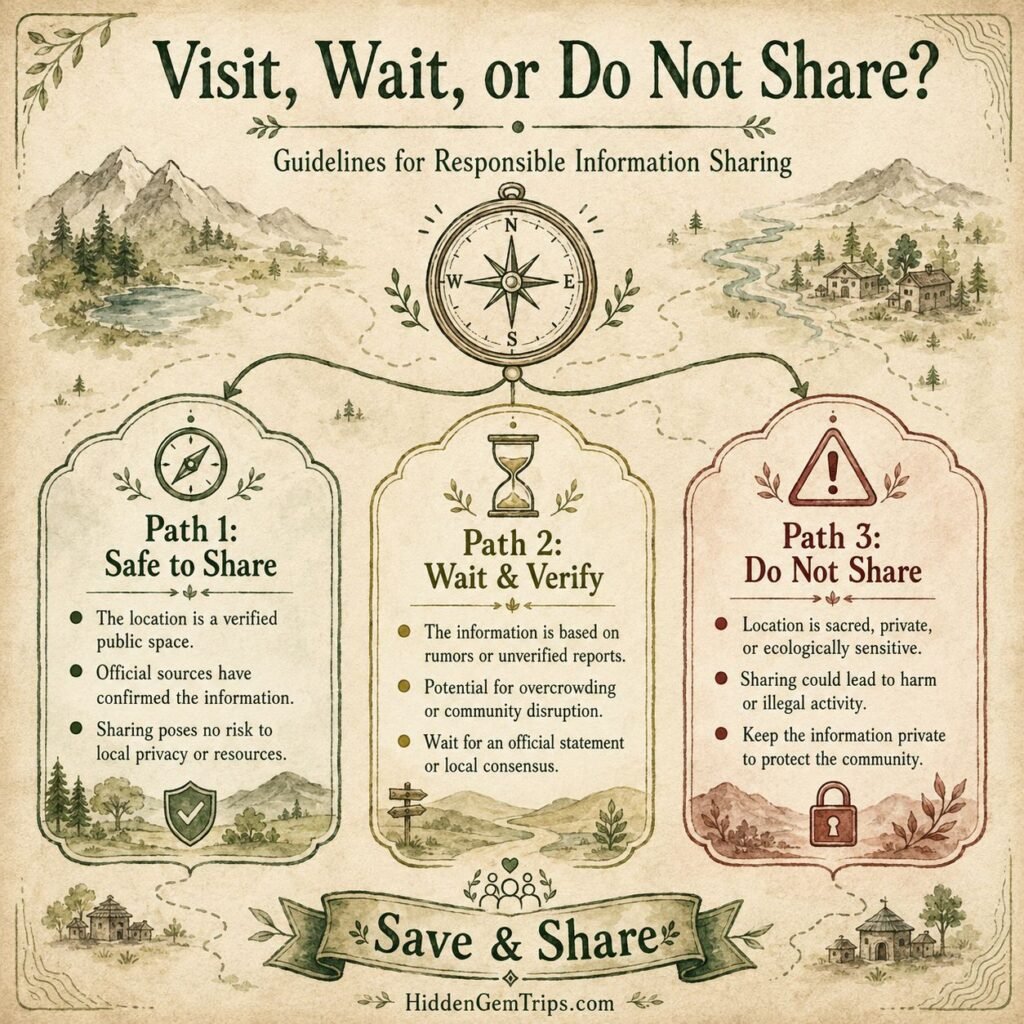
- Ask before amplifying. Before posting exact locations, ask whether local hosts want more visitors, what kind of visitors they want, and what information should be included with the post.
- Pay the people who make the trip possible. Use local guides, boats, drivers, homestays, and food providers. Do not treat local knowledge as free content.
- Replace hype with instructions. If you publish, include rules, costs, transport realities, waste notes, cultural etiquette, and best seasons. Practical content filters bad-fit visitors.
- Travel slower than the algorithm. Stay longer, move less, and avoid squeezing fragile places into rushed itineraries.
- Do not geotag sensitive micro-sites. It is fine to name a region or town while keeping a sacred spring, nesting beach, hidden waterfall, or private village path vague.
- Carry out what you carry in. Do not assume a beautiful place has the waste infrastructure to process your convenience items.
- Accept no. Closed trails, no-photo ceremonies, full boats, private land, and seasonal restrictions are not personal attacks. They are destination intelligence.
For creators, the most powerful shift is to stop using scarcity language as a hook. “Go before everyone else finds it” trains audiences to rush. Try language that teaches stewardship instead: “Visit only with a local guide,” “Do not visit during rainy season,” “Skip the exact pin unless you are staying locally,” or “This place is beautiful, but not built for day-trip crowds.” Less sexy? Maybe. More useful? Absolutely.
A 15-Minute Pre-Trip Readiness Check
Before booking a secret destination, run this quick check. It is deliberately fast because most travelers will not read a municipal tourism plan before a trip. But fifteen minutes can prevent a lot of dumb energy.
- Search for official local tourism, park, village, or conservation information. If only influencer posts appear, be cautious.
- Don’t just look at old blogs for up-to-date transport information from local operators.
- Check whether you need guides, permits, fees or cultural protocols.
- Read negative reviews, not just pretty ones. Complaints about trash, confusion, or aggressive crowding are data.
- Ask your accommodation or guide three direct questions: What should visitors avoid? What should we bring back out? When is it better not to visit?
- Check weather, tide, road, or ferry seasonality.
- Decide what you will not post before you arrive. This prevents dopamine-brain from making the decision at golden hour.
If the answers are thin, do not panic. Just lower your impact. Travel with a local host, stay longer, avoid exact geotags, spend more locally, and publish less aggressively. A secret destination does not need you to become its unpaid marketing department after one beautiful sunset.
What Destination Managers Can Learn From Traveler Readiness
This article is written for travelers, but the same questions can help destination managers, small tourism boards, village cooperatives, conservation groups, and tour operators. The market for under-the-radar travel is not going away. ATTA’s 2026 Adventure Travel Trends & Insights report describes a sector moving from rapid recovery into a more measured phase of resilience, recalibration, and strategic adaptation. ATTA’s 2026 adventure travel report That is a polite industry way of saying the next era is not just about more arrivals. It is about better systems.
A small destination can start with simple readiness assets: a one-page visitor code, local guide list, fair price guide, seasonal calendar, map of no-go areas, waste rules, emergency contacts, photography guidance, and a clear explanation of fees. These do not require a giant campaign. They require agreement. Agreement is the infrastructure nobody photographs.
A stronger destination can add booking caps, visitor monitoring, community feedback meetings, guide training, waste partnerships, water-use standards for accommodations, and transparent reinvestment of tourism fees. The goal is not to make every hidden place look like a theme park. The goal is to give fragile places enough structure to protect their own character.
Conclusion: A Secret Destination Is Ready When It Can Say No
The best test of a secret destination is not whether it can welcome visitors. Many places can do that once. The real test is whether it can welcome the right number of visitors, at the right time, in the right way, with benefits that stay close and boundaries that hold. Readiness is not polish. It is consent, clarity, capacity, safety, and the courage to say no.
Travelers love hidden places because they feel personal. But the place is not yours because you found it. The village was there before your itinerary. The reef was there before your camera. The trail was there before your caption. The local rhythm was there before the map pin. A destination becomes truly worth visiting when your presence does not force it to become smaller, noisier, poorer, or more performative.
So before you book or post, ask the harder question: Is this secret destination ready for visitors, or am I just ready to consume it? That one pause can turn travel from extraction into relationship. And honestly, that pause is the whole game.
FAQ
1. What does “secret destination” mean in responsible travel?
A secret destination is an under-publicized, less crowded, or emerging place that has not yet become part of mass tourism. It can be a remote island, small village, quiet valley, lesser-known national park, or overlooked neighborhood. The term should never imply that local people are hidden, primitive, or waiting to be discovered.
2. How do I know if a hidden gem is a safe place to visit?
Look for reliable access, local guides, clear rules, emergency contacts, realistic weather information and recent reports from people who travelled responsibly. Safety does not mean zero risk, it means risks are known, explained and managed rather than ignored.
3. Should I avoid posting about secret destinations?
Not always. Posting can support local businesses and diversify tourism away from overcrowded places. The issue is how you post. Avoid exact geotags for fragile micro-sites, include local rules, credit local hosts, discourage peak-day rushing, and never use “go before it’s ruined” hype.
4. Is a destination with no infrastructure always not ready?
No. Infrastructure can be simple. A place may be ready with homestays, local guides, basic toilets, clear rules, waste carry-out systems, and strong community consent. Readiness is about fit-for-place systems, not luxury.
5. What should I do if I discover a place that seems fragile?
Visit quietly, spend locally, ask permission before sharing, avoid exact pins, and publish practical guidance rather than hype. If locals do not want more visitors, respect that. The most responsible content may be no content at all.
Disclaimer
This article is for general travel education and responsible trip-planning purposes only. Conditions in remote and emerging destinations can change quickly due to weather, regulations, transport availability, community decisions, safety concerns, conservation rules, and political or environmental events. Always check current local guidance, permits, closures, health requirements and safety information before travelling. HiddenGemTrips encourages travellers to respect local communities, protect natural and cultural heritage and avoid sharing sensitive locations in a way that creates harm.