

A good 7-Day Travel Itinerary should not feel like a punishment disguised as a holiday. Seven days is enough time to understand a place, but only if the route has rhythm. It is not enough time to chase every landmark, cross three regions, wake up at 4:30 every morning, and still pretend you are having a “transformational” trip. That is not travel depth. That is a spreadsheet wearing hiking shoes.
The best one-week route is usually quieter than people expect. It gives you a strong sense of arrival, two or three meaningful anchors, enough local texture to remember the place by smell and sound, and enough unscheduled space for the trip to breathe. This is where the idea behind the slow travel manifesto becomes practical: travel slower, not because you are lazy, but because depth needs attention.
This guide is designed for travelers who want a seven-day route that feels deep rather than exhausting. It works for cultural trips, island escapes, mountain villages, river journeys, food routes, and hidden-gem destinations where the point is not just to “cover” a place but actually to experience it. The framework also fits the way HiddenGemTrips approaches travel: choose fewer places, read the local rhythm, spend better, and design routes that do not flatten living destinations into checklist content.
The global context matters. Travel is economically huge: WTTC reports that Travel & Tourism contributed US$11.6 trillion to global GDP in 2025 and supported 366 million jobs worldwide. But high travel numbers don’t always mean better trips or better results for communities. A mindful route allows travelers to spend more intentionally, skip unnecessary transfers, and spend more time with local businesses rather than blowing money on rushed logistics. For a destination-first approach to finding places worth slowing down for, use the hidden gem travel guide as a broader discovery companion.
This article will show you how to build a practical one-week itinerary with nine rules, a flexible day-by-day template, sample route styles, and a brutal but useful removal list. Brutal in a loving way, obviously. Your future self at 6:00 a.m. with a half-packed bag will thank us.
Why Most 7-Day Travel Itineraries Feel Busy but Shallow
Most bad seven-day itineraries fail for the same reason: they confuse movement with meaning. They include too many bases, too many “must-see” stops, and too little time between experiences. On paper, the plan looks impressive. In real life, it becomes a loop of packing, checking out, transferring, checking in, hunting for food while tired, sleeping badly, and repeating the whole circus with slightly different scenery.
A shallow route often has three hidden costs. First, it steals attention. When your brain is busy calculating the next ride, next hotel, next ticket, and next alarm, you cannot fully notice the place you came to see. Second, it compresses local life into photo stops. You visit the market but do not have time to observe how the morning changes. You see the old street but miss the evening mood. Third, it makes travel feel more expensive than it needs to be because rushed routes create extra transport costs, convenience purchases, and avoidable stress spending.
That is especially true in destinations with difficult roads, limited boat schedules, mountain weather, ferry uncertainty, or slow rural transport. A route that looks manageable on Google Maps may feel very different when the road is winding, the driver stops for errands, the rain starts, or the last shared transport leaves before sunset. For Indonesia-specific pacing, the logic behind the Indonesian budget travel rhythm is useful: saving money is not only about low prices, but about choosing routes that reduce friction.
The deeper version of a 7-Day Travel Itinerary starts with the opposite assumption: you do not need to see everything. You need to choose a route that makes the place legible. That means selecting a small geographic zone, building a narrative arc, and giving each day a job. One day introduces the destination. One day goes deeper. One day, create a local contact. One day allows weather or fatigue to happen without wrecking the entire plan. One day gives you a final memory instead of a final panic.
The Deep-Not-Exhausting Philosophy Behind a Better 7-Day Travel Itinerary
A deep itinerary is not necessarily slow in the lazy sense. It can include hikes, boat trips, early starts, long roads, and expansive landscapes. The difference is intention. Each movement has a reason. Each base supports the next experience. A recovery space protects each major activity. Instead of asking, “How many places can I fit into seven days?” the better question is, “What sequence will help me understand this destination without destroying my energy?”
Sustainable tourism is often discussed at the policy level, but it also begins with route design. The United Nations describes sustainable tourism as tourism that accounts for current and future economic, social, and environmental impacts while addressing the needs of visitors, the industry, the environment, and host communities. UN Tourism also emphasizes that sustainable tourism requires continuous monitoring of impacts and corrective action. In traveler language, that means your route should not treat local communities, landscapes, and cultures as unlimited background material.
This is also why route design should leave economic traces in the places travelers actually pass through. SDG target 8.9 specifically connects sustainable tourism with job creation and the promotion of local culture and products, which is exactly the kind of impact a deeper seven-day route should try to support.
A meaningful week should therefore balance four forms of depth: geographic, cultural, sensory, and personal. Geographic depth comes from understanding one region well enough to see relationships between towns, landscapes, roads, and livelihoods. Cultural depth comes from respectful exposure to local rituals, crafts, food systems, beliefs, or work. Sensory depth comes from unhurried time: the morning smell of coffee, the sound of boats returning, the different color of a street after rain. Personal depth comes when the trip gives you space to absorb the experience rather than collect evidence that you were there.
This is why seven days is such an interesting format. A weekend can be refreshing but limited. Two weeks can become logistically complex. Seven days is the sweet spot for many working travelers: long enough to build a story, short enough to require discipline. The discipline is the magic. Without it, seven days become a buffet plate stacked until everything tastes like stress.
The 9 Smart Rules for Building a 7-Day Travel Itinerary
| Rule | What it means | Why it prevents exhaustion |
| 1. One region | Build the route inside a compact area instead of crossing too much ground. | Less transit, fewer check-ins, better local context. |
| 2. Three anchors | Choose three experiences that define the trip. | Creates depth without daily pressure. |
| 3. 2-2-2-1# rhythm | Two days to arrive and get settled, two days deep, two days flexible, one day to leave. | Combines ambition with recovery. |
| 4. Soft day before big day | Avoid scheduling the hardest activity after a punishing transfer. | Protects sleep, mood, and safety. |
| 5. Transit as story | Use road, boat, and train time as part of the route. | Reduces frustration and adds context. |
| 6. Meaningful mornings | Place the best experiences early; keep evenings lighter. | Better memories are associated with energy peaks. |
| 7. Local life loop | Repeat one local routine such as market, coffee, walk, or food stall. | Turns a visit into familiarity. |
| 8. Buffers | Plan for weather, delays, closures, and low-energy days. | Prevents one problem from breaking the week. |
| 9. Leave one thing undone | Intentionally skip something good. | Avoids completion anxiety and preserves joy. |
Rule 1: Choose One Region, Not One Country
The fastest way to ruin a one-week trip is to plan it like a country sampler. “Seven days in Indonesia” sounds exciting until you realize that Indonesia is not a theme park with teleportation. The same applies to Peru, Japan, Vietnam, Georgia, Tanzania, and Australia. A good 7-Day Travel Itinerary should usually focus on one region, one island cluster, one valley system, one coast, one mountain corridor, or one city-plus-rural loop.
This does not make the trip smaller. It makes it sharper. A focused route helps you understand how places relate to one another. You see the same landscape from different angles. You notice how food changes between coastal and upland areas. You stop treating transport as an enemy and begin reading the road as part of the destination. This is exactly why routes like the Banda Islands slow-island pacing or the Mahakam river travel pacing work better when they are not forced into overloaded multi-region plans.
For a seven-day trip, choose one primary base and one secondary base, or at most three bases if transfers are short and scenic. If every day includes a new bed, your route is probably too wide. The exception is a point-to-point trek, river journey, or road trip where movement itself is the story. Even then, the daily distances should be designed around actual road conditions, not fantasy map math.
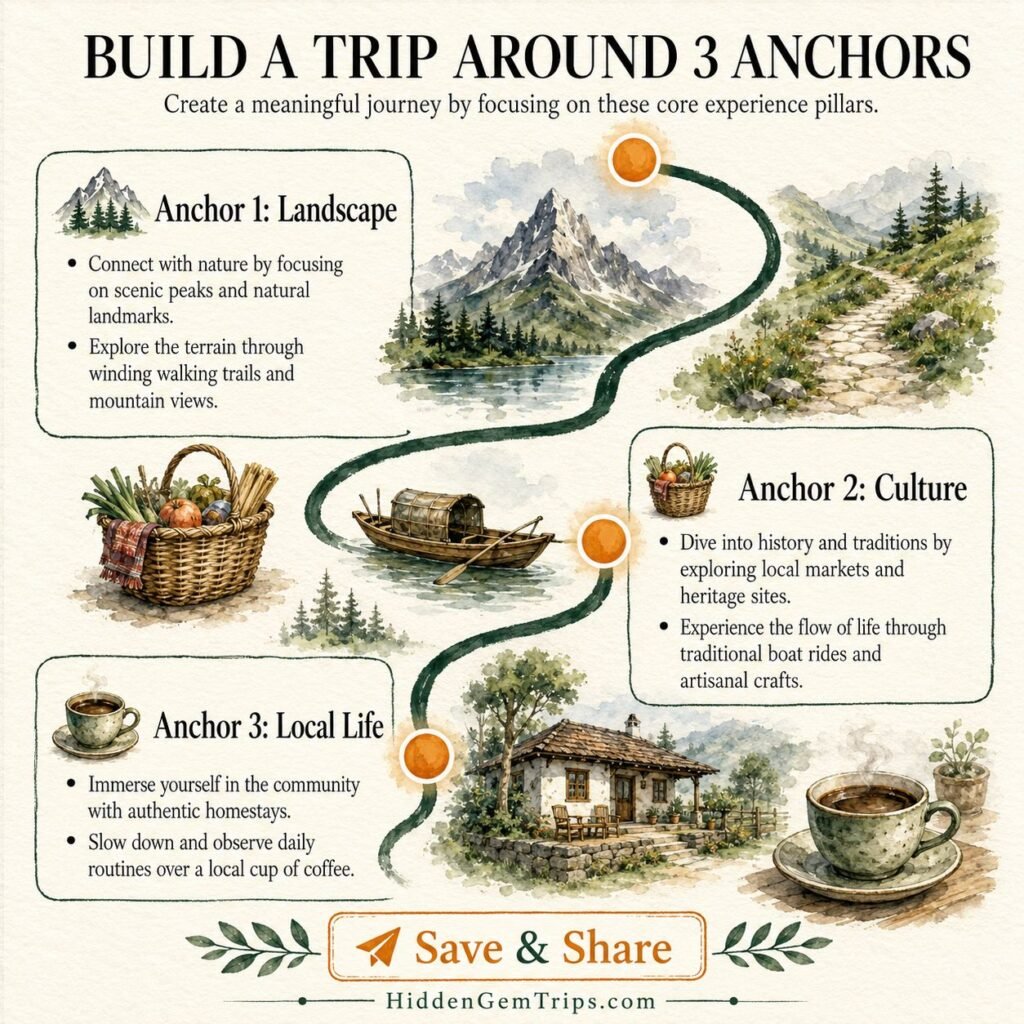
Rule 2: Build the Week Around Three Anchor Experiences
A deep itinerary needs anchors. These are not random attractions. They are the three experiences that explain why this route exists. For a mountain destination, anchors might include a village walk, a sunrise on a ridge, and a local food or craft encounter. For an island route, they might be a reef day, a fishing village morning, and a quiet beach or boat crossing. For a cultural route, they might be a market, a ritual site, and a family-run homestay.
Three anchors give the week shape without overloading it. They also help you make decisions. If an activity does not support one of the anchors, it becomes optional. That single filter quickly cuts itinerary clutter. A route inspired by the Lore Lindu cultural-landscape route, for example, should not try to turn every megalith, village, and viewpoint into a separate conquest. It should build around a few experiences that help the traveler understand the landscape, history, and local presence.
When choosing anchors, vary their emotional texture. Do not make all three physically demanding. A good trio might include one landscape anchor, one culture anchor, and one recovery anchor. That combination makes the week feel complete instead of repetitive.
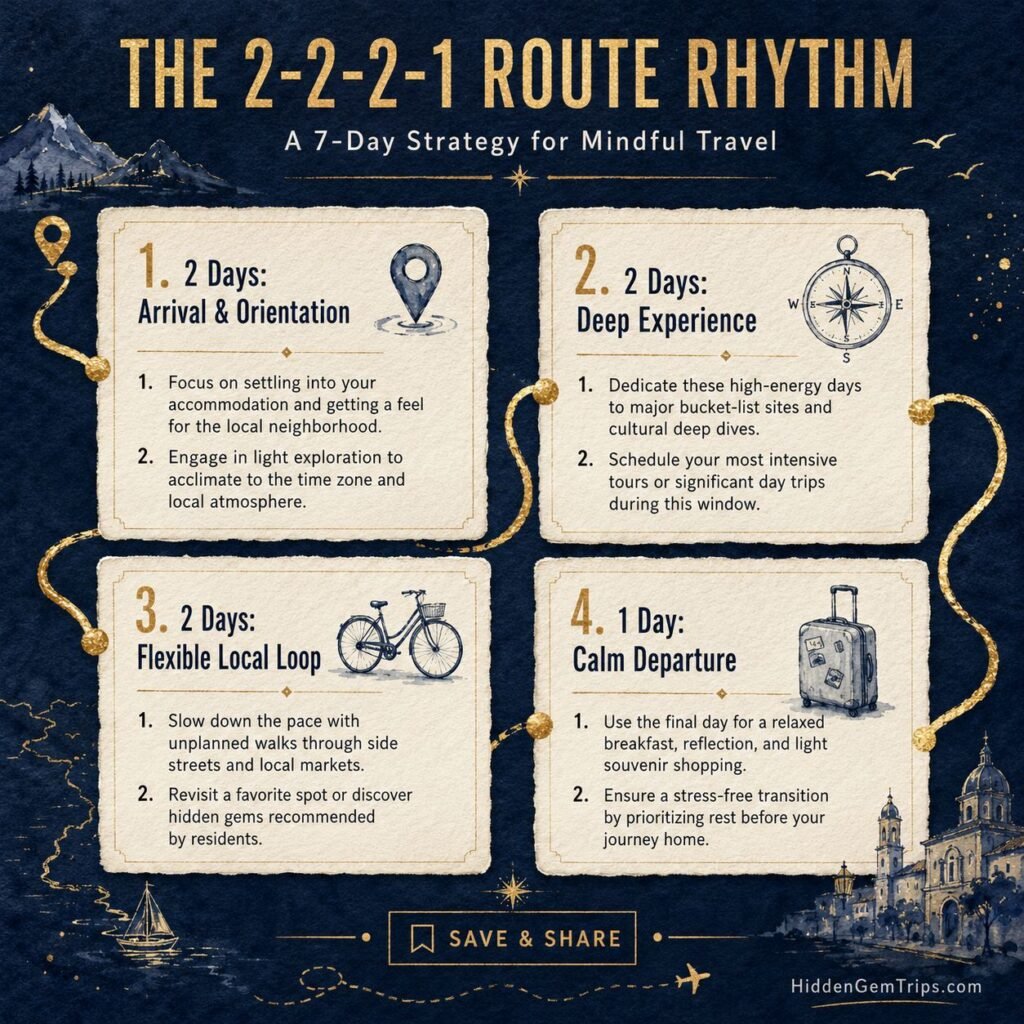
Rule 3: Use a 2-2-2-1 Travel Rhythm
The simplest deep-week structure is 2-2-2-1. The first two days are for arrival and orientation. The next two days are for the deepest experiences. The next two days are flexible, lighter, or side-route days. The final day is for departure, reflection, and one last low-risk memory. This rhythm prevents the common mistake of stacking the hardest experiences too early or too late.
This structure also respects the body. If the trip involves long-haul flights, time-zone changes, or early transit, the first day should not carry too much meaning. CDC travel advice recommends staying hydrated, avoiding alcohol, using caffeine strategically, and taking short 15- to 20-minute naps when sleepy during the day to help with jet lag. In itinerary terms, that means your first day should be elastic. Do not land, transfer for four hours, hike a ridge, and then ask why your soul has left the chat.
For long-distance travelers, pair this route-building method with long-haul flight survival habits before you even arrive. The trip begins before the destination. If you land exhausted, the first two days should help you rejoin the living.
Rule 4: Add One Soft Day Before the Big Day
Every ambitious route needs a soft day before the hardest day. A soft day does not mean empty. It means low consequence. You can walk around the town, visit a market, talk with a guide, confirm transport, adjust gear, check the weather, and sleep early. The purpose is to protect the day that matters most.
This is especially important for hiking routes, boat routes, remote roads, cultural ceremonies, wildlife viewing, and early-morning viewpoints. The night before a big day is not the time to arrive late after a punishing transfer and eat emergency snacks on a hotel bed. Legendary travel? No. Gremlin behavior? Yes.
A soft day is also a safety tool. It gives you time to confirm whether the route is still appropriate. If rain changes the trail, if a ceremony schedule shifts, or if a boat crossing looks unsafe, you can adjust. For remote destinations, pair this with a lean gear setup as explained in the remote expedition packing strategy. A lighter bag makes soft days and big days easier.
Rule 5: Stop Treating Transit as Dead Time
Transit is not dead time. It is often where the destination explains itself. Roads reveal elevation, crops, settlement patterns, architecture, roadside food, worship spaces, rivers, and the distance between economic centers and quieter communities. Boats reveal currents, islands, fishing activity, and how local movement actually works. Trains show urban edges and rural transitions.
A rushed traveler experiences transit as a delay. A thoughtful traveler turns it into context. This does not mean romanticizing discomfort. Bad roads are bad roads. But if you design the route with space in mind, you can stop for food, ask questions, photograph respectfully, and understand how one place becomes another. This is one reason the Tanjung Puting river-and-village approach offers a useful model: the journey is not only the famous wildlife moment; the river itself is part of the learning.
When building a 7-Day Travel Itinerary, label transfers honestly. Is this a functional transfer, a scenic transfer, or a story transfer? Functional transfers should be minimized. Scenic transfers deserve daylight. Story transfers can be built into the article, video, or personal memory of the trip.
Rule 6: Protect Mornings for Meaning and Evenings for Recovery
Most travelers have better attention in the morning, especially in warm climates, mountain areas, and destinations where local life starts early. Markets, fishing activity, temple routines, coffee roasting, road lights, and wildlife movement often happen before the day becomes heavy. A deep itinerary should protect mornings for experiences that require attention.
Evenings should be lighter unless the destination is specifically known for night culture. A calm dinner, a short walk, a sunset, local conversation, or early sleep can be more valuable than forcing another attraction. This is not boring. It is strategic. You are not quitting the day; you are investing in tomorrow.
In a one-week route, fatigue compounds quickly. One bad night can damage the next two days. Protecting evenings is especially important in destinations like Sumba Island, where travel rhythms can be slow, landscapes can be wide, and the best experiences often happen in strong daylight.
Rule 7: Design One Local Life Loop
A local life loop is a small routine you repeat during the trip. It might be the same coffee stall, morning market, evening promenade, village footpath, bakery, ferry dock, or family-run warung. The point is not novelty. The point is recognition. On the first visit, you are a stranger. On the second, you notice patterns. On the third, the place begins to feel less like a backdrop.
This is one of the easiest ways to make a seven-day route feel deeper without adding more activities. Repetition creates familiarity. Familiarity creates nuance. You start to notice who opens early, who buys what, which road gets busy, which older men gather at the same table, and which food stall sells out first. That is travel gold, and it costs less than another rushed attraction.
A local life loop works especially well on routes like Harau Valley slow-adventure base, where the value lies not just in the cliffs and landscapes but in the daily rhythm of rice fields, villages, homestays, and quiet roads.
Rule 8: Plan Weather, Closures, and Energy Buffers
A route without buffers is not efficient. It is fragile. Weather changes. Ferries pause. Trails close. Guides get sick. Roads flood. Museums shift hours. Small destinations may have ceremonies, repairs, political events, family obligations, or religious calendars that affect access. A deep itinerary accepts this reality instead of pretending the world exists to support your color-coded plan.
Build one floating half-day into the route. This can absorb delays or become a bonus if everything goes well. Also, avoid placing your most important activity on the final full day unless there is a backup. The final full day is often psychologically charged; if the activity falls short, the entire trip can feel unfinished.
Buffers matter on coastal and island routes, too. In places like the Kei Islands, route planning, caution, weather, and boat schedules can shape the week more than wishful thinking. A smart traveler plans flexibility before being forced into it.
Rule 9: Leave One Thing Undone on Purpose
The most underrated itinerary skill is choosing not to do something. Not because it is bad. Because the route is better without it, leaving one good thing undone protects the quality of everything else. It also gives the destination dignity. You are not trying to consume it completely in seven days. You are accepting that a place can remain larger than your trip.
This is hard because travel culture rewards completion. People ask how many places you saw, not how well you understood one place. But the best memories often come from the margin: the extra hour at a quiet beach, the second coffee with a guide, the unplanned road stop, the afternoon nap that saves the sunset, the market visit that replaces a tired viewpoint.
The route is not weaker because you skipped something. It is stronger because you chose. That is the difference between itinerary design and itinerary hoarding.
A Practical 7-Day Route Template That Feels Deep, Not Exhausting
Below is a route skeleton you can adapt to almost any destination. The exact activities will change, but the rhythm should remain. Think of it as a travel operating system: simple enough to use, flexible enough not to ruin your week when reality arrives wearing muddy shoes.
| Day | Role in the route | Recommended pace | What to avoid |
| Day 1 | Arrival and orientation | Arrive, settle, walk nearby, eat simply, sleep early. | Big tours, long onward transfers, expensive dinners while exhausted. |
| Day 2 | First anchor | Do a meaningful but manageable experience: market, village, old town, guide walk, or food route. | Trying to “catch up” on everything missed during arrival. |
| Day 3 | Deep experience | Schedule the most important landscape, cultural, river, hiking, or island day. | Late-night social plans before an early start. |
| Day 4 | Buffer and local loop | Use a slower day: repeat a market, take a local road, rest, journal, check weather. | Moving base unless necessary. |
| Day 5 | Side route or second base | Add one focused side trip or move to the secondary base in daylight. | Combining transfer day with a hard activity. |
| Day 6 | Second deep anchor | Choose one strong final experience, ideally different in texture from Day 3. | Overloading the final full day with multiple distant stops. |
| Day 7 | Departure with closure | Leave time for breakfast, a final walk, souvenirs from local producers, and calm transit. | Last-minute shopping frazzle and risky same-day hook-ups. |
This template works because it has a narrative shape. Day 1 says hello. Day 2 builds confidence. Day 3 gives the trip a main memory. Day 4 absorbs reality. Day 5 changes perspective. Day 6 delivers a final anchor. Day 7 closes the loop. It feels complete without trying to be comprehensive.
For short regional trips, you can compress the structure without losing the principle. The West Java weekend escape logic shows how even a shorter route can feel larger when it uses contrast well: city departure, natural reset, local food, and a manageable return. A seven-day version gives that logic more room to breathe.
Sample 7-Day Itinerary Blueprints for Different Travel Styles
A good framework becomes stronger when adapted to a travel style. Not every traveler wants the same depth. Some want cultural immersion. Some want nature. Some want food. Some want movement, but not chaos. Use these blueprint styles as starting points.
| Travel style | Best route shape | Three anchor ideas | Best internal fit |
| Cultural slow route | One town base plus villages nearby | Market morning, craft or ritual context, guided village walk | Tana Toraja, Lore Lindu, Mentawai-style cultural routes |
| Island deep route | One island base plus one boat day | Reef or beach, fishing village, quiet inland or sunrise road | Banda, Kei, Rote, Moyo |
| River and forest route | One river corridor with limited moves | Boat journey, village stop, wildlife or forest walk | Mahakam, Tanjung Puting |
| Mountain valley route | One valley base plus ridge/road loops | Sunrise viewpoint, local farm or coffee stop, village walk | Harau Valley, High Tatras, Simien-style routes |
| Coastal road route | Two bases along one coast | Beach morning, local food stop, sunset or fishing harbor | Pacitan, Oaxaca coast, Koh Kood-style routes |
For beach-heavy routes, avoid treating every beach as a separate objective. Pick one “active” beach, one “quiet” beach, and one local-life stop such as a harbor, food stall, village, or coastal market. This is especially useful when adapting ideas from Pacitan secret-beach routing or Rote Island surf pacing.
For cultural routes, do not schedule sensitive traditions, such as entertainment slots. Build time around context, local permission, and guide interpretation. This matters in living-culture destinations where ceremonies, sacred sites, and ancestral memory are not performances. The traveler’s role is to enter carefully, listen more than they perform, and accept that some experiences should remain private.
For nature and adventure routes, avoid daily intensity. Alternate hard and soft. If Day 3 is a trek, Day 4 should be local food, photography, laundry, and gentle walking. If Day 5 is a boat crossing or a long road, Day 6 should have one good anchor, not four. This is how a route remains exciting without turning into a low-budget survival documentary.
How to Build Your Own 7-Day Travel Itinerary Step by Step
Now, let us turn the philosophy into a practical build process. Open a blank document, not a booking app. Booking too early locks in bad assumptions. Start with the story you want the week to tell. Is this a coffee road? A coastal reset? A village culture route? A river journey? A mountain valley? A food-and-market week? The story decides the route, not the other way around.
Step 1: Define the Trip Promise in One Sentence
Write one sentence that describes what the trip should feel like. For example: “A calm seven-day route through mountain villages, coffee farms, and morning markets.” Or: “A one-week island route with two reef days, one fishing village morning, and enough empty beach time to actually exhale.” If the promise sounds like “see everything,” rewrite it. That is not a promise. That is a threat.
Step 2: Draw a Small Circle on the Map
Choose the smallest satisfying geographic area. A good circle might be two hours across, a ferry-connected island pair, one highland valley, one coast, or one city with nearby villages. For remote destinations, smaller is usually better. Bad roads and limited transport punish overconfidence. For packing and route friction, the remote expedition packing strategy becomes relevant again: the lighter and simpler your setup, the easier it is to adapt.
Step 3: Choose 3 anchors and 2 optional bonuses
Choose 3 anchors that will behave like a compass. Then list 2 optional bonuses that are completely optional. This prevents the common itinerary disease, where every idea becomes mandatory. Optional means optional even when Instagram says otherwise. Put your anchors on Days 2, 3, and 6 or Days 2, 4, and 6, depending on arrival difficulty. Keep Day 5 for a side route, transfer, or local loop.
Step 4: Estimate Real Travel Time, Then Add 30 Percent
Map estimates are often optimistic, especially in mountainous, island, and border regions, on rural roads, and in cities with unpredictable traffic. Add 30 percent to road times and more for boat connections. If that makes the plan feel impossible, the plan was already impossible. This is not pessimism. This is an itinerary adulthood.
Step 5: Decide Your Base Strategy
A seven-day route usually works best with one or two bases. One base gives emotional continuity and reduces packing. Two bases create contrast without chaos. Three bases can work only if distances are short or the route is naturally linear. More than three bases usually mean the itinerary is designed for content extraction rather than actual enjoyment.
Step 6: Place Recovery Before and After Intensity
Every major activity needs a recovery shadow. A sunrise hike needs a calm afternoon. A long transfer needs a lighter evening. A cultural day with emotional weight needs a quiet space afterward. A boat day needs flexible weather planning. The route should respect your attention as much as your legs.
Step 7: Add Local Spending Intentionally
A deeper itinerary should include local producers, family-run stays, small restaurants, guides, markets, community museums, craft workshops, farm stops, or village-owned experiences where appropriate. UN Tourism has long emphasized tourism’s role in rural development, noting that it can support jobs and rural businesses and protect natural and cultural heritage when managed well. The traveler’s itinerary is one small lever in that bigger system.
Step 8: Create a Fail-Safe Version
Create a version of the route that still works if one anchor fails. What if the rain cancels the hike? What if the ferry is delayed? What if the guide is unavailable? What if your energy drops? A resilient 7-Day Travel Itinerary has Plan B activities within the same area, not desperate replacements three hours away.
Step 9: Remove Until It Feels Human
Finally, remove activities until the route feels human. Not lazy. Human. A week should include meals you remember, conversations you did not rush, quiet moments, and sleep. If the route only works when every transport is punctual, every road is clear, every traveler is energetic, and every weather forecast behaves, it is not a route. It is fan fiction.
What to Remove from a 7-Day Travel Itinerary
Editing is where great itineraries are made. Most travelers know how to add. Fewer know how to subtract. The following items are usually the first to be cut.
| Remove this | Why it weakens the route | Better replacement |
| One-night stays with long transfers | They create more packing and less presence. | Stay two nights or cut the stop. |
| Duplicate viewpoints | They add effort without adding meaning. | Choose the best light or most accessible one. |
| Activities chosen only because they are famous | Fame does not equal fit. | Choose what supports the trip promise. |
| Final-day risky excursions | Delays can affect departure. | Use final day for low-risk local closure. |
| Too many restaurant reservations | They reduce flexibility and local discovery. | Reserve only key meals; leave space for finds. |
| Daily sunrise plans | Sleep debt ruins attention. | Choose one or two sunrise moments max. |
| Backtracking roads | Wastes time and energy. | Build loops or linear routes. |
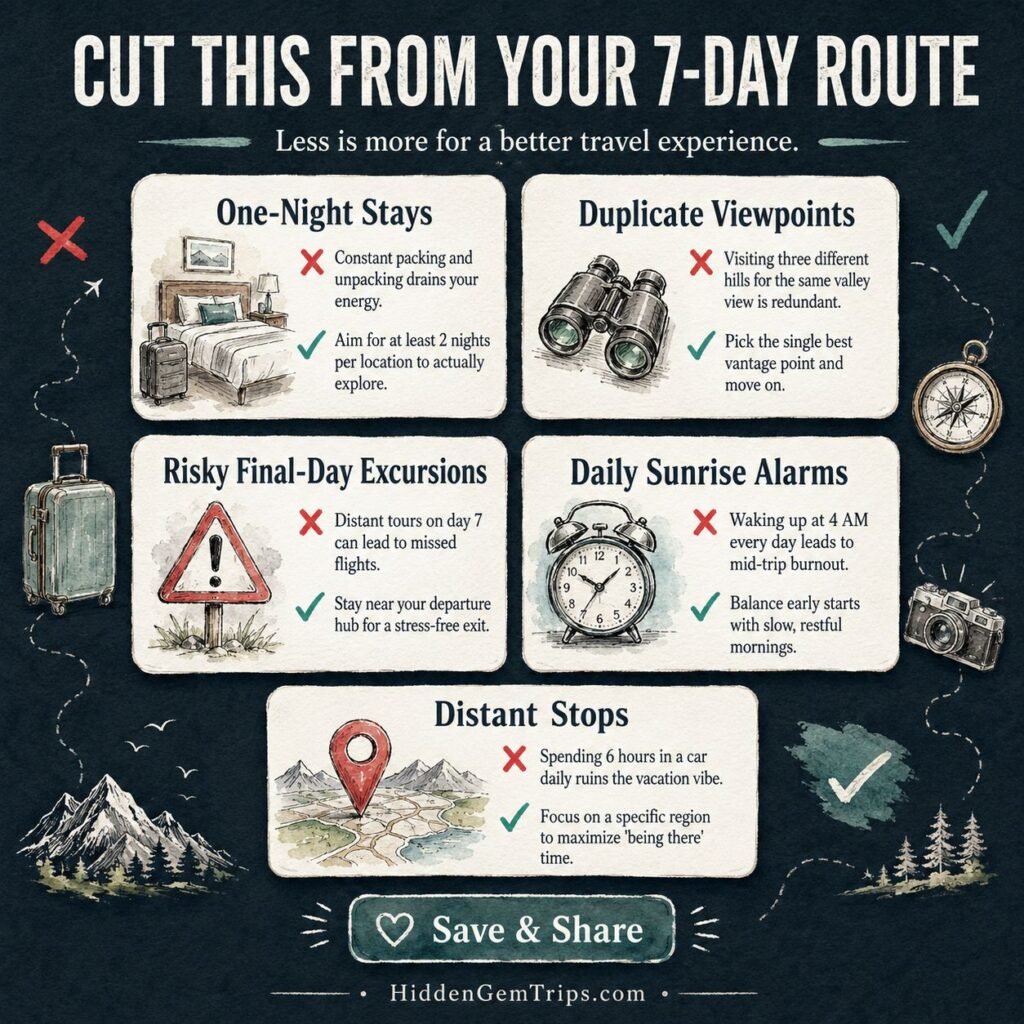
One strong method of removal is the “memory test.” Ask: Will I probably remember this stop one year from now? If not, remove it or make it optional. Another method is the “conversation test.” Would I tell a friend about this experience in detail, or would I only list it because it was on the route? Keep the experiences that produce stories. Cut the ones that only produce location tags.
Responsible Travel: How a Slower 7-Day Route Helps Local Communities
A slower route is not automatically ethical, but it creates better conditions for responsible travel. When you stay longer in fewer places, you are more likely to buy locally, hire local guides, use family-owned accommodation, learn basic etiquette, and understand what should not be photographed or interrupted. You also reduce the number of transfers that exist only to chase another landmark.
The GSTC explains that sustainable tourism is not a narrow niche but an aspiration for ensuring that the impacts of all forms of tourism are sustainable for future generations. That framing matters because itinerary planning is not just personal convenience. It shapes where money goes, how pressure is distributed, and whether travelers behave like temporary participants or extraction machines with backpacks.
In rural and hidden-gem destinations, your route can either concentrate pressure or distribute benefit. If every traveler storms the same viewpoint at the same hour, the place becomes a bottleneck. If travelers include village stays, food stops, local roads, lesser-known walks, and guided interpretation, the route may support a wider network. This does not mean inventing “secret” spots irresponsibly. It means designing with respect, permission, and context.
Responsible route design also means being honest about physical limits. An exhausted traveler becomes impatient, careless, and more likely to ignore etiquette. A rested traveler listens better. This is the part people rarely admit: good pacing is not just self-care; it is community care too.
Final Checklist Before You Book the Route
Before booking hotels, transfers, and tours, run the route through this checklist. If the answer is “no” too many times, fix the itinerary before money makes the bad plan emotionally expensive.
| Question | Good sign | Warning sign |
| Does the route focus on one clear region? | One primary area with logical loops. | Multiple distant regions in one week. |
| Can you explain the trip promise in one sentence? | Clear theme such as food, culture, coast, mountain, river. | A vague list of famous stops. |
| Are there three anchors or fewer? | Three strong experiences plus optional bonuses. | Every day has a “must-do” highlight. |
| Are transfer days realistic? | Daylight transfers with recovery space. | Long transfer plus major activity. |
| Is there at least one buffer half-day? | Weather or fatigue can be absorbed. | One delay breaks the whole route. |
| Are mornings protected? | Key experiences happen early. | Late nights followed by early starts. |
| Does local spending appear in the plan? | Local guides, markets, producers, family-run stays. | Only chain hotels and famous attractions. |
| Does the final day feel calm? | Breakfast, walk, local purchase, safe departure. | Risky excursion before flight or ferry. |
A route that passes this checklist will not be boring. It will be durable. It will have enough structure to feel intentional and enough space to let the place surprise you. That is where the best travel memories usually hide.
Three Example 7-Day Travel Itinerary Concepts
The following concepts are not destination-specific so that readers can adapt them to Indonesia, Southeast Asia, mountain regions, island chains, cultural towns, or river corridors. Each uses the same deep-not-exhausting logic.
Concept 1: The Cultural Town and Village Loop
Day 1: arrive in the main town, settle, walk nearby streets, and eat. Day 2: guided orientation walk, market, local museum, and early dinner. Day 3: village route with a local guide and one major cultural anchor. Day 4: easy day, market again, laundry, journaling, sunset walk for a bit. Day 5: secondary village or craft route. Day 6: final deep anchor, such as a family-run food experience, a landscape road, or a cultural interpretation session. Day 7: final coffee, local purchase, departure.
This is the best structure for places where living culture is the core attraction. It gives travelers enough time to move from observation to context. It also reduces the risk of treating communities as drive-by content.
Concept 2: The Island Base and Boat Day Route
Day 1: Arrive and stay close to the harbour or main village. Day 2: Local beach, food and boat planning. Day 3: main reef or island-hopping day. Day 4: rest and village loop. Day 5: inland road, viewpoint, or second quieter coast. Day 6: second water day or no-boat alternative, depending on weather. Day 7: buffer departure.
This structure is useful for island groups where weather controls the plan. It avoids the classic mistake of scheduling the boat day too late. For inspiration, study the pacing behind the Banda Islands’ slow-island pacing and adapt the logic without copying the exact route.
Concept 3: The Mountain Valley Base
Day 1: Arrive at the valley base. Day 2: gentle village walk and food orientation. Day 3: Walk or waterfall, sunrise ridge. Day 4: Rest, local life loop, short road. Day 5: farm, coffee, craft, or neighboring village route. Day 6: second scenic anchor with a slower afternoon. Day 7: final breakfast and departure.
This is a strong model for places where landscape and local life are inseparable. It avoids turning a mountain destination into nothing but viewpoints. The valley becomes a place, not a backdrop.
How to Adapt the Framework for Remote, Urban, and Cultural Routes
The same 7-Day Travel Itinerary framework can serve very different destinations, but the weighting changes. Remote trips need more logistics protection. Urban trips require more management attention. Cultural routes need more permission, context and humility. Treating all destinations with the same itinerary formula is one reason travel plans become either shallow or stressful. The framework is stable, but the emphasis should move with the destination.
For remote routes, start with transport reliability. Ask how often boats, buses, shared cars, ferries, or domestic flights actually run. Then ask what happens if one connection fails. Remote travel rewards simplicity. Use fewer bases, fewer “tight” connections, and more daylight transfers. It is better to reach one village calmly than almost to reach three places while slowly becoming a suitcase of opinions.
For urban routes, the danger is not distance alone. It is decision fatigue. Cities offer endless museums, neighborhoods, restaurants, viewpoints, shopping streets, and nightlife options. A deep city itinerary should cluster experiences by neighborhood and mood, not by popularity alone. One morning can be built around old streets and a local breakfast. One afternoon can be built around a museum and coffee. One evening can be dedicated to a single food district rather than a scattered restaurant crawl across town.
For cultural routes, the biggest mistake is assuming access equals understanding. Sacred sites, traditional houses, ceremonies, ancestral landscapes, and community rituals need interpretation. Build time for a local guide, local etiquette, and quiet observation. Do not place sensitive experiences into a rushed schedule where you arrive late, photograph aggressively, and leave before learning what you just saw. That is not cultural travel; that is drive-by consumption with a nicer camera.
For nature routes, design around energy cycles. Put the hardest hike, boat day, or wildlife experience after at least one settling day. Avoid scheduling two high-effort days back-to-back unless the traveler is trained and the route is built for it. The best nature itineraries usually alternate intensity and recovery: ridge day, slow village day, river day, food day, final viewpoint. This produces stronger memories because each experience has room to land.
Budget Logic: Why a Slower 7-Day Route Can Cost Less
A slower route often feels more expensive at first because travelers compare it against fantasy itineraries with cheap-looking transport and too many stops. In practice, overpacked routes create hidden costs: extra transfers, last-minute taxis, emergency snacks, unnecessary luggage handling, rushed laundry, convenience meals, and expensive accommodation chosen only because the traveler is too tired to research properly.
A better itinerary uses money where it changes the quality of the trip. Spend on a good local guide for one important day. Spend on a well-located base that reduces daily transport. Spend on a safe driver for difficult roads. Spend on a family-run stay where the host can help with timing and context. Save money by cutting duplicate attractions, unnecessary base changes, and distant side trips that only exist because another blog said they were “must-see.”
The deeper budget question is not “How do I make every item cheaper?” It is “Which spending actually improves the route?” A cheap transfer that arrives after dark and ruins the next day may cost more than a slightly better option. A low-cost homestay that connects you with local rhythm may be more valuable than a polished hotel far from everything. A slower seven-day plan makes these trade-offs visible before the trip, not during the meltdown.
How to Turn the Route into Better Travel Content
For content creators, a deep seven-day route also produces better material. A rushed itinerary creates disconnected clips: one landmark, another road, another meal, another hotel room. A designed route creates narrative. The viewer can feel arrival, adjustment, contrast, local rhythm, and closure. That is more powerful than shouting “hidden gem” over a montage of places that barely relate to each other.
Use the three-anchor method as a content structure. Anchor one becomes the hook: why this route matters. Anchor two becomes the emotional center: what the destination teaches. Anchor three becomes the payoff: why the trip was worth doing slowly. The buffer day becomes behind-the-scenes honesty. The local life loop becomes a recurring visual texture. The final morning becomes the reflective close. Suddenly, the itinerary is not just a schedule; it is a story arc.
This approach also helps with responsible storytelling. When you spend more time in fewer places, captions can include context rather than just location labels. You can mention local etiquette, timing, guide value, small businesses, road reality, and whatnot to do. That kind of content is more useful to readers and less likely to send people into fragile places with unrealistic expectations.
Red Flags That Your 7-Day Travel Itinerary Is Becoming Exhausting
The first red flag is that you need perfect conditions for the route to work. Perfect weather, perfect traffic, perfect punctuality, perfect sleep, and perfect motivation are not planning assumptions. They are a group fantasy. Real travel includes delays, heat, rain, confusion, and at least one moment where someone cannot find their socks. A good route survives a normal human mess.
The second red flag is that meals are treated as gaps instead of experiences. If the itinerary has every viewpoint mapped but no real plan for where to eat, rest, drink water, or sit down, it is not finished. Food is not just fuel. In many destinations, food is culture, economy, family history, agriculture, and local identity on a plate. A deep itinerary makes room for that.
The third red flag is that every day has the same emotional texture. Seven days of only viewpoints become repetitive. Seven days of only museums become heavy. Seven days of only beaches can blur together. Mix textures: one landscape day, one people day, one food day, one road day, one quiet day, one final anchor. Variety does not require more distance; it requires smarter sequencing.
The fourth red flag is feeling guilty when nothing is scheduled. That guilt usually comes from social media travel logic, not from the destination. Space is not wasted if it helps you notice where you are. Some of the best travel moments happen after the plan stops performing and the place starts speaking. Dramatic? Maybe. True? Annoyingly, yes.
Conclusion: Depth Is a Design Choice
A 7-Day Travel Itinerary does not become meaningful because it is packed. It becomes meaningful because it is designed. The best one-week routes are not afraid of space. They use fewer bases, stronger anchors, softer transitions, and local routines to create a trip that feels complete without feeling crushed.
Depth comes from sequence. Arrival before intensity. Context before consumption. Recovery before the next big thing. Local life before another distant checklist stop. When the route receives attention, the destination becomes easier to understand. When the route respects energy, the traveler becomes easier to be around—big win. Humanity survives.
The goal is not to travel less. The goal is to travel better. Seven days can be enough for a real story if you stop trying to turn it into a highlight reel. Choose one region. Build three anchors. Add a buffer. Repeat one local loop. Leave one good thing undone. That is how a seven-day route becomes deep, memorable, and surprisingly calm.
FAQ
1. How many places should I visit in a 7-Day Travel Itinerary?
Most travelers should choose one primary region and one or two bases. Three bases can work if transfers are short or scenic, but more than three usually creates too much packing and transit friction.
2. Is seven days enough for slow travel?
Yes, if the route is focused. Seven days is enough for slow travel when you choose one region, build around three anchor experiences, and protect recovery time.
3. Should I plan every meal and activity?
Of course, no, the key anchors, essential transport, and important bookings, but leave room for local discoveries. Overplanning removes the flexibility that makes hidden-gem travel rewarding.
4. What is the biggest mistake in a one-week itinerary?
The biggest mistake is trying to cover too much geography. The itinerary is busy but shallow, with long transfers, one-night stands and big activities every day.
5. How to make a trip of 7 days more meaningful?
Use a clear trip promise, repeat one local routine, hire local guides where appropriate, include markets or small producers, and leave space after major experiences to absorb what happened.
Disclaimer
This article is for general travel planning and editorial information only. Things like the weather, road conditions, local rules, transport timetables, health rules, access to culture, and safety notices can all change. Before you book or travel, we suggest readers check the latest information with official sources, local operators, accommodation hosts, and relevant government travel notices. HiddenGemTrips supports respectful, lawful, and culturally sensitive travel. If you are visiting living cultural sites or rural communities, ask permission, follow local guidance, and don’t take intrusive photos or behave badly.