

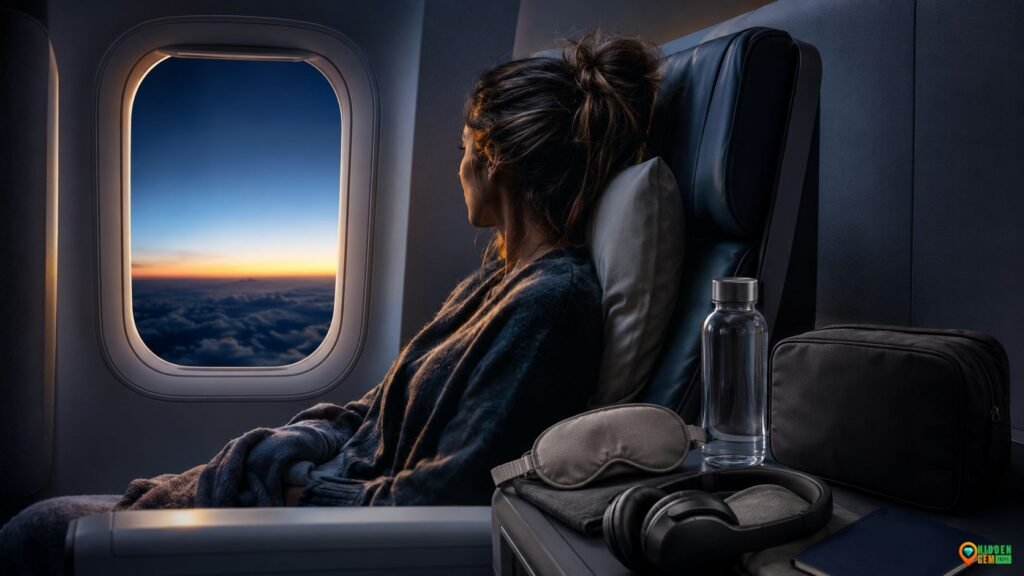
Long-haul flights expose a funny little lie in modern travel: we plan the destination like strategists, then treat the flight like a punishment we have to endure. We research boutique stays, remote islands, border rules, reef-safe sunscreen, sunrise viewpoints, hidden cafes, and whether the bus from the airport takes cards. Then we board a 12-hour flight wearing stiff jeans, forget to bring water, eat whatever shows up on the tray, doom-scroll until our eyes hurt, sleep for 41 minutes, land in another time zone, and wonder why our bodies feel like badly folded maps.
This guide is for travelers who want a smarter system for surviving long-haul flights, not another fluffy list that says “bring a neck pillow” and calls it wisdom. A long-haul flight is not just sitting in a metal tube. It is a controlled stress test: low cabin humidity, lower cabin pressure than sea level, restricted movement, circadian disruption, airport decision fatigue, meal timing chaos, and the psychological weirdness of being both bored and overstimulated at the same time. Cute, right? Travel really said: “Here is paradise, but first, sit upright for half a day next to a stranger eating boiled eggs.”
The stakes are not only comfort. They are arrival quality. If you waste the first day of the trip, you lose time, money, and momentum. For hidden-gem travel, that matters even more because many of the best places are not built around convenience. If you are heading toward quiet islands, remote highlands, wild coastlines, or multi-leg routes like the ones we curate on the HiddenGemTrips homepage, you need to treat the flight as the first stage of the expedition, not the annoying loading screen before the “real” trip begins.
Air travel is also back at full force. The International Air Transport Association reported record-high passenger demand for 2025, which means fuller aircraft, busier airports, tighter connections, and less room for lazy planning. In other words, your personal long-haul system matters more than ever.
Why Surviving Long-Haul Flights Is Mostly About Systems, Not Willpower
Here is the brutally honest part: most long-haul misery is self-inflicted. Not because travelers are weak, but because they board without a plan. They rely on hope, airline meals, random sleep, and the magical healing power of one sad airport latte. Hope is not a strategy. Hope is what you do when the gate agent says your connection is “technically possible.”
A good flight system has four jobs: protect circulation, protect hydration, protect your circadian rhythm, and protect your mood. Everything else is decoration. The best travelers are not the ones with the fanciest carry-on or the most expensive headphones. They are the ones who know exactly what they will do in the first hour, the middle block, the final approach, and the first daylight window after landing.
For hidden-gem travelers, this mindset is even more important. A mainstream city break may allow you to recover lazily in a hotel room. But if your itinerary involves a ferry, a dawn trek, a rough road, a second regional flight, or an island with limited services, your body needs to arrive in good working order. The same logistical discipline that makes a route like the Banda Islands travel guide more rewarding also makes long-haul flying less miserable: prepare early, reduce friction, and accept that distance has a cost.
The goal is not to feel glamorous on the plane. Nobody looks glamorous after sleeping under a polyester airline blanket with one sock missing. The goal is to land with enough energy, mobility, and mental clarity to enjoy the first 24 hours instead of becoming a zombie with a passport.
There is also a deeper travel philosophy here. A long flight is not separate from the trip. It shapes your first decisions, your patience, your appetite, your risk tolerance, and your ability to appreciate subtle places. That is why the mindset in our 2026 Slow Travel Manifesto belongs inside a flight-survival guide: travel gets better when you stop trying to bulldoze time and start respecting transition.
The Long-Haul Reality Check: What Actually Happens to Your Body
Long-haul flights feel strange because your body is doing several jobs at once. It is adjusting to a cabin environment that is not at sea level, tolerating dry air, managing reduced movement, processing irregular meals, and trying to adjust to a time zone that may no longer match the sun outside. This is not drama. This is physiology.
Cabin Pressure, Dry Air, and Why You Feel Weird at 35,000 Feet
Commercial aircraft are pressurized, but not to the same pressure as sea level. A review of the aircraft cabin environment in the National Library of Medicine explains that cabins are commonly maintained at an effective altitude below 8,000 feet, a level designed to be acceptable for healthy travelers but still different enough that some passengers may feel tired, dry, puffy, or slightly foggy.
Cabin humidity is also lower than many everyday indoor spaces. Your skin, eyes, mouth, and throat can feel dry, especially on overnight flights. Add coffee, alcohol, salty meals, stress breathing, and poor sleep, and suddenly your “vacation glow” looks more like “airport lizard energy.” Hydration helps, but the real trick is steady hydration, not panic-chugging water before boarding and spending the next five hours negotiating with your bladder.
Immobility, Circulation, and the Blood Clot Conversation
The scary topic everyone mentions but few understand is blood clots. The good news: for most healthy travelers, the absolute risk is low. The serious news: prolonged immobility can increase risk, especially for people with additional risk factors. The CDC travel blood clot guidance recommends moving around, stretching your legs, and choosing an aisle seat when possible so you can walk every two to three hours.
For a more clinical context, the CDC Yellow Book discussion of travel-related DVT and pulmonary embolism explains that extended limited mobility is inherent to long-distance travel and can increase risk for venous thromboembolism. That is not meant to scare you into canceling your trip. It is meant to make the advice boringly obvious: move your legs, do calf raises, avoid sitting like a folded receipt for 12 hours, and talk to a clinician before flying if you have risk factors.
Jet Lag Is Not Laziness. It Is Biology.
Jet lag is not a moral failure. It happens when your internal clock disagrees with the local clock. The Sleep Foundation guidance on jet lag emphasizes that light exposure, sleep timing, stress reduction, and schedule buffers can help travelers adapt more smoothly. This is why “just sleep on the plane” is incomplete advice. Sleep is useful only if it supports your destination schedule.
Sleeping at the wrong time can sometimes make the first two days worse. Eating at odd times, scrolling under bright light, drinking caffeine too late, and taking a giant nap after arrival can all confuse your body further. Your body is not being dramatic. It is running software from the wrong time zone.
| Flight Stressor | What It Can Cause | Your Practical Response |
| Low cabin humidity | Dry eyes, dry throat, skin tightness, headache-like fatigue | Sip water steadily, use lip balm, moisturize lightly, and avoid overdoing alcohol. |
| Lower cabin pressure | Mild fatigue, bloating, poorer sleep quality in some travelers | Eat lighter meals, breathe calmly, avoid rushing, and move regularly. |
| Long immobility | Leg swelling, stiffness, higher clot risk for some people | Walk when safe, do ankle circles, raise heels and toes, and consider compression socks if appropriate. |
| Time-zone shift | Jet lag, insomnia, morning fog, irritability | Use a destination-time sleep strategy and timed daylight exposure. |
| Sensory overload | Anxiety, irritability, decision fatigue, screen exhaustion | Use earplugs, headphones, eye mask, fewer screens, and a simple routine. |
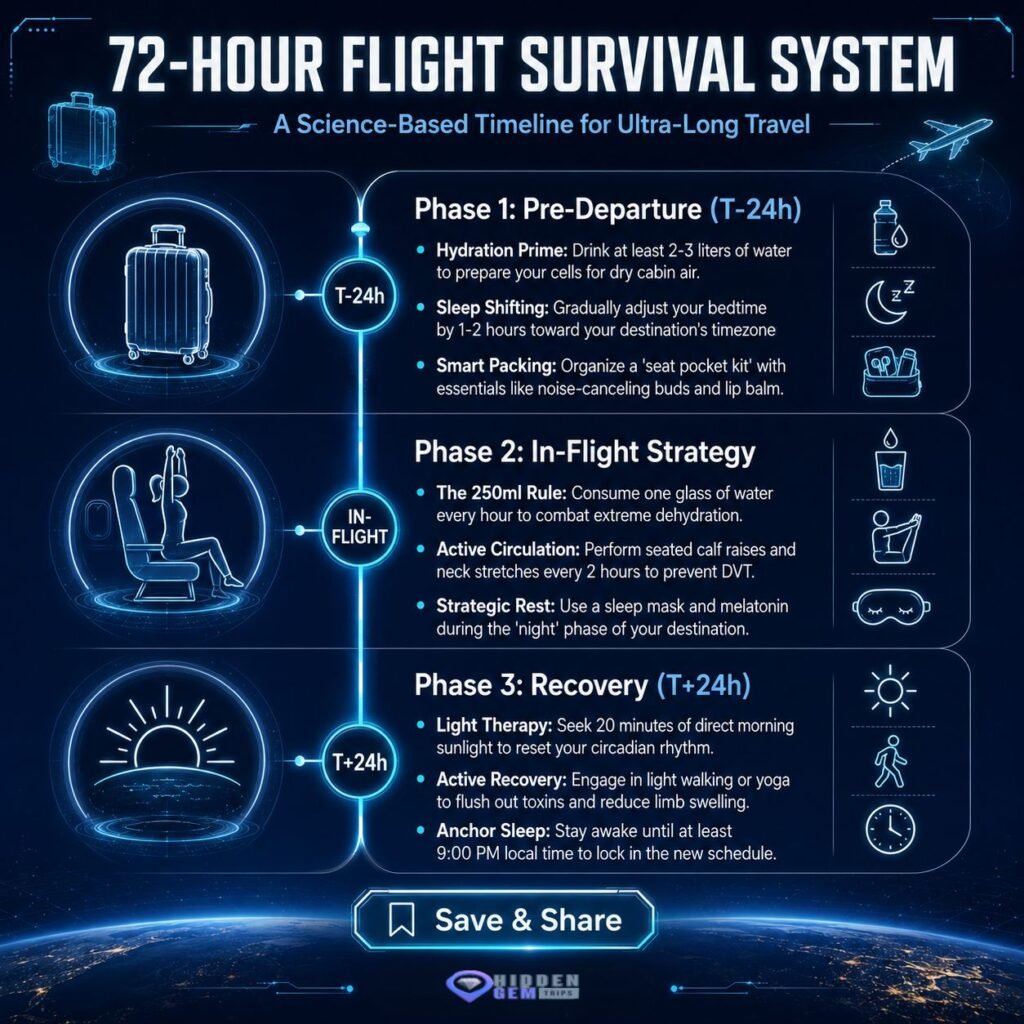
The 72-Hour Long-Haul Survival System
The best long-haul strategy starts before boarding and continues after landing. Think of it as a 72-hour system: the 24 hours before departure, the flight itself, and the first 24 hours after arrival. Most travelers only think about the middle part. That is why they land cooked.
Before the Flight: Build a Boring but Powerful Setup
The day before a long-haul flight should be boring on purpose. This is not the day to test a new restaurant, crush a leg workout, stay up until 2 a.m., or pack your bag while your ride to the airport is already outside. Your pre-flight job is to reduce inflammation, reduce decisions, and reduce chaos.
Start by building a simple carry-on architecture. Use one pouch for sleep, one for health and hygiene, one for electronics, and one for documents. If that sounds too organized, good. Long-haul flights punish messy bags. For broader gear planning, the Gear & Tech travel guides section can support readers who want practical tools without turning this article into a shopping list.
Eat normally, hydrate steadily, and avoid arriving at the airport already exhausted. A long-haul flight is not a spa. It will not fix your bad pre-flight decisions. It will magnify them.
During the Flight: Protect Sleep, Circulation, Hydration, and Sanity
Once you board, mentally switch to the destination time. This does not mean you must sleep immediately. It means your decisions should serve the arrival clock. If it is nighttime at your destination, reduce light exposure, limit caffeine intake, and establish a sleep window. If it is daytime at your destination, stay awake longer, eat lightly, and avoid sabotaging your first night.
Movement should not be random. Build a rule: every two to three hours, stand if safe, walk a little, and do calf movements. If the seatbelt sign is on, do ankle circles, heel raises, toe raises, glute squeezes, and gentle seated twists. It is not sexy. It works. Airport wellness is mostly unglamorous micro-actions repeated consistently.
Your entertainment strategy matters too. Do not spend the entire flight in a dopamine casino of short videos, stress emails, and blue light. Pick one movie, one reading block, one sleep block, and one reset block. Long flights become less miserable when you stop treating them like an endless blur and start dividing them into manageable chapters.
After Landing: Win the First 12 Hours
The first 12 hours after landing decide whether you adapt or spiral. Get daylight as soon as the local schedule allows, eat a normal meal at local time, take a short walk, and avoid a heroic three-hour nap. A short nap can help. A monster nap can destroy your first night and make you feel like you flew through a washing machine.
This arrival principle is especially important if your next step involves regional flights, ferries, or remote transfers. Travelers planning complex routes should browse the Itineraries travel guides because pacing is not just about sightseeing. It is about energy management, connection safety, and avoiding the classic mistake of making day one too ambitious.
| Phase | Main Goal | Best Moves | Mistake to Avoid |
| 24 hours before | Lower friction and physical stress | Pack early, hydrate steadily, eat familiar food, sleep normally | Leaving packing until departure morning. |
| Airport window | Protect documents and reduce decision fatigue | Check gates, fill bottle, buy sensible food, keep meds accessible | Overloading on caffeine and rushing every step. |
| First flight hour | Create structure | Set watch to destination time, organize seat area, choose sleep or wake block | Starting with random scrolling. |
| Mid-flight | Protect circulation and mood | Move every few hours, hydrate, keep meals light, manage light exposure | Staying frozen in one posture. |
| First 12 hours after landing | Anchor local rhythm | Get daylight, walk, eat local-time meals, use short naps only | Collapsing into a long daytime nap. |
The Brutally Honest Seat Strategy
Seat choice will not save a terrible plan, but it can make a good plan much easier. The best seat depends on your body, sleep style, bladder frequency, anxiety level, and whether you need to work or rest. Stop asking strangers online for the “best seat” without admitting what kind of passenger you are. Window sleepers and aisle walkers need different things. Tall travelers and anxious flyers need different things. Parents and solo backpackers need different things.
| Passenger Type | Best Seat Bias | Why It Helps | Trade-Off |
| Sleep-first traveler | Window | Wall support, fewer interruptions, better light control | Harder to leave for bathroom or stretching. |
| Movement-first traveler | Aisle | Easier walking, calf movement, bathroom access | More bumps from carts and passengers. |
| Tall traveler | Exit row or extra-legroom when safe and allowed | More leg space can reduce stiffness | May cost extra; some seats have fixed armrests. |
| Anxious flyer | Forward cabin or wing area | May feel more stable and less isolated | Usually pricier or fills quickly. |
| Family traveler | Paired seats, bassinet rows when eligible | Easier logistics with children and bags | Less under-seat storage; airline rules vary. |
If you are traveling alone, safety and comfort are also linked. The same planning mindset behind our Solo Female Travel Map 2026 applies here: plan the boring parts so you can enjoy the beautiful parts. A good seat is not vanity; it is risk reduction, sleep protection, and arrival strategy.
My brutally honest recommendation: if your flight is over ten hours and you know your knees, back, anxiety, or bladder will be a problem, budget for the seat before you budget for a cute airport meal. Extra legroom is not always necessary, but when it is necessary, it is cheaper than losing the first day of a once-in-a-year trip.
What to Wear and Pack for Surviving Long-Haul Flights
The best long-haul outfit is not “airport chic.” It is soft armor. You want layers, stretch, warmth, breathability, and nothing that cuts into your waist after four hours. Tight jeans on a 13-hour flight are character development nobody requested.
For trips that continue into remote regions, your carry-on should also be suited to the destination. The same logic that applies to the Breathtaking Isolation of Yukon guide applies to long-haul flights: remote travel rewards people who prepare before conditions punish them.
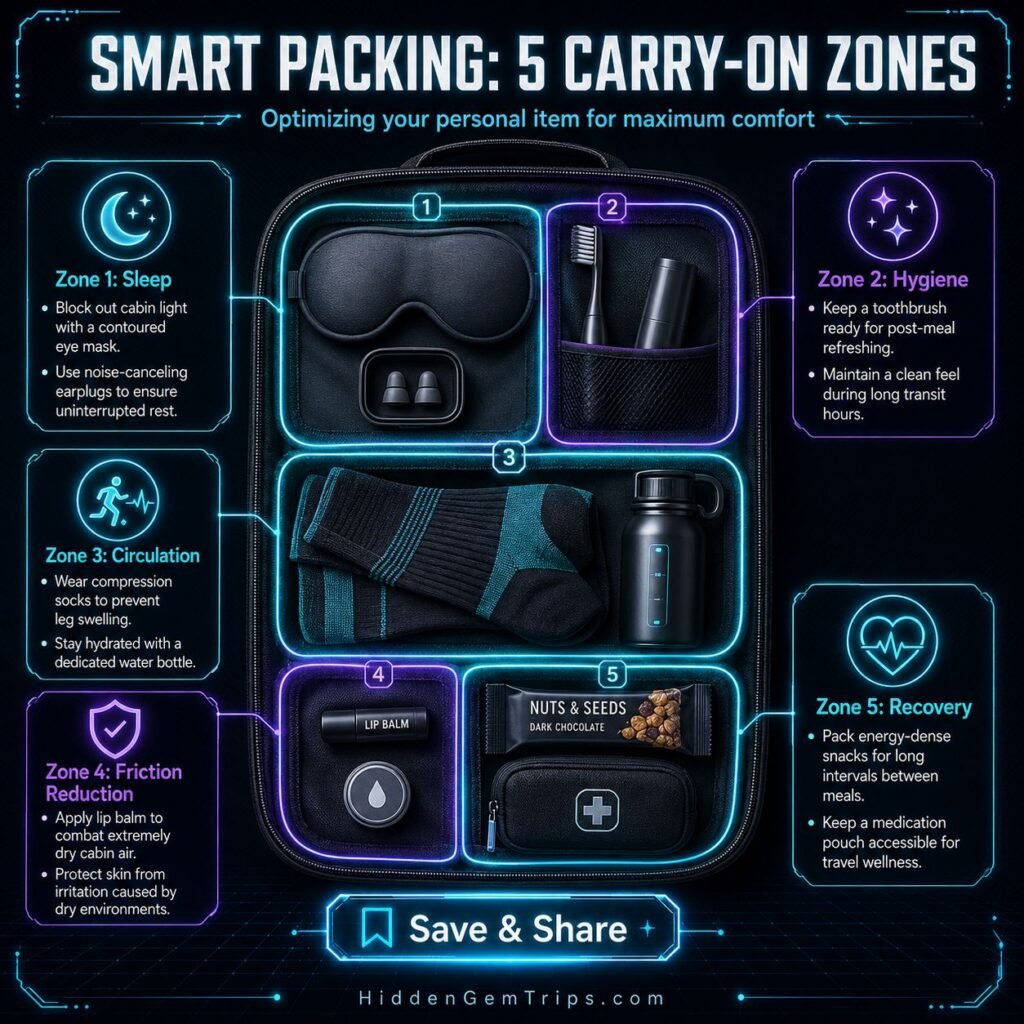
Pack for five zones: sleep, hygiene, circulation, friction reduction, and recovery. If an item does not serve one of those zones, question it. Long-haul carry-ons become chaotic when travelers pack for fantasy versions of themselves. You are not going to read three books, edit a documentary, learn Italian, and write a novel between Doha and Sydney. Calm down, main character.
| Carry-On Zone | Items | Why It Matters | Brutal Rule |
| Sleep | Eye mask, earplugs, neck support, warm layer | Controls light, noise, posture, and temperature | If it helps sleep, it gets priority. |
| Hygiene | Toothbrush, wipes, lip balm, hand sanitizer, moisturizer | Makes you feel human again after 10+ hours | Tiny items, massive morale boost. |
| Circulation | Loose socks, compression socks if appropriate, slip-on shoes | Supports comfort and movement | Do not trap your feet in stiff shoes. |
| Friction reduction | Pen, documents, charger, power bank, medication, snacks | Prevents airport and arrival chaos | Anything critical stays under the seat. |
| Recovery | Electrolyte packets, simple snack, refillable bottle | Smooths the landing window | Do not depend fully on airline timing. |
For broader packing logic, start with our Travel Guides hub and the site’s Essentials travel guides. Those resources help readers move naturally from flight survival into complete trip preparation, especially when the destination involves more than an easy taxi ride from the airport.
For a deeper packing philosophy, the article on packing light for remote expeditions is the natural next step. Long-haul survival is not about carrying more. It is about carrying the right small things in the right place so you can use them without turning the overhead bin into a public excavation site.
Food, Water, Alcohol, and Caffeine: The No-Nonsense Rules
The honest rule for airplane food is simple: eat enough to stabilize your energy, not so much that your digestive system files a complaint. Long-haul cabins can amplify bloating, reflux, dehydration, and sluggishness. This does not mean you need to become a monk in seat 42A. It means you should stop treating the tray table like an all-inclusive buffet.
Hydration should be steady, not dramatic. Chugging a liter right before boarding only turns your flight into a bathroom pilgrimage. Sip consistently. Bring an empty bottle through security and refill it. Add electrolytes if they help you, especially if you know you under-drink when traveling.
Alcohol is the trap. One drink may feel like a sleep shortcut, but alcohol can worsen dehydration and fragment sleep. Caffeine is another double-edged tool. Use it to support the destination schedule, not your boredom. If it is close to your destination bedtime, coffee is not “a vibe.” It is self-sabotage in a paper cup.
| Choice | Better Long-Haul Move | Why |
| Water | Sip regularly throughout the flight | Prevents the dehydration spiral without overloading your bladder. |
| Coffee | Use early in destination daytime only | Helps alertness when timed well; hurts sleep when timed badly. |
| Alcohol | Keep it minimal or skip it | Can worsen sleep quality and dehydration. |
| Meals | Choose lighter, familiar foods | Reduces bloating and digestive drama. |
| Snacks | Pack protein or fiber-based options | Protects you if meal timing is weird or you sleep through service. |
Budget travelers also need to plan this section honestly. Airport food is expensive, and poor snack planning becomes a hidden tax. Our Budgeting travel guides are useful here because long-haul travel costs do not begin at the destination; they begin the moment tired people start buying overpriced emergency food at the terminal.
The Jet Lag Playbook: Eastbound, Westbound, and Red-Eye Flights
Jet lag advice becomes useless when it pretends all flights are the same. Eastbound and westbound flights feel different because your body adapts differently to advancing or delaying sleep. Eastbound travel often feels harder because you usually need to sleep earlier than your body wants. Westbound travel often asks you to stay awake longer. Red-eyes are their own little circus.
| Flight Type | Main Problem | Best Strategy | Avoid |
| Eastbound | You must sleep earlier than normal | Dim lights, avoid late caffeine, target early sleep | Staying wired on screens until landing. |
| Westbound | You must stay awake longer | Use daylight, light meals, short caffeine window | Long naps after arrival. |
| Red-eye | Sleep is compressed and uncomfortable | Create sleep ritual immediately after meal service | Watching three movies just because. |
| Ultra-long-haul | Multiple body systems get stressed | Break flight into blocks: settle, sleep, move, reset | Treating the whole flight as one endless blur. |
| Short trip across many zones | No time to fully adapt | Anchor sleep and light to purpose of trip | Overcorrecting and wrecking the return. |
The more remote the destination, the more important this becomes. If you are traveling to Indonesia’s outer islands, the Pacific, or Australia and Oceania, your first day may involve real logistics, not just hotel check-in. That is where guides like our Sumba Island travel guide and the broader Australia & Oceania hidden gems category mindset become useful: recovery windows are not weakness; they are what make ambitious routes actually enjoyable.
A useful rule: never schedule the most physically demanding, culturally sensitive, or expensive experience for the first morning after a brutal long-haul arrival. That sunrise hike, reef dive, safari drive, or remote village visit deserves a traveler who can pay attention. Showing up half-broken is not adventurous. It is poor planning wearing hiking shoes.

Special Cases: Families, Solo Travelers, Tall Travelers, and Anxious Flyers
Families
Families do not need perfect flights. They need damage control. Pack food, spare clothes, simple entertainment, wipes, and a plan for sleep windows. Lower the expectation from “peaceful cinematic family journey” to “everyone arrives alive, and nobody loses a shoe.” That is success. Seriously.
Solo Travelers
Solo travelers should prioritize security, access to documents, and energy management. Keep essentials under the seat, not in an overhead bin five rows behind you. Choose a seat that matches your risk profile. If you sleep deeply, secure your valuables before takeoff. If you are arriving late, pre-plan transport rather than improvising while exhausted.
Tall Travelers
Tall travelers need to be honest about cost. Paying for extra legroom can feel painful, but so can spending 14 hours folded like a camping chair. If budget allows, legroom is not a luxury; it is musculoskeletal mercy. If budget does not allow, choose an aisle when possible and commit to movement.
Anxious Flyers
Anxious flyers need a routine, not shame. Download calming audio, understand turbulence basics, avoid too much caffeine, and tell your nervous system what comes next. Predictability is medicine. If anxiety is severe, speak with a medical professional before travel rather than relying on airport panic as a lifestyle.
Adventure travelers also need to be honest about post-flight demands. A safari route, mountain route, or river route may require immediate focus. If you are planning physically intense experiences like those discussed in the Ruaha safari guide, do not schedule your hardest activity on the day after a brutal overnight flight unless you enjoy suffering as a hobby.
The 10-Minute In-Flight Reset Routine
When the cabin starts to feel stale and your brain turns into mashed potatoes, use a 10-minute reset. It is simple, discreet, and effective enough to keep you from becoming airport carpet in your mind. The point is not to perform a full wellness routine in the aisle. The point is to interrupt physical and mental stagnation before it snowballs.
| Minute | Action | Purpose |
| 0-1 | Sit tall, relax jaw, slow breathing | Downshift the stress response. |
| 1-2 | Drink water slowly | Rehydrate without chugging. |
| 2-4 | Toe raises heel raises ankle circles | Circulation support. |
| 4-6 | Stand or walk if safe | Soften stiffness and reset posture. |
| 6-8 | Bathroom or hygiene refresh: rinse face, brush teeth if possible | Signal a new phase of the flight. |
| 8-10 | Reset seat: blanket, screen, light, next block decision | Create structure instead of drifting. |
This kind of micro-routine fits the broader HiddenGemTrips belief that great travel is designed through small, practical systems. It is the same mindset behind planning under-the-radar routes rather than chasing overcrowded checklists, as shown throughout the site’s Travel Guides hub.
Common Long-Haul Flight Mistakes That Wreck Your Arrival
Most people do not fail long-haul flights because of one huge mistake. They fail because of a pile of tiny bad choices. Late packing. Bad seat. No water. Three coffees. Two wines. Heavy meal. No movement. Six hours of blue light. No daylight after landing. Then they blame the airline. Nice try, but no.
| Mistake | Why It Hurts | Better Move |
| Packing essentials overhead | You cannot access what you need during sleep or turbulence | Keep sleep, health, meds, and documents under the seat. |
| Sleeping randomly | Can worsen jet lag if mistimed | Sleep according to destination strategy. |
| Skipping movement | Increases stiffness and swelling | Use walking and seated calf exercises. |
| Overusing alcohol | Fragments sleep and worsens dehydration | Keep it minimal or skip. |
| Landing with no plan | Decision fatigue hits hardest when tired | Pre-book first transport and first meal option. |
| Scheduling too much on arrival day | You burn the trip before it begins | Make day one a recovery-and-orientation day. |
The same “do less, experience more” principle appears in HiddenGemTrips pieces about slowing down and avoiding overstuffed routes. For readers who want a deeper destination-planning philosophy, pair this article with the Itineraries travel guides and the Breathtaking Isolation of Yukon guide, where distance and pacing are treated as part of the experience rather than obstacles to bulldoze through.
There is also a financial version of this mistake. A chaotic flight creates chaotic spending: airport taxis instead of planned transport, overpriced hotel meals because you are too tired to think, replacement toiletries because you packed poorly, and avoidable upgrades because you underprepared. This is where long-haul strategy overlaps with Affordable Opulence travel planning: comfort does not always come from spending more; it comes from spending before the crisis, not during it.
A Hidden-Gem Traveler’s Arrival Rule: Do Less on Day One
Here is a rule that sounds boring but saves trips: your arrival day should be designed for orientation, not achievement. Check into your accommodation, get daylight, walk around the neighborhood, buy water, eat something normal, and confirm tomorrow’s plan. That is it. You do not need to prove your worth to the travel gods by stacking five activities after a 14-hour flight.
This matters even more for remote places. If your dream route involves islands, ferries, informal transport, or regions where English is not always widely spoken, your tired brain becomes a liability. Guides like Travel Indonesia Like a Local and the Derawan Islands guide make more sense when readers understand that successful hidden-gem travel depends on pacing, not just courage.
Day one should answer simple questions: Where is the nearest water? What is the safest way back at night? What time does breakfast start? Where is the ATM? Does your SIM card work? What is tomorrow’s pickup time? These little details sound painfully unromantic until they prevent a meltdown in a place where “just order delivery” is not an option.
Final Verdict: The Flight Is Part of the Trip
The brutal truth is that long-haul flights will never feel like a wellness retreat. Even in business class, you are still sleeping in a pressurized cabin while crossing continents at unnatural speed. The goal is not perfection. The goal is control.
Surviving long-haul flights comes down to a few boring but powerful behaviors: choose the right seat for your needs, hydrate steadily, move regularly, protect sleep timing, manage light, eat like a sane person, pack what you actually use, and treat arrival day with respect. None of this is flashy. That is why it works.
For HiddenGemTrips readers, this is not just comfort advice. It is destination protection. When you travel to places that are quieter, wilder, less convenient, or more culturally layered, your first responsibility is to show up present. Whether you are planning remote island travel through the Banda Islands travel guide, building a safer independent route with the Solo Female Travel Map 2026, or chasing silence through the Breathtaking Isolation of Yukon guide, the flight is not separate from the adventure. It is the first test of whether you respect the journey enough to prepare for it.
So no, you do not need 47 gadgets, a viral airport outfit, or a miracle supplement. You need a system. You need humility. You need water. You need to move your legs. And you need to stop pretending that a 14-hour flight can be survived on vibes alone. Vibes are cute. Calf raises are better.
FAQ
1. What is the best way to survive a long-haul flight?
The best way to survive a long-haul flight is to use a system: sleep according to the destination time, hydrate steadily, move every two to three hours when safe, pack accessible essentials, and keep the first day after arrival realistic.
2. How often should I move during a long-haul flight?
A practical rule is to move or stretch every two to three hours when the seatbelt sign is off. If you cannot stand, do seated ankle circles, heel raises, toe raises, and gentle leg movements.
3. Should I sleep the whole long-haul flight?
Not always. Sleep should support your destination time zone. If sleeping through the whole flight leaves you landing wide awake at local midnight, it may worsen jet lag. Match sleep timing to arrival needs.
4. Do I need compression socks on a long-haul flight?
They can aid some passengers, especially those who are prone to swelling or other conditions that increase the chance of blood clots, but need to be fitted appropriately. If you have a medical ailment, see your doctor before you rely on them.
5. What should I pack in my personal item for a long-haul flight?
Keep sleep items, medication, documents, charger, water bottle, snacks, toothbrush, lip balm, hand sanitizer, and any critical valuables under the seat so you can access them without opening the overhead bin.
Disclaimer
This article is for general travel education and editorial guidance only. It is not medical advice and does not replace consultation with a qualified healthcare professional. Long-haul flights may carry health considerations for people with cardiovascular disease, respiratory conditions, pregnancy, recent surgery, blood clot risk factors, mobility limitations, anxiety disorders, or other medical concerns. If you have any health risks or questions about medication, compression socks, sleep aids, hydration, or mobility, ask your doctor before you fly. Airline/airport policies, aircraft configurations and travel requirements may differ. Always verify the latest information with your airline, government health agencies and travel providers before flying.