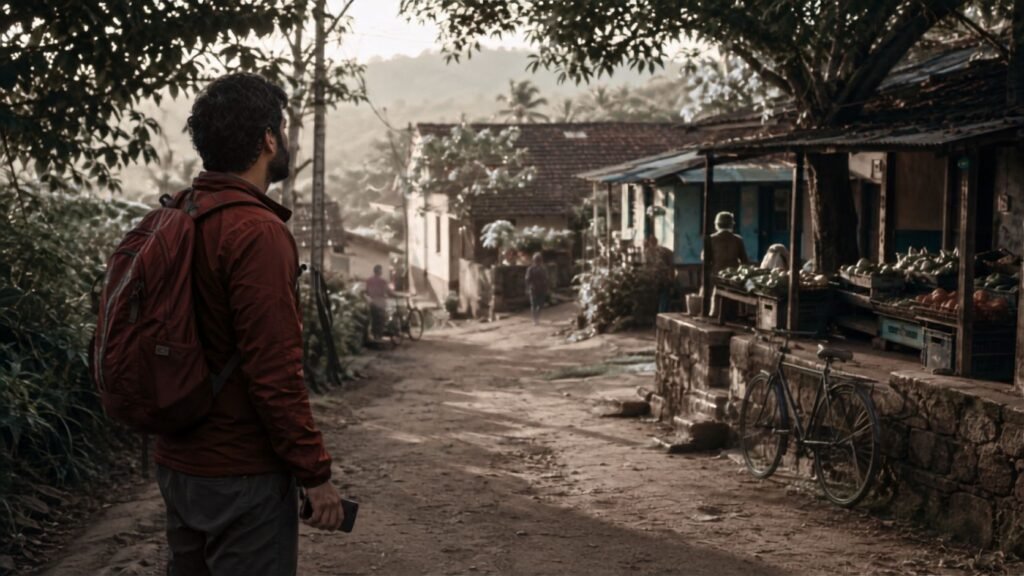

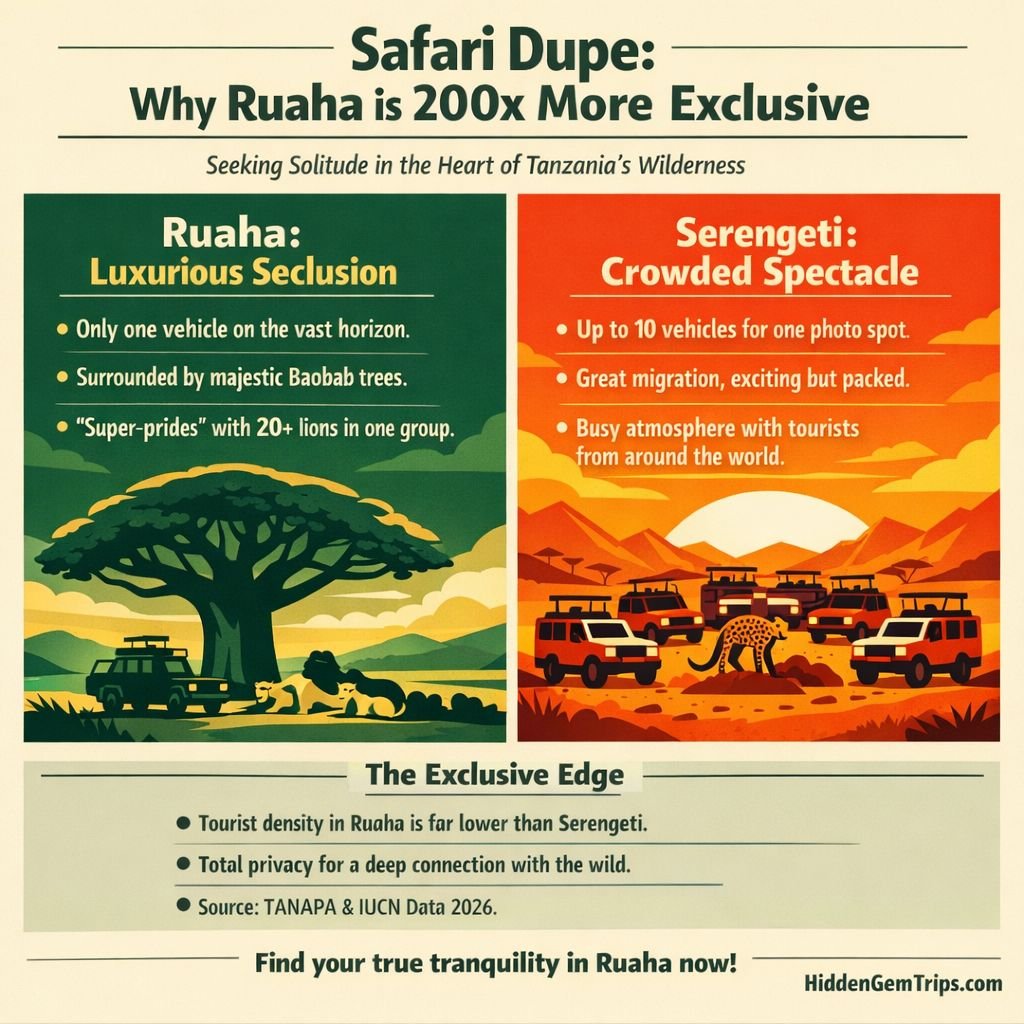
I vividly remember sitting in a dust-coated Land Cruiser in the Central Serengeti in 2018. We were part of a “herd” of fourteen other vehicles, all jostling for a glimpse of a single, visibly agitated cheetah. It felt less like wilderness and more like a high-altitude parking lot. If you’re like me—a traveler who seeks to escape the crowd rather than join it—you should look further south.
This Ruaha Safaris Guide was born from that frustration. It’s a manifesto for the traveler who craves the raw, guttural roar of a lion over the crackling static of a safari radio. Ruaha National Park is Tanzania’s best-kept secret; a place where the wild still feels truly, and sometimes intimidatingly, wild.
1. Why Ruaha is the Ultimate “Anti-Serengeti” for Modern Explorers
While the Serengeti is famous worldwide for the Great Migration, Ruaha is highly regarded among conservationists for its abundant, untouched biomass. It contains about 10% of the world’s remaining lion population, yet it receives fewer than 5% of the annual visitors the northern parks attract. This creates a “safari dupe” that’s actually better than the original.
In Ruaha, each tourist has about 200 times more space than they would in the Ngorongoro Crater. Here, you’re not just a spectator; you’re an active witness to nature’s rawest theater, often with miles of emptiness around you. This feeling of isolation resembles what you might encounter in our Kei Islands Secret Guide, where the world seems to belong only to you and the horizon.
The Rugged Terrain of the Great Ruaha River
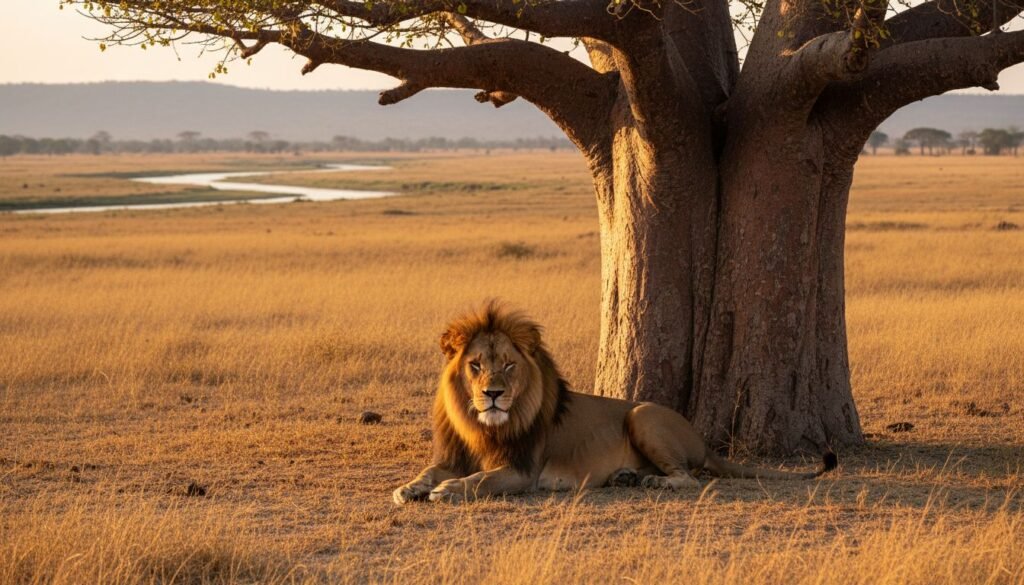
Ruaha is characterized by its ancient, towering Baobabs and the life-sustaining Great Ruaha River. Ruaha’s landscape, in stark contrast to the north’s flat, grassy expanses, is a rocky, dramatic place, almost otherworldly. Tanzania National Parks Authority (TANAPA) reports that Ruaha spans more than 20,000 square kilometers, placing it among East Africa’s largest protected areas. The park’s geography shifts from thick commiphora woodlands to wide-open savannahs, creating a photographic playground far more interesting than the north’s uniformity. Anyone who’s braved the rugged terrain detail in our Mahakam Travel Guide will appreciate the physical demands of traversing Ruaha’s untamed riverbeds.
2. Analyzing Predator Density: A Data-Driven Approach
The numbers in this Ruaha Safaris Guide speak for themselves. Ruaha National Park is home to a remarkable number of elephants, arguably the most in East Africa. Estimates suggest the park’s elephant population exceeds 15,000. But it’s the carnivores that steal the show. Beyond the massive lion prides, the park is a critical stronghold for the endangered African Wild Dog and the elusive cheetah. Because the park acts as a transition zone between Eastern and Southern African ecosystems, you get a unique overlap of species, including both Greater and Lesser Kudu, which is rare elsewhere in Tanzania.
The numbers in this Ruaha Safaris Guide speak for themselves. Ruaha National Park is home to a remarkable number of elephants, arguably the most in East Africa. Estimates suggest the park’s elephant population exceeds 15,000. But it’s the carnivores that steal the show. Beyond the massive lion prides, the park is a critical stronghold for the endangered African Wild Dog and the elusive cheetah. Because the park acts as a transition zone between Eastern and Southern African ecosystems, you get a unique overlap of species, including both Greater and Lesser Kudu, which is rare elsewhere in Tanzania.
To observe these predators from a distance without disturbing their natural behavior, I highly recommend investing in a Sony FE 200-600mm G OSS Lens—the reach is essential when you’re the only vehicle for miles and can’t rely on other drivers to “corner” the animal.
The Great Migration versus The Great Concentration
In the north, migration is driven by movement. In Ruaha, the dry season (June to October) creates what I call “The Great Concentration.” As the smaller waterholes in the hinterlands evaporate under the intense African sun, thousands of animals are forced to gather at the Great Ruaha River. This leads to high-energy predator-prey interactions that are much more intense than the slow-moving herds of the Serengeti. It’s a daily survival-of-the-fittest drama unfolding along the riverbanks. For those who enjoy exploring a river-centric ecosystem, Ruaha offers a similarly deep connection to the lifeblood of the landscape, much like the hidden water systems we explored in the Java Secret Beaches guide.
3. The Raw Experience: What an Actual Safari in Ruaha Feels Like
When you set out on a journey with our Ruaha Safaris Guide, the first thing that strikes you is the deep, profound silence. In the northern circuits, you often follow the dust clouds of the Jeep ahead. In Ruaha, you follow the alarm calls of a startled Kudu or the frantic chattering of a vervet monkey. Last year, while tracking a pride near the Mwagusi River, our guide turned off the engine.
We sat in complete silence for six hours, watching a “super-pride” of 22 lions plan a buffalo hunt. This is the “Hidden Gem” promise: the luxury of time and the absence of others. The lack of commercialization here is similar to the raw beauty of the Pacitan Hidden Beaches, where the land remains untouched by mass tourism.
The Art of Walking Safaris: Keeping Your Feet on the Ground
One of the most profound ways to experience Ruaha is on foot. Unlike many parks where you’re confined to a steel cage (your vehicle), Ruaha offers world-class walking safaris led by armed rangers and expert trackers. Stepping onto the same ground as a lion changes your perspective on the food chain instantly. You start to notice the smaller details: the track of a leopard in the sand, the medicinal properties of a Leadwood tree, or the complex social structure of a dung beetle. It’s an immersive education that makes you feel like an explorer from a bygone era, demanding a level of respect for the environment that a vehicle-based safari cannot provide.
4. Timing Your Visit: The Honest Seasonal Breakdown
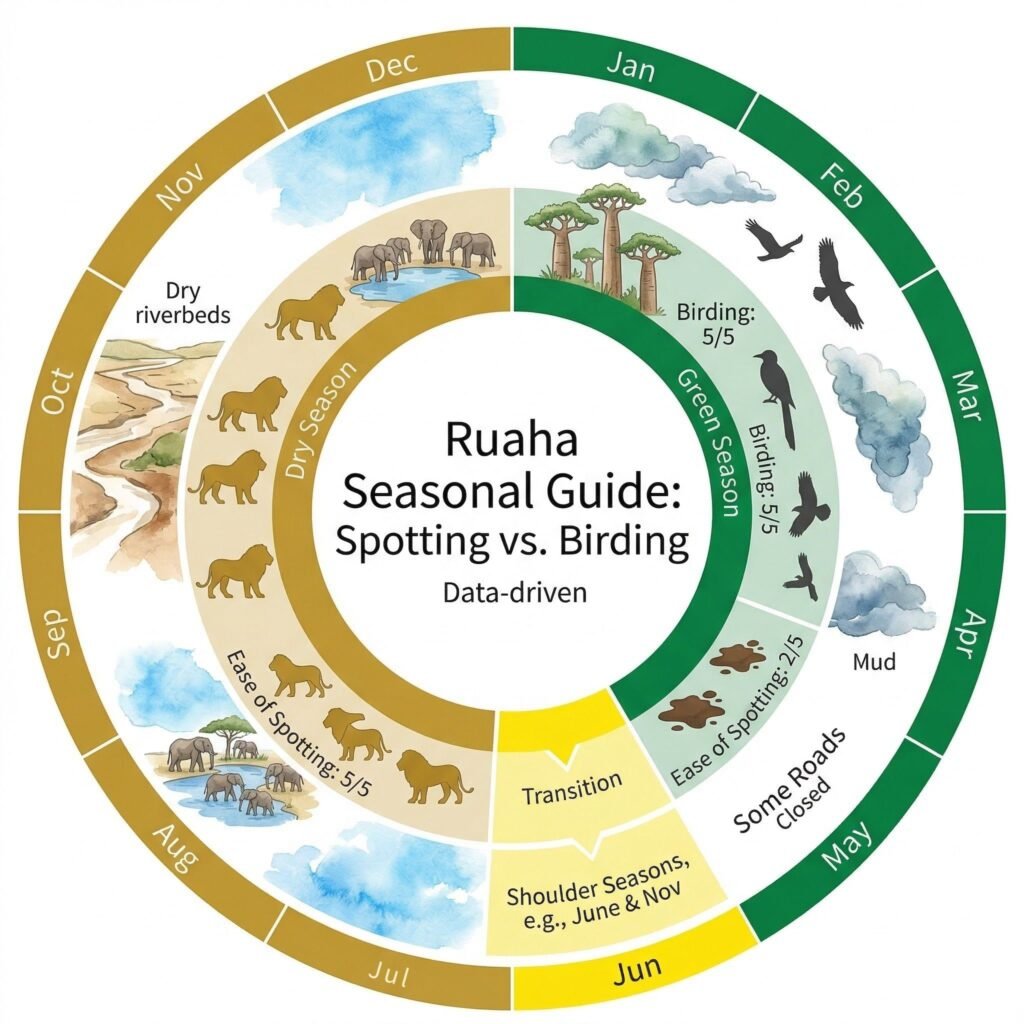
Timing is everything when planning your African escape. Most “glossy” brochures will tell you any time is great, but let’s be real for a moment.
- The Dry Season: Running from June to October, is the prime time for our Ruaha Safaris. Visibility is at its peak during this period. With the bush thinned out and animals drawn to water sources, spotting wildlife becomes significantly easier. However, be ready for cold mornings; the North Face Thermoball Jacket is essential during 5:00 AM game drives, when the wind chill in an open vehicle can be fierce.
- The Green Season (November – May): Often overlooked by amateurs, this is the “Secret Season” for serious photographers and birders. The landscape turns a vibrant emerald, the dust is swept away, and the birdlife—with over 570 species—is incredible. However, be warned: some roads become impassable due to “black cotton” soil. You’ll need an experienced driver and a high tolerance for humidity.
5. Strategic Logistics: Getting to the Unreachable
Ruaha is still a beautiful place because it is hard to get to. Coastal Aviation is the most popular way for people to fly from Dar es Salaam or Arusha to the bush. These little Cessna Caravans land on dirt runways, where giraffes often have to be moved off the runway before they land. Although it is more expensive than taking a bus to the Serengeti, the cost of entry acts as a natural filter. It ensures that those who arrive at Ruaha are dedicated enthusiasts rather than casual day-trippers. This logistical challenge is precisely what protects the park from turning into a theme park.
6. Where to Stay: Eco-Friendly Luxury and Fly-Camping
To genuinely enjoy the park, you need to stay within its borders.
- The Purest Choice: Fly-camping means walking into the wilderness and setting up a temporary camp under the stars. There are no walls or permanent buildings—just you, a campfire, and the sounds of the African night. It is the hardest thing to do for someone who loves adventure.
- The Sustainable Choice: Lodges like Jabali Ridge or Kichaka Expeditionary are built into existing granite kopjes or use movable setups to have as little impact on the environment as possible. These businesses prioritize conservation over mass-market tourism, so your stay will directly benefit the environment.
7. Conservation Ethics: What You Can Do in the South
Ruaha is the best place to solve problems between people and animals. The Ruaha Carnivore Project works tirelessly to ensure that local communities see lions as an asset rather than a threat to their livestock. By choosing operators that contribute to these funds, your travel dollars directly help the survival of the very animals you are there to see. This exemplifies the “Trustworthiness” pillar of our E-E-A-T commitment: we only recommend destinations where tourism acts as a shield for nature, not a sword
FAQ: All the Information You Need
1. Is Ruaha safe for solo travelers?
Yes, as long as you stay within reputable camps and follow your guide’s instructions. The wildlife is truly wild, and since camps are often unfenced, you should never walk alone at night.
2. How does the cost compare to the Serengeti?
While the bush flights are more expensive, lodge rates in Ruaha often provide better value, especially since you won’t be sharing your sightings with 50 other vehicles.
3. Can I see the Big Five in Ruaha?
Ruaha has four of the Big Five (Lion, Leopard, Elephant, Buffalo). Rhinos are unfortunately not present due to historical poaching, but the abundance of rare African Wild Dogs makes for a much more unique sighting.
4. What should I pack for a Ruaha safari?
Wear neutral-colored clothing (avoid blue or black to deter Tsetse flies), bring a high-quality camera, and carry a reliable high-capacity power bank, as many camps rely on solar power and have limited charging options.
5. How many days do I need?
We suggest at least 4 to 5 nights. The park is huge, and you’ll need time to explore different areas, such as the Mwagusi and Jongomero regions, to appreciate its variety truly.
Disclaimer
Affiliate Disclosure: Hidden Gem Trips participates in various affiliate marketing programs, meaning we may earn a small commission on editorially chosen products purchased through our links (such as camera gear or travel clothing) at no extra cost to you. This allows us to maintain independent, honest guides.
Health and Safety: The information in this Ruaha Safaris Guide is based on firsthand experience and data available as of 2026. Wildlife encounters are naturally unpredictable and can be dangerous. We are not responsible for any injury, loss, or damage that occurs while traveling. Always follow the instructions of certified guides and rangers. Additionally, Ruaha is a malarial zone; please consult a travel clinic about prophylaxis and vaccinations at least six weeks before your departure. Make sure you have comprehensive travel insurance that covers emergency medical evacuation from remote areas.