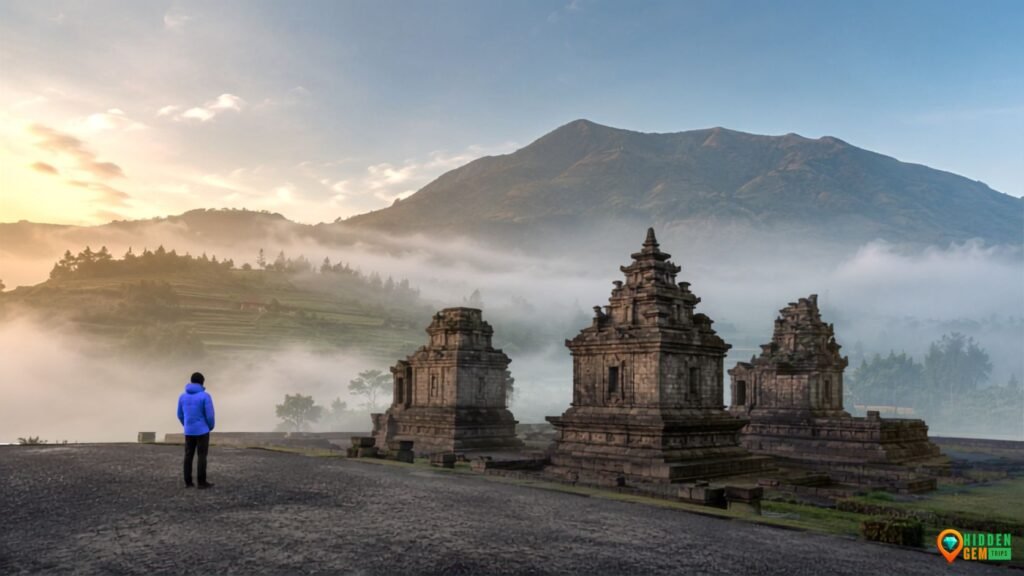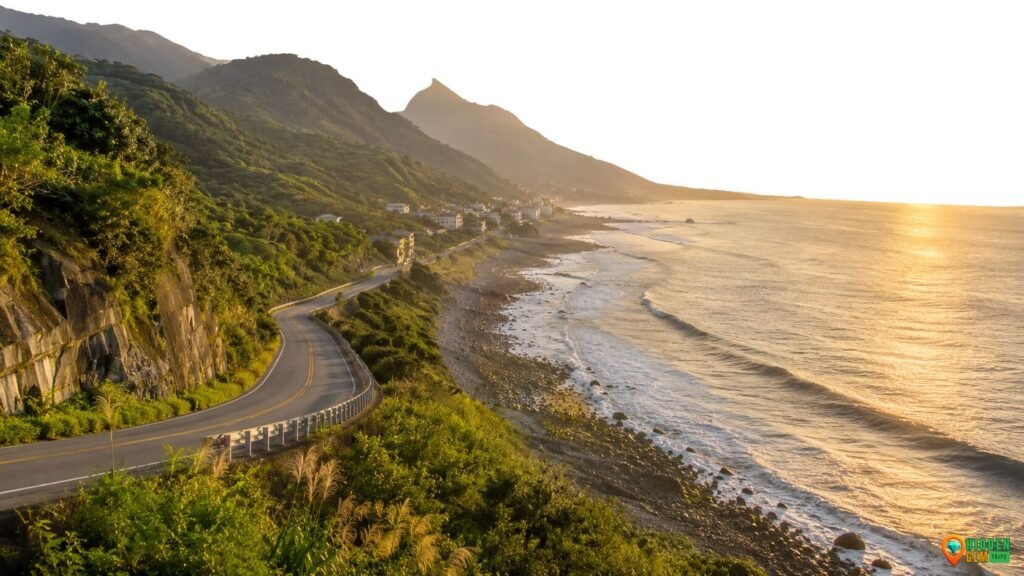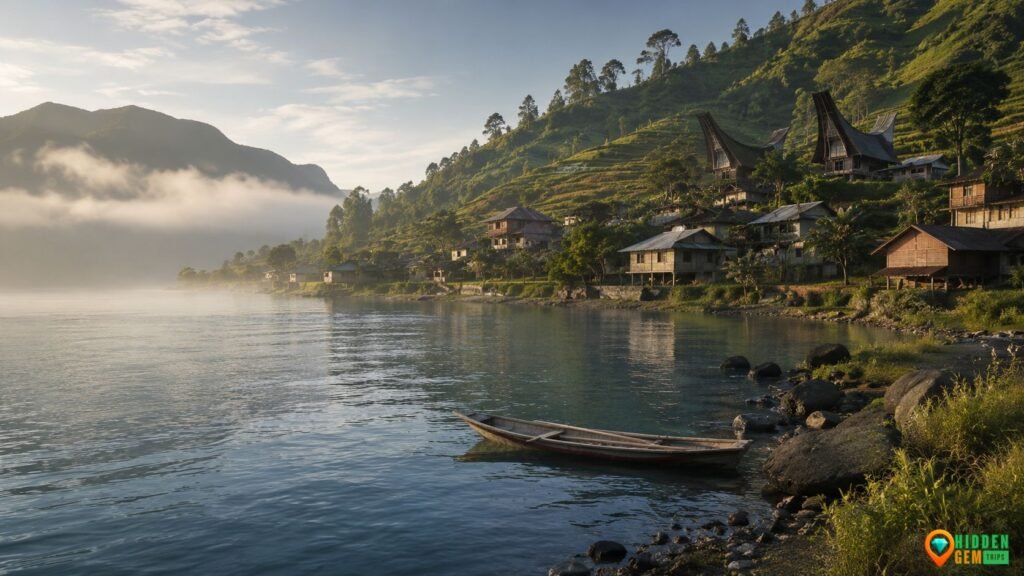

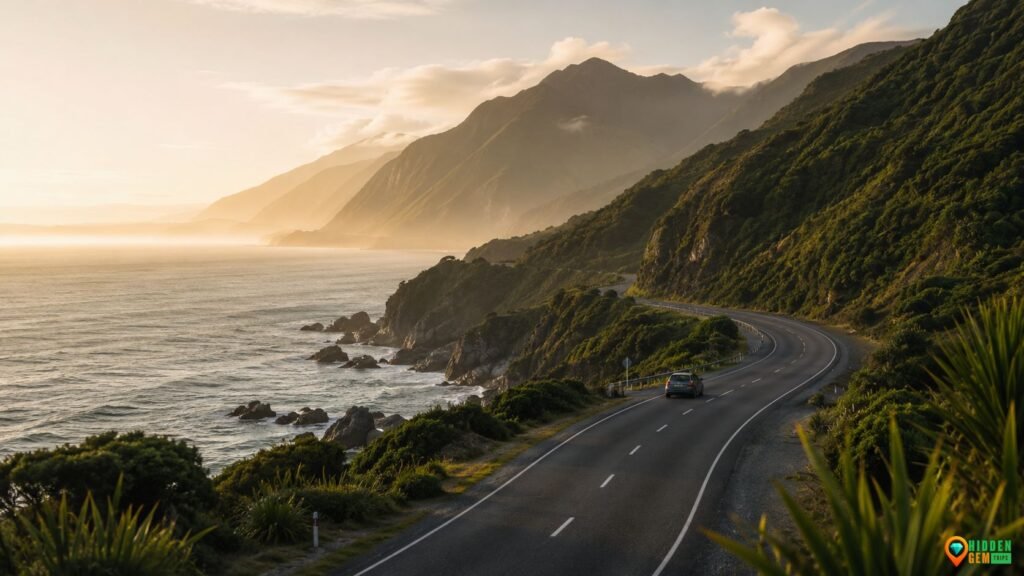
New Zealand’s coastal roads are more than just pretty lines on a map. This is the type of route where the best moments are typically between the famous stops, a one-lane bridge after rain, a farm gate with the sea behind, a bakery that closes early, or a beach car park where no one is performing for social media. This guide is for those who desire the coast without turning every vista into a crowd-management exercise. It highlights seven gorgeous journeys that still reward patience, early starts, flexible timing, and a little bit of “do less, notice more” energy. Big protagonist journey, but with the ego safely parked.
New Zealand has firmly re-emerged on the worldwide travel map. Stats NZ tourism statistics showed 358,900 visitor arrivals for March 2026, up 15 percent compared with March 2025, meaning famous icons will only get busier in peak months. The clever play is not to ignore New Zealand. Smart move. Better timing, better route choices, and a calmer definition of what counts as noteworthy.
This is not a speedrun list. It’s not about “doing” the country like a checklist with petrol receipts. If that’s your planning style, begin with HiddenGemTrips' leisurely travel philosophy, then come back to this post with calmer shoulders. These New Zealand coastal roads are finest when you allow them some spare time. Time for weather changes, slow vehicles, animals, shuttered cafes, gravel shoulders and the occasional view telling your itinerary to shush.
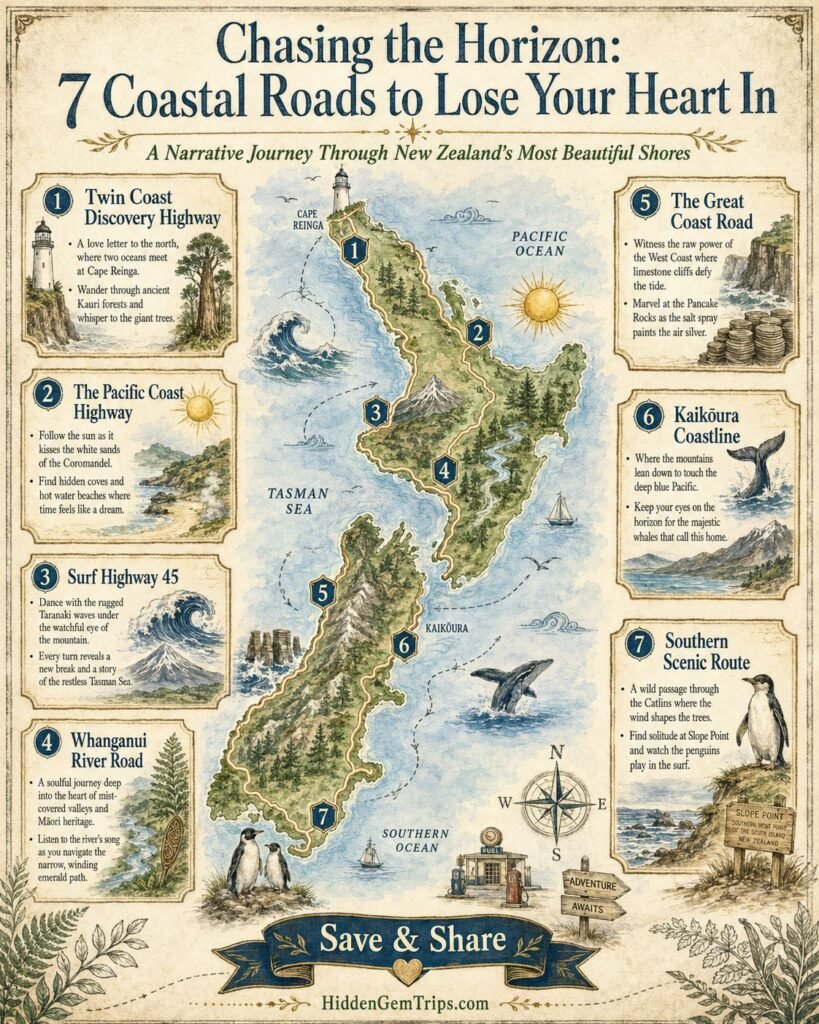
The following routes are a combination of North and South Island coastal drives: Northland’s Twin Coast Discovery Route, Thames Coast Road, East Cape, Kaikōura, Great Coast Road, Otago Peninsula and the Catlins. Some are known to road-trippers, but all still have quieter edges if you know where to slow down, where not to force a photo op, and when to drive past the obvious halt.
Why New Zealand Coastal Roads Reward Slow Drivers
New Zealand looks compact on a screen, but road time behaves differently here. Distances that seem small can feel longer because many coastal roads are narrow, winding, weather-exposed, and built around landforms rather than through them. That is part of their charm. It is also why the best self-drive trips are planned by hours, not just kilometers.
Coastal driving in Aotearoa is not only about beaches. You are moving through living places: Māori cultural landscapes, working farms, fishing settlements, conservation areas, surf breaks, small harbors, and towns where tourism is useful but not the only story. Treating these roads as “content backdrops” misses the point. Treating them as shared local infrastructure makes the trip better for everyone.
Quiet scenic drives also need a different kind of ambition. The quieter road is not always the most dramatic road. Sometimes it wins because it gives you breathing room. You can hear birds, watch weather travel across the water, and stop without feeling like you are blocking a production line of rental campervans.
For travelers who already like remote islands and raw coastlines, this article pairs naturally with HiddenGemTrips’ Tasmania’s wild west road energy and the Kimberley Australia wilderness guide. The same rule applies: wild places are not props. They are systems, communities, and weather patterns that deserve respect.
Quick Planning Table for 7 Quiet Scenic Drives
| Drive | Best base | Best for | Suggested time | Quietness tip |
| Twin Coast Discovery Route | Whangārei, Paihia, Kaitaia | Two-coast variety, Māori history, long beaches | 5-7 days | Use the west coast for slower, moodier stops. |
| Thames Coast Road | Thames or Coromandel Town | Sunset coastline, pōhutukawa, short escapes | Half day to 2 days | Go outside peak beach hours. |
| East Cape Road | Ōpōtiki or Gisborne | Remote coast, cultural depth, low traffic | 2-4 days | Do not compress it into one heroic day. |
| Kaikōura Coast | Kaikōura | Mountains meeting ocean, marine wildlife | 1-2 days | Stop only in safe pull-outs; avoid random shoulder stops. |
| Great Coast Road | Westport or Greymouth | Surf, limestone, rainforest, moody light | 1 day | Start early and linger at small bays. |
| Otago Peninsula Loop | Dunedin | Wildlife, harbor villages, high viewpoints | Half day to 1 day | Choose one wildlife experience, not all of them. |
| Catlins Coast | Kaka Point, Owaka, Curio Bay | Waterfalls, sea lions, southern ocean drama | 2-3 days | Stay overnight; day-trippers miss the best light. |
Before You Drive: Safety, Weather, and Road Reality
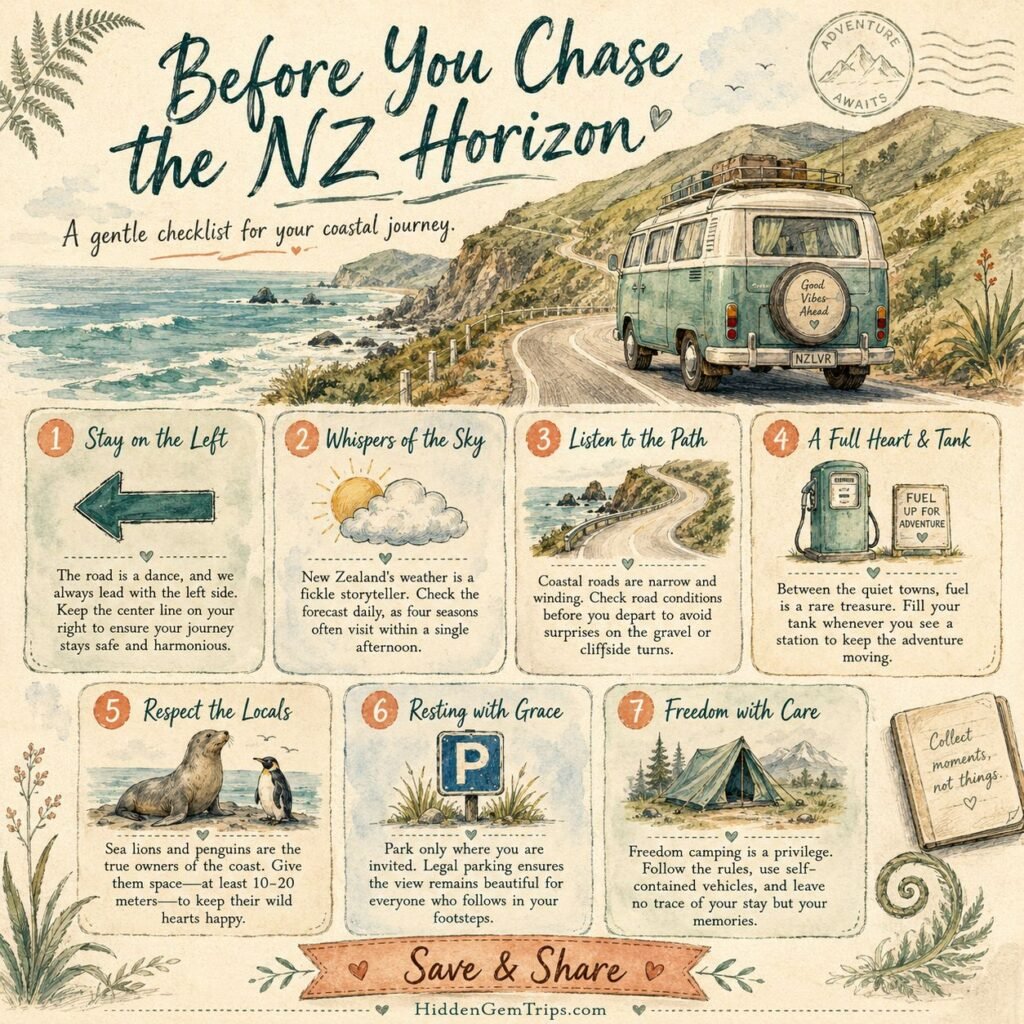
Before choosing any coastal route, read official safety guidance from Waka Kotahi visiting-driver guidance. New Zealand drives on the left, many roads are narrower and more winding than visitors expect, and fatigue after long-haul flights is not a personality test. It is a real risk. If you land after a long international flight, plan a recovery day before taking on a scenic coastal route.
Check Waka Kotahi highway conditions before departure, especially when your route includes exposed coast, recent rain, landslip-prone sections, or long gaps between towns. Coastal roads can change mood fast. One minute you are a travel influencer in your head; ten minutes later you are negotiating fog, wind, wet corners, and a logging truck with no interest in your aesthetic journey.
Weather matters. Use the MetService severe weather outlook before longer drives and again the morning you leave. The goal is not paranoia. It is basic competence. High wind, heavy rain, swell, slips, and surface flooding can all affect coastal roads, and the safer move is sometimes to delay, reroute, or cut the day shorter.
For camping or campervan trips, follow DOC freedom camping rules and local council restrictions. Do not assume a pretty beach car park is a free hotel because a random reel made it look romantic. New Zealand has been tightening expectations around waste, parking, and self-contained vehicles for a reason. The quiet traveler does not leave noisy problems behind.
Finally, treat the Tiaki Promise as more than a tourism slogan. Care for land and sea, travel safely, and respect culture. This article leans into that because quiet travel is not just about finding fewer people. It is also about becoming the kind of visitor places can tolerate seeing again.
1. Twin Coast Discovery Route, Northland
Northland’s Twin Coast Discovery Route is the long, generous option for travelers who want both sides of the island without forcing the South Island into every conversation. The Twin Coast Discovery Route is a long Northland loop rather than a quick coastal detour, and seven days should be treated as a taster rather than a complete conquest. That alone tells you how to approach it: slowly, with space for weather, cultural sites, beach towns, and west-coast quiet.
The eastern side around the Bay of Islands is more immediately polished and popular, while the western side feels moodier, wider, and less packaged. If you want quieter coastal energy, do not only chase the postcard blues. Give the Kauri Coast, Hokianga Harbour, Opononi, and Ahipara serious time. These places do not need to shout. They work on you slowly.
Best quiet stops and local rhythm
Start by resisting the urge to treat Cape Reinga as the only meaningful point. Te Rerenga Wairua is culturally significant and visually powerful, but the route earns its depth through the spaces before and after it. Hokianga Harbour gives you a softer, more reflective version of Northland: dunes across the water, historic settlements, and evening light that makes rushing feel embarrassing. Around Ahipara, Ninety Mile Beach can feel endless, but driving on the beach itself requires local knowledge, rental-car permission, tide awareness, and common sense. For most visitors, enjoying it from safe access points is the smarter flex.
The smarter way to experience Northland is to let the famous stops frame the trip, not control it. Arrive early, leave before the pressure builds, and spend the saved time in smaller settlements, short walks, and weather breaks nearby. This is how a known road can still feel personal without pretending you discovered it with a compass and a dramatic soundtrack.
Practical driving notes
Build this route over five to seven days, especially if you are arriving from Auckland. The roads are generally manageable, but long daily distances will turn the experience flat. Keep fuel topped up, book accommodation earlier in peak summer, and avoid leaving remote stretches for late-night driving. Northland rewards morning starts and unhurried afternoons.
If you are building a broader Oceania road-trip mindset, compare this with HiddenGemTrips’ island packing strategy because the same coastal logic applies: protect your energy, simplify your load, and leave margin for places that refuse to behave like an itinerary.
2. Thames Coast Road and Coromandel’s Western Edge
The Thames Coast Road is one of the most accessible New Zealand coastal roads, but accessible does not mean boring. The Thames Coast route follows the Hauraki Gulf through pōhutukawa-fringed edges, but the peninsula also has exposed coastal sections and weather-sensitive roads. That combination is exactly why the road is beautiful and why you do not wing it during bad weather.
This drive is ideal when you want a coastal road that can fit into a shorter trip without losing all emotional value. The western edge between Thames and Coromandel Town has a tide-and-tree rhythm: water close on one side, bush and small settlements on the other, and plenty of small pull-ins that feel better than the big-ticket beach names.
Best quiet stops and local rhythm
Use Thames as a practical base rather than only a gateway. Time the road for late afternoon if weather is clear; the sunset side of the Firth of Thames can make even a short drive feel cinematic. Stop in small communities for coffee or simple food, but do not park like the road belongs to your rental agreement. If you continue around the peninsula, choose one or two anchors instead of trying to inhale every beach name. Coromandel is at its best when you let the coast fold around you.
For the Coromandel, the quiet advantage comes from timing. Drive outside the busiest beach hours, choose fewer stops, and give the western edge permission to be simple: sea, trees, small settlements, and slow light. That is enough.
Practical driving notes
This is a narrow, winding road in places, and the prettiest section is not where you should drive like you are in a car commercial. Pull over only where safe. Check road updates after heavy rain. If you are new to left-side driving, use this as a gentle scenic day once you are rested rather than your first jet-lagged challenge.
For gear, a light day pack, rain shell, water, offline maps, and motion-sickness awareness beat overpacking. HiddenGemTrips’ packing light for remote expeditions has a useful philosophy here: bring what keeps you mobile, not what makes your car a rolling storage unit.
3. East Cape Road, Ōpōtiki to Gisborne
East Cape is where New Zealand’s coastal road story becomes quieter, more cultural, and less convenient in the best possible way. The region around State Highway 35 feels off-the-beaten-track in a way that is not marketing fluff. This is not a place to rush through with a checklist face. The road moves through coastal Māori communities, headlands, bays, farms, marae, small stores, and long stretches where the Pacific feels like the main character.
The drive from Ōpōtiki around the cape to Gisborne is often underestimated because the map does not look terrifying. Classic rookie error. Distances take time, services can be spaced out, and the beauty is not always in a single famous stop. It is in the feeling of distance from the standard tourist circuit.
Best quiet stops and local rhythm
Do not approach East Cape as “the long way to Gisborne.” Approach it as the reason for the trip. Plan for small coastal pauses, local food where available, and respectful curiosity. Around Te Araroa, the East Cape Lighthouse side trip is a major draw, but conditions and access should always be checked locally. Tolaga Bay Wharf, beaches, and small settlements can form a gentle rhythm if you stop trying to dominate the day.
On East Cape, the better travel rhythm is not “see everything.” It is “move respectfully.” Use the famous lighthouse or wharf as one chapter, then leave enough time for ordinary places: a store, a bay, a roadside view, a quiet meal, or a slow arrival into Gisborne.
Practical driving notes
This route deserves two to four days. One long day is technically possible for some drivers, but it usually drains the route of its meaning. Keep fuel and snacks sensible, do not rely on late opening hours, and drive alert because livestock, local traffic, narrow corners, and weather can all appear without asking your calendar.
If you are designing a deeper trip around this route, use HiddenGemTrips’ guide on how to build a deeper 7-day route so the coast becomes a framework, not a blur. And if you love remote sea routes, the same slow respect appears in the Mergui Archipelago island guide where distance changes how you travel.
4. Kaikōura Coast, Christchurch to Blenheim
The Kaikōura coast is not exactly secret, but it can still be quietly powerful if you stop treating it as a transit strip. Kaikōura sits on State Highway 1 between Christchurch and Picton/Blenheim, with mountains and ocean sharing the same frame. That is the headline. The quieter story is how carefully you need to move through it.
This road is famous because the geography is ridiculous: Pacific water on one side, the Seaward Kaikōura Range on the other, seals on rocks, seafood stops, surf, railway lines, and cliffs. It is also a transport corridor, not a private scenic platform. The 2016 earthquake reshaped the region’s road and rail story, and the rebuilt corridor is a reminder that beauty here sits on active land.
Best quiet stops and local rhythm
Use Kaikōura as more than a lunch break. Stay overnight if you can. Early morning light can be calmer, and the town becomes more interesting once day-trippers move on. Instead of trying to photograph every seal, choose safe viewing areas and keep respectful distance. Marine wildlife does not owe you content. The best version of the Kaikōura coast is slow seafood, shoreline walking, local operators, and a drive that lets the landscape breathe.
The quieter Kaikōura move is to stay longer than the lunch crowd. Let the coast be a place, not a drive-by. One good shoreline walk, one responsible wildlife experience, and one unhurried meal will usually beat ten rushed photo stops.
Practical driving notes
Only stop in safe, legal pull-outs. This matters more here than almost anywhere else because traffic, curves, railway corridors, and limited shoulders can make careless stopping dangerous. Check Waka Kotahi updates before driving if weather is unsettled.
For visitors arriving after international flights, combine this route with a recovery plan. HiddenGemTrips’ guide to survive the long-haul arrival fog is relevant because tired drivers make bad scenic decisions. Harsh, but true.
5. Great Coast Road, Westport to Greymouth
The Great Coast Road between Westport and Greymouth is one of the South Island’s most atmospheric coastal drives. The raw drive between Westport and Greymouth is short enough to tempt rushed travelers, but the better approach is to slow down for beaches, small bays, forest edges, and safe lookouts. That last part is the real instruction manual.
This is not a sterile blue-sky coast. It is rainforest, limestone, black rock, surf, mist, cliffs, old mining towns, and weather with opinions. It can feel cinematic under sun, but it becomes more interesting when clouds lower and the Tasman Sea starts doing drama. If your idea of a beach road requires perfect weather, the West Coast may humble you. Good. Humility looks good on travelers.
Best quiet stops and local rhythm
Punakaiki and the Pancake Rocks are the known anchor, but do not let one stop swallow the whole drive. Small beaches, lookouts, and bush edges make the road feel layered. Start early or stay nearby to avoid the busiest parts of the day. Let the coast decide the mood. If it is raining lightly, lean into short walks and cafés. If the sea is wild, watch from safe distance. This coast does not reward reckless closeness.
On the Great Coast Road, do not let Punakaiki become the whole story. Use it as a strong anchor, then keep space for small bays, safe lookouts, forest edges, and weather moods. The road is short enough to rush, but good enough to deserve the opposite.
Practical driving notes
Plan the drive as a full-day experience even if the raw driving time looks short. The West Coast’s weather can change quickly, and road conditions should be checked in rough weather. Sandflies can be very committed to their work, so carry repellent.
If you enjoy coastlines where the landscape feels older than your plans, compare this drive with HiddenGemTrips’ Hidden Vanuatu shipwreck route and Socotra ethical travel guide. Different oceans, same reminder: dramatic places deserve non-chaotic visitors.
6. Otago Peninsula Coastal Loop, Dunedin
Otago Peninsula is a compact scenic drive with a lot of emotional range. For this loop, Highcliff Road gives broader ocean and harbor views, while Portobello Road offers a lower coastal route through harborside villages. That choice is the fun: high drama above, intimate coastline below.
This drive is not about long-distance heroics. It is about texture. Dunedin gives you city access, but the peninsula quickly shifts into bays, boat sheds, sheep paddocks, wind, birds, and viewpoints that make the harbor look like a living map. It is one of the easiest ways to get a deep coastal feel without committing to a multi-day remote route.
Best quiet stops and local rhythm
Choose your wildlife experiences carefully. The peninsula is known for albatross, penguins, sea lions, and coastal habitats, but sensitive wildlife areas are not casual playgrounds. Book responsible operators where needed, obey signs, and do not wander into closed or protected spaces. The quietest version of the loop is not the one with the most stops. It is the one where each stop has a purpose.
For Otago Peninsula, depth comes from editing. Pick one high viewpoint, one low harbor village, and one ethical wildlife or conservation stop. The loop becomes stronger when you stop trying to collect every possible pin.
Practical driving notes
Highcliff Road can be narrow and winding, while Portobello Road hugs the water and villages. Drive slowly, use pull-outs, and watch for cyclists, locals, and weather. If you only have a half day, do not overbuild it. Pick one high viewpoint, one village pause, and one ethical wildlife or conservation stop.
For HiddenGemTrips readers who like the “small route, deep reward” pattern, this links naturally to the Banda Islands travel guide because both trips prove that compact geography can still feel huge.
7. The Catlins Coast on the Southern Scenic Route
The Catlins is the quiet closer this article deserves. The Catlins forms part of the lower South Island’s Southern Scenic Route, where wildlife, waterfalls, walking tracks, rainforest, and sandy coastline meet. Translation: do not make this a rushed detour from Dunedin to Invercargill and then complain that it felt thin. That is a planning error.
The Catlins coast feels wilder than its map position suggests. You get headlands, waterfalls, forest, sea caves, lighthouses, sea lions, penguins, and Southern Ocean weather that can switch from poetic to rude in minutes. It is one of the best places in New Zealand for travelers who like the edge of things.
Best quiet stops and local rhythm
Kaka Point, Nugget Point, Owaka, Purakaunui Falls, Papatowai, Curio Bay, Slope Point, and Waipapa Point can all shape the route, but the magic is in not stacking them too tightly. Some wildlife viewing is seasonal or sensitive. Some roads are slower than expected. Some beaches are better watched than walked, depending on conditions. Leave room for a second coffee, a longer waterfall pause, or the simple joy of doing absolutely nothing beside a cold southern sea.
In the Catlins, the quiet-travel advantage comes from staying overnight. Day-trippers often see the highlights, but they miss the cold early light, empty road rhythm, and slow southern mood that make this coast feel properly alive.
Practical driving notes
Give the Catlins two to three days if you can. One day is possible but stingy. Check weather, carry layers, keep fuel practical, and respect wildlife distances. Sea lions can look sleepy until they are not; do not be the visitor who turns a beach into a blooper reel.
For packing, pair this route with HiddenGemTrips’ remote travel gear that survives bad roads. You do not need expedition cosplay, but you do need practical shoes, rain protection, offline maps, and a car that suits the roads you actually plan to use.
How to Turn These Roads into a 7-Day Quiet Coastal Itinerary
A strong seven-day plan does not try to connect all seven roads. That would be a spreadsheet having a breakdown. Choose one region and go deeper. Here are three realistic frameworks.
| Itinerary style | Best route combination | Who it suits | Why it works |
| North Island slow coast | Twin Coast Discovery Route + Thames Coast Road | First-time visitors with 7-10 days | It mixes accessible roads, cultural depth, warmer beaches, and manageable driving days. |
| Remote cultural coast | East Cape Road + one Gisborne rest day | Travelers who dislike crowds | It gives the road enough space and avoids turning East Cape into a drive-through. |
| South Island wild coast | Kaikōura + Great Coast Road + Catlins or Otago Peninsula | Return visitors with 10+ days | It samples very different coastal moods without pretending the South Island is tiny. |
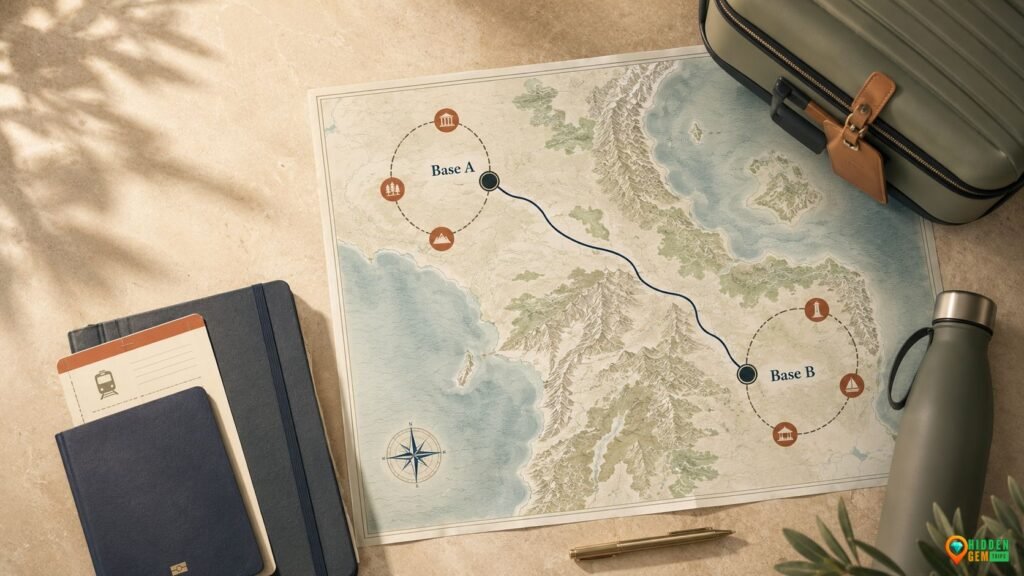
If you only have a week, pick rhythm over coverage. A useful rule is two nights in the first base, two nights in the second, two nights in the third, and one flexible buffer. That buffer is not laziness. It is premium itinerary insurance. For a more detailed planning logic, use HiddenGemTrips’ build a deeper 7-day route and adapt it to one coastline rather than one countrywide sprint.
If you want to compare this New Zealand coastline with other remote Oceania trips, the Kimberley Australia wilderness guide, Tasmania’s wild west road energy, and the Hidden Vanuatu shipwreck route show the same pattern: remote coastlines change your pace, gear choices, and responsibility.
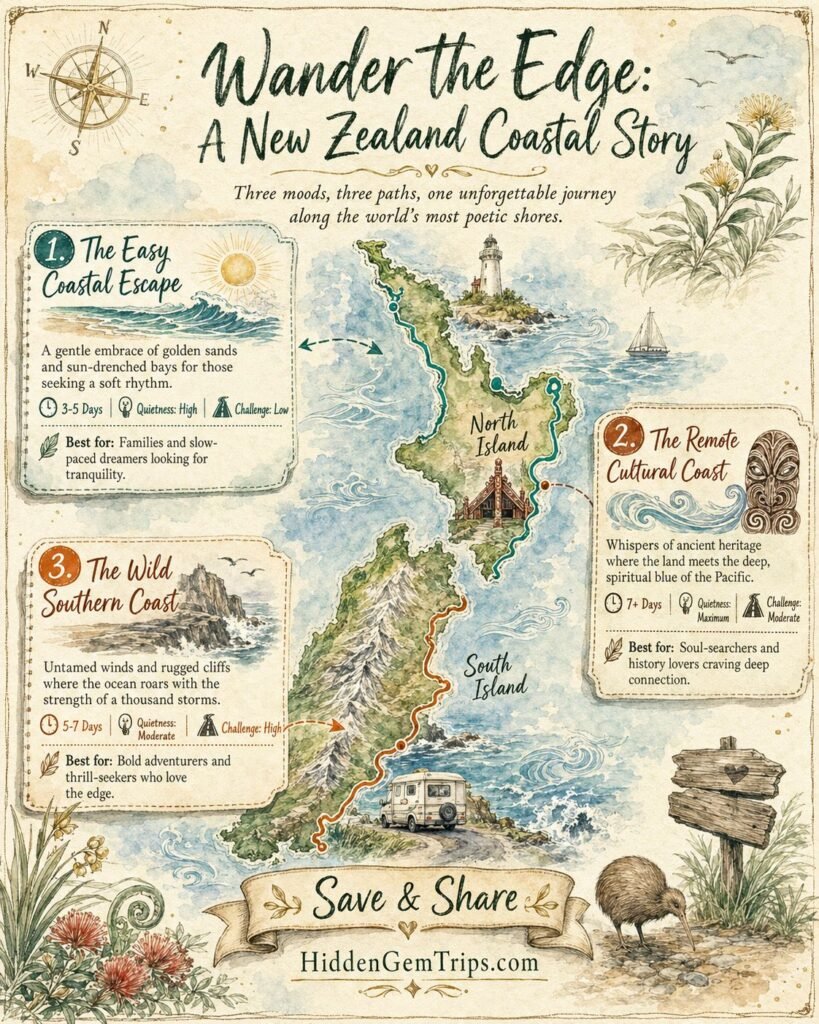
Responsible Travel Notes for New Zealand Coastal Roads
Responsible coastal travel in New Zealand starts with parking like a grown-up. Do not block driveways, farm gates, beach access, boat ramps, or narrow roads. If a viewpoint has no safe pull-out, it is not a viewpoint for you. Drive on.
Wildlife distance is non-negotiable. Seals, sea lions, penguins, and nesting birds are not interactive props. Use zoom lenses, guided experiences, and posted viewing areas. If your presence changes an animal’s behavior, you are too close.
Food and fuel choices matter. Small towns are not vending machines, and many places do not keep city hours. Buy locally where you can, carry basic supplies, and treat early closing times as local reality rather than a personal betrayal.
Weather humility is part of the trip. New Zealand’s coast can move from postcard to sideways rain quickly. A flexible itinerary is not weaker. It is smarter. The quiet traveler checks conditions, changes plans without drama, and refuses to treat risk as content.
Do not turn quiet communities into secret-location bait. Share useful context, not private driveways, fragile access points, or sensitive wildlife spots. Good travel writing can inspire without making every place instantly overexposed.
Ethically, the mindset is similar to HiddenGemTrips’ Socotra ethical travel guide: the more fragile or remote a place feels, the less extractive your behavior should become. Quiet travel is not just about avoiding crowds. It is about lowering your impact.
The same principle applies to photography. If the safest place to take the photo is not available, skip the shot. New Zealand’s roads are beautiful because they move through real communities and real ecosystems. Your best travel memory should not require a local driver to brake hard because you wanted one more cliff-road angle.
Budget and Booking Notes for a Quieter Coastal Trip
A quiet New Zealand coastal road trip is not automatically cheap, but it can be controlled if you make smart choices early. The big costs are usually rental vehicle, fuel, intercity transfers, accommodation, food, and paid wildlife or boat experiences. The budget trap is not one expensive item; it is stacking too many short stays, last-minute bookings, and long drive days that force convenience spending.
For better value, stay two nights in fewer bases instead of moving every morning. This reduces packing friction, gives you backup time for weather, and helps small towns benefit from more than a quick coffee stop. Mix self-catered meals with local cafés rather than choosing one extreme. Pay for guided wildlife experiences when they improve ethics, access, or interpretation, but skip paid activities that only duplicate what the road already gives for free.
Vehicle choice also affects budget more than many travelers expect. The cheapest car is not always the best value if it makes long coastal days uncomfortable, struggles with luggage, or pushes you toward risky roadside stops because everyone inside is tired. Choose a vehicle that fits the road style, the number of passengers, and the amount of gear you genuinely need. For most routes here, comfort, visibility, fuel efficiency, and a clear rental agreement matter more than looking adventurous in the car park.
Accommodation strategy should follow the same logic. A slightly more expensive two-night stay can be cheaper in real life than constantly moving bases, paying for last-minute meals, losing daylight to packing, and arriving too tired to enjoy the coast. Quiet travel is not only about finding quiet places. It is also about removing the friction that makes good places feel rushed.
When to Drive: Season, Light, and Crowd Strategy
The best season for New Zealand coastal roads depends less on one perfect month and more on the kind of trip you want. Summer brings long daylight, warmer beach energy, and more services, but it also brings heavier demand in popular coastal towns. Shoulder seasons can be the smarter travel choice because the roads feel calmer, accommodation pressure eases in many places, and the light often becomes more interesting for photography.
For Northland and Coromandel, late spring and early autumn often work well because coastal towns still feel alive without the full summer crush. East Cape can feel beautifully empty outside peak periods, but travelers should be realistic about shorter opening hours and fewer backup options. On the South Island, the West Coast, Otago Peninsula, and Catlins can deliver astonishing mood in imperfect weather, but drivers need to respect rain, wind, and cold conditions. The vibe is cinematic; the responsibility is practical.
The most underrated planning move is to build your day around light rather than mileage. Start early, stop before you are exhausted, and avoid scheduling the most winding or exposed road for the end of the day. Many coastal roads look better in morning or late-afternoon light anyway, so safety and beauty are not fighting each other. Finally, avoid treating every roadside stop as urgent. If the parking area is full, move on. A quieter beach ten minutes later will usually save the day.
Final Thoughts
New Zealand coastal roads are popular for a reason, but popularity does not have to flatten the experience. The quieter version exists in timing, pacing, route choice, and attitude. You do not need to “discover” a secret road to travel well. Sometimes you just need to stop treating every coastal drive like a leaderboard.
The seven drives in this guide are different: Northland is expansive, Coromandel is accessible, East Cape is culturally deep, Kaikōura is dramatic, the Great Coast Road is moody, Otago Peninsula is compact and rich, and the Catlins is wild at the lower edge of the map. Together, they show that New Zealand’s coast is not one thing. It is many rhythms stitched together by roads that deserve attention.
If you remember one thing, make it this: plan less tightly than your ambition wants. The sea, weather, local communities, and road conditions will all have opinions. Listen to them. That is where the good trip starts.
FAQ
1. What is the best quiet coastal drive in New Zealand for first-time visitors?
For first-time visitors, the Thames Coast Road is the easiest quiet coastal introduction because it is accessible from Auckland and can be done without a huge itinerary. For deeper travel, East Cape and the Catlins feel more remote and rewarding.
2. Are New Zealand coastal roads safe for international drivers?
Yes, but only if drivers respect local conditions. New Zealand drives on the left, many roads are winding or narrow and weather can change quickly. Rest after long flights, check road conditions and don’t overload your daily plan.
3. Can I drive all seven routes in one trip?
You can, but it is not recommended unless you have several weeks. A better strategy is to choose one island or one coastal region and travel more slowly. The article’s seven-day frameworks help narrow the route.
4. When is the best season for quiet scenic drives in New Zealand?
Shoulder seasons such as late spring and early autumn often provide a better balance of daylight, weather, and lower crowd pressure. Summer has long days but heavier demand in popular coastal towns.
5. Do I need a 4WD for these New Zealand coastal roads?
Most routes in this guide are on sealed public roads, so a normal car usually suffices. But side roads, beach access, gravel stretches, weather damage and rental restrictions mean you need to be cautious. Check local conditions and your rental agreement.
Disclaimer
This article is for general travel planning and editorial information only. Road conditions, weather, access rules, conservation restrictions, business hours, ferry schedules, and accommodation availability can change quickly. Always check official road, weather, conservation, and local council sources before driving. Follow all posted signs, local laws, rental-vehicle terms, and safety guidance. HiddenGemTrips does not encourage trespassing, unsafe stopping, illegal freedom camping, wildlife disturbance, or driving beyond personal ability.