
The world is running out of places that feel truly unconquered. As a traveler who has sought the edge of the map from the Sahara to the Andes, I can confidently say that Western Australia’s northernmost corner remains one of the few places where nature still holds the upper hand. This Kimberley Australia guide is born from the dust of the Gibb River Road and the salt of the Buccaneer Archipelago.
Spanning an area larger than Germany, yet populated by fewer than 40,000 people, the Kimberley is a land of red dust, turquoise waters, and billion-year-old rock formations. It is a place where you don’t just “visit” the landscape; you negotiate with it. Whether you are flying over the “beehive” domes of the Bungle Bungles or navigating a 4WD through a flooded river crossing, the Kimberley demands your full attention. If you have already explored untouched paradises in a crowded world, the Kimberley is your next mandatory expedition.
Why the Kimberley is Australia’s Most Rugged Hidden Gem
While the East Coast of Australia offers iconic sights like Sydney and the Great Barrier Reef, the West Coast offers something more visceral. The Kimberley is a place where the infrastructure is minimal, and the rewards for those willing to endure the journey are monumental.
Beyond the Outback: A Land of Giants and Gorges
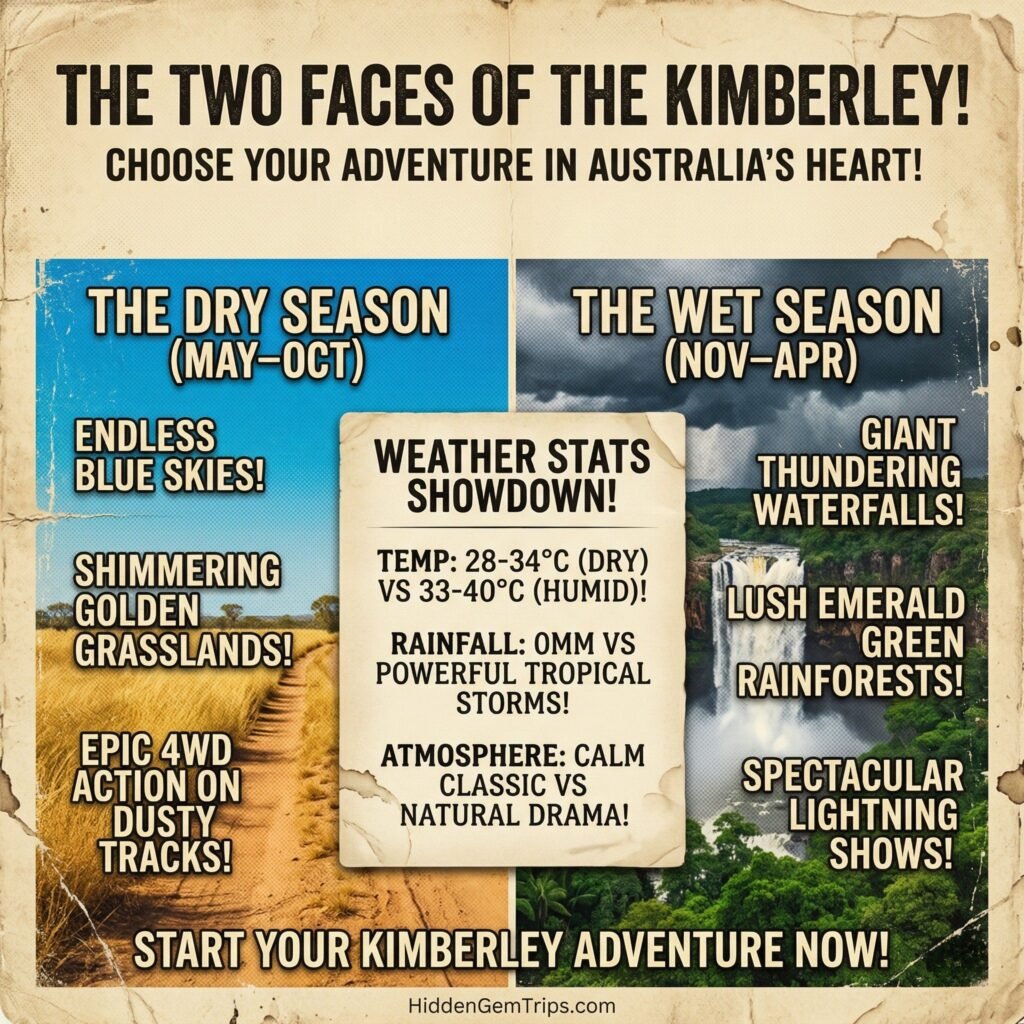
The Kimberley is characterized by its dramatic seasonal shifts: a “Dry Season” of endless blue skies and a “Wet Season” of thundering waterfalls and lightning shows that transform the desert into a lush, green Eden. Between the pearling town of Broome and the hub of Kununurra lies a wilderness that remains largely inaccessible to those without a 4WD or a sturdy boat.
The Slow-Travel Manifesto: Negotiating with the Landscape
It is this very difficulty that preserves its status as a “Hidden Gem”. You aren’t just another tourist here; you are an explorer participating in a slow-travel manifesto by necessity. Every mile gained on a corrugated track is a victory of preparation over the elements.
Planning Your Kimberley Australia Guide Expedition
Timing is everything in the Kimberley. The “Dry Season” (May to October) is the only time most inland roads, including the Gibb, are open to the public.
Seasonal Shifts: From Dry Skies to Thundering Waterfalls
- Peak Season (June–August): Perfect weather, but the most crowded.
- Shoulder Season (May and September): My personal recommendation. The roads have just been graded, but the waterfalls are still roaring from the rain that dropped in May.
- The “Waterfall” Season (November–April): Most land-based attractions are closed due to flooding, but scenic flights offer the only way to see the landscape at its most powerful.
Timing Your Trip: Peak, Shoulder, and Waterfall Seasons
When planning your Kimberley Australia guide itinerary, you must decide if you want the accessibility of the winter months or the raw power of the tropical summer. For many, the shoulder months represent the perfect balance of adventure and logistics.
The Gibb River Road: A 4WD Rite of Passage
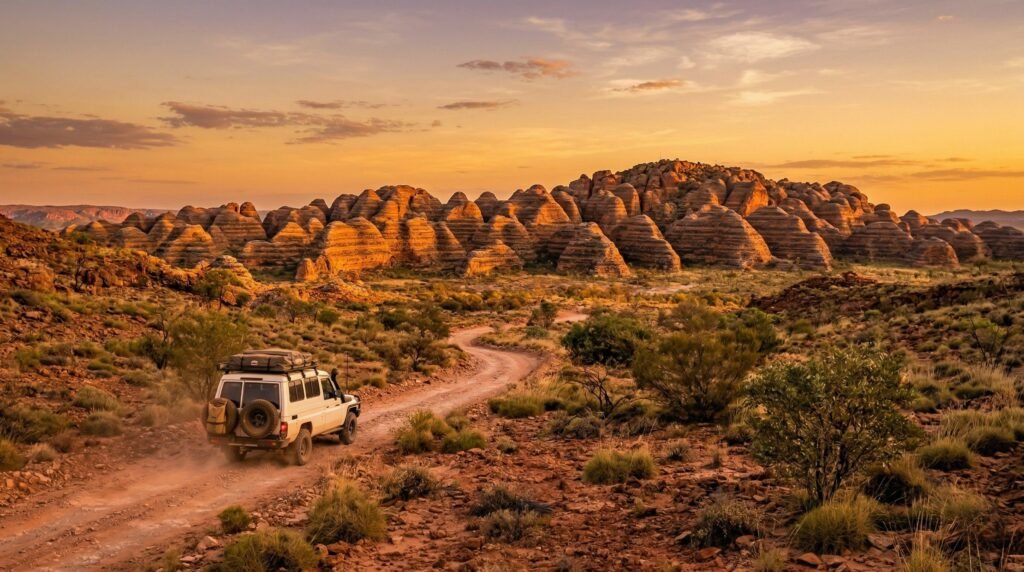
The legendary Gibb River Road is the 660km heart of the Kimberley. Once a simple stock route for cattle, it is now one of the world’s most famous outback trails.
Navigating the 660km Heart of the Kimberley
Driving it is a lesson in patience and mechanical preparation. You will encounter corrugated tracks, sharp limestone rocks, and river crossings that require a snorkel on your vehicle. This is when all of your hard work pays off, and your remote expedition gear is put to the test.
Windjana and Bell Gorges: Hidden Oases
But the benefits are unlike any other. Every few hours, the crimson dust gives way to a secret oasis. Gorges like Windjana, where freshwater crocodiles sunbathe on the banks, and Bell Gorge, with its tiered waterfalls, are cool places to escape the heat. This is the most basic kind of bush travel: rough, dusty, and indisputably gorgeous.
Choosing Your Vessel: 4WD vs. Luxury Cruise
The Kimberley is unique in that it can be experienced from two completely different perspectives.
Land Exploration: High-Clearance 4WD Requirements
On land, you need a high-clearance 4WD. If you don’t know how to drive off-road well, you might want to think about going on a guided 4WD tour that takes care of the licenses and logistics for you. This lets you enjoy the view while an expert takes care of the river crossings and tire pressures.
Getting to Horizontal and King George Falls from the coast
A Kimberley coastal cruise, on the other hand, lets you visit the area’s “untouchable” portions. Highlights like the Horizontal Falls—where massive tides are squeezed through narrow mountain gaps—and the King George Falls can only be reached by water or air. This perspective reveals a side of the Kimberley that even most 4WD adventurers never see.
Ethical Exploration: Respecting the Oldest Living Culture
The Kimberley is where the oldest living culture in the world is. For over 40,000 years, Aboriginal people have lived in harmony with this rugged landscape.
Indigenous-Owned Businesses and Cultural Experiences
As a traveler, your priority should be ethical, sustainable travel that engages with Indigenous-owned businesses.
| Cultural Experience | Location | Why It Matters |
| Mowanjum Art Centre | Near Derby | Preservation of Wandjina and Gwion Gwion art. |
| Mimbi Caves | Fitzroy Crossing | Ancient limestone caves with Gooniyandi guides. |
| Narlijia Tours | Broome | Yawuru perspectives on Roebuck Bay and the mangroves. |
| Camping with Custodians | Various | Staying on traditional lands with direct benefit to the community. |
Gaining Spiritual Depth through Aboriginal Tourism
According to the Western Australian Government, Aboriginal tourism is a key pillar of the regional economy. By choosing these tours, you gain a spiritual depth to your trip that a standard guidebook cannot provide.
Secret Spots: The Icons and Beyond
Purnululu National Park: The Bungle Bungles
These orange-and-black-striped sandstone domes, a UNESCO World Heritage site, were a “secret” from the outside world until the 1980s. Hiking into Cathedral Gorge, a natural amphitheater with acoustic properties that will make your skin crawl, is a mandatory experience. Ensure you check the UNESCO World Heritage Centre for details on why this geological karst is unique worldwide. If you enjoy these surreal landscapes, you’ll find similar awe in the megaliths of Sulawesi.
The Dampier Peninsula and Australia’s Pearling History
North of Broome lies a peninsula where red cliffs meet white sand and turquoise sea. This area offers a quieter alternative to the resort-heavy Cable Beach. It is also the center of Australia’s pearling industry; a visit to Cygnet Bay Pearl Farm offers a look into a trade that shaped the region’s modern history. This rugged coastal beauty rivals the Kei Islands in terms of untamed paradise.
Packing and Survival: Navigating the Edge
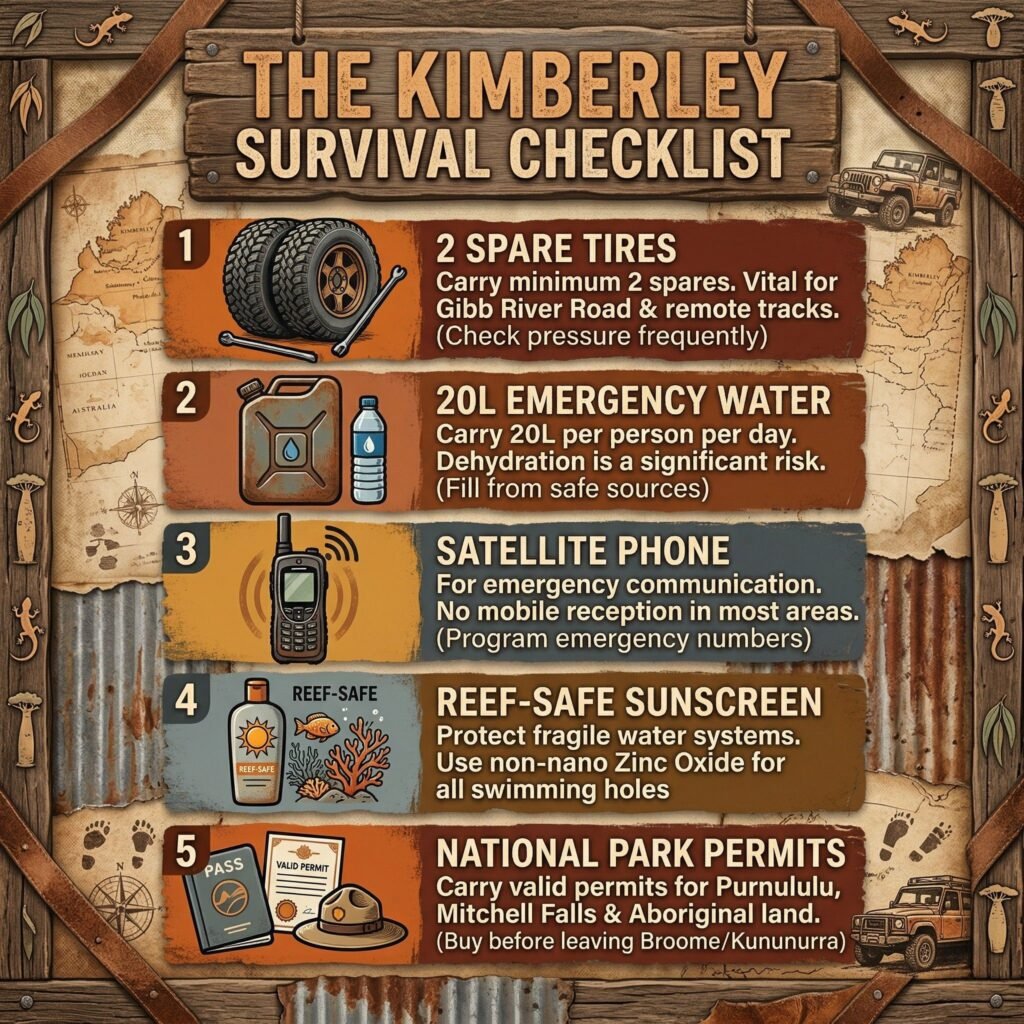
In the Kimberley, “over-packing” is a liability, but “under-preparing” is dangerous. You must master the secrets of packing light while carrying the essential gear for remote trips.
Remote Communication and Essential Safety Gear
There is no phone service on the Gibb or in most national parks. A satellite phone or Garmin InReach is non-negotiable for solo travelers. Distances are vast, and mechanical failure in the heat can be life-threatening if you cannot call for help.
Managing Resources Like Fuel, Water, and Reef-Safe Gear
- Fuel and Water: Always fill up before you leave a roadhouse.
- Water Requirements: Carry at least 20L per person as emergency backup.
- Reef-Safe Gear: The coastal habitats here are delicate, much like in the Mergui Archipelago. Choose your products carefully to safeguard them.
Conclusion: Embracing the Last Frontier
The Kimberley isn’t a good place for individuals who get afraid quickly, and you can’t truly understand it after only one visit. People feel little when they stroll through its red dust and hidden gorges because it is a huge, historic area. This tour to Kimberley, Australia will take you on a route that is not obvious and leads to something deeper.
Whether you find yourself silenced by the acoustics of Cathedral Gorge or watching the “Staircase to the Moon” from a quiet beach in Broome, the Kimberley leaves a permanent mark on your soul. It reminds us that there is still a “Last Wilderness” that we should protect and explore with the deepest care. As you get ready for your trip in 2026, keep in mind that the real luxury of this area isn’t in the high-thread-count bedding, but in the rare chance to be completely alone.
Bring your sense of wonder, get your car ready, and get ready to experience the timeless beat of Northern Australia. The outback is calling, and it is every bit as majestic as the legends suggest.
FAQ: Everything You Need to Know
1. Can I drive the Kimberley in a 2WD vehicle?
Generally, no. While some parts of the Dampier Peninsula and the main Highway 1 are sealed, the most iconic parts (The Gibb, Purnululu, Mitchell Falls) require a high-clearance 4WD.
2. Is it safe to swim in the Kimberley?
Only in designated freshwater holes. Saltwater crocodiles ("Salties") are present in all coastal areas and many river systems. Always "be crocwise" and look for signage.
3. How much money should I save aside for a two-week trip?
3. How much money should I save aside for a two-week trip? Fuel, permits, and food requirements make the Kimberley pricey. For a mid-range self-drive vacation, expect to pay at least $3,000–$5,000 AUD per person. For high-end luxury trips, expect to pay more than $15,000 AUD.
4. Do I need permission to go to Aboriginal communities?
Yes, some places need a permit to enter. For example, the Uunguu Visitor Pass is needed to get to the Mitchell Plateau. Most tour companies include these in their prices.
5. What does "Staircase to the Moon" mean?
5. What does "Staircase to the Moon" mean? From March to October, the full moon shines across the mudflats of Roebuck Bay near Broome, producing an optical illusion of a stairway.
Disclaimer
Traveling to the Kimberley is hard because of the weather, wildlife, and the fact that the roads are so far away. This Kimberley Australia guide gives basic information based on statistics from 2026, but it is not a replacement for advice from local experts. Before you go, always check the official alerts from Western Australia Parks and Wildlife.