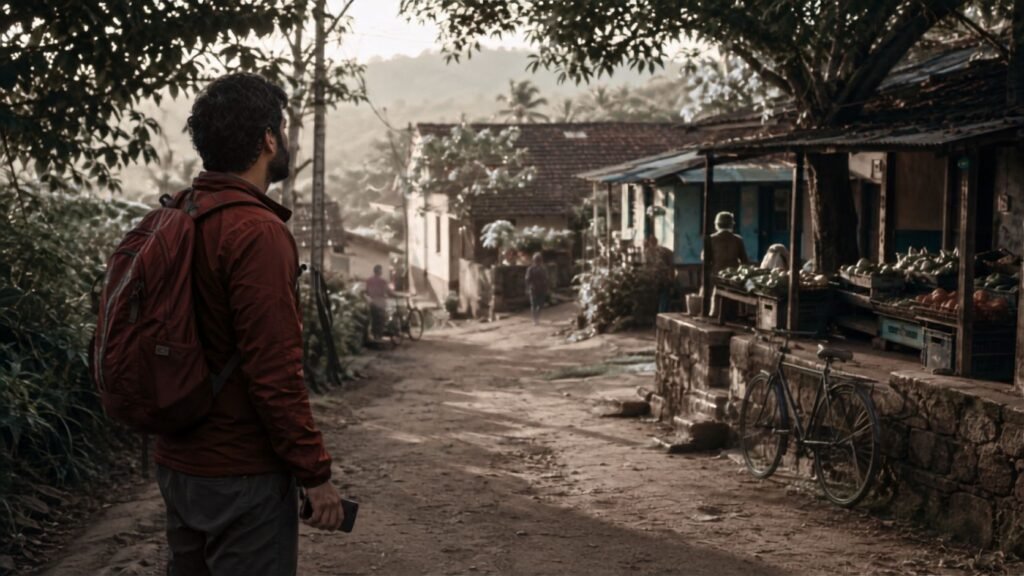


A remote trip budget is not just the price of flights, rooms, and a few meals. That version of budgeting works in cities where there is always another ATM, another ride-hailing driver, another pharmacy, and another hotel with a spare room. It starts falling apart the moment your trip depends on a once-a-day ferry, a dirt road, a local guide, patchy signal, or weather that politely ignores your Google Sheet.
Remote travel is seductive because it feels simple from far away. A mountain village looks cheap. A quiet island looks peaceful. A river town looks slower. Then the small costs arrive one by one: a private transfer because the shared truck is full, a second SIM because the first network dies after the last bridge, a cash withdrawal fee because card machines are decorative at best, or a night in the transit town because the ferry left early. None of these costs are dramatic enough to make the headline. Together, they are the reason many remote trips end with the sentence, “How did this become so expensive?”
The point of this guide is not to scare you away from wild roads, quiet coasts, deep valleys, or small communities. It is to build a more honest budget. International travel demand is still strong: UN Tourism’s 2026 update reported that international tourist arrivals grew in the first quarter of 2026 despite uncertainty, and its UN Tourism World Tourism Barometer data showed global travel had already reached record levels in 2025. More travelers are moving beyond obvious capitals and famous beaches, which means hidden-gem trips need better planning, not louder hype.
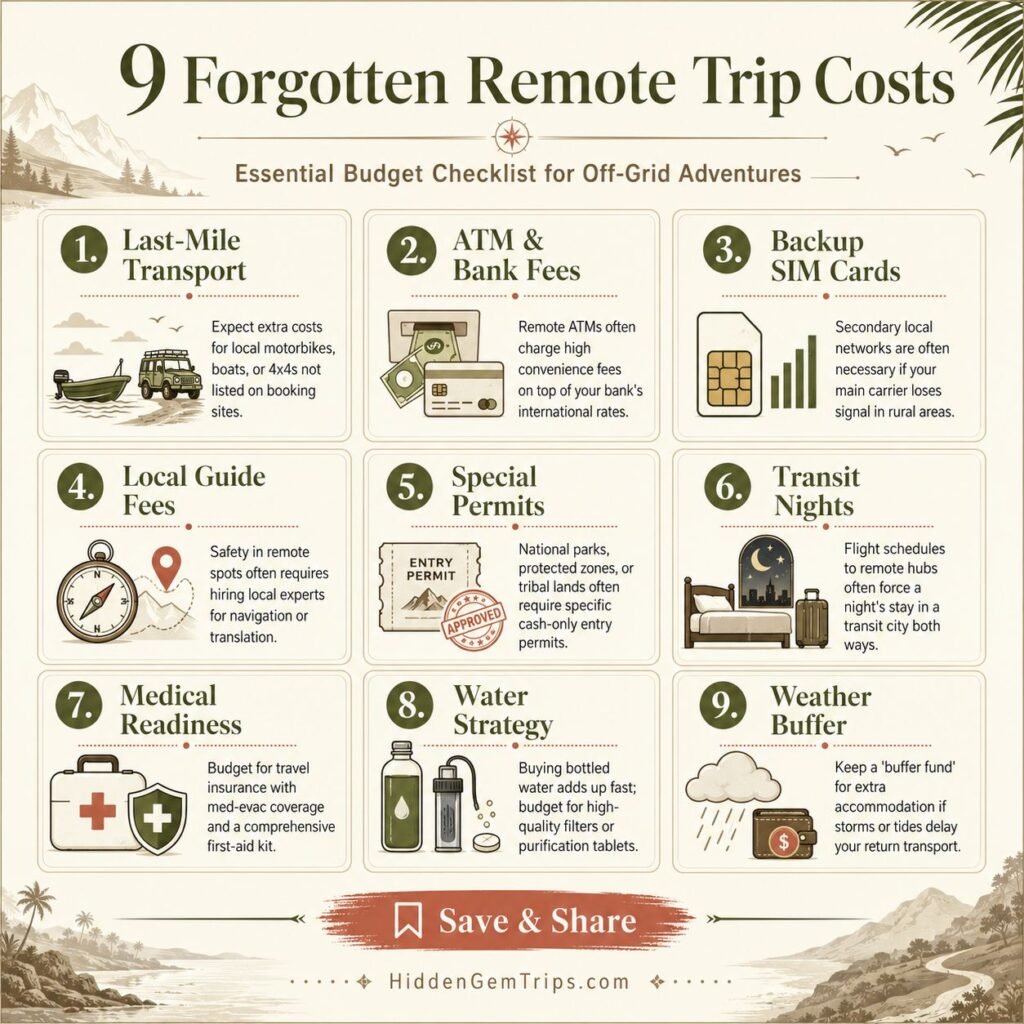
This article focuses on the nine costs travelers forget when planning remote routes: last-mile transport, cash access, communication, guide fees, permit friction, backup lodging, medical readiness, gear replacement, and weather delays. The goal is a budget you can actually travel with, not a fantasy spreadsheet that collapses faster than a cheap umbrella in mountain rain.
Why a Remote Trip Budget Fails Faster Than a City Budget
City travel gives you margin. If one restaurant is closed, ten others are nearby. If a bus is late, a taxi might still be affordable. If you forget a charger, a mall can rescue you. Remote travel removes those cushions. Distance turns a small mistake into a paid problem.
The common budgeting mistake is using the “average daily cost” method. A traveler says, “I spend $50 per day in this country, so seven days will be $350.” That can work in a dense travel corridor. It fails in remote places because costs are not evenly distributed. You may spend very little for two days in a village homestay, then pay a large one-off amount for a boat, a driver, a guide, a permit, or an emergency reroute. Remote trips are lumpy. Your budget needs to be lumpy too.
This is where Hidden Gem Trips should avoid generic advice. Budget travel is not always about going cheaper. Sometimes it is about choosing where not to be cheap. You can use budget habits that actually work in real destinations for day-to-day decisions, but remote routes need a separate “friction fund” for the costs that only appear when infrastructure gets thin. You can also borrow ideas from a mid-range comfort plan that does not pretend every trip is luxury because comfort in remote travel often means resilience: arriving before dark, having a safe backup room, and paying a local operator who actually knows the road.
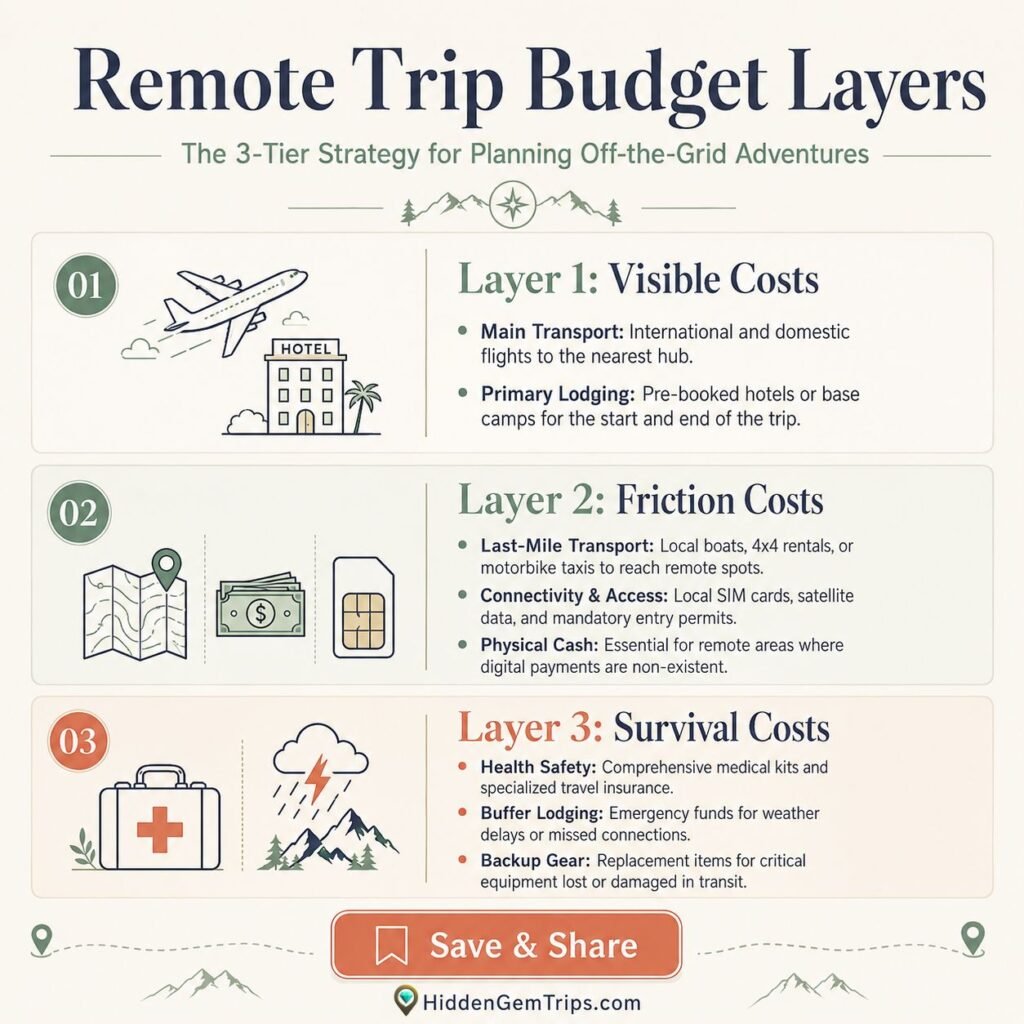
A useful remote trip budget has three layers. The first is the visible layer: transport, accommodation, food, entrance fees, and activities. The second is the friction layer: transfers, cash fees, phone data, permits, guide minimums, luggage storage, laundry, tips, and small logistics. The third is the survival layer: insurance, medical care, evacuation, backup lodging, emergency transport, and weather delays. Most travelers budget the first layer and vaguely hope the second and third behave. Spoiler: they often do not.
Remote Trip Budget Snapshot: What to Add Before You Go
| Forgotten cost | Why travelers miss it | Practical budget range | Smart planning move |
| Last-mile transport | The route looks short on a map | 10–35% of trip cost | Price the final 30–80 km separately |
| Cash access | Remote ATMs can be rare, empty, or expensive | 2–8% of spend | Carry layered cash and cards |
| Offline communication | One network may not cover the whole route | $5–$40+ | Buy data redundancy, not just data |
| Local guide or fixer | Not every place is DIY-friendly | $20–$150+ per day | Ask what is included before booking |
| Permits and local fees | Fees may be paid in person or cash only | $5–$100+ | Create a permit envelope |
| Backup lodging | Missed transfers create forced nights | 1 extra night per major transfer | Keep one transit-night reserve |
| Medical readiness | Clinics may be far away | $30–$300+ pre-trip | Budget consults, meds, and insurance |
| Gear replacement | Small failures become expensive | $10–$150 | Pack repair items and power backup |
| Weather delays | Boats, roads, and flights can stop | 1–3 buffer days | Add delay money and flexible dates |
This table is not a universal price list. Remote destinations vary wildly. The point is to make invisible categories visible before you book the shiny part of the trip.
Remote Trip Budget: The 9 Forgotten Costs
1. Last-Mile Transport Costs
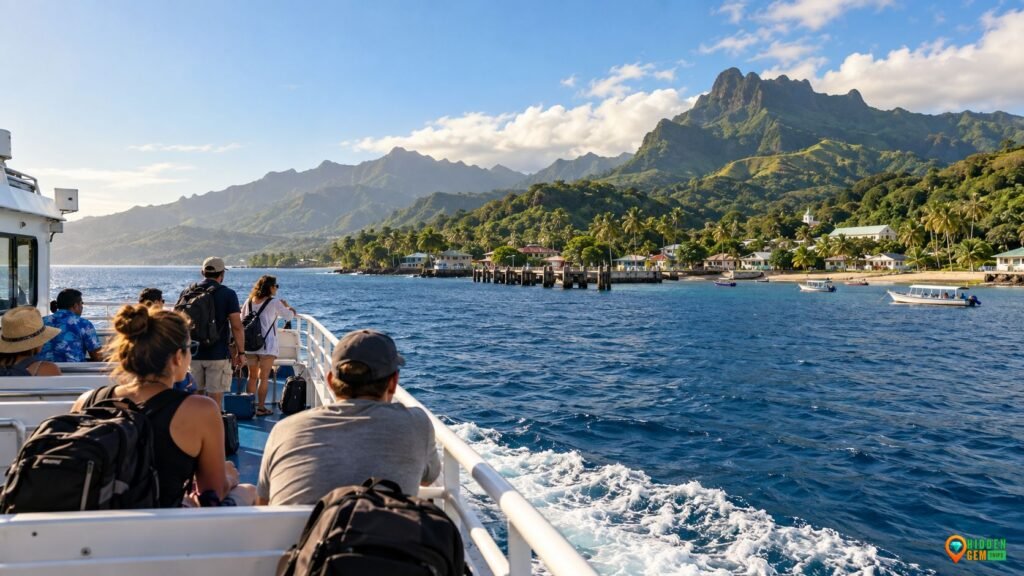
The most expensive part of a remote trip is often not the international flight. It is the final stretch: the road from the airport to the river port, the chartered boat from the pier to the island, the motorbike taxi after the public bus ends, or the 4WD needed because the road becomes a suggestion after heavy rain.
Maps flatten reality. A route that looks close can take six hours if it involves bad roads, ferry timing, landslides, police checkpoints, or a transfer that only runs when enough passengers show up. This is why remote budgeting should separate “main transport” from “last-mile transport.” Do not bury it in the daily average. Give it its own line.
Transport access is not evenly distributed. The World Bank rural accessibility research uses the Rural Access Index to estimate the share of rural people living within two kilometers of an all-season road, which is exactly the kind of infrastructure gap travelers feel when the final segment becomes slow, seasonal, or expensive. Safety also belongs in the budget conversation: the WHO road traffic injury fact sheet estimates that about 1.19 million people die each year from road crashes globally, with most fatalities occurring in low- and middle-income countries. That is not a reason to panic. It is a reason to pay for safer timing, better vehicles, and daylight transfers when the route is rough.
A practical rule: before booking accommodation, ask three questions. First, what is the cheapest public route from the nearest transport hub? Second, what is the realistic private option if public transport fails? Third, what time must you arrive to avoid paying after-dark rates? The third question is underrated. Night arrivals are where prices get spicy, and not in the fun sambal way.
For gear-heavy routes, read packing light for remote expeditions before you assume you can carry everything. A heavy backpack can force private transport, extra porters, baggage fees, or a slower itinerary. Light packing is not just a comfort choice. It is a budget decision.
2. Cash, ATM, and Payment Friction
Remote travel punishes people who assume cards work everywhere. Even when card payments are accepted, machines may be offline, electricity may be unstable, or the only working ATM may be in the district capital two hours away. You do not need to carry a dramatic brick of cash, but you do need a cash plan.
Payment friction has several parts: ATM withdrawal fees, foreign exchange spreads, minimum cash withdrawals, small local change, and the cost of going back to town if you run out. In the United States, Bankrate’s 2025 ATM fee study found average out-of-network ATM fees at a record high, which is a useful reminder that cash access has a price even in highly banked markets. In remote international travel, that price can include time, transport, and stress.
Create three money layers. Keep a primary card for normal withdrawals, a backup card stored separately, and enough local cash for at least two transport days. Break large notes early in towns. Remote drivers, homestays, and food stalls may not have change for large bills, and “I only have a big note” is not a personality trait locals enjoy dealing with.
For countries where emergency money transfers might become necessary, the World Bank Remittance Prices Worldwide database is a useful source for understanding that sending money across borders still carries meaningful fees. You may never need it. Good. Budgeting is partly the art of paying attention to problems you hope remain boring.
3. Connectivity and Offline Navigation
Travelers often budget for a SIM card. Remote travelers should budget for connectivity failure. That means offline maps, a second network option, downloaded translation files, saved accommodation directions, and a way to contact a guide when your main data plan disappears.
The mistake is assuming that “the country has good coverage” means your route has good coverage. National coverage maps can hide dead zones in valleys, forests, islands, border regions, and mountains. If your route depends on messaging a driver, confirming a homestay, downloading ferry updates, or navigating after sunset, one cheap SIM is not enough planning.
A good remote trip budget may include a local SIM, an eSIM backup, and one paid offline app if the route is complex. It may also include the deeply unglamorous cost of printing copies: hotel names, pickup points, medical contacts, passport copies, and permit details. Paper is not retro. Paper is what saves you when your phone dies in a rainstorm and your power bank is in the wrong bag.
Communication also affects safety. If you are planning bad roads, boat connections, or multi-day rural segments, combine your data plan with a bad-road gear strategy so your phone, charger, and documents stay dry and usable.
4. Local Guide, Fixer, and Community Fee Costs
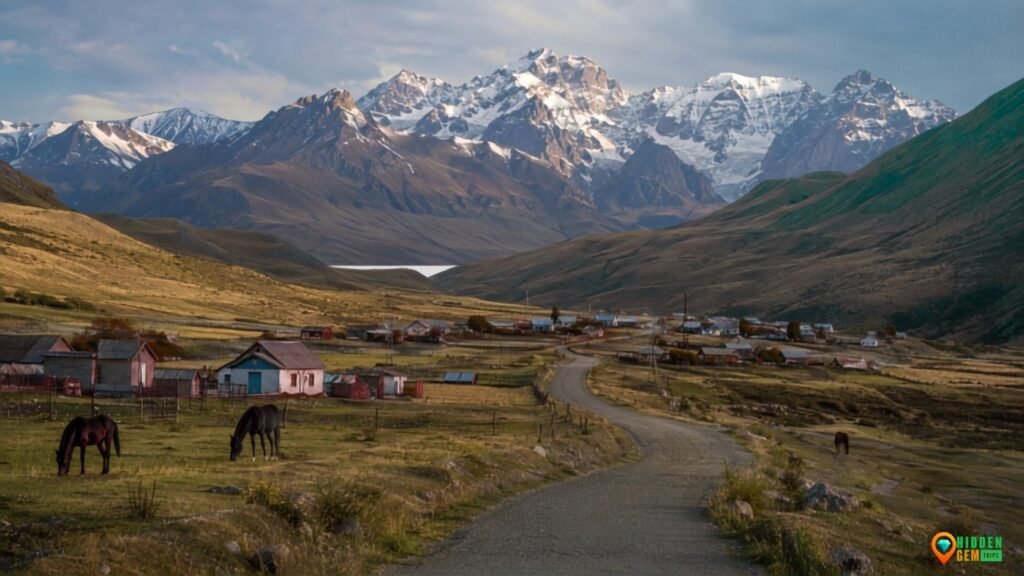
Some remote destinations should not be treated like DIY playgrounds. A guide may be required by regulation, expected by the community, or simply wise because the path is confusing, the river is seasonal, the cultural rules are specific, or the road crosses private or customary land. The cost is not a tourist trap by default. Often, it is the price of access done properly.
The budgeting mistake is counting a guide only as an activity cost. In remote travel, a guide can also be a translator, safety monitor, cultural bridge, wildlife spotter, route planner, and problem solver. That does not mean you should accept vague pricing. Ask what the fee includes: transport, meals, permits, village contributions, boat fuel, overnight costs, park fees, and guide accommodation.
This is especially important in places where local life is the reason to visit. A river journey is not only a line on a map. If you are inspired by the deep-river logistics of Mahakam travel or by Tanjung Puting beyond wildlife cruises, budget for people, not just places. A fair local fee can prevent the trip from becoming extractive.
One human rule: if a destination is marketed as “untouched,” assume you need more local guidance, not less. Untouched usually means fewer systems built for visitors. That is beautiful. It is also exactly why you should pay for context.
5. Permits, Conservation Fees, and “Small Official” Costs
Remote travel often involves protected areas, border zones, marine parks, cultural sites, drone restrictions, village permissions, or conservation fees. These costs are easy to miss because they may not appear on booking platforms. Sometimes they are paid at a local office. Sometimes they are cash only. Sometimes the fee changes depending on nationality, season, camera equipment, or activity.
Do not treat permits as an afterthought. A permit problem can cost more than the permit itself if it forces a delay, reroute, or extra night. Create a permit line in your budget and save screenshots or printed copies of confirmation emails. If no official online information exists, message your accommodation and ask exactly where, when, and how payment is handled.
This is also where responsible travel becomes practical. Before sending readers into fragile places, use the mindset from checking whether a secret destination is ready for visitors. A destination that lacks clear waste systems, visitor limits, emergency response, or community consent may not be ready for heavy promotion. The cheapest trip is not always the most ethical one.
If there is a conservation fee, do not automatically complain. Ask where it goes. Good fees support trail maintenance, ranger work, waste management, cultural preservation, or community infrastructure. Bad fees exist too, of course. But the answer is transparency, not pretending remote places should absorb visitor impact for free.
6. Backup Lodging and Forced Transit Nights
The quietest budget killer is the forced overnight. The boat is full. The bus arrives after the last connection. The mountain road closes. The local flight is canceled. The guesthouse owner thought you meant next month. Suddenly, you are paying for a transit hotel you did not plan, plus dinner, transport, and maybe a new ticket.
Remote itineraries should not be built like a stack of dominoes. If every transfer depends on the previous transfer working perfectly, you do not have an itinerary. You have a prayer with booking confirmations.
For every major remote transfer, budget either time or money. Time means an extra buffer day. Money means enough cash to handle a private ride, extra room, or reroute. Ideally, budget both. This is why a deeper seven-day itinerary instead of a rushed checklist is often cheaper in the end. Slow routes reduce forced spending because they leave room for reality.
Backup lodging does not have to mean fancy lodging. It means knowing your transit towns, saving two or three backup stays offline, and avoiding late-night arrival in places with limited rooms. When remote accommodation supply is thin, “we will find something when we get there” can become expensive very quickly.
7. Medical Readiness, Insurance, and Evacuation Gaps
Health costs are where remote travel budgeting gets serious. A city traveler may be minutes from a clinic. A remote traveler may be a boat ride, rough road, or small flight away from reliable care. Even a minor illness can become expensive when it changes transport timing or forces rest days.
The CDC notes in its CDC Yellow Book guidance on travelers’ diarrhea that travelers’ diarrhea is one of the most predictable travel-related illnesses and can affect a large share of travelers depending on destination and season. In remote areas, the cost is not only medicine. It can be lost days, missed connections, extra nights, rehydration supplies, private transport, or a guide waiting fee.
Insurance is not magic, and it is not a substitute for reading the policy. But it is part of a serious remote trip budget. The CDC guidance on travel insurance and medical evacuation coverage recommends discussing what existing coverage does and does not cover abroad. The U.S. State Department medical evacuation guidance warns that air ambulance evacuation back to the United States can cost from $20,000 to $200,000 depending on location and health condition.
That does not mean every traveler needs the same policy. It means remote travelers should price the risk before the trip, not after the injury. For long trips or flexible routes, compare travel medical options such as SafetyWing Nomad Insurance and read the exclusions carefully. The boring policy details matter more than the pretty landing page. Adventure activities, motorbike use, pre-existing conditions, altitude, alcohol-related incidents, and evacuation rules can all change the real value of a plan.
8. Water, Food Safety & Small Health Supplies
It’s often more difficult to keep to simple routines when visiting remote destinations. Safe drinking water may be available, but not always convenient. Food may be fresh and wonderful, but your stomach may not share your optimism. Pharmacies may be basic. Sunscreen, electrolyte packets, insect repellent, menstrual supplies, prescription refills, and contact lens solution can be difficult or expensive to replace.
The WHO drinking-water fact sheet emphasizes that safe and readily available water matters for public health. For the traveler this means a water strategy budget line: refills, purification tablets, a filter bottle, boiled water or sealed bottles as appropriate. On longer routes, a reusable purifier can reduce plastic waste and emergency spending. A compact option such as a travel water filter bottle on Amazon can make sense for certain trips, but check what it actually filters or purifies before buying. Not all filters handle viruses, chemicals, saltwater, or heavy sediment.
Do not over-medicalize travel. Just be practical. Pack oral rehydration salts, basic pain relief, any personal medication, blister care, and a small stomach kit recommended by a qualified clinician. If you need vaccines, malaria advice, altitude medication, or prescriptions, budget the pre-trip clinic visit too. The hidden cost may happen before the trip starts.
9. Delay, Weather, and Gear Failure Costs
Weather is not a vibe. It is a logistics system with opinions. Rain changes roads. Wind changes boats. Fog changes flights. Heat changes walking pace. Landslides change everything. Remote trip budgets need a weather delay line because nature does not care that your return flight is non-refundable.
The gear side matters too. Remote travel is where small failures become paid problems. A cracked phone screen, dead cable, wet passport pouch, broken sandal, failed headlamp, or weak power bank can cost time and money. Aviation rules also affect how you pack power. The FAA airline passenger battery rules state that spare lithium batteries, including power banks and portable chargers, must be carried on rather than checked, with limits for larger batteries. If your backup power is packed incorrectly, your “preparedness” can disappear at the airport.
Baggage delays are another forgotten risk. IATA’s baggage tracking overview cites industry estimates of 6.3 mishandled bags per 1,000 passengers in 2024, amounting to tens of millions of mishandled bags. The rate is low, but remote trips are less forgiving. A delayed checked bag in a capital city is annoying. A delayed checked bag before a boat transfer or mountain route can wreck the plan.
Pack your first 24–48 hours of essentials in your carry-on: medication, chargers, a light layer, basic toiletries, documents, one change of clothes, and anything that would be hard to replace before the remote segment. This is not paranoia. This is the traveler version of wearing a seatbelt.
The Remote Budget Buffer Method
Here is a simple method that works better than guessing.
Start with your visible budget: flights, main transport, rooms, meals, activities, and basic fees. Then add a friction buffer based on route difficulty:
| Route type | Add this friction buffer | Best used for |
| Easy remote | 10–15% | Good roads, frequent transport, multiple lodging choices |
| Moderate remote | 20–25% | Limited transfers, cash-heavy towns, seasonal weather |
| Hard remote | 30–40% | Boats, 4WD, guides, permits, weak signal, few backup rooms |
| Expedition-style | 40%+ | Multi-day wilderness, charter transport, medical distance, complex permits |
The buffer is not “extra shopping money.” It is assigned money. Label it before you go: transport rescue, delay night, medical gap, cash fee, guide overtime, gear replacement, and weather reroute. If you return home with the buffer unused, congratulations. That is not wasted money. That is a trip that behaved.
For deep routes such as Northern Laos river-and-mountain stops, Taiwan East Coast quiet towns, Lake Toba local stops beyond Samosir, or Kalimantan river towns, the buffer should be part of the itinerary design from day one. These are not places to budget like a weekend in a capital city.
A More Honest Sample Remote Trip Budget
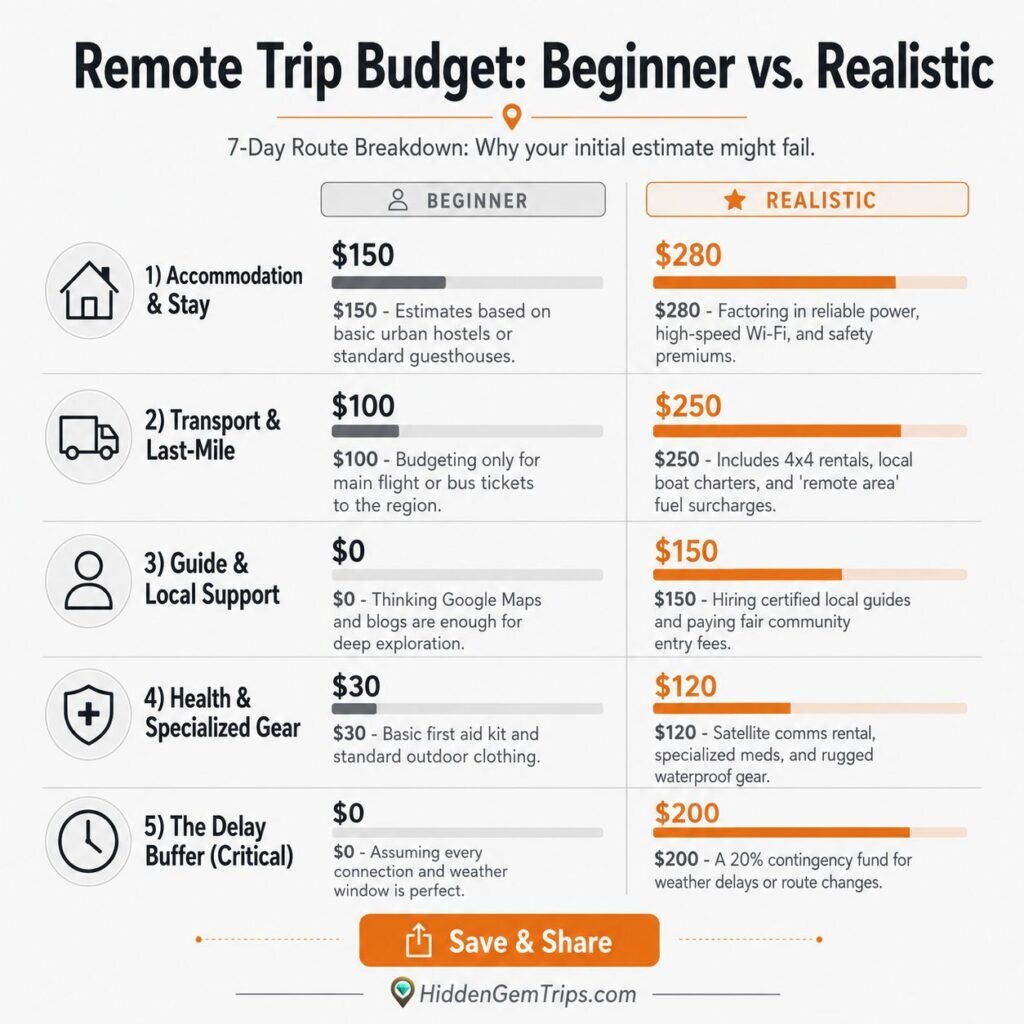
Imagine a seven-day remote route with one domestic flight, two long land transfers, a boat segment, homestays, a local guide for two days, and one protected-area visit. A typical beginner budget might look like this:
| Category | Beginner estimate | More honest remote estimate |
| Accommodation | $210 | $240 including one backup night reserve |
| Food and drinks | $140 | $175 including water and limited-choice meals |
| Main transport | $250 | $250 |
| Last-mile transport | $50 | $180 |
| Activities and fees | $80 | $140 including permits and community fees |
| Connectivity | $10 | $35 including backup data |
| Health and supplies | $15 | $90 including pre-trip and route supplies |
| Gear and power backup | $0 | $75 |
| Delay buffer | $0 | $150 |
| Total | $755 | $1,335 |
That difference looks uncomfortable until you compare it with the cost of being stranded, skipping the best part of the route, or pressuring locals to solve your poor planning for free. Remote travel is not always cheap. It can be excellent value, but only when you understand what you are paying for.
How to Cut Costs Without Cutting Safety
A better remote trip budget is not an excuse to overspend. It simply shows where savings should and should not happen.
Save money by staying longer in fewer places. Every transfer produces friction. Fewer transfers usually bring lower transport costs, less stress, more meaningful time. This is part of the slow travel mindset that guards the local rhythms, especially in small communities with fast visitor turnover can create more pressure than value.
Travel a little out of season, but don’t do it blindly. Shoulder season can reduce lodging costs, yet it can also bring rough seas, muddy roads, or reduced transport schedules. Cheap dates are not cheap if they increase delay risk.
Save money by choosing one anchor experience instead of five shallow ones. Pay properly for the guide, boat, or cultural visit that defines the trip. Skip the filler activities. Hidden-gem travel is not a scavenger hunt. It is not necessary to collect every viewpoint like browser tabs you forgot to close.
Save money by planning your exit route as carefully as your arrival. Many travelers obsess over getting in and forget the cost of getting out. Exit transfers often happen when energy is low, cash is thin, and patience has left the group chat.
Finally, save money by researching readiness. The wider hidden-gem travel method is not about chasing places nobody knows. It is about understanding whether a place can receive visitors well, whether your spending stays local, and whether your presence makes the destination better or noisier.
Conclusion: A Good Remote Trip Budget Buys Calm
A strong remote trip budget does not remove uncertainty. It makes uncertainty survivable. It gives you the freedom to wait out bad weather, pay a fair local rate, handle a missed connection, buy medicine without panic, and choose the safer road instead of the cheapest one.
The forgotten costs are not random. They appear where systems get thinner: the last road, the final boat, the only ATM, the weak signal, the small clinic, the full guesthouse, the local rule you did not know, and the weather window you cannot control. Budgeting for those things is not negative thinking. It is respect for the destination.
If your remote trip budget only works when everything goes perfectly, it is not a budget. It is fan fiction with airfare. Build the buffer. Travel slower. Pay the right people. Carry backup cash. Read the fine print. Then go enjoy the quiet places with less drama and more presence.
FAQ
1. How much extra money should I add to a remote trip budget?
For most remote routes, add at least 20–25% beyond your visible costs. For routes involving boats, 4WD transport, guides, permits, seasonal weather, or limited lodging, a 30–40% buffer is more realistic. The buffer should be assigned to specific risks such as delay nights, last-mile transfers, medical gaps, and cash access.
2. Are remote destinations more expensive than cities to visit?
Not always. In remote areas, accommodation and food can be cheaper but transport, guides, permits, cash access and delays can add to the overall cost. Remote travel is often cheaper per peaceful hour, but more expensive per logistical mistake. That is why the budget needs to separate daily costs from one-off friction costs.
3. Should I purchase travel insurance for remote travel?
Coverage comparison is important especially if you will be on a route where medical care is limited, adventure activities, motorbike travel, boats, mountains or far from hospitals. Look for travel medical coverage, evacuation terms, exclusions, claim requirements, and activity limits. Insurance is not automatically useful unless it matches your actual route.
4. What is the easiest forgotten cost to avoid?
Forced transit nights are often avoidable with better timing. Arrive early, avoid tight same-day connections and have backup lodging options saved offline. One planned buffer night can be cheaper than a chaotic unplanned night after a missed ferry, closed road or late bus.
5. What do you never cut from a remote travel budget?
Don’t cut safety critical costs: safe transport, fair guide pay, medical readiness, clean water, communication backup, weather flexibility. Cut extra activities, unnecessary luggage, rushed transfers, or luxury add-ons first. In remote travel, the cheapest option can become the most expensive one when it removes your margin.
Disclaimer
This article is for general travel planning and educational purposes only. Costs vary by destination, season, exchange rate, traveler profile, health needs, and local regulations. Always check current official requirements, local advisories, insurance policy wording and medical guidance before traveling. Some links may be affiliate links, meaning Hidden Gem Trips may earn a commission at no additional cost to you if you purchase through them. Recommendations should be viewed in light of your itinerary, risk tolerance and personal circumstances.