
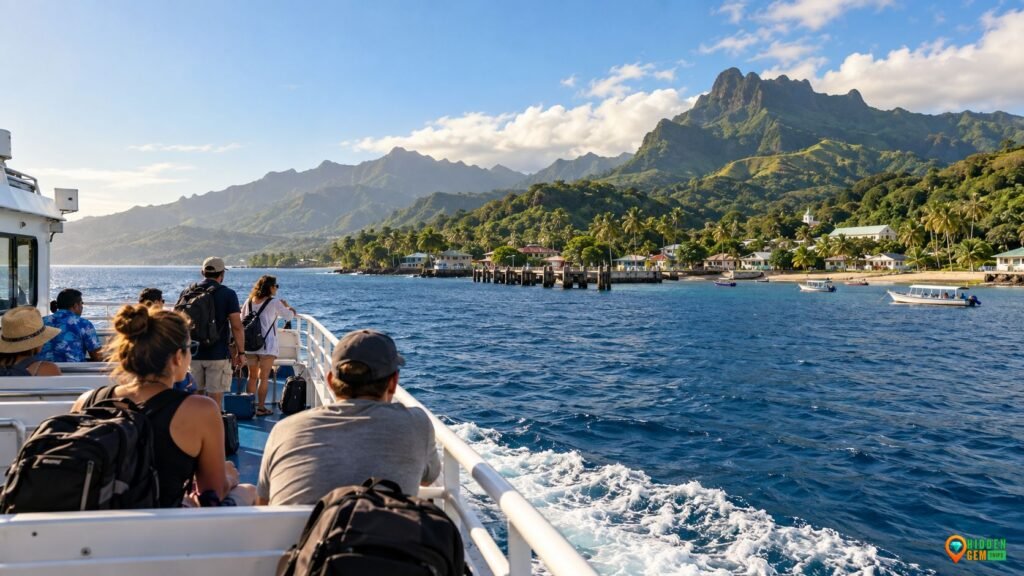
Fiji ferry routes reveal a version of the country that is easy to miss when every transfer begins and ends at a resort jetty. The sea network links working ports, historic towns, second-island communities, village-managed landscapes, and places where the timetable is shaped as much by weather and cargo as by tourism. For travelers who want to see Fiji beyond a single beach base, ferries can be a practical way to understand how the archipelago actually functions — but only if the route is planned with more patience than a normal resort transfer.
This is not a guide to “dropping into authentic villages.” A ferry ticket gives access to an island or port, not automatic access to a community. Before adding a village to any itinerary, it is worth reading the site’s field test for deciding whether a lesser-known destination is ready for visitors. Fiji’s strongest non-resort routes work when transport, local hosting, cultural permission, and buffer time are treated as one planning problem rather than four separate details.
| Research note — last verified 29 September 2026 This is a research-based guide, not a first-hand trip report. Resort-ferry schedules are relatively easy to confirm online; local inter-island services can change with maintenance, weather, port conditions, cargo requirements and operator decisions. Reconfirm each local sailing close to departure. |
Quick Answer: Which Fiji Ferry Routes Work Best Beyond Resorts?
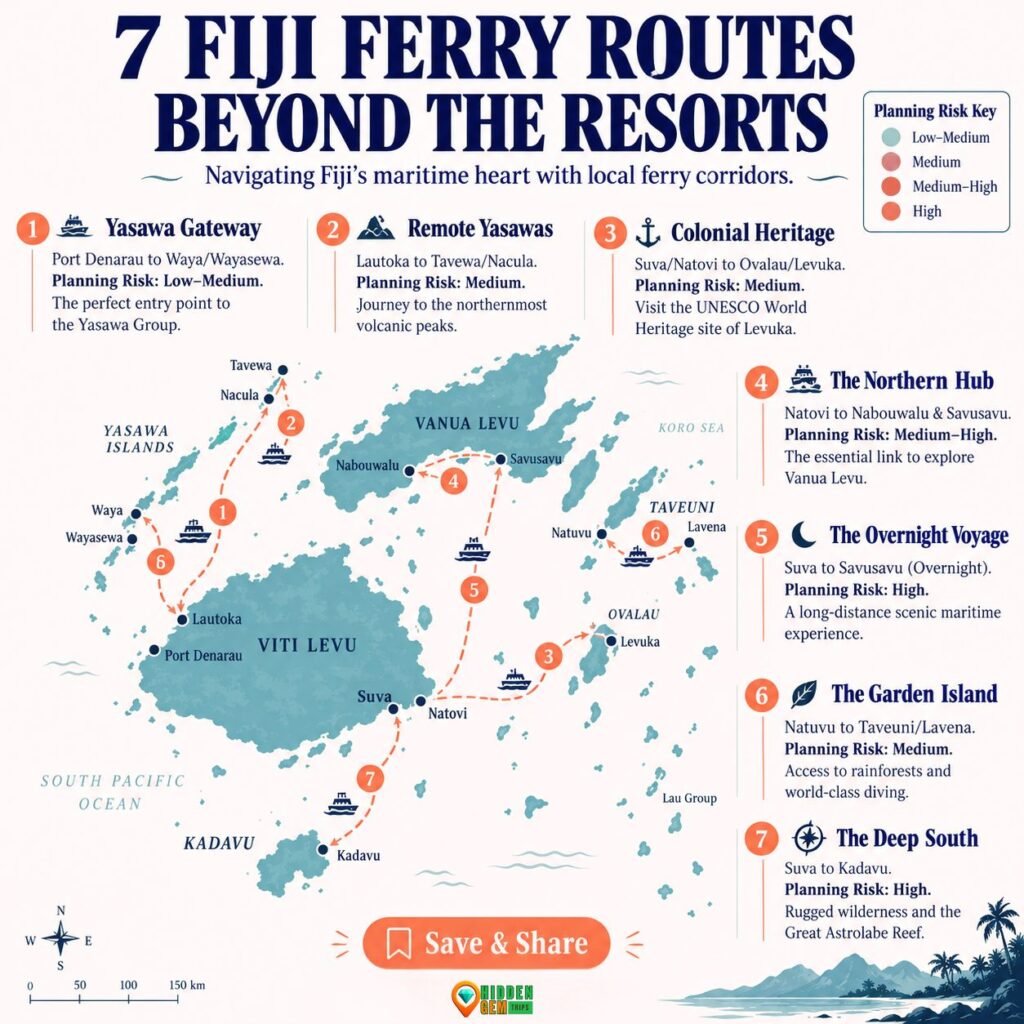
The simplest route is the daily Yasawa corridor from Port Denarau. The more revealing local-transport routes run through Natovi, Suva, Savusavu and Natuvu toward Ovalau, Vanua Levu, Taveuni and Kadavu. Tourism Fiji’s sea-transport overview separates the polished passenger ferries serving the Mamanuca and Yasawa islands from the local RoRo network used for Vanua Levu, Ovalau and Kadavu. That distinction is useful: the farther you move from the resort network, the more important schedule confirmation and local coordination become.
| Route | Sea gateway | Community anchor | Best for | Planning risk |
| 1. Denarau → Waya/Wayasewa | Port Denarau | Hosted Yasawa village experience | First-time island hoppers | Low–Medium |
| 2. Lautoka → Tavewa/Nacula | Lautoka Kings Jetty | Northern Yasawa homestay/community link | Budget-minded return visitors | Medium |
| 3. Suva/Natovi → Ovalau | Natovi / Levuka | Levuka + hosted Lovoni or Silana visit | History + culture | Medium |
| 4. Natovi → Nabouwalu → Savusavu | Natovi / Nabouwalu | Vuadomo and local-community tours | Daytime local transport | Medium |
| 5. Suva → Savusavu overnight | Walu Bay / Savusavu | Natewa/Savusavu community-led activities | Slow travelers | Medium–High |
| 6. Natuvu → Taveuni | Natuvu / Taveuni | Lavena village and Bouma landscape | Nature + community tourism | Medium |
| 7. Suva → Kadavu | Suva / Vunisea area | Hosted village/resort boat connections | Remote-island travelers | High |
Why Look at Fiji Beyond the Resort Transfer Map?
Fiji is not short of visitors. The Fiji Bureau of Statistics reported 99,963 visitor arrivals in August 2026, a record for that month, after the country reached 986,367 arrivals in 2025. High national demand does not mean every outer island has the same tourism capacity. It means route design matters more: visitors can either concentrate spending around the easiest hubs or spread time and money more thoughtfully through smaller transport corridors and community-led experiences.
The idea is not to leave resorts because they are “inauthentic” in some way. That argument quickly becomes lazy. The more pertinent question is whether a portion of the trip—public wharves, bus-ferry connections, local markets, a historic town, a village-managed trail, or a lengthy crossing where passengers include families, students, freight workers, and island residents—can demonstrate how Fiji operates outside of a private transfer bubble.
Additionally, this method makes the editorial distinction from “secret island” lists more obvious. Access restrictions and trade-offs, not only aesthetics, should be explained in a helpful hidden-gem guide. In Fiji, where a charming village is still a person’s home and a rough ferry station is still public infrastructure rather than a tourist attraction, the website’s more comprehensive guidance to discovering hidden locations without turning them into trophies is a suitable companion philosophy.
How Fiji Ferry Routes Work Beyond Resort Transfers
The seven routes listed below are not covered by a single national “Fiji ferry pass.” Port Denarau and, to a lesser degree, Lautoka serve as the hub of the western tourism network. Ovalau, Vanua Levu, Kadavu, and other maritime islands are connected to local RoRo and passenger services via Natovi and Suva. Some trips are ferry-only, while others involve buses, ferries, buses, or a host-arranged final longboat.
That is why a Fiji ferry itinerary should be built around corridors rather than exact minute-by-minute connections. A route can still be valid even when a vessel, departure time or operator changes. The practical question is: which gateway serves the island, what is the current sailing, where does it actually land, and who is responsible for the final community transfer? The site’s seven-day deep-trip planning rules are particularly useful here because they treat travel days as real days rather than invisible gaps between attractions.
Route 1 — Port Denarau to Waya and Wayasewa: The Easy Yasawa Entry
The Yasawa Flyer is the cleanest introduction to Fiji island hopping by scheduled passenger ferry. The current 2026–27 Yasawa timetable shows the vessel leaving Port Denarau in the morning, running north through the island chain, then returning south later in the day. Unlike a local RoRo, this is a tourism-oriented catamaran with organized resort transfers and tender pickups.
Use the boat as the main mode of transportation for a beyond-resort version of the journey, but select lodging or a local operator who specifically arranges a hosted village visit to Waya, Wayasewa, or another island in the chain. The difference is important. Many ferry “stops” are not public docks that provide unfettered access to neighboring settlements; rather, they are offshore transfer locations where a tiny tender picks up passengers.
Before tackling more difficult routes, it’s a good idea to practice slower island logistics here. Spend at least two nites in one place, find out if a visit to the village is part of the plan or not, and leave one half-day free. In the Yasawas, where the temptation to jump every day may turn a lovely chain into a luggage-management exercise, the Karimunjawa guide’s justification for purposefully allowing room in an island schedule applies well.
Best for: first-time Fiji visitors who want a dependable sea corridor but still want community context beyond a private-resort bubble.
Route 2 — Lautoka to Tavewa and Nacula: The Northern Yasawa Alternative
Lautoka offers a different gateway to the Yasawas. Tavewa Seabus currently advertises daily departures from Lautoka toward northern Yasawa islands and communities. This route can be useful for travelers staying around Nadi or Lautoka who prefer not to start at Port Denarau, and it can fit properties or homestays in the Tavewa, Nacula and Nanuya area.
The trade-off is that operational specifics, such as vessel information and route updates, have been more flexible in 2026. This does not render the route useless; rather, it increases the need of same-week confirmation. Check the destination name on the ticket, the boarding location, the operating vessel, and whether a smaller boat needs to meet the service offshore. After the return voyage, do not establish a same-day international flight connection.
Northern Yasawa stays also reward a lighter bag. Tender transfers, beach landings and small boats become annoying when luggage behaves like a mobile apartment. The site’s packing-light framework for remote expeditions is more relevant here than a glossy “what to wear in Fiji” list: fewer rigid bags, fewer loose electronics, and fewer things that cannot tolerate a splash.
Best for: budget-aware travelers and return visitors comfortable with reconfirming transport close to departure.
Route 3 — Suva to Ovalau: Levuka First, Then a Hosted Village Day
Ovalau is one of the best Fiji routes for travelers who want history before beach time. Ferries and bus–ferry services connect the Suva/Natovi corridor with Levuka or Buresala, depending on operator. Levuka itself is not a generic colonial stop: UNESCO lists Levuka Historical Port Town as Fiji’s World Heritage property, recognizing the unusual Pacific port landscape that grew through contact between Indigenous communities and European colonial institutions.
The smarter sequence is simple: make Levuka the first base, learn the island’s transport rhythm, then arrange any village visit through a known host or guide. Lovoni, in Ovalau’s volcanic interior, is often approached through guided local visits rather than as a place to wander into unannounced. Coastal communities such as Silana can also be part of locally arranged experiences. The goal is not to collect a “traditional village” photo; it is to understand how settlement, history, land and island transport connect.
Natovi serves as a reminder that transportation infrastructure is subject to change. After underwater risks were eliminated, the Maritime Safety Authority of Fiji put a temporary restriction on Natovi berthing in June 2026, which was later lifted. A research-based guide shouldn’t operate as though a duplicated ferry schedule is permanent because of that little incident.
For culture-first island travel elsewhere in the region, compare the route logic with the site’s Vanuatu outer-islands guide. The common lesson is that community schedules and transport conditions are part of the destination, not an inconvenience layered on top of it.
Best for: history-focused travelers who want a manageable outer-island crossing and are willing to arrange village access properly.
Route 4 — Natovi to Nabouwalu: A Daytime Road–Ferry Route to Vanua Levu
The Natovi–Nabouwalu corridor is one of Fiji’s most useful local ferry links because it combines a road journey from Suva, a daytime sea crossing, and onward road transport across Vanua Levu. The Savusavu Tourism Association’s ferry guide notes that the crossing is served by inter-island operators and that schedules should be checked close to travel. It is less glamorous than flying to Savusavu, but it makes the geography of the country legible: ferry, road, small towns, then the southern coast.
Vuadomo is a better communal anchor in Savusavu than a haphazard village stop. Before the brief trek, the waterfall path is usually prepared by local guides and incorporates village protocol. This establishes a clear economic tie, a host, and a purpose for the visit. It is a far more powerful approach than showing up with a camera and inquiring about the location of the “real village.”
This is where the site’s Wakatobi route beyond diving offers a useful parallel: islands become more interesting when markets, roads, villages and conservation systems are treated as part of the trip rather than as scenery between reef sessions.
Best for: travelers who prefer daylight sea crossings and want to see how local transport joins Fiji’s two largest islands.
Route 5 — Suva to Savusavu Overnight: A Slower Gateway to Community-Led North Fiji
The overnight Suva–Savusavu route is the alternative to the Natovi–Nabouwalu daytime chain. Current local tourism information describes overnight RoRo sailings between Suva and Savusavu on selected days, with the important warning that Fiji ferry timetables change. This route is not about efficiency. It is for travelers who would rather board once in Suva, sleep or rest on the vessel, and wake on Vanua Levu without a mid-journey bus transfer.
Savusavu then works as a base for community-led nature experiences around Vuadomo, the Salt Lake and the Natewa Peninsula. The useful test is not whether an activity looks “authentic” online, but who organizes it and where the fee goes. Community-run or community-linked tours create a clearer relationship than informal wandering into settlements.
The cost is also altered by overnight ferry travel. The headline ticket may not accurately include the cost of cabins or upgraded seating, terminal food, cabs at unusual hours, a buffer nite, and missed-connection risk. Instead of researching boat and aircraft prices separately, incorporate those factors into the website’s remote-trip budget checklist.
Best for: slow travelers who value the journey itself and can tolerate basic overnight transport.
Route 6 — Natuvu to Taveuni: Ferry Into a Community-Managed Landscape
Taveuni is often reached by air, but the local sea approach from Vanua Levu is more interesting if the trip already includes Savusavu. Tourism Fiji’s current Taveuni guidance describes a road transfer from Savusavu to Natuvu Jetty followed by a ferry across the Somosomo Strait. On arrival, the best “village route” is not an improvised visit but a community-managed nature experience.
The standout is Lavena. Tourism Fiji’s Lavena Coastal Walk guide places the trailhead in Lavena Village and explains the locally managed walk, boat options, fees, road conditions and practical limits. The route combines coastal forest, beaches, a waterfall destination and village-based tourism in a way that gives visitors a clear structure for participation.
Because of this, Taveuni is particularly helpful for tourists who wish to see nature without acting as though it is distinct from villages and landowners. Don’t regard the village as a free pre-hike attraction; instead, pay the local fees, ask permission before taking pictures of people or houses, and hire guides when instructed. The neighborhood is not the setting; the controlled path is the experience.
Because the road to Lavena can be rough and the island bus schedule is limited, pack for a real transport day. The site’s remote travel gear list for bad roads and rough transfers is a better preparation tool than packing extra “island outfits.”
Best for: hikers, conservation-minded travelers and anyone already moving through Savusavu who wants a community-managed Taveuni experience.
Route 7 — Suva to Kadavu: Overnight Ferry, Then Local Boat Connections
Kadavu is the highest-friction route in this guide and should be planned accordingly. Tourism Fiji’s national destination guide describes the ferry from Suva as an overnight journey of roughly seven to eight hours. Once on Kadavu, the road network is limited and many stays or community experiences require another boat connection from the Vunisea area or a pre-arranged pickup.
That final transfer is not a detail to solve after arrival. Confirm it before boarding the ferry. Ask who is meeting the vessel, where, what happens if the ferry is late, whether the transfer runs after dark, and how much luggage the small boat can safely carry. On islands like Kadavu, the “last mile” can be water.
This is also where trip design should become more conservative. Do not schedule Kadavu as a two-night stunt between fixed flights. Use the site’s two-base itinerary method and make Kadavu one of the main bases, not an accessory. A long stay gives weather, local boats, diving, birding and village-hosted activities room to breathe.
Best for: experienced island travelers with flexible dates, pre-arranged local transfers and no fear of a timetable that occasionally has opinions of its own.
Village Protocol: A Ferry Ticket Is Not Permission to Enter
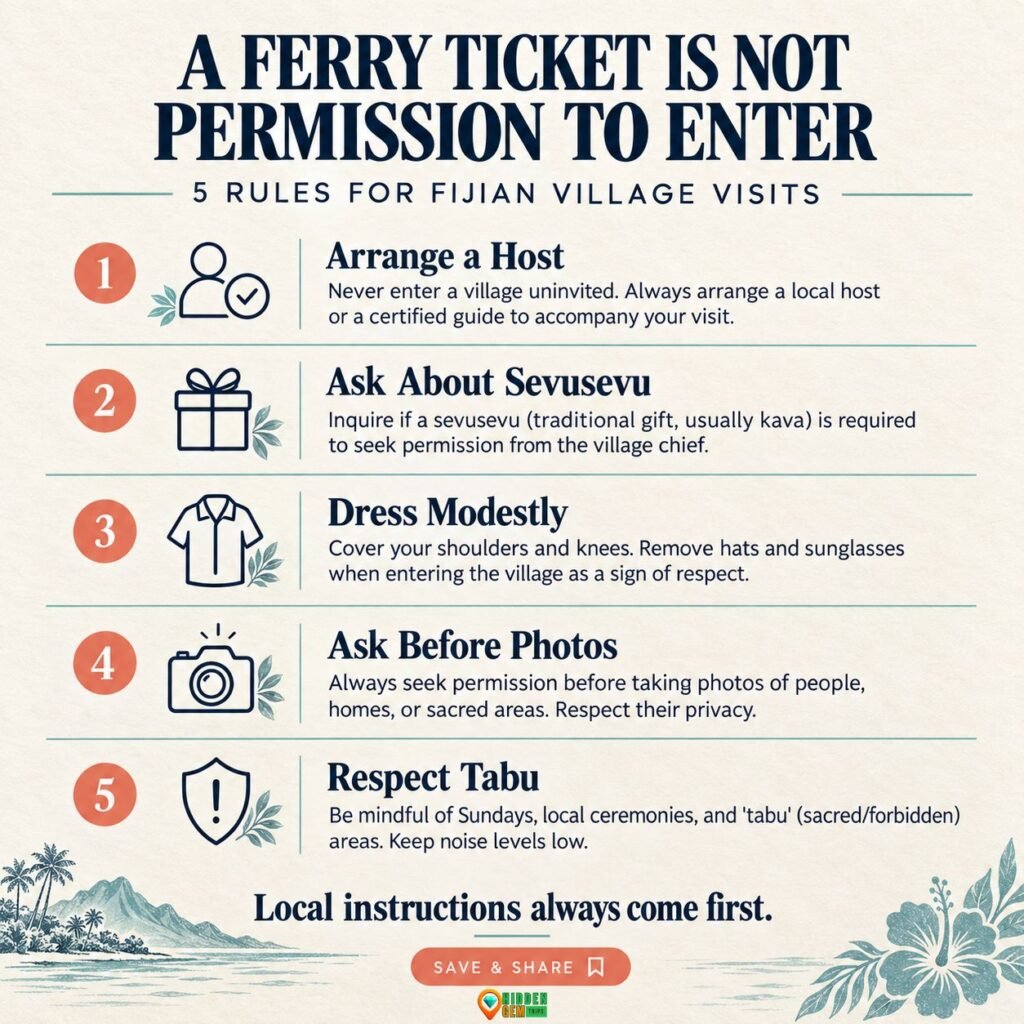
The communities of Fiji are distinct cultural landmarks. Local instructions are more important than any online checklist, because protocol differs. According to Tourism Fiji’s village etiquette guidelines, guests should follow a host or guide, dress modestly, take off hats and sunglasses, obtain permission before taking pictures, and, where appropriate, respect the role of sevusevu.
Use the site’s full respectful-travel checklist for village visits as the deeper framework. For Fiji specifically, five rules are enough to prevent most avoidable mistakes:
- Arrange the visit through a recognized host, guide, accommodation, tour operator or community contact.
- Ask whether sevusevu is required and let the host explain how it will be handled.
- Dress for the community, not for the beach. Carry a sulu if advised.
- Ask before photographing people, homes, ceremonies, children or community spaces.
- Treat Sunday, funerals, ceremonies and local tabu as schedule-changing realities, not customer-service failures.
This is the central distinction in the article: ferries create mobility; hosts create permission. Mixing those two ideas is how “independent travel” turns into accidental intrusion.
How to Create a Ferry Itinerary for Fiji That Can Handle Actual Delays
Make use of a two-base structure
Select two bases: one shallow and one deep. For instance, Savusavu + Taveuni, Viti Levu + Kadavu, or Yasawa + Ovalau. Seven routes don’t belong in a single seven-day vacation; they belong in a guide. A vacation that is culturally fascinating would become unpaid logistics management if all seven were connected.
Set aside money for friction in addition to airfare
Include transportation to the dock by taxi or bus, food during lengthy delays, baggage handling, an unplanned hotel stay, community fees, guide fees, and last-minute small-boat transfers. Only when the schedule assumes that nothing will ever move does a cheap ferry become costly.
Examine your coverage thoroughly before leaving if you would rather have a commercial safety net for large travel disruptions or international medical expenses. Travel insurance is an affiliate-ready alternative for longer or multi-country journeys; instead of presuming that “travel insurance” covers every ferry delay or activity, check the current policy wording, exclusions, destination coverage, and claim conditions.
Pack for wet transfers and basic terminals
Keep passports, electronics, medication and one dry layer together in a compact waterproof system. A small waterproof dry bag for ferry transfers can be more useful than another piece of hard luggage, especially where tenders or longboats meet a larger ferry offshore. For the broader packing logic, use the site’s island packing strategy and scale it down rather than adding gear “just in case.”
Check marine and weather information twice
First check the operator or accommodation that is responsible for your actual sailing. Then check the Maritime Safety Authority of Fiji marine notices for restrictions or infrastructure issues. Finally, check weather on the day. The Fiji Meteorological Service notes that the regional tropical-cyclone season normally runs from November to April, with out-of-season systems still possible. A new seasonal outlook should be checked when it is published for your travel period.
For important onward flights, a one-night buffer on the mainland is boring in exactly the way good travel insurance is boring: you appreciate it most when something goes wrong.
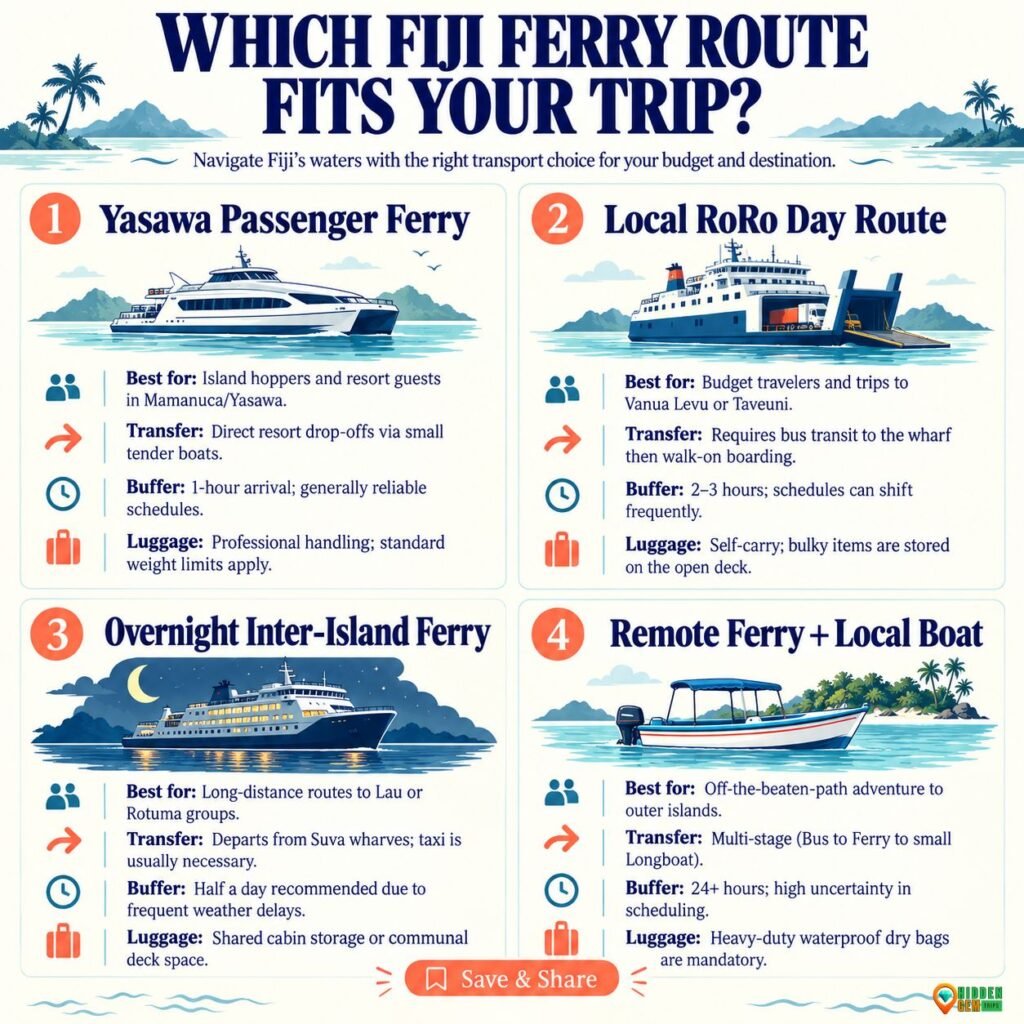
Which Route Fits Which Traveler?
| Traveler type | Best route | Why | Avoid if… |
| First Fiji trip beyond a resort | Denarau → Waya/Wayasewa | Most structured ferry logistics with room for hosted cultural context | You want zero transfer handling |
| Budget-conscious return visitor | Lautoka → northern Yasawas | Alternative gateway and simpler northern access | You dislike last-minute operational changes |
| History and culture traveler | Ovalau / Levuka | World Heritage context plus arranged village access | You only want beaches |
| Local-transport enthusiast | Natovi → Nabouwalu | Classic road–ferry–road corridor | You need a fast transfer |
| Slow-travel planner | Suva → Savusavu overnight | Journey becomes part of the trip | You sleep badly on basic vessels |
| Hiker / eco-tourism traveler | Natuvu → Taveuni → Lavena | Community-managed trail and landscape | You have only one spare day |
| Remote-island repeat visitor | Suva → Kadavu | High-friction route with strong payoff for long stays | Your schedule is rigid |
The Bottom Line
The most interesting Fiji ferry routes are not necessarily the ones with the prettiest boat or the most famous beach at the end. They are the routes that help travelers understand the country as an inhabited archipelago: a daily Yasawa catamaran, a Natovi RoRo, a bus climbing away from Nabouwalu, a night ferry into Savusavu, a short crossing toward Taveuni, or a long approach to Kadavu followed by one more local boat.
Avoiding the temptation to make those links into a race is part of good planning. Select two areas, confirm all local sails, leave a buffer, and allow village access to be set up by locals. You don’t necessarily need a better travel tip if a route begins to seem too difficult. The site’s remote-archipelago planning comments for the Mergui Islands continually emphasize that sometimes the destination is telling you to stay longer.
Frequently Asked Questions
1. Are ferry lines in Fiji dependable enough for a set schedule?
Although local inter-island services are subject to weather, maintenance, port conditions, and operator decisions, the main Yasawa passenger route is comparatively structured. Instead of scheduling fixed foreign flights around the arrival of an outer-island boat on the same day, schedule them around buffer nights.
2. Can travelers visit Fijian villages independently?
Do not assume so. Some community experiences are organized for visitors, while other villages expect a host, guide or local introduction. Ask in advance, follow local dress and photography rules, and let your host explain whether sevusevu is appropriate.
3. Which ferry route is easiest for a first trip beyond the resorts?
The Port Denarau–Yasawa corridor is the easiest starting point because the passenger-ferry system is designed for visitors and the transfer process is well established. Add a hosted village experience rather than trying to improvise one independently.
4. Is the Kadavu ferry suitable for all travelers?
No. The crossing is longer, overnight travel can be basic, and many onward connections require an arranged local boat. Travelers on tight schedules, with significant mobility constraints or little tolerance for disrupted plans may choose to fly and still arrange for local community experiences upon arrival.
5. When is the best time to schedule a ferry ride between islands in Fiji?
Although conditions vary by route and year, it is often easier to organize outdoor activities and sea trips during the drier months. Travelers should be extra cautious and keep an eye on official meteorological and maritime advisories throughout Fiji’s tropical-cyclone season, which typically lasts from November to April.
Disclaimer
This article is for general travel-planning information and was researched using sources available up to 29 September 2026. Ferry schedules, fares, vessel types, port conditions, road connections, village access rules, weather conditions and local fees can change without notice. Confirm transport directly with the current operator or accommodation, and follow local host, community, MSAF and Fiji Meteorological Service guidance. Village visits should be hosted or explicitly permitted. Some links may be affiliate links, which can earn HiddenGemTrips a commission at no additional cost to the reader; affiliate relationships do not change the editorial criteria used in this guide.