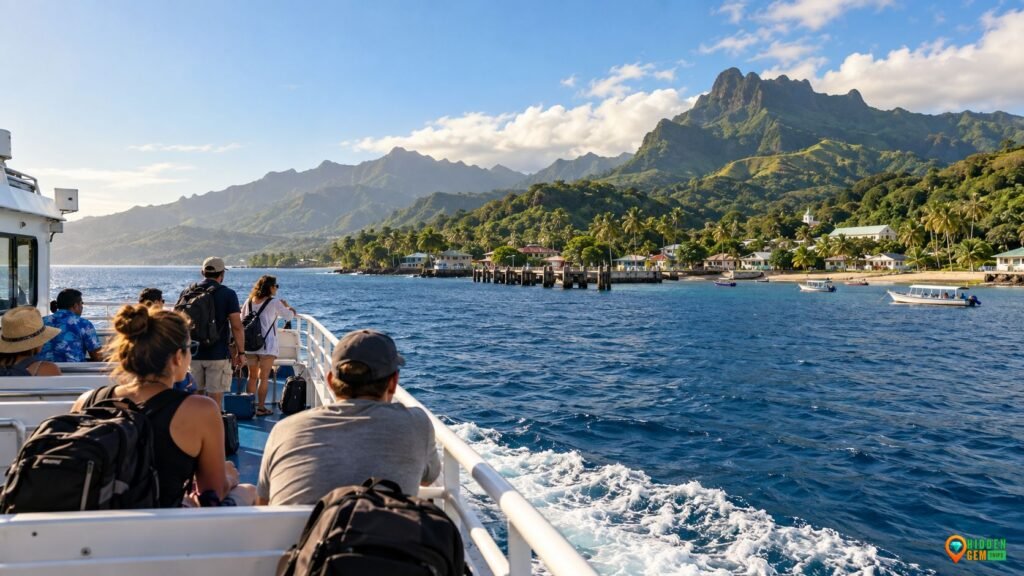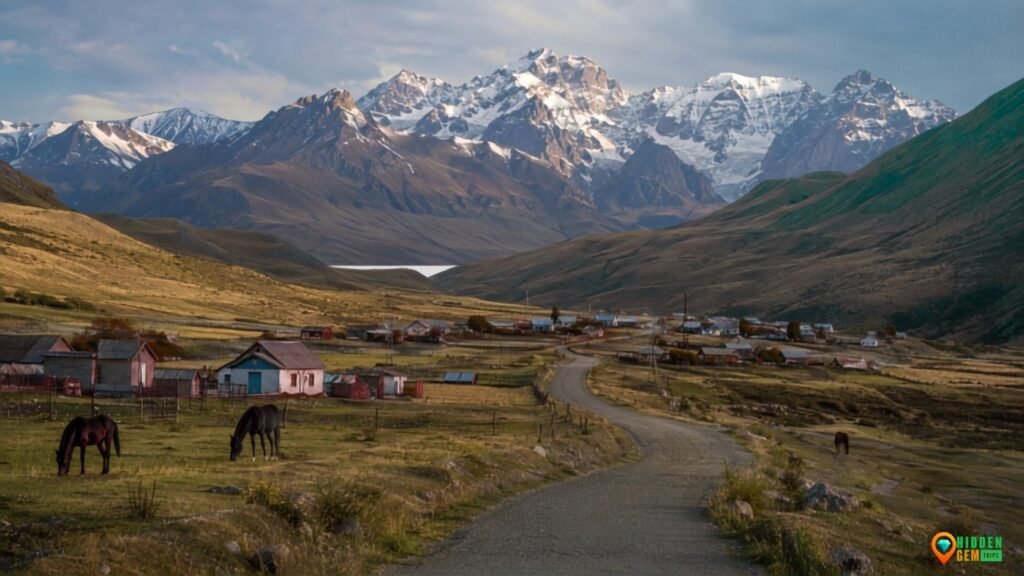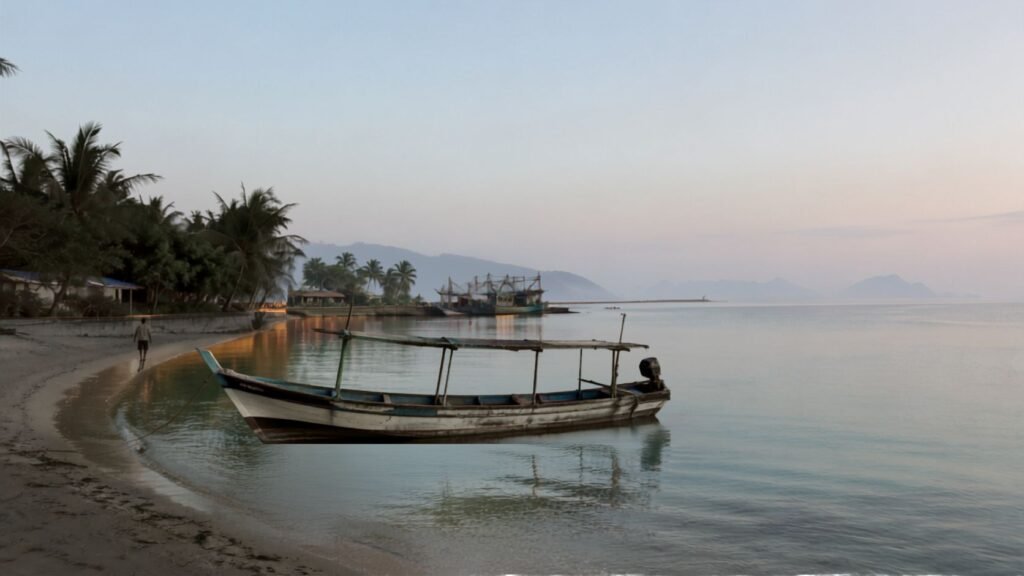

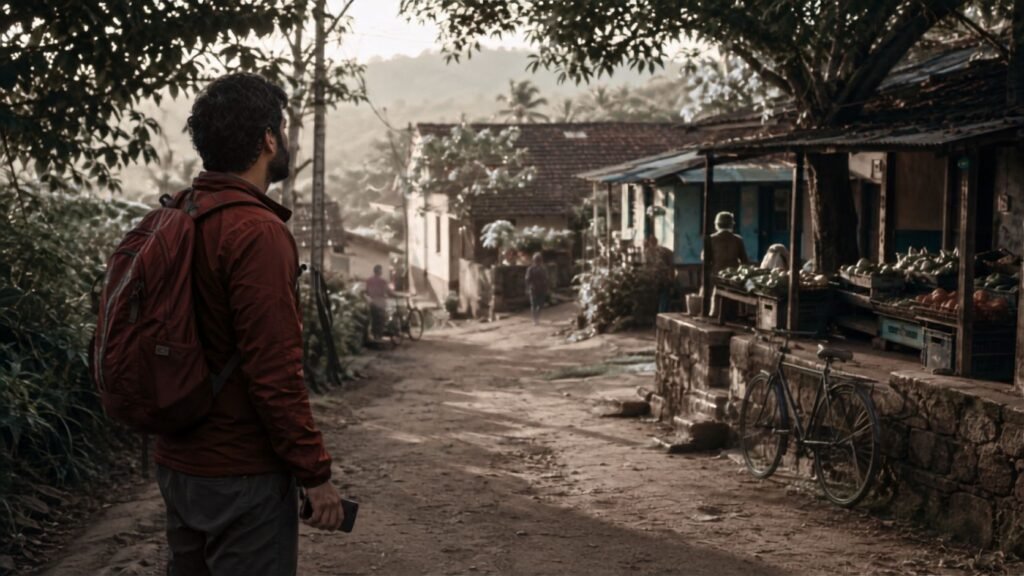
Affiliate disclosure: This article may contain affiliate links. If you buy or sign up through an eligible link, HiddenGemTrips may earn a commission at no extra cost to you. Recommendations should still be checked against current product terms and your own travel needs.
A respectful travel checklist sounds simple until you arrive somewhere that is not built around visitors. A village lane may also be a school route. A photogenic house may be someone’s kitchen. A market may be where families buy dinner, not a stage for street photography. A ceremony may be visible from the road without being open to outsiders. The difference between a memorable visit and an intrusive one often comes down to small choices made before the camera comes out.
That matters in 2026 because travel demand is not exactly taking a nap. UN Tourism reported an estimated 1.52 billion international tourist arrivals in 2025, up 4% from 2024, while international arrivals grew another 2% in the first quarter of 2026. At the same time, UN Tourism said in February 2026 that its Best Tourism Villages network brought together 319 rural destinations, including more than 230 recognized villages, reflecting a wider push to use tourism for rural development, cultural preservation, and community well-being. More travelers are looking beyond major hubs. That can distribute income more fairly — or distribute bad tourist behavior more widely.
HiddenGemTrips has always argued that a place being lesser-known does not automatically make it better for visitors. Before chasing another pin on the map, use our guide to checking whether a secret destination is actually ready for visitors. This article asks the companion question: are you ready to enter somebody else’s community without making yourself the main event?
The answer is not perfection. You will occasionally misunderstand a custom, stand in the wrong place, or pronounce something badly enough to create accidental comedy. Respectful travel is not about performing cultural anxiety. It is about reducing preventable friction: ask, observe, pay fairly, move lightly, accept no gracefully, and remember that access is a privilege rather than a souvenir included with your transport ticket.
Why Respectful Village Travel Matters More in 2026
Village tourism is often marketed with soft words: authentic, timeless, untouched, traditional, local. Some of those words can be useful. They can also turn living communities into scenery. A village can preserve traditional architecture and still have teenagers scrolling TikTok, families running online businesses, farmers using modern equipment, and residents who would rather not be photographed before breakfast. “Traditional” does not mean publicly available.
UN Tourism’s rural-tourism work explicitly links tourism with rural development, well-being, and resilience. Its Best Tourism Villages initiative recognizes places that preserve cultural and natural assets while using tourism as one driver of community well-being. That framing is important: the village is not there to service tourism; tourism is one activity that may or may not serve the village.
The same logic appears in the GSTC Destination Standard, which calls for sensitive treatment of intangible heritage and visitor experiences that involve and benefit local communities. In plain English: culture should not be stripped of context simply because a traveler wants a more dramatic reel.
This is where the shift from “hidden gem hunting” to mature travel becomes useful. A good hidden-gem traveler does not ask only, “Can I get there?” The better questions are: Who benefits if I go? What rules apply? What is private? What pressure am I adding? If the route is already fragile, our 2026 slow travel approach is often more valuable than adding three more stops to the day.
The Low-Friction Guest Test Before You Enter a Village
Before the nine rules, run a quick four-part check. Think of it as P4: Permission, Pressure, Privacy, and Payment. It takes less than a minute, and it catches many of the mistakes that a polished itinerary will not.
| P4 Question | Ask Yourself | Why It Matters |
| Permission | Do I know whether visitors are welcome here today, and whether this specific activity is allowed? | Access changes with ceremonies, funerals, harvests, weather, religious observances, community meetings, and local decisions. |
| Pressure | Will my vehicle, group size, drone, noise, waste, or schedule create extra work for residents? | A visit can be legal and still be disruptive. |
| Privacy | Am I treating homes, children, worship, grief, bathing areas, or daily work as public content? | Visibility is not consent. |
| Payment | Is some of the value of my visit staying with local guides, guesthouses, food vendors, craftspeople, or community projects? | “Budget travel” should not mean extracting the cheapest possible experience from people with less bargaining power. |
If two or more answers make you uncomfortable, change the plan. That might mean hiring a guide, parking farther away, skipping the drone, choosing a different day, or not entering at all. The point is not to win an ethics medal. The point is to become easier to host.

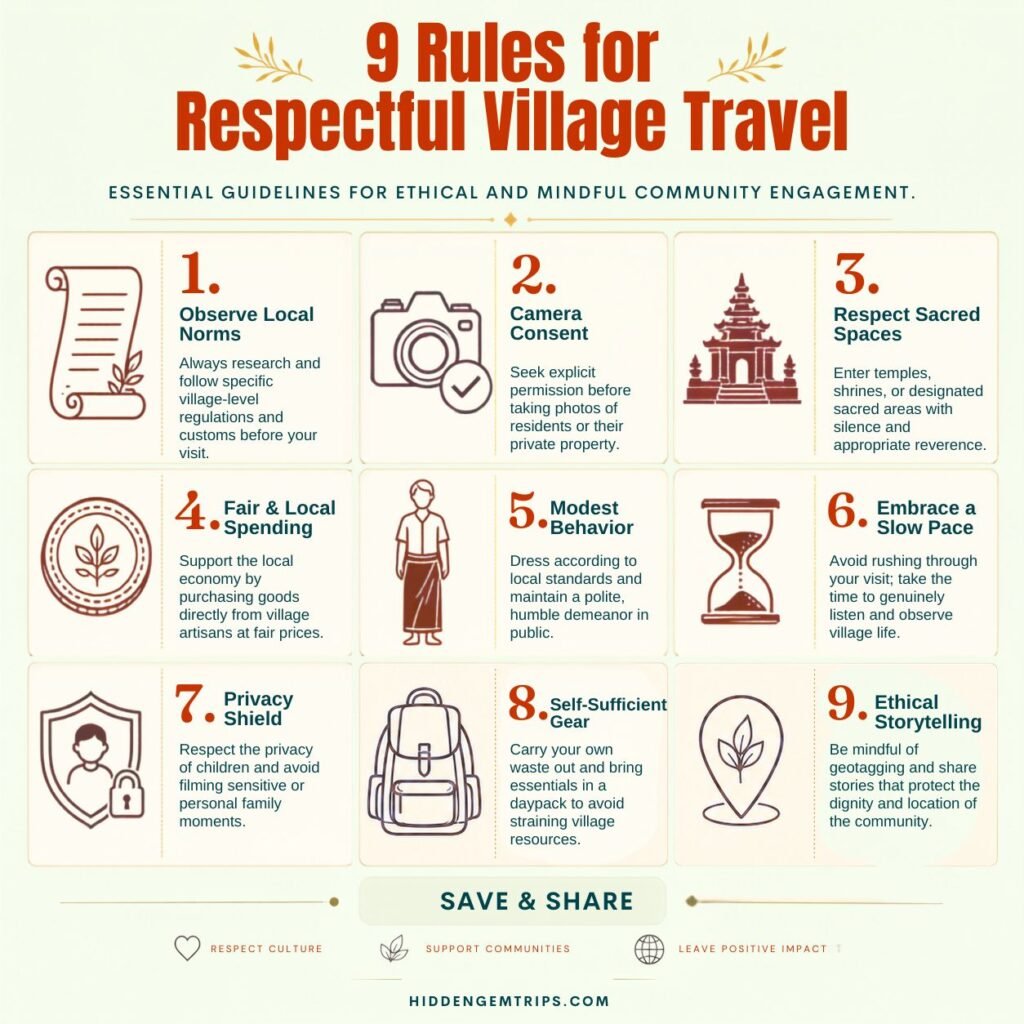
Respectful Travel Checklist: 9 Rules for Villages
Rule 1: Learn Who Sets the Rules Before You Arrive
Do not assume that a village has one universal rulebook. Depending on the place, guidance may come from village leaders, religious authorities, Indigenous or customary institutions, local government, park management, tourism cooperatives, landowners, guides, or individual families. Your job is not to decode the entire governance system. Your job is to find the person or source that can tell you what is appropriate for the activity you want to do.
Start with official destination information, your accommodation host, a licensed or community-recognized guide, or a local tourism office. This matters because rules can change. Bali, for example, has continued to formalize visitor behavior requirements, including respect for sacred sites, customs, dress, and conduct. A generic blog post written three years ago does not outrank a current rule on the ground.
If you are visiting a culturally complex region, use a destination guide for context before you arrive. Our Tana Toraja slow travel guide shows why a local guide is useful not only for navigation but also for understanding when ceremonies, burial areas, and family spaces are appropriate for visitors. The same habit applies far beyond Indonesia: verify first, then enter.
Rule 2: Ask Before Photographing People, Homes, or Daily Work
The most reliable village-photography rule is boring and therefore excellent: ask before taking close, identifiable photos of people. A smile, gesture toward the camera, or simple question often solves the issue. If the answer is no, the interaction is over. No disappointment face. No sneaky long-lens workaround. No “but I am documenting culture” speech.
Homes deserve the same care. An open doorway is not an invitation. Laundry, kitchens, family altars, yards, fishing gear, workshops, and farm activity can look visually rich to a visitor while remaining ordinary private life to the people who live there. In our Lake Toba village guide, consent is a core rule precisely because lakeside compounds and daily routines are easy to turn into content without realizing you have crossed a boundary.
Street scenes are more nuanced. Wide images of a public market or road may not require individual permission everywhere, but local rules still matter. Avoid isolating vulnerable people, humiliating situations, children, medical conditions, conflict, or grief. If your image gets its power from someone else being exposed, the photograph is probably costing more than you paid for it.
Rule 3: Treat Sacred, Ceremonial, and Grief Spaces as Conditional Access
Sacred does not mean secret, and visible does not mean open. Some ceremonies welcome visitors. Others allow visitors only in particular areas, at certain times, with specific clothing or contributions. Some places prohibit photography even when entry is allowed. Some knowledge is intentionally restricted.
UNESCO guidance on intangible cultural heritage makes this distinction explicit: awareness-raising and access should respect customary practices, including restrictions around secret and sacred aspects of heritage. UNESCO also describes living heritage as something that supports dialogue and mutual respect — which is a useful reminder that cultural practice belongs first to the people who carry it, not to the visitor who happens to witness it.
Never chase a funeral, healing ritual, initiation, prayer, or mourning event because it looks “authentic.” If a local guide or host says visitors are welcome, ask where to stand, what to wear, whether a contribution is expected, and when to put the camera away. If nobody can give a clear answer, uncertainty is your answer. Skip it. There are plenty of meaningful ways to understand a place without turning private emotion into sightseeing.
Rule 4: Spend Locally Without Turning Every Price Into a Contest
Bargaining can be normal in some markets and inappropriate in others. The respectful skill is not “never bargain”; it is knowing when bargaining is part of the transaction and when you are simply pushing a small business below a fair price because you enjoy winning. Ask your host or guide what is normal. Watch how locals transact. Keep perspective about the difference between saving a small amount and undercutting someone’s margin.
A useful village budget should include guide fees, small entrance charges, transport, meals, locally made products, and perhaps community contributions. Our remote trip budget guide is a good companion because remote travel often contains costs that do not appear on a city-break spreadsheet. If you can afford the flight but your plan depends on negotiating every local service into the floor, the route may be too expensive for your actual budget.
Where possible, choose locally rooted accommodation, eat in locally owned places, hire local guides, and buy products that are genuinely made or grown in the area. Do not demand staged “traditional” experiences if the community is offering something simpler. Money is not the only measure of respect, but it is one of the clearest ways tourism can move from observation to local benefit.
Rule 5: Match Your Dress, Voice, and Public Behavior to the Place
Clothing rules vary wildly, so the answer is not a global dress code. The rule is contextual modesty. If you are entering a church, mosque, temple, family compound, memorial, council space, or ceremony, ask what is expected. Carry a light layer or scarf rather than relying on “nobody said anything” as proof that an outfit is appropriate.
Volume matters too. Villages are not silent, and romantic travelers sometimes imagine rural life as a spa soundtrack. There may be roosters, motorbikes, music, construction, children, dogs, tractors, and loud conversations. The point is not that locals must be quiet. The point is that your portable speaker, drone, group shouting, or late-night drinking should not become somebody else’s problem.
The same awareness improves destination-specific travel. Our North Bali villages route moves through communities where religious life, farms, marine activity, and homestays overlap. Your behavior should change with the setting. Beach behavior does not automatically belong on a village road; hiking behavior does not automatically belong inside a sacred compound.
Rule 6: Slow Down Enough to Stop Creating Extra Work
Rushing creates surprisingly rude travel. Drivers get pressured to speed. Hosts get messages demanding early breakfast, late dinner, immediate laundry, and last-minute transport. Village lanes get blocked because a car must stop exactly where the traveler wants the photo. A ten-stop itinerary may look efficient on a map, but it transfers the stress to everyone who has to make it happen.
Use fewer bases and fewer daily stops. The Two-Base Itinerary Method is especially useful for rural regions because it reduces check-ins, luggage movement, vehicle time, and the temptation to treat every nearby village as a collectible. Stay long enough to learn the rhythm of a place instead of forcing the place to learn your schedule.
This is also why our Portugal inland villages guide works better as a series of local escapes than as a speed run through every stone village on the map. Slower travel is not automatically ethical, but it creates the time needed to notice whether you are blocking a doorway, interrupting work, or arriving at the wrong moment.
Rule 7: Protect Children and Private Lives From Content Extraction
Children are not free travel content. Even when a child is cheerful, curious, or asks to see your camera, you should be cautious about posting identifiable images publicly. A child cannot meaningfully evaluate the long-term consequences of being uploaded to a stranger’s account, especially when the post includes a precise location, school uniform, family home, or a story about poverty.
Do not hand out sweets, money, or gifts to children to create an interaction. That can distort local dynamics and encourage future begging. If you want to contribute, ask a trusted local organization, school administration, community group, guide, or host what is genuinely useful. The same principle applies to adults: avoid captions that turn people into symbols of simplicity, hardship, purity, or “a life untouched by modernity.” That language often says more about the traveler’s fantasy than the community’s reality.
When visiting communities along wildlife routes, the human story deserves its own dignity. Our Tanjung Puting guide beyond wildlife cruises makes this point clearly: villages are not side content attached to a headline attraction. They are places where people work, raise families, run businesses, and live regardless of whether a visitor arrives.
Rule 8: Carry Your Own Essentials, Waste Plan, and Safety Backup
One of the most respectful things you can do in a small community is reduce how much rescue your trip requires. Carry water appropriate for the local context, basic medication, sun and rain protection, cash where digital payments are unreliable, a charged phone or power bank, and a realistic plan for transport back out. Our remote travel gear guide and packing-light guide for remote expeditions can help you prepare without hauling a portable apartment.
Bring a small reusable bag for your own trash, especially in places without frequent waste collection. A compact packable tote or dry bag on Amazon can be more useful than another gadget if it helps you carry wrappers, wet clothing, or market purchases without creating extra plastic waste. Choose a product that suits your route rather than buying gear because an influencer called it essential.
For longer or remote trips, also decide what happens if you get sick, injured, delayed, or evacuated. SafetyWing’s Nomad Insurance information is one current option for travelers who want to compare travel-medical coverage, but read the policy, exclusions, destination limits, and eligibility carefully before buying. Insurance does not make risk disappear; it helps prevent a medical problem from becoming an improvised burden on a community with limited resources.
Rule 9: Leave Cleanly — Then Tell the Story Responsibly
Respect does not end when the vehicle leaves. Pay anything you owe. Return borrowed items. Do not leave unwanted clothes, broken gear, toiletries, or “donations” unless someone has asked for them. If you promised to send a photo, send it. If a guide helped you understand a place, credit them when appropriate and leave a review that describes their work accurately rather than turning them into a character in your adventure story.
Be careful with geotags. A well-managed tourism village may actively want visibility. A fragile sacred site, nesting area, private viewpoint, or informal swimming spot may not. Ask before publishing precise coordinates for places that were shared with you personally. The old internet rule — “if I found it, everyone deserves the pin” — is not a law of nature.
Finally, tell stories that leave people with more dignity than the stereotype you arrived with. Our Wakatobi local island guide deliberately looks beyond diving because islands are lived places, while the Guatemala Highlands guide balances markets, landscapes, and community life rather than treating culture as decoration. Your post-trip story should do the same.
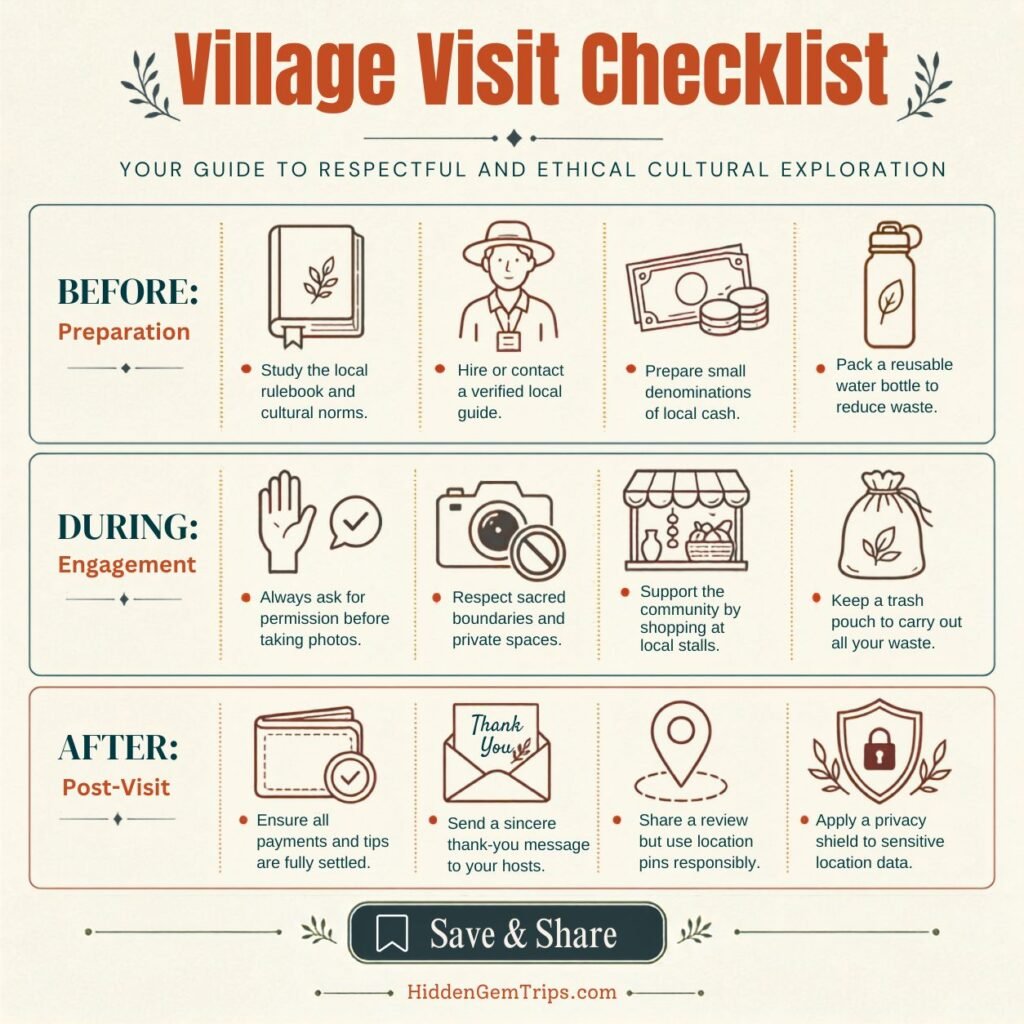
A 60-Second Village Visit Checklist
| Moment | What to Do |
| Before arrival | Check current local rules; ask whether visitors are welcome; learn basic greeting/thank-you; carry cash and essentials; choose a local guide if context is complex. |
| At the entrance | Park without blocking homes or work; reduce volume; observe clothing and behavior cues; ask where you may go. |
| Photos/content | Ask for close portraits; avoid children and grief; no drones without explicit permission; do not treat private homes as sets. |
| Money | Pay posted fees; bargain only where normal; buy local when it is genuinely useful; do not make underpayment a travel hack. |
| Sacred/cultural spaces | Follow local instructions; stay within permitted areas; dress appropriately; accept no photography or no entry without argument. |
| Waste/resources | Carry out your own trash where needed; avoid unnecessary single-use items; do not consume scarce water or services carelessly. |
| Departure | Settle payments; thank hosts/guides; keep sensitive locations private; write accurate reviews; share photos responsibly. |
When the Respectful Choice Is Not to Visit
Travel culture often treats cancellation as failure. In village travel, choosing not to enter can be the most competent decision you make. Skip or postpone the visit when local authorities or residents ask visitors to stay away, when a ceremony is private, when the community is dealing with disaster recovery, when roads or weather make your arrival risky for drivers and residents, or when there is no realistic way to manage your waste and basic needs.
Also reconsider a visit if your only reason for going is a viral image and you have no reliable information about access. “I saw it on Instagram” is not a permit. A destination can appear on Google Maps and still contain private land, sacred areas, dangerous tracks, seasonal closures, or a community that has become exhausted by unplanned visitors.
This is particularly important on remote islands and culturally sensitive routes. Our Vanuatu Outer Islands guide is built around culture and volcano stops, but remoteness changes the planning equation. Logistics, community access, weather, and safety all deserve more weight than the desire to complete a checklist.
A Stricter Standard for Creators, Photographers, and Drone Users
If you create content for a living, your impact can multiply after you leave. A traveler with 300 followers and a creator with 300,000 followers can stand in the same lane, but the second person may send a sudden wave of visitors toward that lane next month. That does not mean creators should hide every village. It means publishing carries responsibility.
Ask three extra questions before posting: Did the person consent to public posting, not merely to the photo? Does the caption reveal private or sensitive information? Could precise location data create pressure on a place that lacks toilets, parking, waste management, guides, or visitor rules? If the answer to the last question is yes, describe the region without dropping a hyper-specific pin.
Drone users need even more restraint. Legal airspace permission does not equal social permission. A drone can disturb ceremonies, livestock, wildlife, schools, homes, and ordinary conversation long before it violates aviation law. Ask both the relevant authority and the people affected on the ground. If the value of the shot depends on surprising people from above, keep the drone in the bag.
How to Choose Guides and Experiences That Keep Value Local
A local guide is most useful when they do more than repeat facts. Look for someone who can explain current etiquette, introduce you only where visitors are welcome, clarify photography rules, and tell you when the better decision is to skip something. Community tourism cooperatives, locally owned guesthouses, village associations, and regional tourism offices can be good starting points.
Ask who owns the experience and where the money goes, but do not turn every conversation into an audit. A small operator may partner with an external booking platform and still keep substantial value local. What you want to avoid is a product that uses a village name, costumes, or cultural performance while the community has little control over the story or revenue.
For a broader planning mindset, our Hidden Gem Travel Guide is useful because it focuses on finding less obvious places without treating obscurity as proof of quality. The best village experience is not always the least-known one. It is the one with clear access, local agency, fair value, and enough infrastructure to host you without turning your curiosity into someone else’s unpaid labor.
Common Village Travel Mistakes That Good Intentions Do Not Excuse
| Common Excuse | Better Standard |
| “I only took one photo.” | One intrusive image is still intrusive. Ask when the person or situation is identifiable or sensitive. |
| “They did not tell me to stop.” | Silence can reflect language barriers, politeness, age, power differences, or simple discomfort. Look for positive permission, not just absence of confrontation. |
| “I am helping by posting this place.” | Visibility can help businesses, but it can also create crowding. Ask whether the place actually wants more exposure. |
| “I paid, so I can film.” | Payment buys the agreed service, not unlimited rights to private people, sacred knowledge, or every room in a family property. |
| “Everyone bargains here.” | Maybe. Learn the local norm instead of using bargaining as sport. |
| “It is public land.” | Legal access can still overlap with sacred, customary, ecological, or socially sensitive use. Follow the most relevant current rule, not the most convenient interpretation. |
Conclusion: The Best Village Visits Feel Smaller Than Your Ego
A respectful travel checklist is not a guarantee that you will never make a mistake. It is a way to arrive with better defaults. Learn the rules. Ask before photographing. Treat sacred and private spaces as conditional. Spend money where it can benefit local people. Match your behavior to the setting. Slow the itinerary down. Protect children and private lives from content extraction. Carry enough of your own needs. Leave without dropping waste, unpaid bills, or a careless geotag behind.
The reward is not moral superiority. The reward is a better trip. Once you stop trying to make every village perform for you, you notice more: the timing of a market, the reason a lane goes quiet, the way a guide changes their voice near a sacred place, the difference between a shop made for visitors and a workshop that actually serves the community. Respect increases detail.
So use these nine rules as a baseline, not a passport to certainty. Every village has its own pace, boundaries, humor, politics, faith, privacy, and idea of hospitality. The best traveler is not the one who arrives knowing everything. It is the one who can learn quickly without demanding that everybody else absorb the cost of the lesson.
FAQ
1. What is a respectful travel checklist?
It’s a real set of behaviours that helps travellers reduce disruption in local communities. The essentials for visiting villages are to check current rules, ask for permission, respect private and sacred space, pay fairly, manage waste and publish responsibly.
2. Do I always have to ask before I take a photo of people in a village?
Yes, especially if it involves close-up or identifiable portraits. Children, ceremonies, private homes, grief, workspaces or settings where there is cultural sensitivity. Broad public scenes can be more contextual. But local rules and social cues still matter.
3. Is it rude to haggle in the village markets?
Not automatically. Bargaining is normal in some markets and unwelcome in others. Ask a local host or guide what is customary, and avoid treating a small price difference as a victory when it meaningfully affects a local seller.
4. Are tourists allowed to attend village ceremonies or enter sacred places?
Sometimes, but it’s conditional access. Follow the local guidance as it is at present, use a trusted guide where appropriate, respect the rules around clothing and photography and accept that some ceremonies, knowledge or places will not be for visitors.
5. What is the most important rule for respectful village travel?
Treat access as permission, not entitlement. If you are unsure whether you may enter, photograph, film, fly a drone, or share a precise location, ask. If the answer is unclear or no, choose the lower-impact option.
Disclaimer
This article provides general travel-etiquette and planning information, not legal, cultural, medical, insurance, or safety advice. Village rules, access conditions, religious customs, photography restrictions, fees, transport, and insurance terms can change. Always verify current requirements with relevant local authorities, community representatives, official destination sources, guides, and policy documents before traveling or publishing content. Affiliate recommendations do not change this standard.