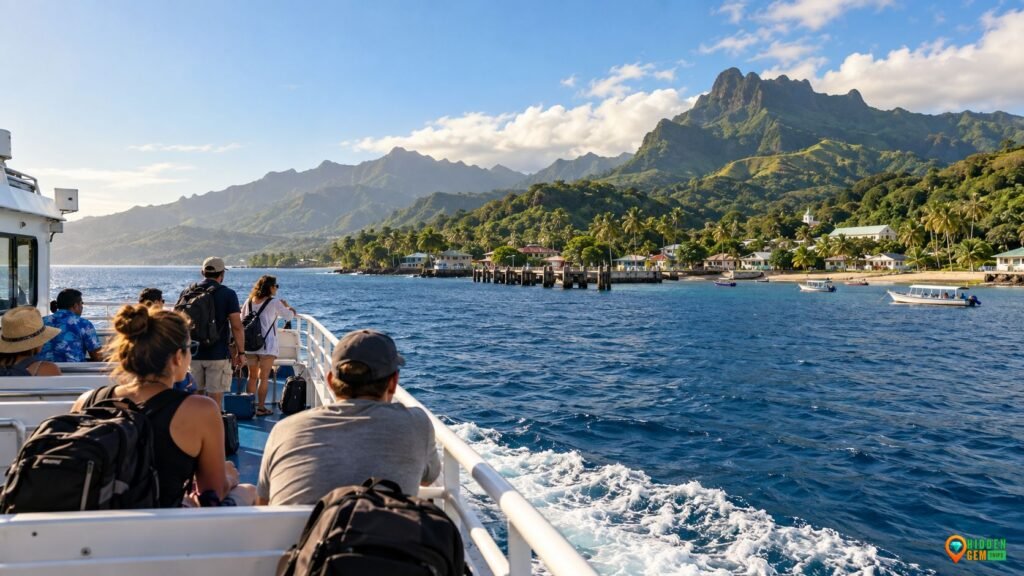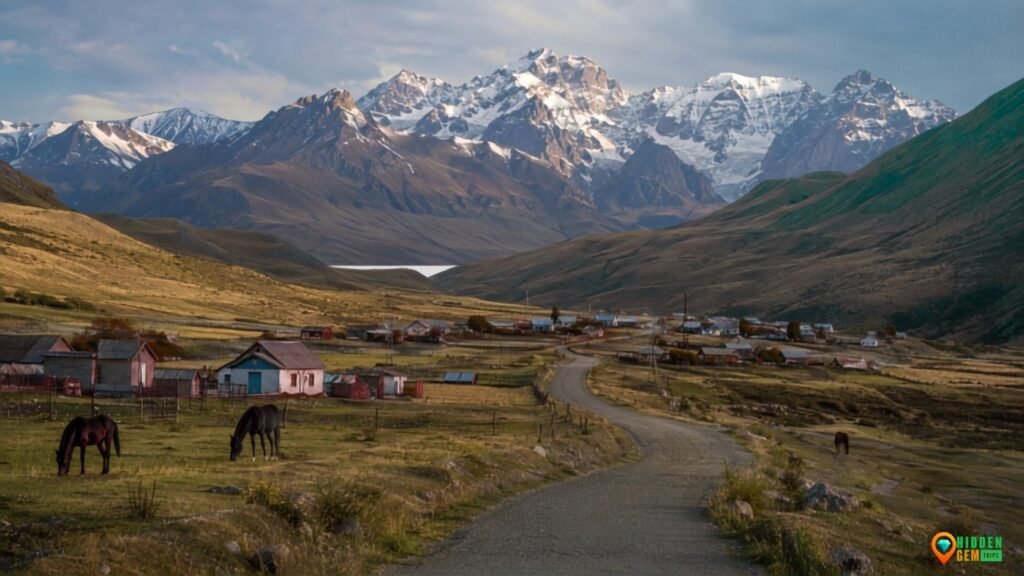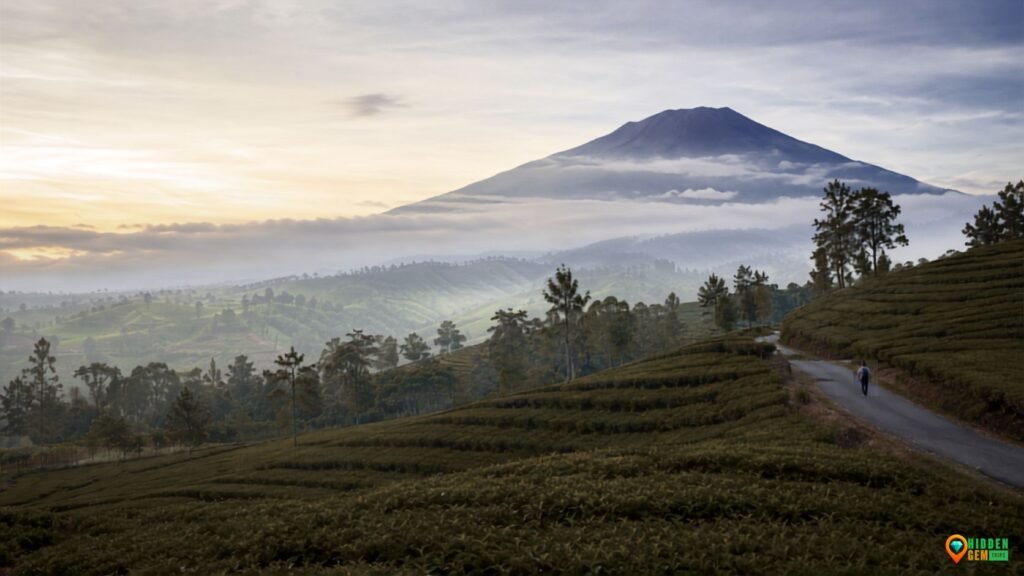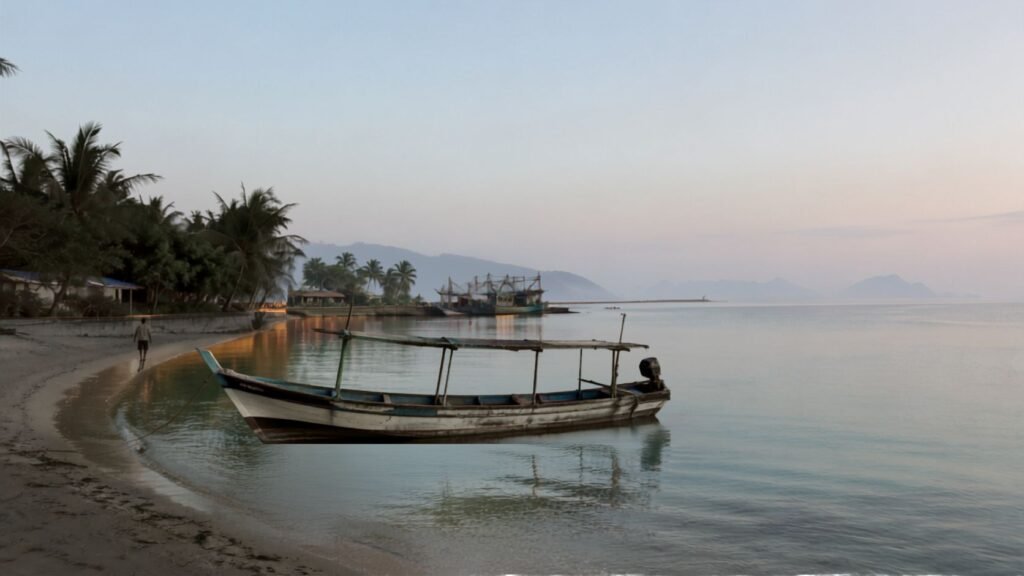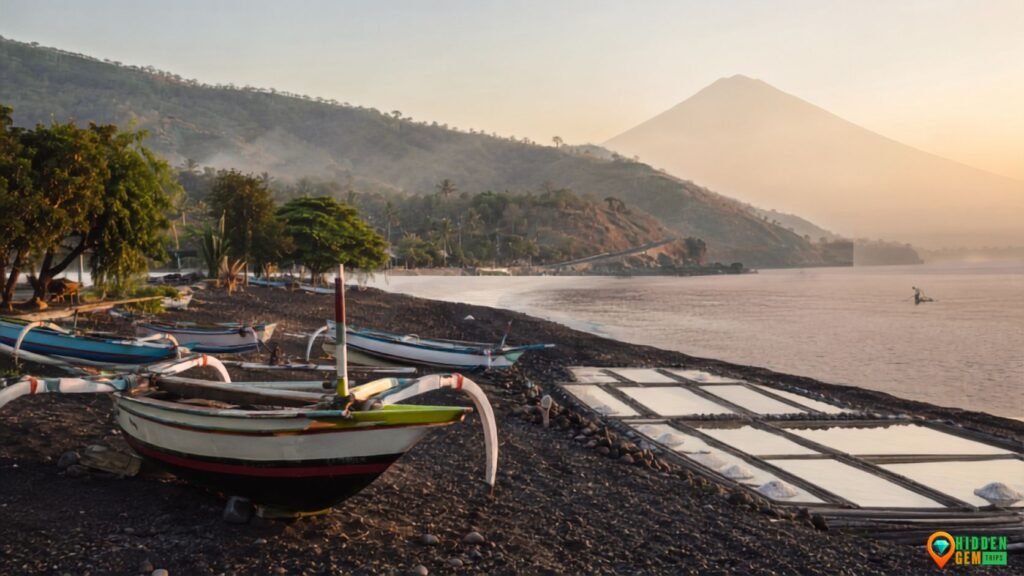

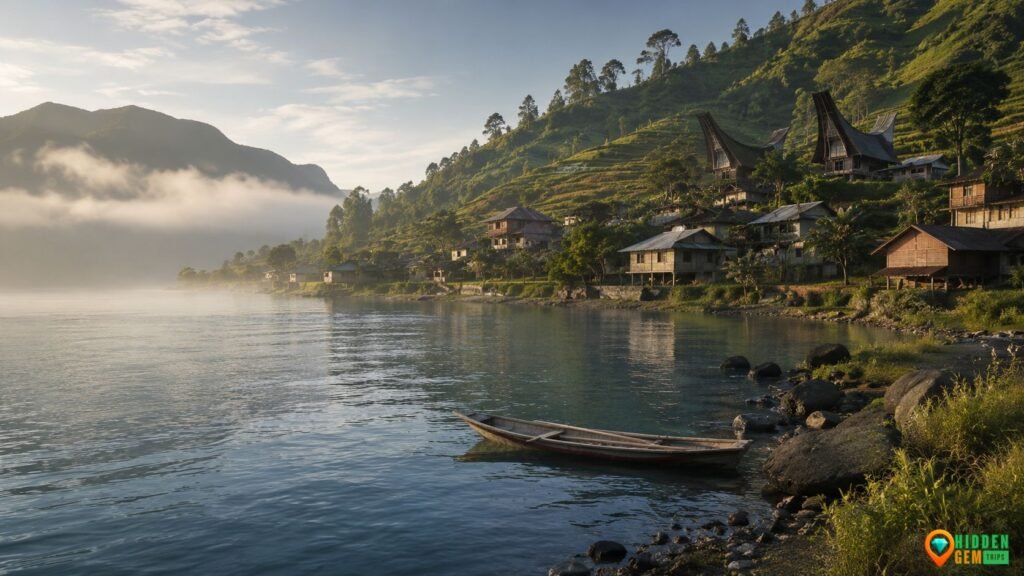
Most Lake Toba itineraries behave as if the lake has only one story: land in Medan, drive to Parapat, cross to Samosir, sleep around Tuk Tuk, take a few photos of Batak houses, then hurry back. That route is not wrong. It is simply too small for a caldera this large, this layered, and this lived-in. The better way to understand Lake Toba villages is to move around the edges, not just toward the famous island in the middle.
This guide focuses on seven local stops beyond the usual Samosir loop: Lumban Bulbul and Balige, Meat, Tipang and Bakkara Valley, Muara and Sibandang, Silalahi and Paropo, Tongging, and Haranggaol. They are not presented as untouched secrets. Please retire that word; it usually means someone did not bother to learn who lives there. These are working lakeside communities, agricultural slopes, fishing shores, viewpoint villages, coffee areas, market towns, and quiet roads where travel can feel more grounded than the standard postcard circuit.
The geological context is massive. The UNESCO Toba Caldera profile describes Lake Toba as the world’s largest volcanic crater lake, spanning about 1,100 square kilometers, with a surface around 904 meters above sea level and a maximum depth of about 505 meters. The same profile also emphasizes the Batak Toba cultural landscape, including traditional wooden houses, gorga carvings, ulos textiles, and communities shaped by generations of living with the lake. In plain traveler language: this is not just a viewpoint. It is a whole highland water world.
There is also a practical reason to look beyond Samosir. Tourism pressure tends to gather where routes are easiest and photos are most familiar. A more distributed Lake Toba trip can support small operators, food stalls, homestays, guides, drivers, boatmen, coffee producers, and village-level tourism groups outside the most obvious corridor. The BPS Sumatera Utara tourism update reported 163.72 thousand foreign tourist arrivals to North Sumatra from January to July 2025, up 15.31 percent from the same period in 2024. That does not mean every Lake Toba village is suddenly crowded. It means the region needs smarter pacing before easy places absorb all the attention and quieter places receive only drive-by visitors.
Use this article with the mindset from our hidden-gem research framework: the best places are not the ones with the fewest visitors; they are the ones where your visit can be understood, absorbed, and returned as value. Lake Toba rewards exactly that style. Go slower. Spend locally. Ask before photographing people. Respect sacred sites. Do not treat a fish-farming village like a scenery prop. And for the love of decent travel, do not build a six-stop day just because the map looks cute. Lake Toba roads can humble even the most confident itinerary spreadsheet.
Why Lake Toba Villages Beyond Samosir Deserve Their Own Route
Samosir is central for a reason. It carries cultural sites, accommodation, ferry routes, lake views, and many of the images travelers already associate with Toba. But centering every trip on Samosir alone can flatten the lake into a single tourism zone. The wider caldera is more interesting. Each shore has a different texture: Balige feels civic and cultural, Meat feels agricultural and quiet, Bakkara feels like a valley held between history and water, Silalahi feels broad and open, Tongging feels dramatic and vertical, and Haranggaol feels like a reminder that lake beauty and lake livelihood are often the same conversation.
The deeper reason to explore Lake Toba villages is that villages explain the lake better than viewpoints do. A viewpoint says, “Look how beautiful this is.” A village says, “Here is how people live with beauty, weather, roads, fish, ceremonies, markets, school schedules, church bells, harvests, waste, water, and visitors who may or may not understand what they are seeing.” That second sentence is less viral. It is also more honest.
The route also fits HiddenGemTrips’ broader editorial philosophy. We have used the slow travel manifesto to argue that slower trips are not less ambitious; they are more observant. We have used the secret-destination readiness checklist to ask whether a place can host travelers without being damaged by them. Lake Toba sits right at that intersection: famous enough to be accessible, but wide enough that many villages still receive visitors unevenly.
This is not a guide to escaping people. It is a guide to escaping lazy patterns. If you want silence, you can find it early in the morning along a shore road. If you want culture, you can find it in architecture, textiles, language, food, music, and family compounds. If you want scenery, the caldera will casually flex on you all day. But if you want understanding, you have to move with patience. That is the whole game.
Lake Toba Villages Snapshot: 7 Local Stops Beyond Samosir
The seven stops below are designed as a route concept, not a ranking. You can combine three or four into a focused trip, or use all seven as a deeper circuit with buffer time. The most important advice: do not force every stop into one rushed lap. Lake Toba is not a theme park loop. It is a highland region with real roads, real weather, and real communities.
| Stop | Best for | Suggested base/time | Responsible travel note |
| Lumban Bulbul + Balige | Soft landing, lakeside food, cultural orientation | Base in Balige; half day to 1 day | Use local stalls and avoid treating beach life as a private photo set. |
| Meat Village | Quiet fields, geosite texture, south-shore calm | From Balige; half day | Move slowly, ask before photographing people or homes. |
| Tipang + Bakkara Valley | Waterfalls, coffee roads, valley scenery | Full day with early start | Use safe pull-offs and respect narrow village roads. |
| Muara + Sibandang | Small island rhythm without Samosir crowds | Day trip or slow overnight if logistics work | Confirm boats locally and keep expectations flexible. |
| Silalahi + Paropo | Open water, boat rides, camping/lakeside mood | Long scenic stop or overnight | Pack out trash and avoid loud campsite behavior. |
| Tongging | Sipiso-Piso views, dramatic northern caldera | Half day to 1 day | Do not reduce it to a quick waterfall selfie stop. |
| Haranggaol | Fish-farming shore, honest livelihood context | Half day, usually with a driver | Observe aquaculture respectfully and avoid adding waste pressure. |
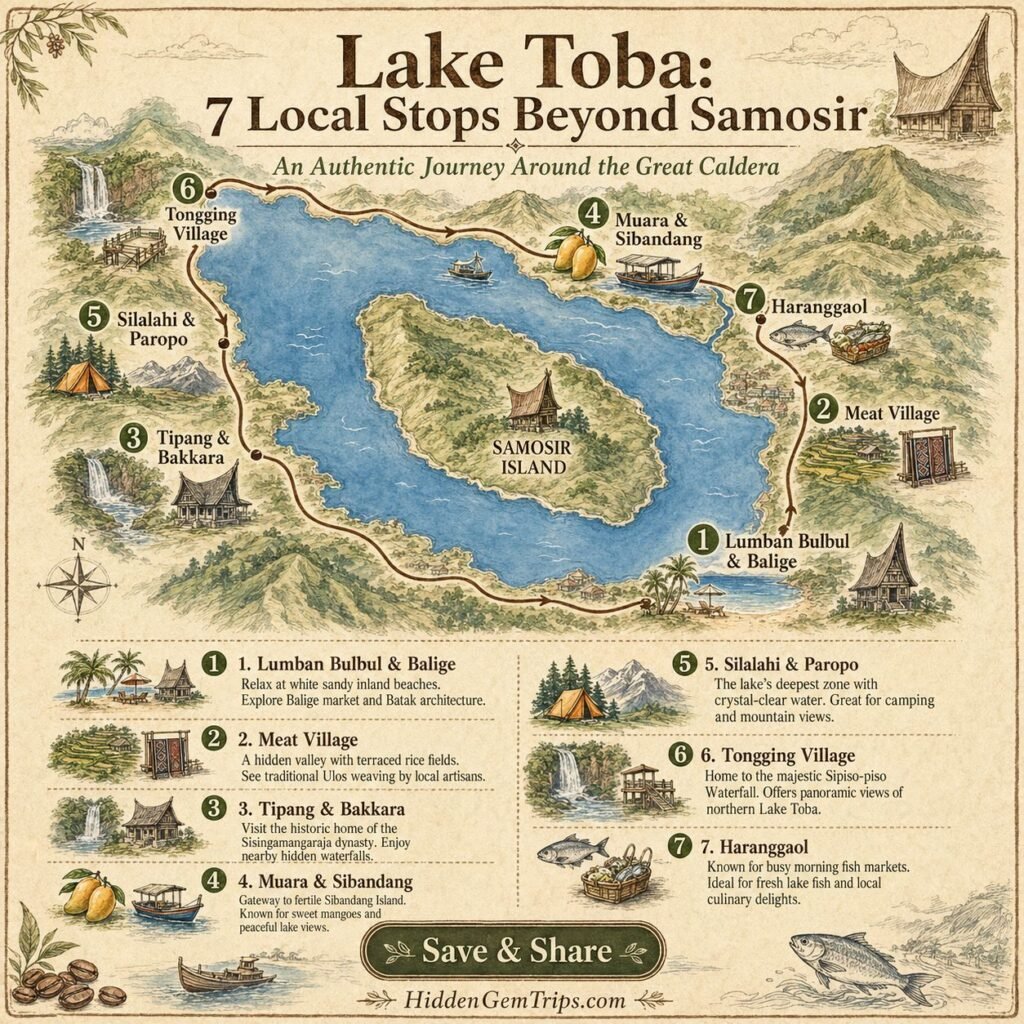
If you usually plan with city-style timing, adjust your expectations. Distances around Lake Toba can look modest and still take longer than expected because of winding roads, viewpoints, local traffic, landslide-prone sections in wet weather, and the understandable human weakness of stopping every time the lake looks cinematic. Our seven-day deep-trip rules are useful here: choose fewer bases, build in unstructured mornings, and leave one open slot for the place that surprises you.
1. Lumban Bulbul and Balige: The Soft Landing for Lake Toba Villages
Balige is often treated as a transit town, but it may be the best soft landing for travelers who want Lake Toba villages beyond Samosir without jumping immediately into remote-road mode. It has lake access, markets, local food, cultural references, accommodation, and a more grounded daily rhythm than the most tourism-focused pockets. Nearby Lumban Bulbul adds the lakeside mood: sand, swimming, families, small stalls, and a view that makes you understand why local weekends matter as much as foreign itineraries.
The official Indonesia Travel story on Lumban Bulbul highlights the village’s role in welcoming visitors during an international F1 Powerboat event, while the BulBul Balige destination page frames the shoreline as a lakeside recreation spot with Batak culinary and cultural atmosphere. For travelers, the useful takeaway is not “go because an event happened.” It is that this shoreline already has a visitor-facing layer, which makes it a sensible first stop before moving into quieter villages.
Balige also helps you place Batak culture in a wider context. The Batak Museum and TB Silalahi Center are often mentioned by official tourism materials as cultural anchors near the south shore of Lake Toba. Even if you are not a museum person, this is where you can slow down and remind yourself that the houses, textiles, carvings, and rituals you may see around the lake are not decorative background. They belong to systems of family, clan, history, migration, belief, and status. Translation: do not treat culture like wallpaper.
How to experience Lumban Bulbul without turning it into a checklist
Spend a morning or late afternoon rather than a rushed thirty minutes. Walk the lakeside slowly. Eat locally. Watch how domestic visitors use the beach. Notice where swimming areas feel appropriate and where the shore is more residential or working space. Ask before flying a drone, and honestly, unless you have a clear purpose and permission, leave the buzzing mosquito-camera in your bag. The lake already has enough mood.
This stop is useful for families and first-time Lake Toba visitors because it offers a gentle blend of scenery, food, and access. It is also a good place to practice a responsible habit that will matter throughout the trip: spend money in small ways. Buy coffee. Buy grilled fish if you eat fish. Pay for parking without drama. Choose locally run accommodation when quality and safety make sense. A hidden-gem trip is not only about where you go; it is about where your money lands.
2. Meat Village: Quiet Fields, Geosite Texture, and the Anti-Postcard Mood
Meat is the kind of place that makes impatient travelers confused and observant travelers happy. It is not built around one giant attraction screaming for attention. Its strength is the combination of lake edge, fields, village roads, geosite context, and a quiet agricultural rhythm. If Lumban Bulbul is a soft landing, Meat is the first reminder that Lake Toba villages are not all trying to entertain you. Some simply let you arrive if you have the manners to arrive properly.
The official Balige-Meat geosite note describes the Balige-Liang Sipege-Batu Basiha-Meat area as part of the southern Toba Caldera zone, shaped by post-supervolcanic processes, pyroclastic deposits, normal faults, erosion, and caldera morphology. That sounds academic because it is. But on the ground, it means the scenery is not random prettiness. The slopes, rocks, caves, fields, and waterline are part of a geological story that began long before tourism discovered the word “authentic.”
Meat works best as a half-day or slow-day stop from Balige. The goal is not to collect photos and leave. The goal is to understand how the south shore shifts from town to village, from market to field, from managed recreation to quieter lake life. Bring patience, modest clothing, cash, and low volume. If you are lucky enough to meet local people willing to talk, listen more than you perform. Not every conversation needs to become content. Painful truth for creators, but we survive.
What makes Meat different from the standard Lake Toba stop
Most standard Toba stops are visual: waterfall, viewpoint, traditional house, ferry, lake panorama. Meat is more textural. The value is in the layers: agriculture, geology, shoreline, village layout, everyday pace, and the feeling of being near the lake without being inside a tourism machine. It pairs well with Balige because the contrast is obvious. Balige gives structure. Meat gives breath.
For readers who liked our Sumatra quiet-valley comparison, Meat carries a similar lesson in miniature. A quiet place does not need to be empty to be valuable. It needs enough room for you to notice details. A field path, a church tower, an old wall, a family compound, a boat pulled close to shore: these are not filler scenes. They are the trip when you stop chasing only the dramatic frame.
3. Tipang and Bakkara Valley: Waterfalls, Coffee Roads, and Deep Caldera Memory
Tipang and the wider Bakkara Valley are where the Lake Toba villages route begins to feel more like a landscape story. The valley has a different emotional weight from the easy shoreline stops. Roads bend through highland farms. Waterfalls cut into the terrain. Villages sit between cultivated land and caldera walls. The lake is present, but not always in the obvious beach-photo way. It appears as space, light, and orientation.
Indonesia Travel’s Tipang and Binanga Janji reference mentions Binanga Janji Waterfall near Tipang and highlights Lintong coffee from the southern Lake Toba area. That combination matters: this stop is not only about looking at water falling off a cliff. It is about understanding a highland route where farms, coffee, village roads, and caldera hydrology overlap. The best Lake Toba days are rarely one-note.
Tipang also fits travelers who prefer a more exploratory drive. You need to be comfortable with slower roads and flexible timing. The views can be spectacular, but the route deserves more respect than a quick detour squeezed between two major transfers. If rain is heavy, check local advice. If your driver says a section will take longer than Google suggests, believe the human who has actually driven the road. Algorithms have confidence; locals have memory. Choose memory.
How to build a responsible Tipang and Bakkara stop
Start early, carry water, and avoid turning every narrow roadside into an improvised photo studio. Use existing pull-offs. Do not block village traffic for the main-character shot. If you visit a waterfall, keep to the path, take trash out, and be careful around slippery stone. If you buy coffee or snacks, choose small vendors when possible. This is the kind of stop where modest spending can spread more value than a single expensive attraction ticket.
Tipang and Bakkara also make the article’s “beyond Samosir” promise real. You are not rejecting Samosir; you are widening the frame. Think of it like our West Java short-escape pacing: the best routes near a famous area often sit one layer beyond the obvious stop, where the road opens and the story becomes less packaged.
4. Muara and Sibandang: Quiet Island Alternative Without The Samosir Rush
Muara and Sibandang Island are one of the most underrated ways to experience the island feel of Lake Toba without defaulting to Samosir. Sibandang is smaller, quieter, and easier to understand as a local island stop rather than a major tourism base. From Muara, the mood is less about checking off iconic sights and more about seeing how lake crossings, small settlements, farms, and island life fit together.
This stop is especially useful for travelers who want a softer island day. The route can feel intimate: boats, small roads, local houses, hillside views, and a sense that the lake is not just something to admire from above but something people cross, work beside, and organize their day around. It may not deliver the instant recognition of Samosir. That is the point. Not every beautiful place needs a famous name to justify your attention.
The Toba Caldera Geopark materials list Muara-Sibandang among the geopark’s wider geosite network, and the broader Toba Caldera Geodiversity page explains the region through multiple geoareas tied to caldera formation and landscape evolution. For travelers, this gives Muara and Sibandang a stronger context: they are not random lake dots. They are part of a wider caldera system where geology, settlement, and movement are connected.
Who should choose Muara and Sibandang
Choose Muara and Sibandang if you want a quiet day with local texture, not a packed attraction list. It works well for photographers who can behave, writers who like details, couples who prefer a slower island crossing, and repeat Lake Toba travelers who have already done the Samosir basics. It is less ideal if you need nightlife, dense accommodation options, or constant English-language tourism infrastructure.
A good visit here should be simple: confirm boat logistics, bring cash, keep plans light, and ask locally about appropriate paths or stops. If you are invited into a community space, behave as a guest. If not, stay in public areas and enjoy what is openly available. This is also a place to remember a key HiddenGemTrips rule from our budget hidden-gem habits: saving money should not mean extracting value from communities without paying into them. Cheap travel and respectful travel are not enemies, but cheapness without manners is just cringe in hiking sandals.
5. Silalahi and Paropo: Open Water, Boat Rides, and the Dairi-Side Mood
Silalahi and nearby Paropo bring a different Lake Toba feeling: broader water, more open horizons, and a strong sense of the northern-western shore as its own world. This is not the intimate village-lane mood of Meat or the valley texture of Tipang. It feels wider, windier, and more exposed. The lake takes up more psychological space here. You notice distance. You notice the opposite shore. You notice how quickly blue water, green slopes, and clouds can change the whole mood.
The official Silahisabungan geosite page places Silalahi within the Toba Caldera Geopark’s geosite network and points to Silalahi III in Dairi Regency. Indonesia Travel’s Lake Toba activity guide also suggests exploring Tao Silalahi by fisherman’s boat as a way to experience the lake from a different angle. That is the key here: Silalahi is not only a shore stop. It is a water-perspective stop.
Paropo, often associated with camping and lakeside recreation, can be beautiful but needs thoughtful behavior. Camping destinations are vulnerable to the classic visitor sins: trash, loud music, careless fires, messy parking, and the mysterious belief that nature will clean up instant noodle cups by itself. Spoiler: nature has better things to do. If you camp or picnic, keep your footprint small and boring. Boring is underrated. Boring is how places survive.
Best way to experience Silalahi and Paropo
Stay overnight only if you have a clear place to sleep, a responsible operator or accommodation, and a plan for waste. Otherwise, make it a long scenic stop with a meal, a boat ride, or a quiet lakeside pause. The reward is not a single object. It is the feeling of Lake Toba as an inland sea, especially when light moves across the water and the slopes begin to lose their hard edges in late afternoon.
If this kind of road-and-water pacing appeals to you, you may also enjoy the logic behind our Northern Laos river-and-mountain route. Different country, different culture, same lesson: water routes and mountain roads are not just transfer lines. They are the structure of the trip.
6. Tongging: The Dramatic North Shore Below Sipiso-Piso
Tongging is the most dramatic stop in this guide, and it knows it. The village sits near one of the lake’s grand visual entrances, where steep slopes, water, and the famous Sipiso-Piso Waterfall create a view that feels almost too composed. This is the stop for travelers who want scale: vertical cliffs, lake depth, changing clouds, and a road that makes you understand the caldera in your stomach before you understand it in your brain.
The Tongging and Sipiso-Piso activity guide from Indonesia Travel describes Sipiso-Piso as around 120 meters high and notes that Tongging offers views of the waterfall flowing toward Lake Toba, plus floating restaurants serving grilled fish and local dishes. This is one of the more visitor-ready stops, but it still deserves patience. Many people rush the waterfall viewpoint and miss the village rhythm below.
Tongging also introduces a useful tension. Some visitors come for scenery; local people live with farming, fish, roads, weather, and changing tourism demand. The fish cages and lakeside restaurants are not visual clutter to edit out of your mental image. They are part of how the shore works. A mature traveler can hold two truths at the same time: Tongging is beautiful, and Tongging is not a fantasy landscape designed for your camera. Wild concept, apparently.
How to avoid the classic Tongging mistake
Do not make Tongging only a waterfall stop. Give it time. Eat in the area if it fits your schedule. Look at the road, the fields, the lake edge, and the way traffic moves. If you descend or walk near steep areas, take safety seriously. Views are not worth a sprained ankle, and no caption has ever healed a knee.
Tongging pairs well with Silalahi, Paropo, or Berastagi depending on your route. It is also a good northern anchor if you are entering Lake Toba from the Karo highlands. For packing and road comfort, see our remote-road gear checklist, especially if your trip includes rain, winding drives, and multiple rural stops.
7. Haranggaol: Fish-Farming Shores and the Honest Side of Lake Beauty
Haranggaol may not be the most polished stop in a Lake Toba villages itinerary, but it may be one of the most important. It forces travelers to see the lake as livelihood, not only scenery. The area is associated with fish farming, lakeside settlements, road access through Simalungun, and views that can be striking precisely because they include evidence of human use. If your idea of beauty requires no people, no work, and no complexity, Lake Toba will eventually challenge you. Good. It should.
This is where responsible travel becomes more than reusable-bottle theater. Lake Toba has long faced debates about water quality, aquaculture, tourism, domestic waste, and governance. A 2024 water quality study of Lake Toba, which used 60 sampling points, found that fish-in-cage farming was not the sole significant contributor to water quality deterioration, recommending a co-management model rather than a simple one-industry blame approach. The linked World Bank Lake Toba water-quality report is also useful background for understanding why lake management is a serious policy issue, not just a travel preference.
For visitors, the lesson is humble: do not pretend you can solve the lake by choosing the perfect village. Instead, avoid adding to the problem. Do not throw waste. Do not use the lake as your personal rinse station for chemical products. Choose responsible accommodation. Respect local rules. Pay for services fairly. Listen when local people explain seasonal issues, fishing concerns, or road conditions. Haranggaol is not the place to float above the story. It is the place to realize you are inside it.
Why Haranggaol belongs in a hidden-gem guide
Because hidden gems should not always be pretty in the easiest way. Some places are valuable because they teach the truth of a landscape. Haranggaol shows that Lake Toba is a living lake with competing needs: food production, tourism, domestic life, environmental protection, cultural identity, and economic pressure. That makes it less simple than a viewpoint. It also makes it more real.
This is the same reason our Kalimantan river-town route focuses on working towns, not only wild scenery. Water destinations are often best understood from the communities that depend on them. Lake Toba is no different. Haranggaol might not be the stop that gets the most likes, but it could be the stop that changes how you talk about the lake afterward.
How to Turn These Lake Toba Villages into a Realistic Route
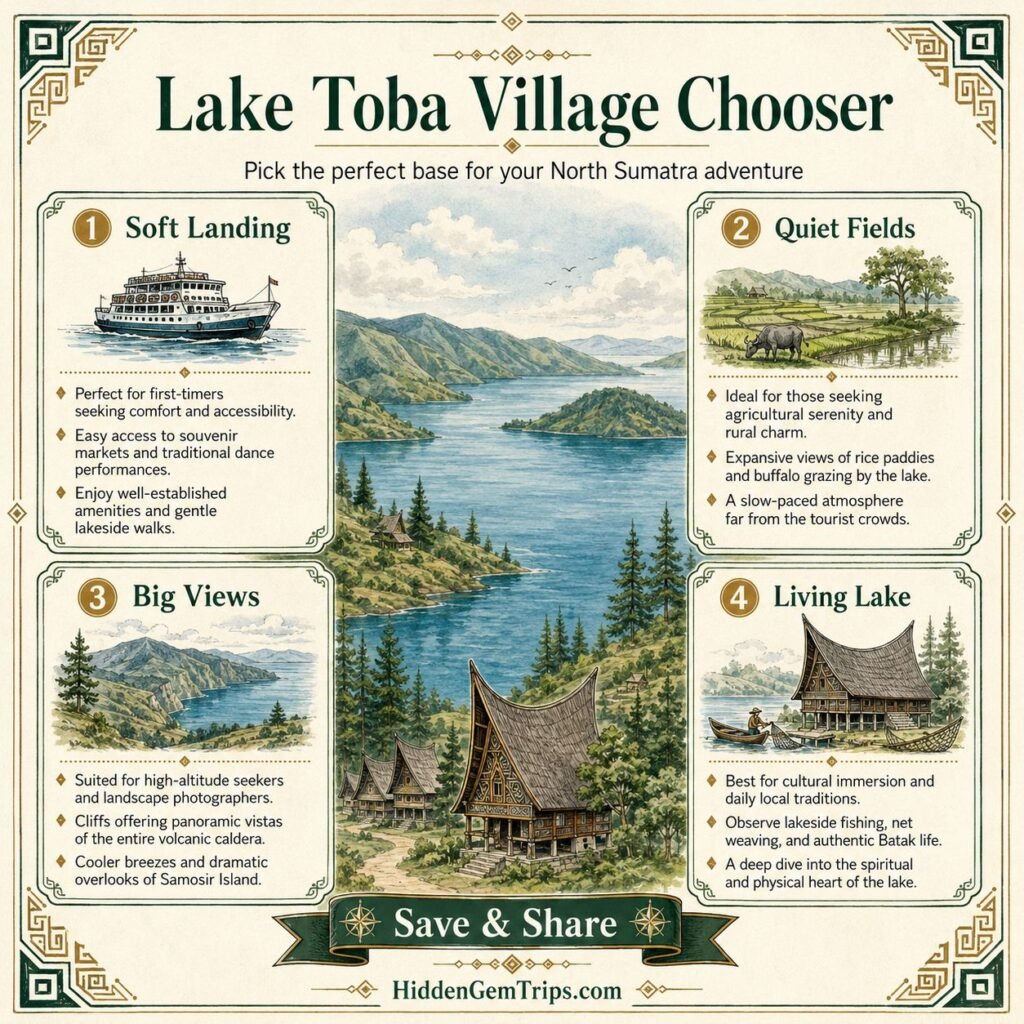
A strong Lake Toba villages route should be built around bases, not a frantic loop. For most travelers, Balige makes the easiest southern base. From there, you can visit Lumban Bulbul, Meat, and possibly Tipang or Bakkara depending on time and road conditions. A northern or western base can then open Silalahi, Paropo, Tongging, and Haranggaol. Muara and Sibandang can work as a quieter island-style addition if your route and transport line up.
A four-day route might look like this: Day 1 in Balige and Lumban Bulbul, Day 2 in Meat and nearby geosite scenery, Day 3 toward Tipang and Bakkara Valley, and Day 4 transfer toward Silalahi or Tongging. A six- or seven-day route can add Muara-Sibandang and Haranggaol with more breathing room. If you also want Samosir, do not squeeze it in like a garnish. Give it its own time. Samosir deserves better, and so do you.
The smartest plan is not the one with the most pins. It is the one with the fewest rushed mornings. Lake Toba rewards early starts, long lunches, weather buffers, and slow viewpoints. Build your trip around light: morning lake air, late-afternoon color, and one flexible day in case rain or road timing changes everything. The lake has been around longer than your itinerary; it does not care about your productivity era.
For readers building a larger Indonesia portfolio, this route sits well beside our Indonesia hidden-gems overview and contrasts nicely with the North Bali village rhythm. North Bali is about highland quiet behind a famous island brand. Lake Toba is about widening a famous lake beyond its most familiar island. Same strategy, different soul.
Best Time to Visit Lake Toba Villages
Lake Toba is a highland destination, so it is generally cooler than Medan and much of lowland Sumatra. Still, weather changes quickly around the lake. Rain can affect road comfort, visibility, boat plans, and waterfall access. Dry-season months are often easier for road trips and viewpoints, but shoulder periods can feel quieter and greener. The safest advice is boring but useful: check local weather close to travel dates, ask accommodation or drivers about road conditions, and avoid building fragile plans around one perfect sunrise.
Weekends and Indonesian holiday periods can change the atmosphere dramatically around accessible beaches, viewpoints, and family recreation areas. That is not automatically bad. Domestic travel is part of Lake Toba’s living tourism economy. But if your goal is quiet, choose weekdays where possible and stay overnight near your chosen base instead of arriving with day-trip crowds.
Morning is your friend. Markets, lake light, low wind, softer temperatures, and village movement often happen before the day becomes too bright and harsh. Late afternoon is your second friend. Midday is for lunch, museum time, travel between bases, or accepting that the sun is being disrespectful. Creators know: harsh noon light is basically nature’s way of saying, “Please stop filming.”
Responsible Travel Rules for Lake Toba Villages
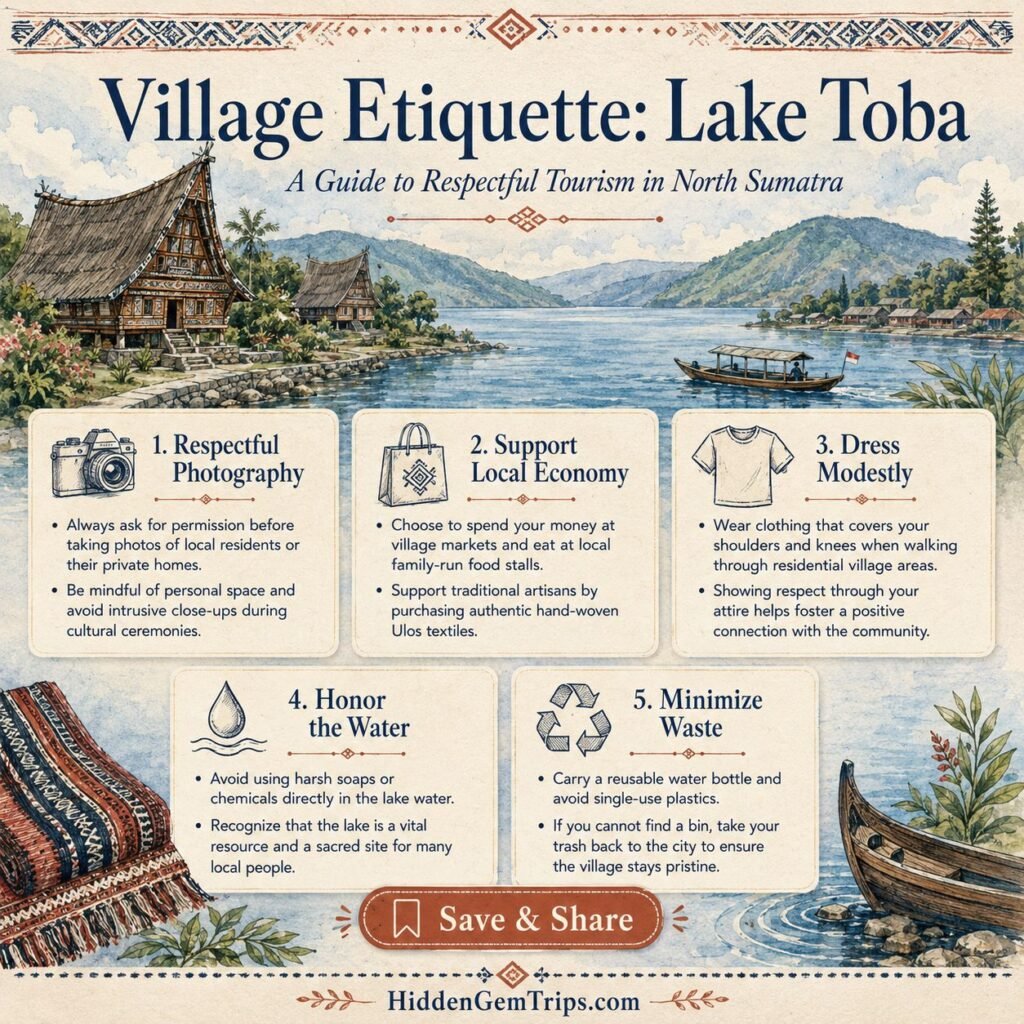
The first rule is consent. Ask before photographing people, homes, ceremonies, work areas, children, or private compounds. A long lens does not magically turn intrusion into art. If someone says no, smile and move on. If someone says yes, still be quick and respectful.
The second rule is modesty. Around villages, churches, family compounds, and cultural spaces, dress with common sense. Lake Toba is not a beach-club fantasy. Swimwear belongs at appropriate swimming areas, not on village roads or in sacred spaces. This is basic guest behavior, not a controversial lifestyle debate.
The third rule is local value. Hire local drivers or guides when it makes sense. Eat at small places. Buy coffee, fruit, snacks, or crafts directly when appropriate. Choose homestays or locally owned accommodation when safety, cleanliness, and comfort are acceptable. Do not bargain so aggressively that the savings become embarrassing.
The fourth rule is water respect. Lake Toba is huge, but huge does not mean invincible. Avoid single-use plastic where practical, take trash out, use refill options when available, and never leave waste at viewpoints or campsites. If you swim, avoid soaps, shampoos, or lotions entering the lake. If you visit fish-farming areas, observe without judgmental performance. Complex livelihoods require more than tourist opinions delivered after one afternoon.
The fifth rule is route humility. Around Lake Toba, local knowledge matters. Road works, rain, landslides, ferry timing, event traffic, and village ceremonies can affect movement. Ask before assuming. This is also why our long-haul flight survival guide pairs well with Lake Toba planning for international visitors: the hardest part of the trip may be arriving rested enough to make good decisions after Medan traffic and a long highland transfer.
What Makes This Guide Different from Generic Lake Toba Lists
Most Lake Toba lists are attraction-led: waterfall, viewpoint, museum, island, beach, repeat. That format is useful for quick planning, but it does not explain why one shore feels different from another. This guide is village-led. It treats the lake as a lived landscape and asks what each stop teaches: Balige teaches orientation, Meat teaches texture, Tipang teaches valley movement, Muara-Sibandang teaches smaller island rhythm, Silalahi teaches open water, Tongging teaches scale, and Haranggaol teaches livelihood complexity.
The difference is subtle but important. Attraction-led travel asks, “What can I see?” Village-led travel asks, “How does this place work?” The second question leads to better behavior. You stop treating the lake as a background and start recognizing the systems that hold it together: roads, ferries, markets, water, farms, fish cages, churches, ceremonies, schools, family networks, government planning, geopark status, and tourism expectations.
This approach also avoids the tired competition between places. You do not need to say Lake Toba is better than Bali, Samosir is overrated, or one village is the “next big thing.” That language creates hype without responsibility. A better claim is simpler: Lake Toba villages beyond Samosir give travelers a wider, more ethical, and more memorable way to understand North Sumatra. No war needed. The lake is not auditioning for your algorithm.
For cultural pacing, compare this with our Tana Toraja slow-culture lens. Both destinations involve powerful landscapes and deep local traditions. Both can be harmed by shallow cultural consumption. Both reward travelers who slow down, ask better questions, and resist turning complex communities into exotic props.
Conclusion: Go Beyond Samosir, But Do Not Go Carelessly
Lake Toba villages beyond Samosir are not a replacement for Samosir. They are the missing context around it. If you only visit the famous island, you can still have a beautiful trip. But if you move through Lumban Bulbul, Meat, Tipang, Muara, Sibandang, Silalahi, Tongging, and Haranggaol, the lake becomes less like a destination and more like a region. That is when the trip gets deeper.
The best route is not the longest one. It is the route you can travel with attention. Choose two or three bases. Leave space for weather. Spend locally. Ask permission. Learn the difference between a viewpoint and a village. Accept that some of the most valuable moments will not look dramatic on camera: a quiet breakfast in Balige, a field road near Meat, mist over Bakkara, a small boat near Sibandang, late light at Silalahi, grilled fish near Tongging, or a conversation in Haranggaol that complicates what you thought you knew about the lake.
That is the real reason to go beyond Samosir. Not to prove you found a secret, and not to escape other travelers like a travel snob with a better backpack. Go because Lake Toba is too large, too human, and too layered to be reduced to one island loop. Go because the villages around the lake still have stories that do not fit into the standard itinerary. And when you leave, make sure your presence added more than it extracted. That is the whole hidden-gem standard.
FAQ About Lake Toba Villages Beyond Samosir
1. What are the best Lake Toba villages beyond Samosir for first-time visitors?
Lumban Bulbul and Balige are the easiest first choices because they have clearer access, food, accommodation, and visitor facilities. Meat is a good next step for quiet village texture. Tongging is best for dramatic scenery near Sipiso-Piso. If you have more time, add Tipang, Muara-Sibandang, Silalahi, Paropo and Haranggaol.
2. Can I visit Lake Toba villages without renting a private car?
It is possible to use a mix of public transport, ferries, local buses, and hired rides, but a private car with a reliable local driver is far easier for a multi-village route. Some stops have limited transport frequency, and road timing can change with weather or events. If you do not rent a car, choose fewer bases and confirm each transfer locally.
3. How many days do I need for Lake Toba beyond Samosir?
Four days is enough for Balige, Lumban Bulbul, Meat, and one wider southern stop such as Tipang. Six to seven days is better if you want to include Muara-Sibandang, Silalahi, Tongging, and Haranggaol without rushing. Add more time if you also want a proper Samosir stay.
4. Is Lake Toba safe for independent travelers?
Many parts of Lake Toba are manageable for independent travelers who plan carefully, use trusted accommodation, respect local customs, and avoid risky night driving on unfamiliar roads. The bigger issue is not danger; it is logistics. Confirm routes, weather, ferry schedules, and driver arrangements close to your travel date.
5. Are Lake Toba villages suitable for families?
Yes, especially Balige, Lumban Bulbul, and some established lakeside areas. Families should plan shorter drives, choose accommodation carefully, carry snacks and cash, and avoid overloading each day. Lake Toba is better with slow mornings than with exhausted children trapped in a car for a heroic route nobody enjoys.
Disclaimer
This article is a travel-planning guide, not a live transport schedule, legal advisory, environmental impact assessment, or safety guarantee. Road conditions, ferry schedules, village rules, accommodation quality, prices, weather, events, and access can change. Always confirm details with local operators, accommodation providers, official tourism channels, and current weather information before traveling. Respect private property, sacred places, local customs, and the environment.