
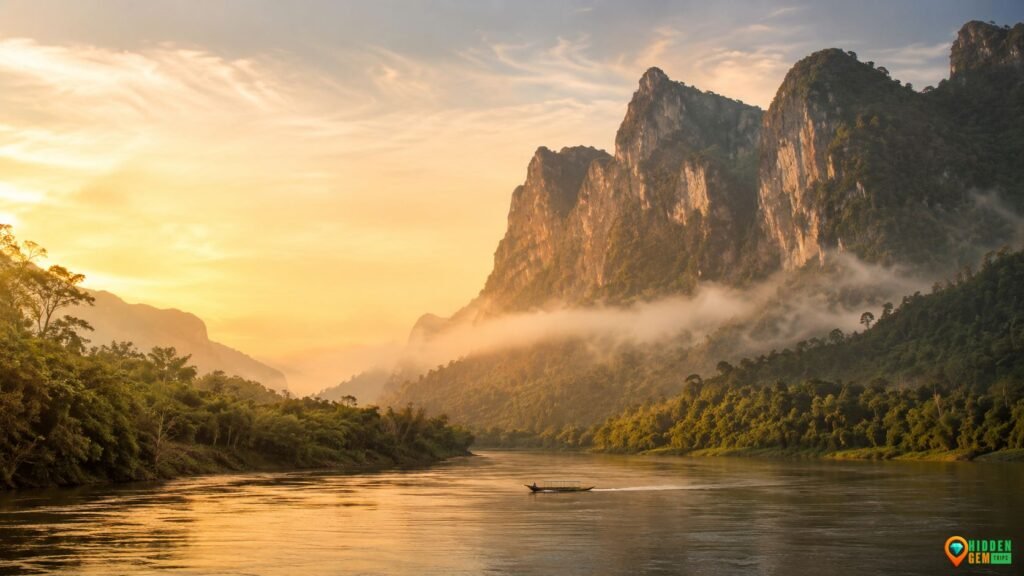
This Northern Laos guide is for travelers who want Laos without turning it into a temple checklist, a party detour, or a bus-window blur. Northern Laos moves differently. The Mekong does not hurry. The Nam Ou bends around limestone cliffs like it has all the time in the world. Mountain roads climb into tea country, forest valleys, and villages where the loudest thing at night may be insects, boat engines, or a rooster with zero respect for your sleep schedule.
The region is not “undiscovered.” Luang Prabang is globally known, backpacker routes are established, and tourism numbers are climbing again. Laos reported more than four million international visitors in 2024, and official tourism reporting projects continued growth through 2026. That matters because the best version of a northern trip is no longer found by simply going where everyone says is “hidden.” The better move is to travel with sharper pacing, better stops, and more respect for places that are beautiful precisely because they are not built for mass movement.
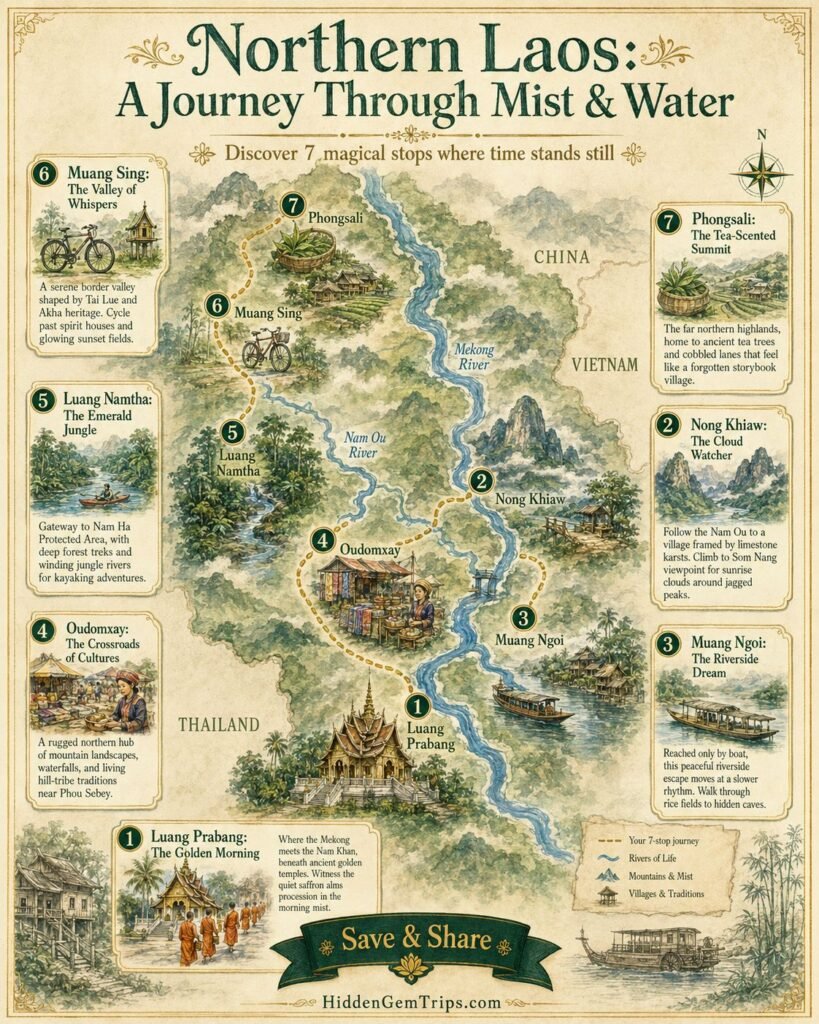
This guide focuses on seven river and mountain stops: Luang Prabang, Pak Ou and the Mekong bend, Nong Khiaw, Muang Ngoi Neua, Luang Namtha, Muang La/Oudomxay, and Phongsaly. They are not ranked like trophies. They work as chapters. Some are easy to reach. Some demand patience. Some are best for first-time visitors, while others suit travelers who already understand that slow roads and limited schedules are not bugs in the system. They are the system. If your travel style already leans toward slower, deeper journeys, pair this article with HiddenGemTrips’ slow travel mindset before you start booking anything.
Northern Laos rewards people who can let a plan breathe. The boat may leave later than expected. A viewpoint may be hazy. A guesthouse may be simpler than the photos. A mountain road may be rougher than your confidence. And somehow, if you stop treating every inconvenience like a refund request, the trip becomes better. That is the strange magic here: the less you try to dominate the route, the more the route opens up.
Why Northern Laos Rewards Slow Travel
Northern Laos is shaped by rivers and ridgelines. The Mekong has long carried trade, pilgrims, families, and travelers through Laos, while the Nam Ou and Nam Tha pull visitors into narrower valleys where mountain silhouettes close around the water. Roads have improved in many places, but travel time still depends on weather, vehicle condition, boat schedules, roadworks, and how remote you want your trip to feel.
This is why a strong Northern Laos guide should not pretend that every stop can be stacked into a perfect seven-day sprint. The region is better understood as a rhythm: river arrival, mountain pause, village night, early boat, slow road, forest walk, market morning. It is closer in spirit to HiddenGemTrips’ deep river travel in Borneo than to a polished city-break itinerary. Water sets the pace. Roads negotiate with terrain. People live here full-time, which means your trip is passing through someone else’s ordinary world, not a stage set for scenic hunger.
The best travelers in northern Laos are not the ones who “cover” the most places. They are the ones who notice texture: monks crossing a quiet lane before breakfast, steam rising from sticky rice baskets, boatmen reading the river by habit, schoolchildren moving along dusty roads, wet limestone after rain, a small guesthouse owner explaining that tomorrow’s transport depends on who else is going. That last sentence is not a problem. It is the whole vibe.
This does not mean planning is unnecessary. It means planning needs humility. Book key nights where demand is high, check current safety and route guidance, carry cash, keep your bag light, avoid illegal or disrespectful behavior, and leave enough margin for delays. Northern Laos is gentle in mood but not always gentle in logistics. The reward goes to travelers who prepare well and then stay flexible.
Quick Planning Table for 7 River and Mountain Stops
| Stop | Best base | Best for | Suggested time | Quiet travel tip |
| Luang Prabang | Old town or riverside edge | UNESCO heritage, temples, soft landing | 2-3 nights | Stay slightly outside the busiest lane and start early. |
| Pak Ou & Mekong Bend | Luang Prabang or riverside lodge | Boat rhythm, caves, village stops | Half day to 1 night | Avoid treating the caves as the only reason to go. |
| Nong Khiaw | Riverside guesthouse | Karst mountains, viewpoints, Nam Ou scenery | 2 nights | Give it one full day without onward transport pressure. |
| Muang Ngoi Neua | Village guesthouse | Slow village life, river mornings, short walks | 1-2 nights | Arrive for the evening mood, not only the day trip. |
| Luang Namtha | Town guesthouse or eco-lodge | Treks, Nam Ha forest, ethnic communities | 2-3 nights | Use licensed guides and avoid DIY village intrusion. |
| Muang La/Oudomxay | Muang La or Oudomxay | Hot springs, valleys, rural roads | 1-2 nights | Use it as a decompression stop between bigger routes. |
| Phongsaly | Phongsaly town | Tea mountains, remote northern edge | 2-3 nights | Travel only if you can handle slower access and simple facilities. |
Before You Go: Route Reality, Safety, and Local Respect
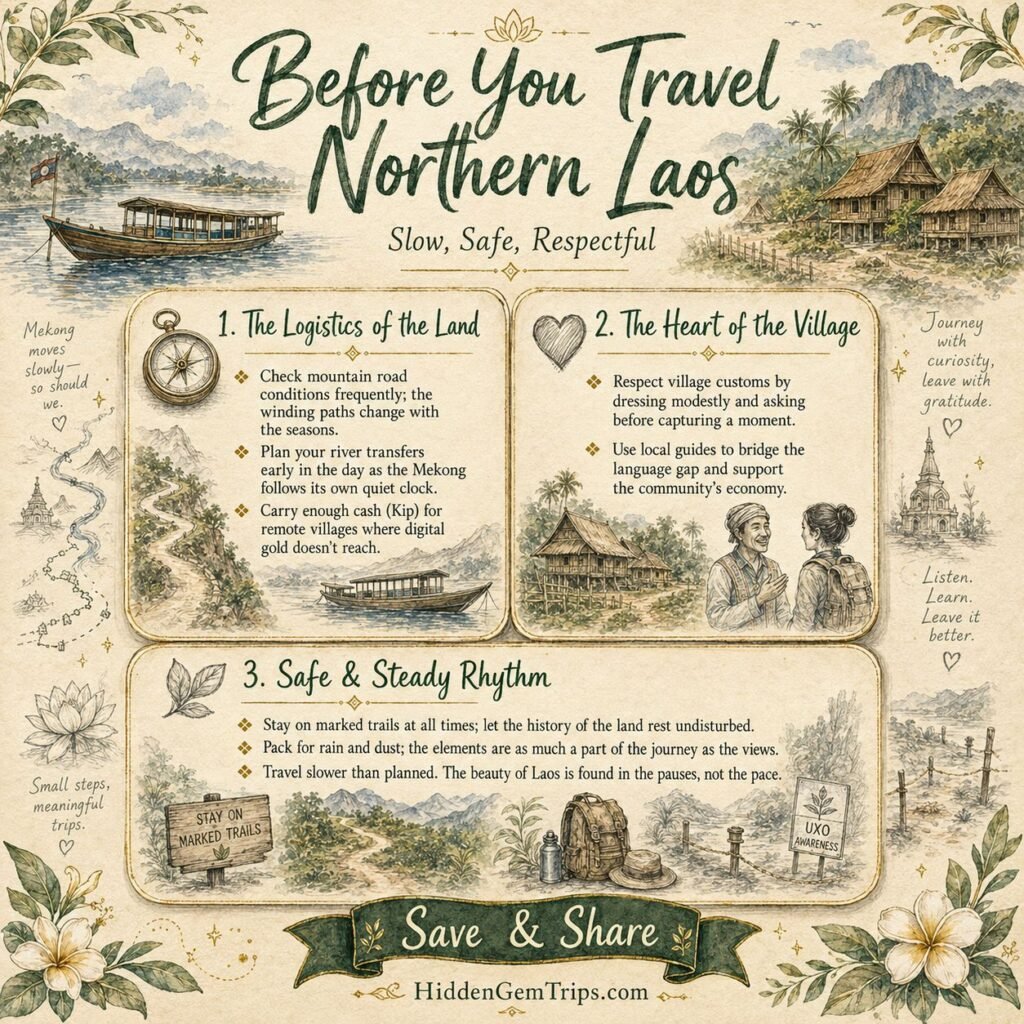
Start with the unglamorous stuff. Check the latest Laos travel advisory before departure, especially if your route includes remote provinces, border areas, or side trips into less-developed terrain. Official guidance highlights risks that travelers should not brush off, including unexploded ordnance in parts of the country, remote-area security concerns, road conditions, and limited emergency support outside major towns. This does not mean panic. It means act like an adult with a passport.
UXO risk is part of Laos travel reality, not a dramatic sidebar. The Lao National Unexploded Ordnance Programme was established by the Lao government in 1996, and its work remains relevant because unexploded ordnance continues to affect rural landscapes and communities. Read about UXO Lao’s national clearance work before you treat every empty field, forest path, or scenic slope as your personal adventure zone. Stay on marked paths, use local guides for hikes, and never touch suspicious metal objects. The worst travel story is the one that could have been avoided with basic respect.
For river travel, remember that the Mekong and its tributaries are living systems. The Mekong River Commission coordinates regional work on water resources across the Lower Mekong countries, which is a useful reminder that rivers here are not only scenic. They are transport corridors, food systems, hydropower debates, local livelihoods, and climate-sensitive landscapes. When water levels change, boat routes and timings can change too.
Pack lighter than your anxiety wants. A heavy suitcase on boat landings, steep guesthouse stairs, dusty roads, and shared vans will humble you quickly. Bring breathable layers, rain protection, footwear that can handle mud and uneven steps, a dry bag for boat days, offline maps, basic medicine, a power bank, and enough cash in smaller notes. Do not expect every village to solve your ATM problem.
For gear discipline, use HiddenGemTrips’ practical remote travel gear checklist and its packing-light strategy for remote trips. Northern Laos is exactly where overpacking stops being cute and starts becoming cardio.
1. Luang Prabang: Rivers, Temples, and a Softer Start
Luang Prabang is the graceful opening chapter of northern Laos. It sits at the meeting of the Mekong and Nam Khan rivers, and UNESCO describes Luang Prabang as an exceptional fusion of traditional Lao architecture and 19th- and 20th-century European colonial urban forms. That sentence sounds formal because UNESCO does formal; the lived version is simpler. Luang Prabang feels like a town where rivers, temples, wooden houses, saffron robes, cafés, markets, and slow mornings overlap in a way that can still be deeply moving if you do not treat it like a backdrop.
Yes, it is popular. Yes, some parts can feel polished. Yes, certain streets now know exactly what tourists want to photograph. But popularity does not cancel value. It just means you need better timing and softer expectations. Luang Prabang is not the place to prove you are too cool for famous sites. It is the place to practice seeing famous sites without flattening them.
Best quiet rhythm
Stay at least two nights, ideally three. Use the first afternoon to walk slowly along the river edges rather than charging into every temple. Wake early for the town before café chatter fills the lanes. If you observe alms-giving, do it respectfully, from a distance, without camera aggression or performative spirituality. The most honest Luang Prabang moment may not be the famous ritual. It may be a quiet lane after rain, a small temple courtyard, or a breakfast where nobody is rushing you away from the table.
Use Luang Prabang as the soft landing for a bigger northern route, not as the whole trip. Travelers coming from long flights should read HiddenGemTrips’ long-haul flight recovery advice before planning an immediate mountain transfer. Jet lag plus winding roads is not brave. It is just bad math.
Practical notes
The town works well without a car. Walk, cycle carefully, use local transport, and choose a base that lets you enjoy mornings and evenings without constant negotiation. Accommodation ranges from simple guesthouses to refined boutique stays. Book early in high season, but do not over-schedule paid activities. Luang Prabang’s strength is not only attractions. It is pace.
Be conservative around dress and temple etiquette. Cover shoulders and knees where appropriate, remove shoes when required, ask before photographing people, and do not treat sacred spaces like lifestyle sets. That sounds obvious, but the internet keeps proving otherwise. Be better than the algorithm.
2. Pak Ou and the Mekong Bend: Caves Without the Rush
The Pak Ou area is often sold as a cave trip from Luang Prabang, but the better experience is the river itself. Boats move upstream past villages, forested banks, fishermen, sandbars, and bends where the Mekong feels broad but not empty. The caves are meaningful and photogenic, yet the journey loses depth if you approach them like a quick errand with a Buddha-statue receipt at the end.
This stretch works best as a half-day or full-day river reset. If you have the budget, consider a slower private or small-group boat that allows calmer timing and village stops without turning the day into a forced shopping circuit. If you take a standard tour, adjust your expectations. You may share space. You may wait. The boat engine may be louder than your inner peace. Still, the river has a way of winning if you stop asking it to be silent.
Best quiet rhythm
Start early or choose a later, less compressed schedule. Let the river carry the mood. Watch how villages sit above the water, how steps and landings change with river levels, how everyday life keeps moving behind the tourism layer. If you stop at a village known for textiles, whiskey, paper, or crafts, buy respectfully or do not buy. Do not perform poverty curiosity. Do not shove cameras into working hands. A small purchase made with dignity beats a hundred extractive photos.
This is a useful place to apply HiddenGemTrips’ hidden-gem travel framework: the “hidden” part is not always a secret location. Sometimes it is a better way of behaving in a familiar one.
Practical notes
Bring sun protection, water, sandals or shoes that can handle uneven landings, and a dry bag during wetter months. Boat steps can be awkward. If mobility is limited, confirm access details before booking. Do not assume every landing will be smooth, level, or handrail-friendly. River travel has charm, but charm does not cancel physics.
3. Nong Khiaw: Limestone Mountains on the Nam Ou
Nong Khiaw is where northern Laos starts to feel properly vertical. The Nam Ou cuts through limestone mountains, and the town spreads along the river with guesthouses, cafés, boat landings, viewpoints, and a rhythm that feels slower than Luang Prabang but not completely remote. It is one of the easiest places in Laos to understand why rivers and mountains belong in the same sentence.
The mistake is arriving too late, hiking one viewpoint, taking the same photo as everyone else, and leaving the next morning while announcing that Nong Khiaw is “done.” Nong Khiaw is not a checkbox. It is a pause. It needs one full day at minimum, and two nights make a huge difference.
Best quiet rhythm
Choose a riverside base and give yourself one unscheduled morning. Walk before breakfast. Watch boats start moving. Let the cliffs change color as the sun arrives. Do a viewpoint only if weather, fitness, and trail conditions make sense. Some hikes are steep, muddy, exposed in heat, or slippery after rain. The Instagram version rarely includes the sweating, but your knees will remember.
The real power of Nong Khiaw is not only the viewpoint. It is the way the valley teaches you to stop over-filling the day. A short walk, a slow lunch, a river crossing, a sunset seat, and an early night can feel more complete than a full spreadsheet of activities.
Practical notes
Road transport from Luang Prabang can take longer than expected depending on conditions and stops. Build buffer time, especially if you are connecting onward by boat or bus. ATMs and services are more limited than in Luang Prabang, so carry enough cash. Book accommodation ahead during busy periods, but keep expectations grounded. Mountain towns are not luxury malls with cliffs attached.
If you enjoy quiet water-and-limestone landscapes, compare this stop with HiddenGemTrips’ Lan Ha Bay alternative to busier Vietnam routes. The geography is different, but the planning lesson is similar: the famous view is only one layer of the trip.
4. Muang Ngoi Neua: A River Village That Slows the Clock
Muang Ngoi Neua sits upriver from Nong Khiaw and still carries the feeling of a place reached by water, even as access and development continue to change. It is small, calm, and easy to misunderstand. Some travelers come expecting untouched paradise. Others come expecting nothing and leave with the kind of quiet memory that stays. The healthier expectation is this: Muang Ngoi is a living village with guesthouses, travelers, farms, trails, local routines, and a river that controls the mood.
Its beauty is not polished. It is in the spacing of the day. Morning mist. Chickens. Wooden balconies. Children heading somewhere important with the seriousness of tiny diplomats. Boats arriving. Boats leaving. Travelers suddenly remembering how to sit still.
Best quiet rhythm
Stay overnight rather than doing only a rushed day trip. The evening and early morning are the point. During the day, take short walks to nearby landscapes and villages only where access is appropriate and local guidance is clear. Use marked paths, respect private land, and do not wander into homes, fields, caves, or sacred areas like your map app has diplomatic immunity.
This stop pairs naturally with HiddenGemTrips’ Tana Toraja slow travel approach because both places ask visitors to slow down around living culture. A village is not a museum. People are not atmosphere. Travel gets better when that line is clear.
Practical notes
Facilities are simple. Bring cash, insect repellent, basic medicine, a headlamp or phone light, and patience. Electricity, Wi-Fi, boat timing, and food options may vary. That is not a failure of the place. It is a sign that you should not arrive with city expectations packaged as “authentic travel.”
If rain is heavy or river conditions are uncertain, confirm transport locally. Boat travel can shift with season and water levels. Keep onward plans flexible and avoid scheduling a same-day flight after a remote transfer. That kind of plan looks efficient until it becomes comedy with expensive consequences.
5. Luang Namtha: Forest Roads and Nam Ha Treks
Luang Namtha is the practical base for travelers who want the forest-and-ethnic-community side of northern Laos with more structure than random wandering. The official Luang Namtha tourism site describes the Nam Ha National Protected Area as known for jungle trekking, kayaking, rafting, mountain biking, and visits to remote ethnic communities. That matters because this is not a place where visitors should freelance their way through villages and protected landscapes. The better version uses licensed guides, local rules, and tours that keep benefits closer to communities.
Compared with Luang Prabang and Nong Khiaw, Luang Namtha feels less instantly pretty at first glance. That is not an insult. It is a different kind of base: functional town, access point, market mornings, trekking offices, roads toward forest and villages, and a useful sense that the trip is moving from river beauty into mountain ecology.
Best quiet rhythm
Give Luang Namtha two or three nights if trekking is the point. One day is often too shallow. Choose a small-group or community-based trek that matches your fitness, season, and ethics. Ask where your money goes, whether the route is approved, how village visits are handled, and what behavior is expected. Good operators will not be offended by smart questions. Dodgy ones may reveal themselves fast. Thank them for saving your time.
The best experiences here are not only scenic. They are interpretive. A guide can explain forest foods, village protocols, shifting landscapes, conservation pressures, and the difference between looking at culture and learning with respect. Without that context, a trek can become just mud, sweat, and photos of people who did not sign up for your personal documentary.
Practical notes
Bring footwear that can handle mud, leeches in wet conditions, and uneven ground. Wear modest, breathable clothing. Carry water purification or enough water as advised by your guide, plus sun protection and rain gear. Do not leave marked routes because UXO risk, land access, and conservation rules are real. Remote does not mean rule-free.
For readers comparing Laos with other Southeast Asian island or coast routes, HiddenGemTrips’ Koh Kood quiet beach guide is a useful contrast. Koh Kood slows you down through beaches; Luang Namtha slows you down through forest, roads, and community boundaries. Different surface, same discipline.
6. Muang La and Oudomxay: Hot Springs and Valley Roads
Muang La and the wider Oudomxay area are often treated as in-between territory, which is exactly why they deserve attention. Many travelers pass through Oudomxay on their way between bigger names, barely noticing the valleys, rivers, markets, temples, and hot springs around Muang La. But a quiet itinerary needs these middle places. They absorb travel fatigue. They give the route texture. They prevent northern Laos from becoming a greatest-hits album played too fast.
Muang La is best approached as a decompression stop: warm water, rural roads, small settlements, low-key walks, and a slower valley rhythm. It may not deliver the instant drama of Nong Khiaw’s cliffs or Phongsaly’s mountain edge, but it offers something just as useful: space between intense travel days. In a region where transport can be tiring, that is not filler. That is strategy.
Best quiet rhythm
Stay one or two nights if your budget and route allow. Use the time for hot springs, gentle walks, village visits only with proper guidance, and a slow reset before heading deeper north or back toward Luang Prabang. Do not overbuild the stop. Its value is not in a long list of attractions. Its value is that your nervous system remembers it is allowed to unclench.
This is the same reason HiddenGemTrips recommends route buffers in its 7-day deep-trip itinerary rules. A buffer is not empty time. It is what keeps a beautiful route from becoming a stamina contest.
Practical notes
Access can involve local transport, private transfer, or longer road movement depending on your route. Confirm road conditions and travel times locally because mountain roads can change with weather and construction. Accommodation can range from simple to boutique, but inventory is limited compared with major towns. Book ahead if you want a specific stay.
Use this stop to do laundry, reorganize your bag, withdraw cash where possible, and recover from dusty roads. These tasks sound unromantic until they save your trip from smelling like a hiking sock with a passport.
7. Phongsaly: Tea Mountains at the Edge of Laos
Phongsaly is for travelers who can handle distance. It is one of the most atmospheric mountain stops in northern Laos, associated with highland tea, ethnic diversity, cool air, and a sense of being close to the country’s northern edges. It is also not the easiest add-on. Getting there takes time, the roads can be demanding, and facilities are simpler than in polished destinations. That is exactly why it should not be thrown into an itinerary just because it looks cool on a map.
The reward is a different Laos mood: mist, tea landscapes, mountain town air, markets, old trees, and a feeling that the trip has moved beyond standard loops. For HiddenGemTrips readers, Phongsaly is the “only if you mean it” stop. It can be deeply rewarding, but only if you respect the access, weather, and slower pace.
Best quiet rhythm
Give Phongsaly at least two nights if you go. One rushed night after a rough road is basically tourism self-sabotage. Use your time for tea landscapes, town walks, market mornings, and guided visits that respect local communities. The best moments may be ordinary: steam over bowls of noodles, fog moving over rooftops, tea leaves drying, or a viewpoint that makes you understand why mountain places should never be rushed.
If remote landscapes are your thing, compare the mindset with HiddenGemTrips’ Socotra ethical travel guide. The ecosystems and cultures are completely different, but the ethical lesson is shared: remoteness is not permission to behave carelessly.
Practical notes
Check current transport before committing. Roads, buses, shared vehicles, and seasonal conditions can change. Bring warm layers because highland evenings can feel much cooler than river towns. Carry cash, medicine, and enough flexibility to handle delays. Phongsaly is not where you want to discover that your entire plan depends on one perfect connection.
For many travelers, Phongsaly belongs in a 10-to-14-day northern Laos trip rather than a tight one-week itinerary. That is not a downgrade. It is route honesty. Better to skip it with respect than to reach it exhausted and leave annoyed that mountains did not rearrange themselves around your calendar.
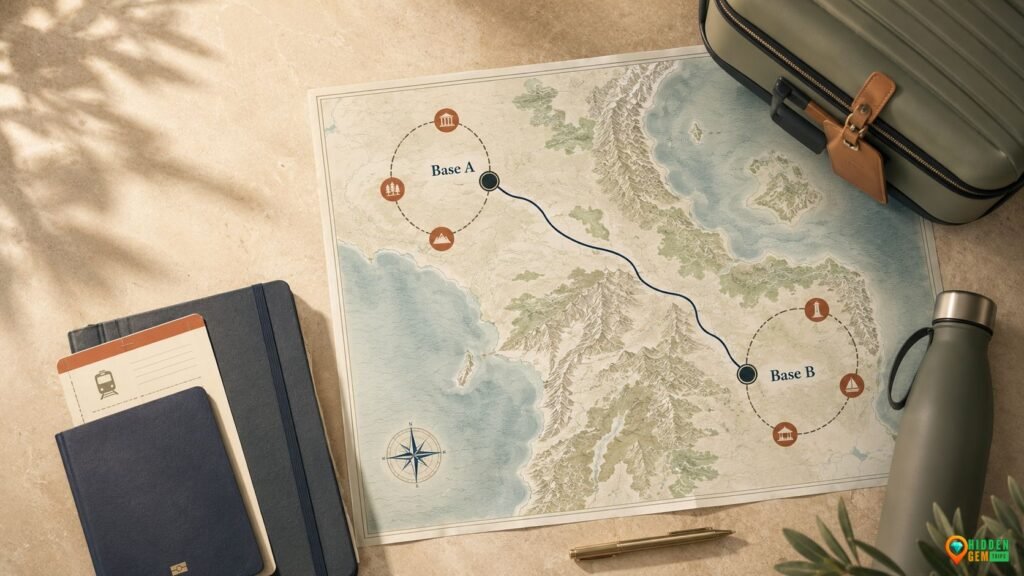
How to Build a 7-Day Northern Laos Itinerary
A smart seven-day Northern Laos itinerary should not try to include every stop above. The region looks smaller on a screen than it feels in the body. Choose one route style: classic river-and-mountain, forest trekking, or remote highland. Then protect the pace like it is part of the budget.
| Itinerary style | Best route combination | Who it suits | Why it works |
| Classic river and mountain | Luang Prabang + Pak Ou + Nong Khiaw + Muang Ngoi | First-time visitors with 7 days | It balances heritage, river travel, limestone scenery, and village rhythm without overreaching. |
| Forest and community route | Luang Prabang + Luang Namtha + Nam Ha trek | Travelers who want guided nature and cultural learning | It uses a practical town base and avoids unsupported wandering into sensitive areas. |
| Remote highland route | Luang Prabang + Oudomxay/Muang La + Phongsaly | Return visitors or slow travelers with tolerance for longer roads | It trades convenience for tea mountains, cooler air, and a stronger edge-of-map feeling. |

For a first visit, the classic route is the cleanest: two nights in Luang Prabang, one river day to Pak Ou, two nights in Nong Khiaw, one or two nights in Muang Ngoi, then return with a buffer. It is not the most adventurous plan, but it gives the region room to breathe. That matters more than novelty points.
For travelers who want deeper forest and community experiences, Luang Namtha deserves its own focus. Do not treat it as a casual overnight between buses. Arrive, choose an ethical operator, trek or kayak with guidance, then leave space to recover. For remote highland travelers, Muang La and Phongsaly can create a richer mountain route, but only with more time and comfort with imperfect logistics.
If you are combining Laos with a broader Southeast Asia trip, HiddenGemTrips’ Mergui Archipelago guide offers a useful contrast: islands slow you through distance and sea access, while northern Laos slows you through rivers, roads, and mountain weather. Either way, the winning strategy is not more stops. It is better spacing.
Responsible Travel Notes for Northern Laos
Responsible travel in northern Laos begins with accepting that quiet places are not empty places. Villages, rivers, forests, temples, markets, and mountain roads all belong to communities first. Visitors are temporary. That should shape everything from clothing to photography to how loudly you speak on a guesthouse balcony at midnight.
Do not enter homes, fields, caves, forest tracks, or sacred areas without permission. Do not fly drones unless you have confirmed legality and local acceptance. Do not photograph people at close range without consent, especially children, monks, elders, and people working. Don’t give out candy or random gifts to children, it creates awkward habits and power dynamics. Buy local food, pay fair prices, tip guides when appropriate, and ask before assuming.
Use licensed local guides for treks, caves, and remote village routes. This is not only about navigation. It is about safety, language, land access, cultural protocol, and economic fairness. A cheaper unguided shortcut can cost the destination more than you saved.
River behavior matters too. Wear life jackets when provided. Do not overload boats with luggage chaos. Keep trash secured. Avoid loud music on slow boats or riverside guesthouse decks. Nobody came to the Nam Ou to hear your playlist fighting the mountains.
If your route includes sensitive cultural landscapes, learn from HiddenGemTrips’ Tanjung Puting villages-and-rivers travel approach. The key principle travels well: waterways are not just scenery. They are livelihoods, memory, transport, and home.
Budget, Booking, and Transport Notes
Northern Laos can be affordable, but cheap travel and smart travel are not always the same thing. The main costs are accommodation, transport, guided activities, food, entrance fees, and the occasional private transfer when public timing does not fit. Budget travelers can keep costs low with guesthouses, local food, and shared transport. Mid-range travelers can spend more on better-located stays, smaller boats and guided treks ethically. Luxury is limited outside key areas, but boutique options exist around Luang Prabang and select rural lodges.
Transport is where itineraries often fall apart. Buses, minivans, boats, and private cars may all appear in one trip. Timetables can shift. Mountain roads can be slow. Boat journeys depend on season, water levels, demand, and local operations. Always confirm current departures locally rather than trusting a months-old blog comment with the confidence of a minor prophet.
Cash remains important. Carry Lao kip in smaller denominations, especially outside Luang Prabang. ATMs may not be available or reliable in smaller towns and villages. Keep emergency cash separate, and do not spend down to your final note before a transport day. That is not minimalist. That is asking the universe to roast you.
For booking, reserve key nights in Luang Prabang and popular river towns during high season, but avoid locking every hour of the trip. The best northern Laos itinerary has a skeleton, not a cage. You need enough structure to avoid stress and enough flexibility to let weather, transport, and your own energy make decisions.
Best Time to Visit Northern Laos
The most comfortable season for many travelers is the cooler dry period, often from November to February. Mornings can be crisp in mountain areas, skies are generally clearer, and trekking conditions can be more pleasant. This is also a popular period, so book important stays earlier and do not expect to have every famous stop to yourself.
March and April can bring heat, haze, and seasonal burning in parts of the region. Some travelers still go, but views may be less clear and physical activity can feel heavier. The rainy season brings greener landscapes, fuller rivers, and fewer visitors, but it also brings mud, leeches, slippery trails, road delays, and transport uncertainty. For photographers and slow travelers, the wet season can be beautiful. For tight itineraries, it can be chaos wearing a green outfit.
The real answer is to match season to route style. For first-time visitors who want comfort, choose cooler dry months. For forest-focused travelers, ask trekking operators what conditions are like for specific trails. For river-heavy trips, confirm boat routes and water conditions. For Phongsaly and higher areas, pack layers even when lowland Laos feels warm. Northern Laos is not one climate mood.
Final Thoughts
Northern Laos is not a destination you win by moving faster. The region gives its best moments to travelers who can handle slowness without calling it boredom. Luang Prabang teaches softness. Pak Ou and the Mekong bend teach river patience. Nong Khiaw teaches vertical silence. Muang Ngoi teaches village time. Luang Namtha teaches guided respect. Muang La teaches recovery. Phongsaly teaches distance.
Together, these seven stops form a route that is less about “must-see” pressure and more about choosing a travel rhythm that fits the land. Rivers and mountains do not care about your content calendar. They will not become more meaningful because you add more pins. The trip becomes meaningful when you give each place enough space to be itself.
Go slowly. Ask better questions. Hire local help where it matters. Stay on marked paths. Eat simple meals without comparing everything to somewhere else. Let a river day be a river day. Let a mountain town be quiet. That is where Northern Laos starts to feel less like an itinerary and more like a memory with weather in it.
FAQ
1. How many days do I need for Northern Laos?
Seven days is enough for Luang Prabang, Pak Ou, Nong Khiaw, and Muang Ngoi at a comfortable pace. For Luang Namtha, Muang La, or Phongsaly, 10 to 14 days is more realistic.
2. Independent travel in Northern Laos safe?
Many travelers travel on their own but safety depends on the routes taken, current advisories, road conditions, guided support and common sense. Remote areas require extra caution and the risk of UXO means you should stick to marked paths and use local guides for hikes.
3. What is the best first-time route in Northern Laos?
A strong first-time route is Luang Prabang, Pak Ou, Nong Khiaw, and Muang Ngoi. It gives you rivers, mountains, heritage, and slower village rhythm without pushing too far into difficult logistics.
4. Do I need to book transport in advance?
Book key transfers when possible during busy periods, but confirm locally because schedules can change. For boats and remote road routes, flexibility is more important than a perfectly printed plan.
5. Can I visit Northern Laos without trekking?
Yes. You can build a rewarding trip around Luang Prabang, river journeys, Nong Khiaw, Muang Ngoi, hot springs, markets, and viewpoints. Trekking is valuable, but it is not mandatory.
Disclaimer
This article is for general travel planning and editorial information only. Route conditions, boat schedules, road safety, weather, visa requirements, local regulations, accommodation availability, entrance rules, and security conditions can change. Always check official sources, local operators, and current advisories before travel. HiddenGemTrips does not encourage trespassing, unsafe hiking, illegal drone use, wildlife disturbance, disrespectful photography, off-path exploration in UXO-risk areas, or travel beyond personal ability.