
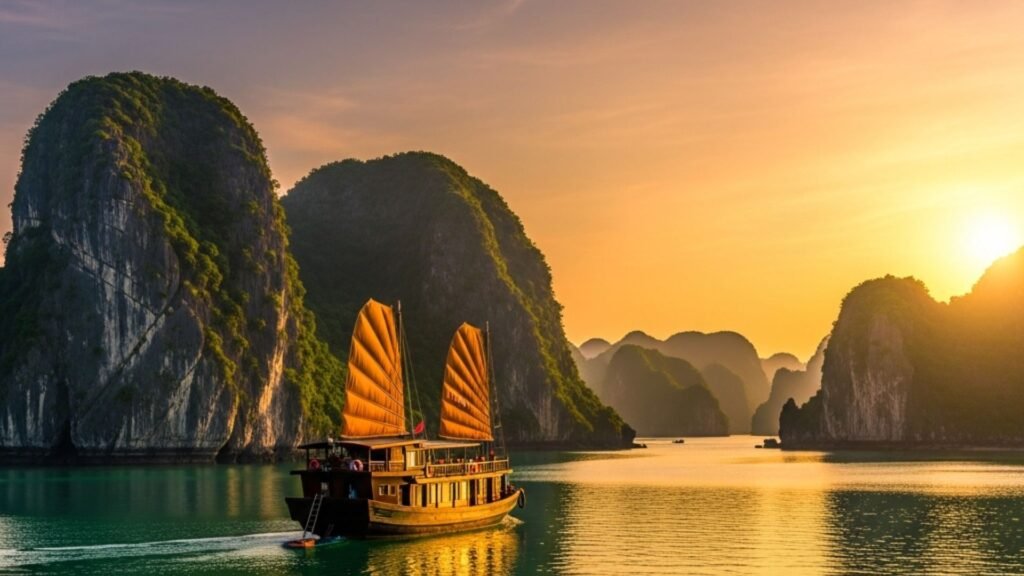
If you have ever scrolled through Instagram and seen the ethereal limestone karsts of Vietnam rising from an emerald sea, you were likely looking at Ha Long Bay. But here is the gritty reality that most travel agencies won't tell you: in 2026, Ha Long has become a victim of its own fame. It is a parking lot for multi-story cruise ships, a hub for diesel fumes, and a place where “solitude” goes to die.
As a seasoned expedition leader who has spent years mapping the Mergui Archipelago Guide: 800 Secret Islands You Must See, I have learned that the best experiences often lie just one nautical mile past the boundary of a famous landmark. That boundary, in this case, leads you to a place of silent wonder. It is time to explore Lan Ha’s Majestic Waters.
Located south of its famous neighbor, Lan Ha Bay offers 400 limestone islands that are geologically identical to Ha Long, but with a soul that remains remarkably intact. In this 2,000-word deep dive, I will explain why this is the only way to experience the Gulf of Tonkin in 2026 without losing your sanity to the crowds.
The Truth About Ha Long Bay in 2026
The decline of Ha Long Bay isn't just a matter of “too many people.” It is an ecological crisis. According to the UNESCO World Heritage Center, the site has faced extreme pressure from rapid urban development and a lack of integrated waste management. While the Vietnamese government has made strides in banning plastic on boats, the sheer volume of traffic—thousands of engines churning daily—has created a “tourist soup” that dilutes the magic of the landscape.
In 2026, visiting Ha Long Bay feels like a conveyor belt experience. You are ushered onto a boat, taken to a cave illuminated with neon “disco” lights, and then parked in a bay with 50 other vessels. It is the antithesis of “Stop Rushing”: The 2026 Slow Travel Manifesto. If you want a connection with nature, you must look south.
Why You Should Explore Lan Ha’s Majestic Waters Instead
When you choose to explore Lan Ha’s Majestic Waters, you are choosing a different philosophy of travel. Lan Ha is technically part of the Cat Ba Archipelago, which is a Biosphere Reserve. Because it is managed under different provincial regulations from Ha Long, the number of cruise permits is strictly capped. This ensures that even in the peak of the 2026 season, you can still find a horizon line that isn't broken by a skyscraper-sized cruise ship.
Pristine Isolation: Same Karsts, Half the Boats
Lan Ha Bay contains 139 small, sandy beaches—many of which are tucked away at the base of sheer limestone cliffs. Unlike Ha Long, where the few public beaches, like Ti Top, are swarmed by thousands of swimmers, Lan Ha allows for true exploration. You can find “secret” beaches that feel like pristine gems.
The geological formation here is breathtaking. These are “Fengcong” and “Fenglin” karst towers—remnants of ancient limestone platforms that have been eroded over 20 million years. To explore Lan Ha’s Majestic Waters is to sail through a prehistoric labyrinth where the only sound is the water lapping against the hull of your junk boat.
Kayaking through Dark and Bright Caves
While Ha Long offers massive “show caves” like Sung Sot, Lan Ha specializes in water-level sea caves that can only be accessed by kayak. The Dark and Bright Cave (Hang Sang Toi) is a 100-meter-long tunnel through a mountain. On the other side lies a hidden lagoon—a perfectly circular “room” of water surrounded by vertical cliffs.
Because the water in Lan Ha is significantly cleaner than in the main tourist hub, you can actually see the vibrant marine life below your kayak. This is where you practice the art of Digital Nomad 2.0 Guide: Master the Best Slow-mading Peaks, disconnecting from the grid to reconnect with the rhythm of the tides.
The Cat Ba Connection: Wildlife and Treks
One of the most significant reasons to explore Lan Ha’s Majestic Waters is the proximity to Cat Ba Island. Most Ha Long cruises start and end at a mainland pier, but Lan Ha cruises often depart from Cat Ba. This allows you to combine a sea expedition with a jungle trek.
Cat Ba National Park is home to the Cat Ba Langur, one of the rarest primates on Earth. With fewer than 70 individuals left in the wild, seeing one is a spiritual experience. This island-jungle hybrid offers a ruggedness that Ha Long cannot match. It reminds me of the wild frontiers described in our Kimberley Australia Guide: 7 Secrets to the Last Wilderness.
Logistics: How to Get to Lan Ha Bay Without the Tourist Traps
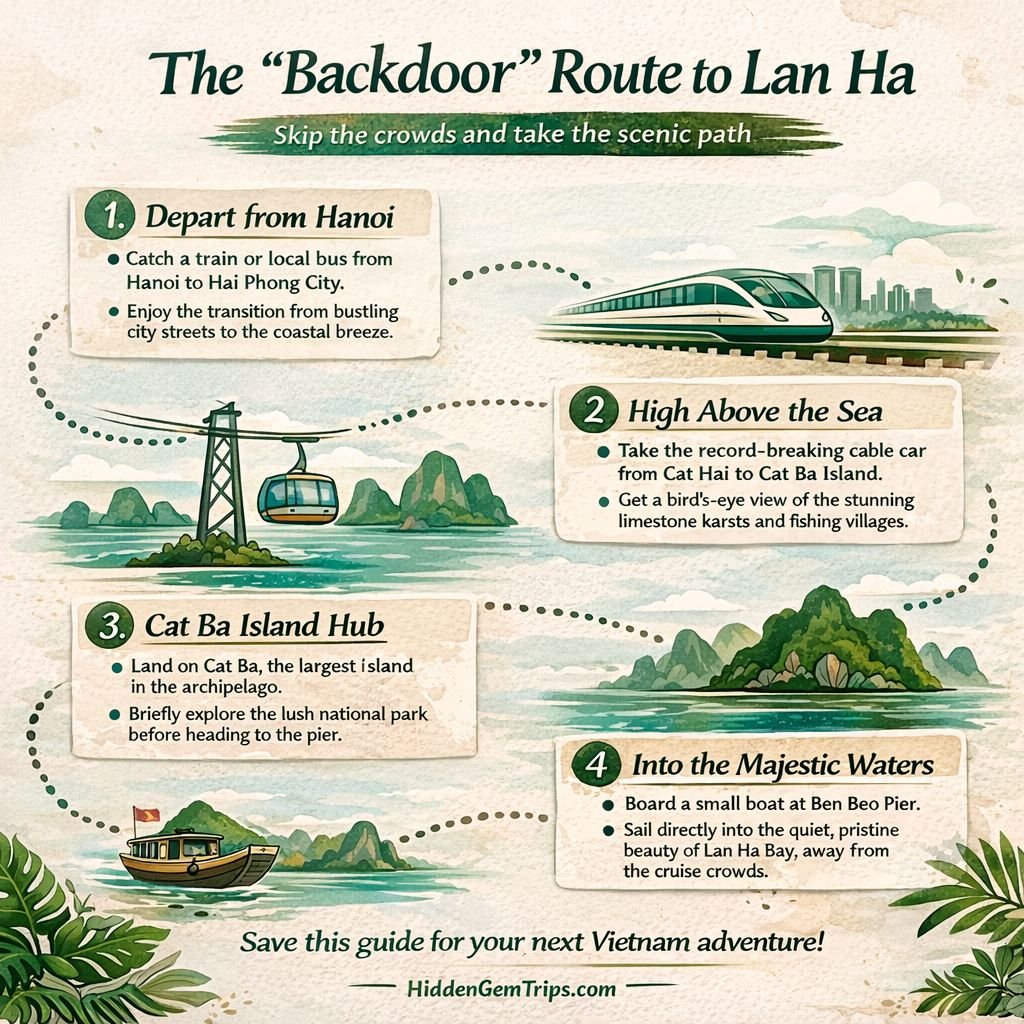
To truly explore Lan Ha’s Majestic Waters, you must avoid the “Hanoi-Ha Long” shuttle buses. Instead, follow these steps to reach the bay via the “Back Door”:
- Hanoi to Hai Phong: Take the high-speed train or a private car to the city of Hai Phong.
- The Cable Car or Ferry: From Hai Phong, take the record-breaking Cat Hai – Phu Long cable car. It offers a bird's-eye view of the fish farms and the limestone towers you are about to explore.
- Ben Beo Pier: This is the local heart of Lan Ha. Unlike the sterile international cruise terminals, Ben Beo is a bustling village of floating houses and small wooden boats.
By starting your journey on Cat Ba Island, you directly support the local economy —a core tenet of—a principle that applies globally.
Sustainable Cruising: Choosing the Right Operator
In 2026, the definition of luxury has shifted. It is no longer about gold-plated faucets; it is about environmental stewardship. When you explore Lan Ha’s Majestic Waters, look for operators that use “Boutique Junk Boats.” These smaller, wooden vessels have a lower draft, allowing them to enter shallower, more secluded lagoons that the “mega-cruises” can't reach.
Several operators in 2026 have moved toward zero-plastic policies and use biodiesel or solar power for their onboard electricity. This is essential for preserving the Deep-Sea Biodiversity of the Gulf of Tonkin.
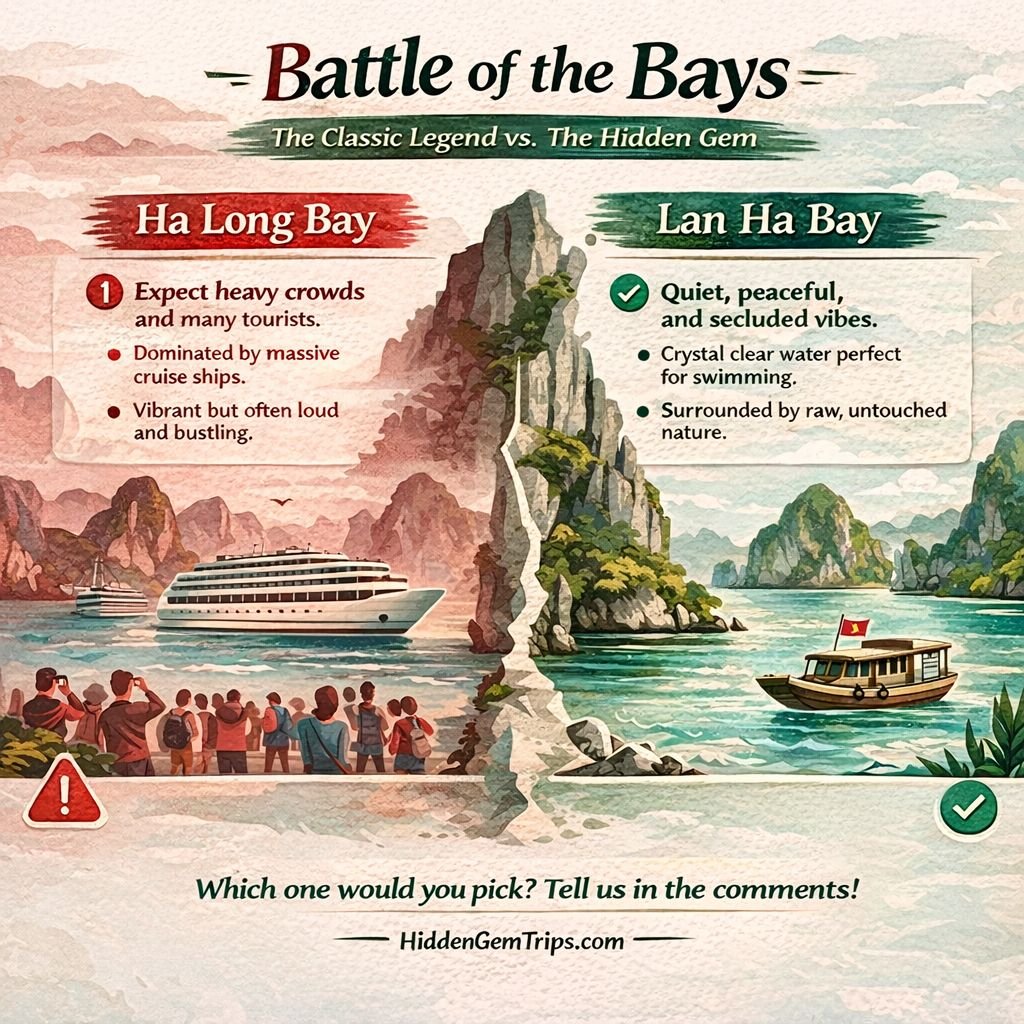
Lan Ha vs. Ha Long: A Comparative Breakdown
To help you decide, let's look at the data. I have compiled this table based on 2026 travel metrics and environmental reports:
| Feature | Ha Long Bay (The Famous One) | Lan Ha Bay (The Hidden Gem) |
| Daily Boat Traffic | 500+ Registered Vessels | ~120 Registered Vessels |
| Water Quality | Turbid (Heavy Sediment/Oil) | Clear to Emerald |
| Accommodation | High-rise “Hotels on Water” | Traditional Junks & Eco-lodges |
| Main Attraction | Massive “Mass Tourism” Caves | Secluded Lagoons & Sea Kayaking |
| Cost | Premium “Brand Name” Pricing | High Value for Money |
As you can see, Lan Ha consistently outranks Ha Long for the authentic traveler. It is the Kei Islands of Vietnam—the place you go when you want the beauty without the bill or the bother.
Conclusion: The Future of Responsible Travel in Vietnam
The choice to explore Lan Ha’s Majestic Waters is a vote for the future of Vietnam’s coastline. We have seen what happens when wanderlust goes unchecked—places like Socotra 2.0 are struggling to maintain their identity. By taking the less trafficked way of Lan Ha, you are helping to spread visitor money to local communities on Cat Ba and promoting a more sustainable type of “Blue Tourism.”
In 2026, don't be just another tourist on a crowded deck. Be the explorer who went south. Be the one who found the silence between the stones.
Frequently Asked Questions (FAQ)
1. Is Lan Ha Bay more expensive than Ha Long Bay?
Actually, it can be more affordable. Because you can stay on Cat Ba Island and hire local boats, you avoid the “package tour” premiums. It is a masterclass in Affordable Opulence.
2. Can I see both bays on one trip?
Yes, but why would you? The “border” is invisible in the water. Most high-end Lan Ha excursions will sail close to the edge, but the best views are deep inside Lan Ha.
3. Is there internet access while exploring the majestic waters?
Most 2026 cruises offer Starlink, but I recommend following the Slow Travel Manifesto and turning off your phone. You don't need to filter the karsts.
4. What should I pack for a Lan Ha expedition?
Follow our 10 Pro Secrets for Packing Light. Focus on quick-dry fabrics, reef-safe sunscreen, and a high-quality dry bag for your kayaking sessions.
5. Is the water safe for swimming in Lan Ha?
Yes. Lan Ha is significantly further from the industrial ports of Quang Ninh, making the water much cleaner for swimming and snorkeling than in Ha Long. For the best experience, visit the Deep-Sea Biodiversity areas near the outer reefs.
Disclaimer
Expeditions to remote areas of Vietnam involve travel by sea and through jungle terrain. While Lan Ha Bay is generally safe, weather conditions (monsoons) can change rapidly. Always check with the National Center for Hydro-Meteorological Forecasting before departure and ensure your travel insurance covers maritime activities.