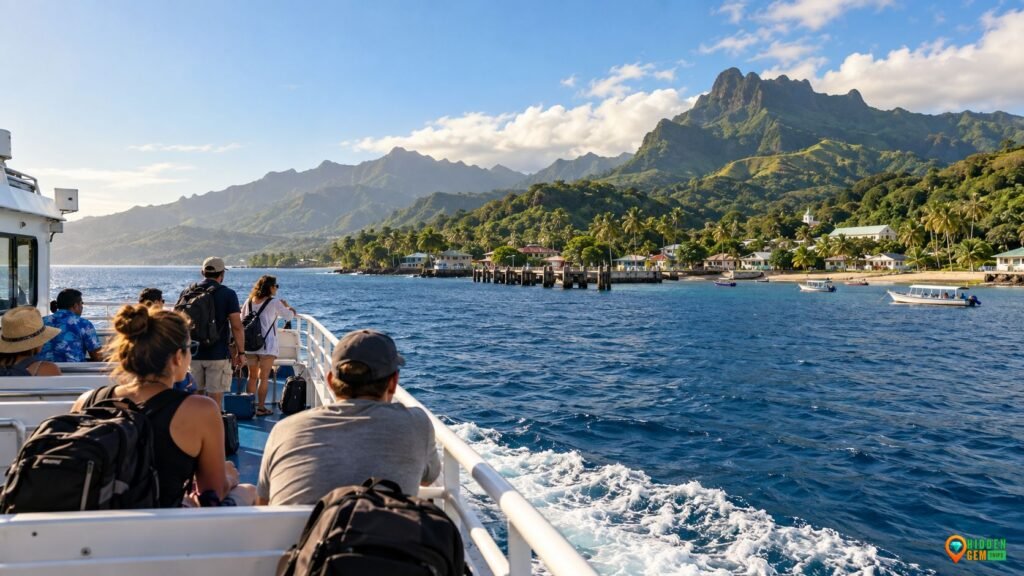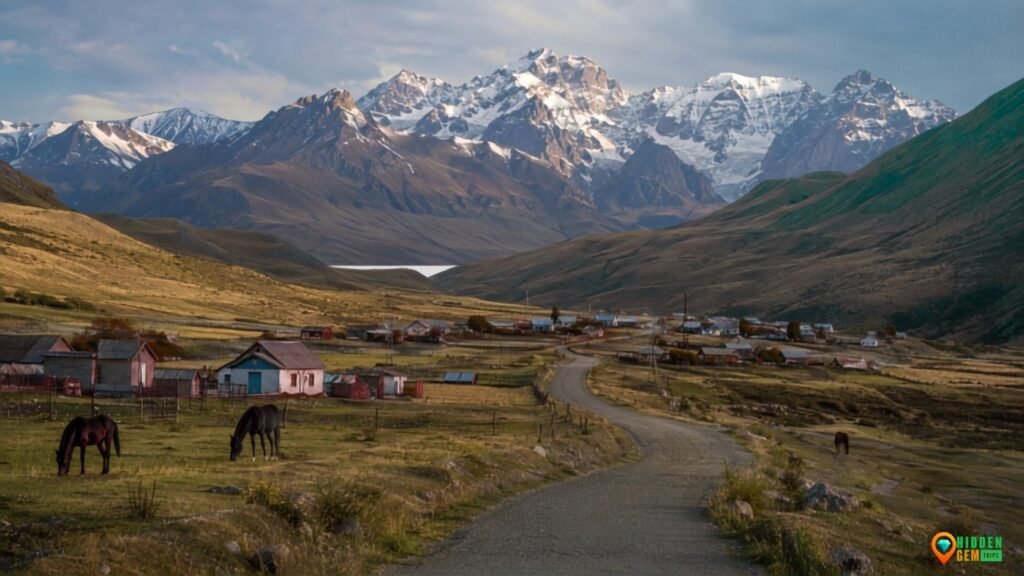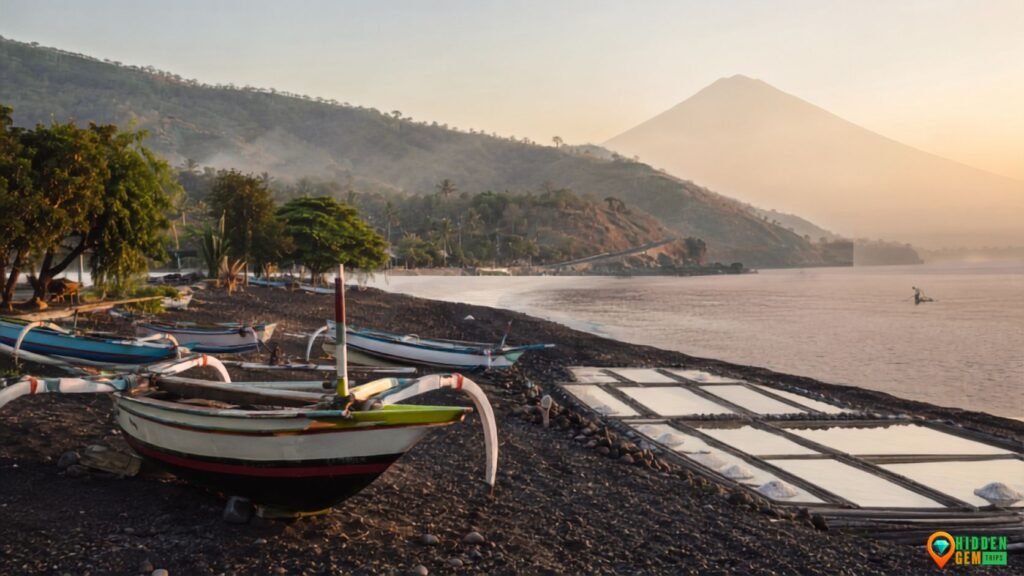

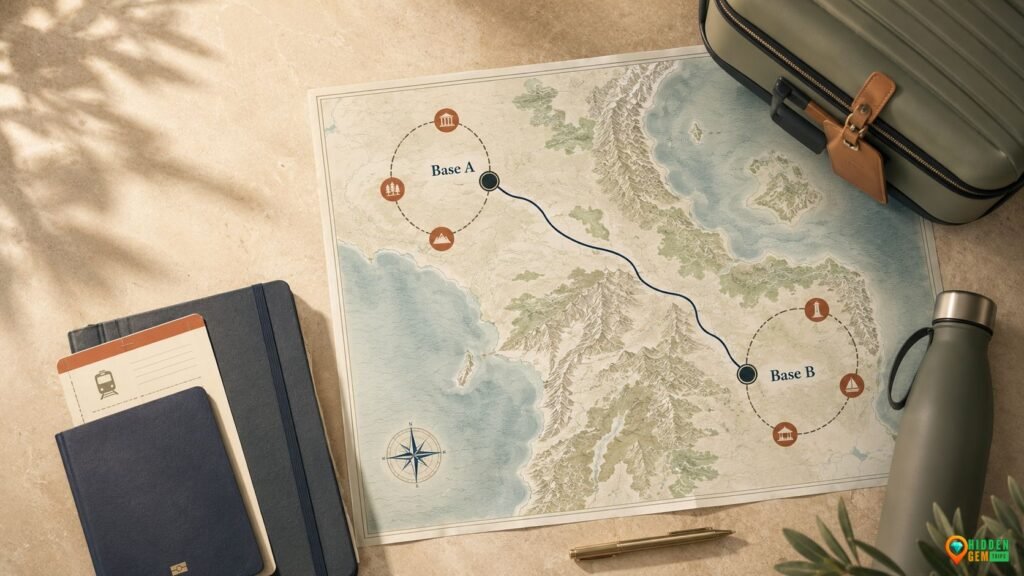
The Two-Base Itinerary Method is a simple way to build a trip around two carefully chosen places to stay instead of changing hotels every night or attempting every day trip from one inconvenient location.
The idea sounds almost too basic: choose Base A, choose Base B, and divide the trip between them. But the method is not really about the number of hotels. It is about giving each base a clear role, limiting unnecessary transfers, and creating access to experiences that would otherwise require exhausting backtracking.
A conventional multi-stop itinerary often looks efficient on a map. In practice, every hotel change creates a small administrative storm: packing, checking out, waiting for transport, finding the next property, storing luggage, checking in, locating food, and reorganizing the bag you swore was already organized.
The Two-Base Itinerary Method removes much of that noise without forcing travelers to spend an entire trip in one town. It works particularly well for journeys lasting seven to fourteen days, including coastal routes, cultural regions, mountain valleys, island trips, and city-plus-countryside combinations.
It also develops the ideas behind practical one-week travel pacing without repeating a day-by-day itinerary formula. The focus here is narrower: how to select two strategic travel hubs and make both of them earn their place in the route.
For the broader philosophy behind spending more time and attention in fewer places, read our guide to traveling slower without turning the trip into inactivity.
Affiliate disclosure: This article contains affiliate links. HiddenGemTrips may earn a commission at no additional cost to you when you make a qualifying purchase through certain links. As an Amazon Associate, we earn from qualifying purchases. Recommendations are selected for their practical relevance, not simply because a commission may be available.
What Is the Two-Base Itinerary Method?
A base is more than the hotel where you sleep. It is the operational center for a section of the trip.
A useful base gives you access to several worthwhile experiences without forcing you to repack every morning. It should offer reasonable transport, food, accommodation, and enough flexibility to survive a delayed train, rainy afternoon, low-energy day, or sudden change of plans.
Under the Two-Base Itinerary Method, the traveler chooses two bases with different functions.
Base A might provide access to a remote landscape, cultural area, island group, or mountain corridor. Base B might offer easier transport, better restaurants, a different environment, and a safer route to the departure airport or railway station.
The bases do not have to be major cities. A small coastal town and an inland village can form a strong pair. So can a regional capital and a quiet valley, a ferry port and an outer island, or a historic town and a national park gateway.
The method works when the two bases expand the trip without duplicating each other.
Staying in two neighboring beach towns with almost identical access, atmosphere, and activities is not automatically a two-base strategy. It may simply be an unnecessary hotel change wearing sunglasses.
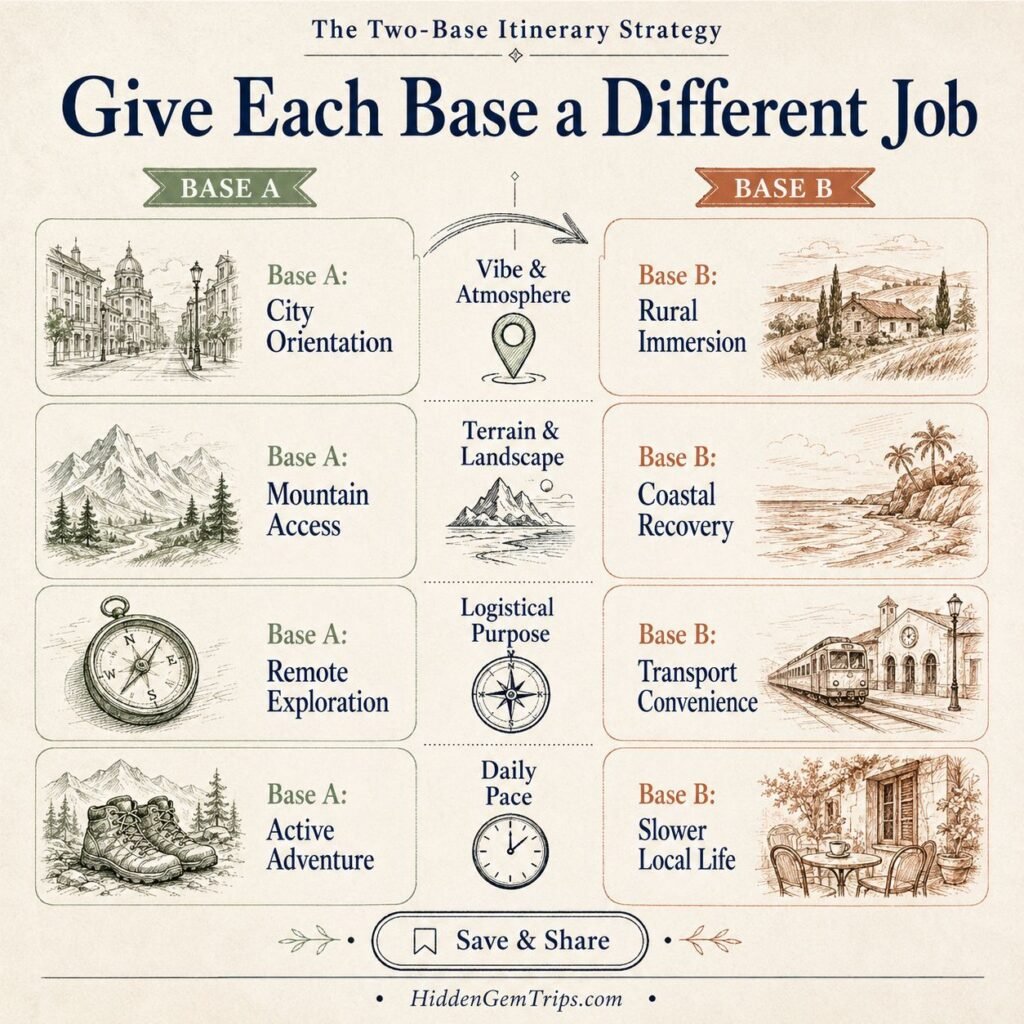
A strong pairing usually creates one of these contrasts:
| Base A | Base B |
| City orientation | Rural immersion |
| Mountain access | Coastal recovery |
| Remote exploration | Transport convenience |
| Cultural depth | Nature access |
| Active adventure | Slower local life |
| Island gateway | Inland community |
| Major sights | Quiet secondary region |
The contrast does not need to be dramatic. It only needs to create a meaningful change in access, rhythm, or experience.
Why the Two-Base Itinerary Method Works
International travel remains enormous. UN Tourism estimated that 1.52 billion international tourists were recorded worldwide in 2025, almost 60 million more than in 2024. More people traveling also means more pressure on gateways, reservations, transport systems, and popular routes. That makes thoughtful itinerary design increasingly valuable. See the official UN Tourism data on international arrivals.
The problem is rarely that travelers visit more than one place. The problem is that they underestimate the real cost of changing locations.
A train journey listed as two hours is not necessarily a two-hour transfer. You may need to check out by 10:00 a.m., reach the station, wait, board, travel, walk to the next property, store your bag, and wait again for the room to become available.
The timetable records vehicle movement. Your body experiences the entire door-to-door process.
The Difference Between Travel Time and Transfer Time
For planning purposes, separate these two ideas:
Travel time is the scheduled time spent on the train, ferry, bus, flight, or road.
Transfer time begins when you start preparing to leave the first accommodation and ends when you are settled enough at the next base to continue the trip normally.
A two-hour train can consume five useful hours. A forty-minute flight can absorb most of a day once airport access, security, boarding, baggage collection, and hotel transport are included.
The following table is not an industry statistic. It is a conservative HiddenGemTrips planning model designed to expose the time travelers frequently fail to count.
| Bases during a seven-night trip | Inter-base moves | Estimated door-to-door overhead | Likely effect |
| 1 | 0 | 0 hours | Maximum stability, limited regional reach |
| 2 | 1 | 4–7 hours | Strong balance of depth and variety |
| 3 | 2 | 8–14 hours | One to two useful days partially disrupted |
| 4 | 3 | 12–21 hours | The trip may become transfer-led |
| 5 | 4 | 16–28 hours | Congratulations, your luggage is now the main character |
The Two-Base Itinerary Method accepts one significant transfer because a second base can unlock a genuinely different area. It rejects additional moves unless they create enough value to justify their cost.
That last sentence matters. Fewer bases are not automatically better. A badly positioned single base can create hours of daily backtracking. The goal is not to minimize hotel changes at all costs. The goal is to minimize low-value movement.
The Two-Base Method Is Not Always Slow Travel
A two-base trip may still include hikes, early departures, long day trips, food tours, boat journeys, and full sightseeing days. It can be active.
The difference is that the traveler repeatedly returns to a familiar operational center. There is less administrative work, fewer luggage decisions, and more freedom to change individual activities without rebuilding the whole route.
This matters after a long journey. The CDC explains that jet lag can affect sleep, mood, concentration, and physical and mental performance. Its guidance also notes that sleep loss during travel can worsen symptoms. The CDC’s current jet lag guidance is a good reason not to schedule a heroic transfer-and-adventure combination immediately after landing.
A two-base route gives travelers time to arrive, recover, and understand the first area before introducing another environment.
Rule 1: Give Each Base a Different Job
The strongest two-base itineraries begin with function, not hotel prices.
Before searching for accommodation, write one sentence describing the job of each base.
For example:
- Base A opens up mountain villages and trailheads to us.
- Base B has food, coastal scenery, and a reliable way out.
Or:
- Base A helps us understand the region’s history and daily urban life.
- Base B gives us quieter landscapes and locally guided day trips.
A base without a distinct job usually becomes redundant. If Base B offers the same scenery, transport network, and activities as Base A, ask whether changing hotels creates any real gain.
Three questions expose weak pairings quickly:
- What can we reach from Base B that would be impractical from Base A?
- How will the rhythm of the trip change after the transfer?
- Would we still choose Base B if the hotel itself were ordinary?
The third question is brutal but useful. Travelers sometimes add a base because they found an attractive property, not because the location improves the trip. A photogenic hotel can be lovely, but it should not force the entire route to perform gymnastics around it.
Good base pairings often follow a gateway-and-depth structure.
The gateway offers arrival infrastructure, orientation, cash machines, pharmacies, transport choices, and food. The depth base offers the landscape, culture, or quieter experience that motivated the trip.
The structure can also be reversed. Travelers may begin in the remote area while their energy is high, then finish in a gateway with easier transport and a comfortable final night.
Routes such as Taiwan’s quieter east-coast corridor demonstrate why neighboring areas can deserve separate operational centers. A long, narrow region may appear simple on a map, yet realistic road and rail access can make one central hotel inefficient.
The same principle applies to Slovenia’s quieter valley regions, where a town that works for famous attractions may not be the smartest base for rural landscapes and slower local routes.
Rule 1 in one sentence: never add a second base merely for novelty; add it because it changes what the trip can realistically reach.
Rule 2: Stay Long Enough for Each Base to Become Useful
A base needs time to repay the effort required to reach it.
For most leisure trips, two nights in a base provide only one uninterrupted day. The arrival day is partially consumed by transport and orientation, while the departure day is shaped by checkout and the next move.
That does not mean every destination needs a week. It means the number of nights should be judged by usable time rather than calendar labels.
For a seven-night trip, the most reliable allocations are:
- Four nights in Base A and three nights in Base B
- Three nights in Base A and four nights in Base B
- Five nights in the experience-heavy base and two nights in an exit base, but only when the second base is deliberately used for recovery or departure
A three-plus-three split with one final airport night technically creates three sleeping locations, so it is no longer a pure two-base itinerary. It can still be sensible, but the airport night should solve a real risk rather than become an automatic habit.
For a ten-night trip, five-plus-five, six-plus-four, and four-plus-six allocations all work. The correct division depends on the number of anchor experiences, transport reliability, and whether one base supports weather-dependent activities.
Use the two-full-day test:
Would this base still be worth choosing if we had to spend two complete days there without taking the longest planned day trip?
If the answer is no, the location may be a stop rather than a base.
A good base should remain useful when the weather changes. It should have local walks, food, cultural context, short excursions, or ordinary daily life worth observing.
This is especially important in rural and island regions. A base chosen around one boat trip or one sunrise viewpoint becomes fragile. If that activity is canceled, the traveler may discover that the “destination” was actually a parking area with expensive coffee.
The village-based logic in North Bali’s quieter corners offers a useful model: choose a place that has a local rhythm, not merely proximity to a single attraction.
Similarly, a route through Morocco’s less-rushed valley landscapes benefits from bases that provide access to both scenery and inhabited places. The objective is not to sleep near every viewpoint. It is to understand a small section of the region from a position that remains useful for several days.
Rule 2 in one sentence: give each base enough nights to produce familiarity, not merely accommodation receipts.
Rule 3: Calculate the Real Transfer Tax
The Transfer Tax is the total cost of moving from Base A to Base B.
It includes more than the ticket.
Calculate it across five categories:
| Transfer-tax component | What to include |
| Money | Tickets, fuel, tolls, luggage fees, taxis, food, storage |
| Time | Packing, checkout, waiting, transport, check-in, orientation |
| Energy | Carrying bags, navigating stations, motion sickness, heat |
| Risk | Delays, missed connections, ferry cancellations, road conditions |
| Opportunity | Activities and rest sacrificed to complete the move |
Suppose a direct bus costs $20 and takes four hours. A private driver costs $80 and takes three hours. The bus appears cheaper, but the calculation changes if reaching the bus terminal requires two taxis, the departure time forces an early checkout, and arrival occurs after local transport has stopped.
The lowest ticket price is not always the lowest transfer cost.
This is where many itineraries quietly become more expensive. Travelers spend on rushed taxis, station meals, extra baggage, hotel storage, replacement toiletries, or last-minute private transport because the original transfer had no margin.
Our guide to the hidden costs travelers forget explores these secondary expenses in more detail.
When comparing base combinations, use door-to-door time and total transfer cost, not the clean number shown beside the transport icon.
A practical rule is that the Base A-to-Base B move should consume no more than one-third of a normal waking day unless the transfer itself is a meaningful experience.
A scenic rail journey, river passage, or culturally important road may deserve more time. A confusing chain of terminals, queues, and luggage negotiations does not become meaningful just because the landscape occasionally appears through a dirty window.
Label the transfer honestly:
- Functional transfer: movement required to reach the next area
- Scenic transfer: movement with significant landscape value
- Story transfer: a journey that is central to understanding the region
- Friction transfer: complicated movement that adds little to the trip
The first three can justify a second base. The fourth is a warning.
Rule 3 in one sentence: count the entire move, including the part nobody photographs.
Rule 4: Build Day Trips Around Returnability
A good base is not simply close to attractions. It allows travelers to visit them and return without turning the day into a transport endurance test.
We call this quality returnability.
An excursion has strong returnability when:
- The outward and return transport options are clear
- Missing one connection does not create an emergency
- The traveler can spend meaningful time at the destination
- The return does not require leaving before the experience becomes interesting
- A delayed return will not destroy the following day
A destination located ninety minutes away may have better returnability than one located forty-five minutes away. The difference may be frequent trains, safer roads, predictable ferries, or several alternative departure times.
Do not choose bases using distance alone.
For most travelers, a practical day-trip radius is approximately sixty to ninety minutes each way. This is an editorial guideline, not a universal scientific limit. Fast rail routes may support longer distances, while mountain roads, island boats, border crossings, or infrequent buses may require a much smaller radius.
The important measurement is the ratio between time experiencing the place and time required to reach it.
A day trip that requires five hours of total transport for two useful hours at the destination is rarely a strong use of a base. It may be better to relocate, stay overnight, or remove the excursion.
Before confirming a base, plot every priority experience and mark it as:
- Walkable
- Short local ride
- Half-day loop
- Full-day loop
- Overnight-only
- Unreliable
If several priority experiences fall into the overnight-only or unreliable categories, the current base is probably wrong.
This is one reason regional itineraries should not be designed from a list of attractive pins. Maps show where places are. They do not automatically show whether travelers can return before the last bus, whether boats operate every day, or whether the mountain road feels very different after dark.
Rule 4 in one sentence: a place belongs to a base only when visiting it and coming back still leaves enough day to enjoy being there.
Rule 5: Put the Harder Base First
In many two-base itineraries, the order should be:
- The remote, physically demanding, or transport-sensitive base
- The easier, better-connected, or departure-friendly base
This sequence uses the traveler’s early-trip energy for the more demanding section and lowers risk near the final departure.
A traveler flying home on Day 8 should not normally spend the night of Day 7 on an island that requires an uncertain morning boat, a four-hour road transfer, and optimistic faith in the weather gods.
Finishing near a reliable airport, train station, or regional transport hub creates a natural buffer. It also allows the final section to feel like a gradual landing rather than an escape operation.
The hard-first principle is especially helpful when Base A involves:
- Mountain access
- Ferry-dependent islands
- Remote roads
- Border procedures
- Wildlife trips
- Weather-sensitive activities
- Limited accommodation
- Physically demanding excursions
However, there are exceptions.
Travelers arriving after a long-haul flight may need one or two nights in an easy gateway before moving deeper. In that case, Base A can be the gateway and Base B the remote area, provided the return journey includes enough buffer before the international departure.
Use our guide to recovering more intelligently after a long-haul flight when deciding how much responsibility the arrival day can realistically carry.
A useful sequencing question is:
Where would I rather be if the final major transfer were delayed by six hours?
The answer often reveals which base should come second.
A river-oriented itinerary such as Kalimantan’s real Borneo towns may require different sequencing from a well-connected city-and-valley route. Boat schedules, road conditions, and regional flights can make the final positioning day more important than the apparent distance.
The same logic applies around Lake Toba’s village routes beyond the obvious stop. Ferry timing and road access should shape the order of the route, not merely the order in which destinations appeared on social media.
Rule 5 in one sentence: place the most uncertain movement where a delay causes less damage.
Rule 6: Protect One Flexible Day and Two Soft Transitions
The Two-Base Itinerary Method is not complete until it includes flexibility.
A good route protects:
- One flexible day or substantial half-day
- A soft arrival into Base A
- A soft arrival into Base B
A soft transition does not mean doing nothing. It means avoiding an activity whose failure would emotionally or financially damage the trip.
After reaching a base, suitable activities include:
- A neighborhood walk
- A market visit
- A short sunset route
- A relaxed local meal
- Transport confirmation
- Grocery shopping
- Laundry
- A small museum
- A café, harbor, or village orientation loop
Unsuitable activities include prepaid boat departures thirty minutes after arrival, difficult hikes without recovery time, distant restaurant reservations, or a sunset viewpoint that requires a second complicated transfer.
The flexible day absorbs real life: weather, fatigue, transport changes, stomach problems, unexpected closures, or an experience worth repeating.
This does not waste a day. It protects the rest of the itinerary.
Research on vacation recovery supports the broader principle that rest should not be treated as an accidental leftover. A meta-analysis indexed by the U.S. The National Library of Medicine discovered positive vacation effects on health and well-being but also cautioned benefits could fade once travelers return to normal routines. The PubMed-indexed research on vacation effects did not specifically test two-base itineraries, but supports the idea that the quality of recovery is what matters, not just the fact of time off.
Flexibility improves local recommendations quality as well. The best conversation, food stall, craft workshop, or village walk may not appear during online planning. A full itinerary has no room to accept discoveries. A flexible itinerary can say yes without creating a scheduling crime scene.
Rule 6 in one sentence: leave enough empty space for the destination to contribute an idea of its own.
Rule 7: Run the FRICTION Audit Before Booking
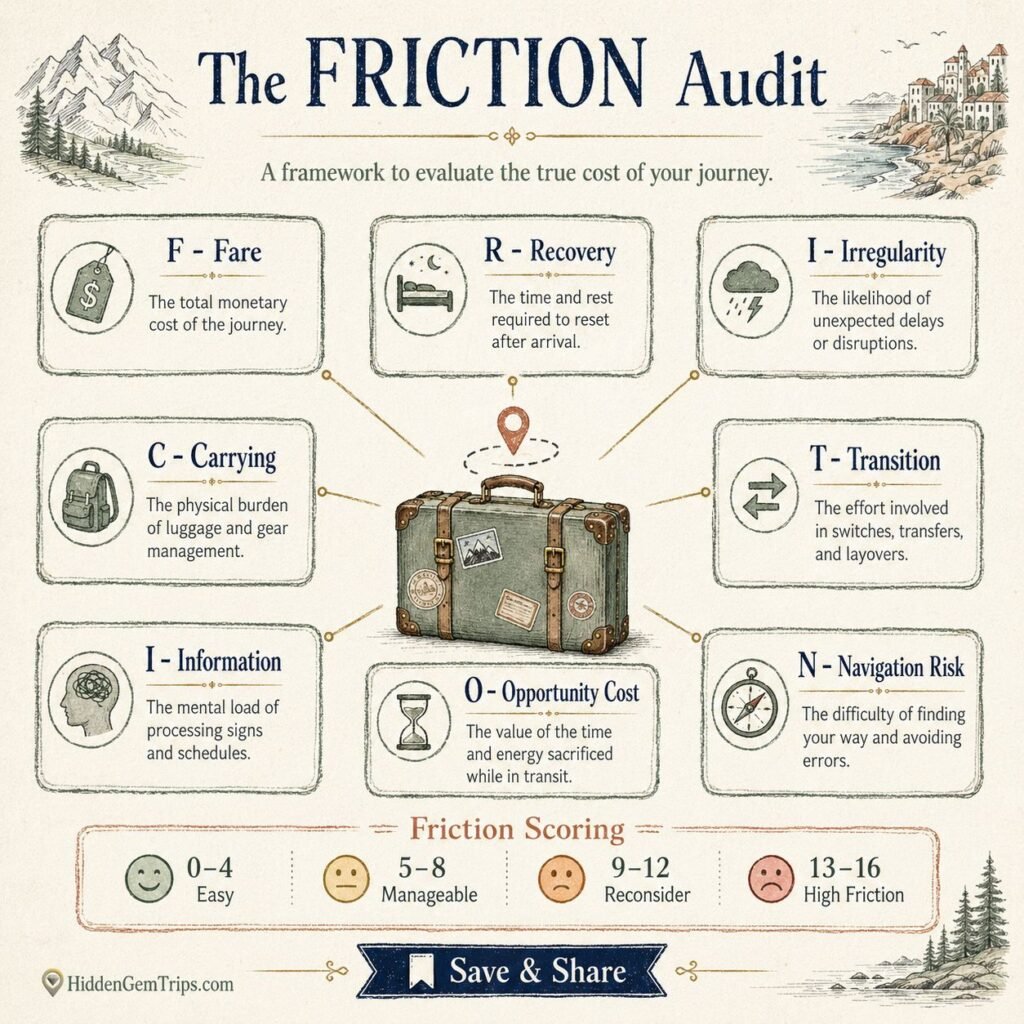
Before paying for hotels, score the transfer between the two bases using the HiddenGemTrips FRICTION Audit.
FRICTION stands for:
| Letter | Factor | Question |
| F | Fare | What is the realistic total cost for everyone? |
| R | Recovery | How much energy or recovery does the move require? |
| I | Irregularity | How often is the transportation late, cancelled or changed? |
| C | Carrying | How hard will the move be with the planned luggage? |
| T | Transition | How much packing, waiting, storing and check-in admin will you have to do? |
| I | Information | Are schedules, tickets and meeting points clear and up-to-date? |
| O | Opportunity cost | What meaningful experience or rest will be lost? |
| N | Navigation risk | How difficult is the route for a first-time visitor? |
How the FRICTION Score Works
Give each factor a score:
- 0: low friction
- 1: manageable friction
- 2: high friction
The maximum score is 16.
| Total score | Interpretation |
| 0–4 | Easy transfer; strong candidate |
| 5–8 | Manageable with planning |
| 9–12 | Add a larger buffer or reconsider the pairing |
| 13–16 | The second base probably costs more than it contributes |
This is an editorial decision tool, not a scientific transport index. Its purpose is to force honest questions before nonrefundable bookings make the itinerary emotionally difficult to edit.
Luggage often changes the score more than travelers expect. A railway station with stairs, a small ferry, a gravel road, or a ten-minute walk in tropical heat feels very different with a carry-on than with a large rigid suitcase.
Our guides to packing lighter for remote transfers, choosing useful equipment for bad-road journeys, and building a more practical island packing setup can reduce the Carrying and Recovery portions of the score.
The audit can also compare transport options.
A private transfer might score higher for Fare but lower for Irregularity, Carrying, Transition, Information, and Navigation. For two or more travelers, it may produce a lower-friction route even when the headline price is higher.
Rule 7 in one sentence: do not ask only whether the transfer is possible; ask what it demands from the entire trip.
Useful Travel Gear for a Two-Base Trip
The following items are not required, but they can reduce packing time, luggage uncertainty, and daily carrying friction. Choose only what matches the trip; buying extra gear to “travel light” is an impressively modern contradiction.
Amazon affiliate disclosure: As an Amazon Associate, we earn from qualifying purchases. Product recommendations are included for practical relevance, and availability or pricing may change.
| Travel item | Why it helps a two-base route | Amazon product link |
| Compression packing cubes | Keep Base A and Base B clothing separated and make one mid-trip repack faster | Compare compression packing cubes on Amazon |
| Portable digital luggage scale | Reduces surprise baggage fees before regional or return flights | Compare portable luggage scales on Amazon |
| Universal travel adapter with USB-C | Lets several devices recharge during short stays without carrying multiple adapters | Compare universal travel adapters on Amazon |
| Lightweight foldable daypack | Useful for day trips while the main luggage remains at the base | Compare foldable travel daypacks on Amazon |
How to Build a Two-Base Itinerary Step by Step
Step 1: Define the Promise of the Trip
Write one sentence explaining what the trip is meant to deliver.
Examples:
- A quiet coastal trip with fishing towns and two strong nature days
- A food-and-culture journey combining a regional city with farming villages
- A mountain trip with hiking access followed by a slower historic town
- An island trip with reef time, local life, and a safe weather buffer
This promise becomes the filter for both bases.
A place can be excellent and still be wrong for the current trip. Removing it is not an insult to the destination. It is simply refusing to make one vacation responsible for your entire lifetime travel list.
Step 2: Plot Experiences Before Hotels
Mark the experiences that matter most before searching for accommodation.
Separate them into:
- Primary anchors
- Secondary interests
- Optional stops
- Weather-dependent experiences
- Activities requiring reservations
- Experiences that are mainly attractive because everyone else appears to be doing them
Then group the useful locations geographically.
The clusters often reveal two natural hubs. One cluster might form around a city or transport corridor. The other may form around a valley, coast, island, or rural town.
For broader destination research, use our framework for finding quieter places responsibly rather than collecting isolated “secret spot” lists.
Step 3: Test Both Bases Against Real Transport
Do not stop after checking approximate driving time.
Verify:
- Current public transport schedules
- Operating days
- Seasonal changes
- The final return service
- Luggage rules
- Station or port location
- Road conditions
- Night-driving considerations
- Local taxi or driver availability
- Whether tickets must be reserved
- What happens when the preferred service is full
Check official operators first. Recent traveler reports can help identify practical difficulties, but they should not replace current schedules or official safety information.
A route with poor information receives a higher FRICTION score even when the vehicle journey is short.
Step 4: Divide the Nights
Allocate nights according to experience density, not equal-looking symmetry.
Base A should receive more nights when it has:
- Several important day trips
- Weather-dependent activities
- A longer recovery period
- More cultural depth
- Limited transport frequency
- A stronger local-life component
Base B should receive more nights when it provides:
- Better food and evening options
- Several short excursions
- Easier independent exploration
- A safer departure position
- Better recovery after an active first section
Three-plus-four and four-plus-three splits are usually more useful than forcing an equal division into a trip length that does not support it.
Step 5: Book in the Correct Order
Book the trip’s least flexible component first.
That may be:
- A limited flight
- A seasonal ferry
- A small property
- A guide with restricted availability
- A national park permit
- A festival or cultural event
- A rail service requiring advance reservations
Then book the two bases around that fixed point.
Avoid purchasing every activity immediately. Keep at least one day movable until weather and energy become clearer.
For international or remote trips, consider whether a practical travel protection plan fits your needs and destination. This is an affiliate link. Coverage, exclusions, availability, and eligibility must be checked directly with the provider.
The World Health Organization advises travelers to prepare for health risks before, during, and after travel and to carry important health documents, including health insurance information where relevant. Review the WHO’s travel and health guidance before departure.
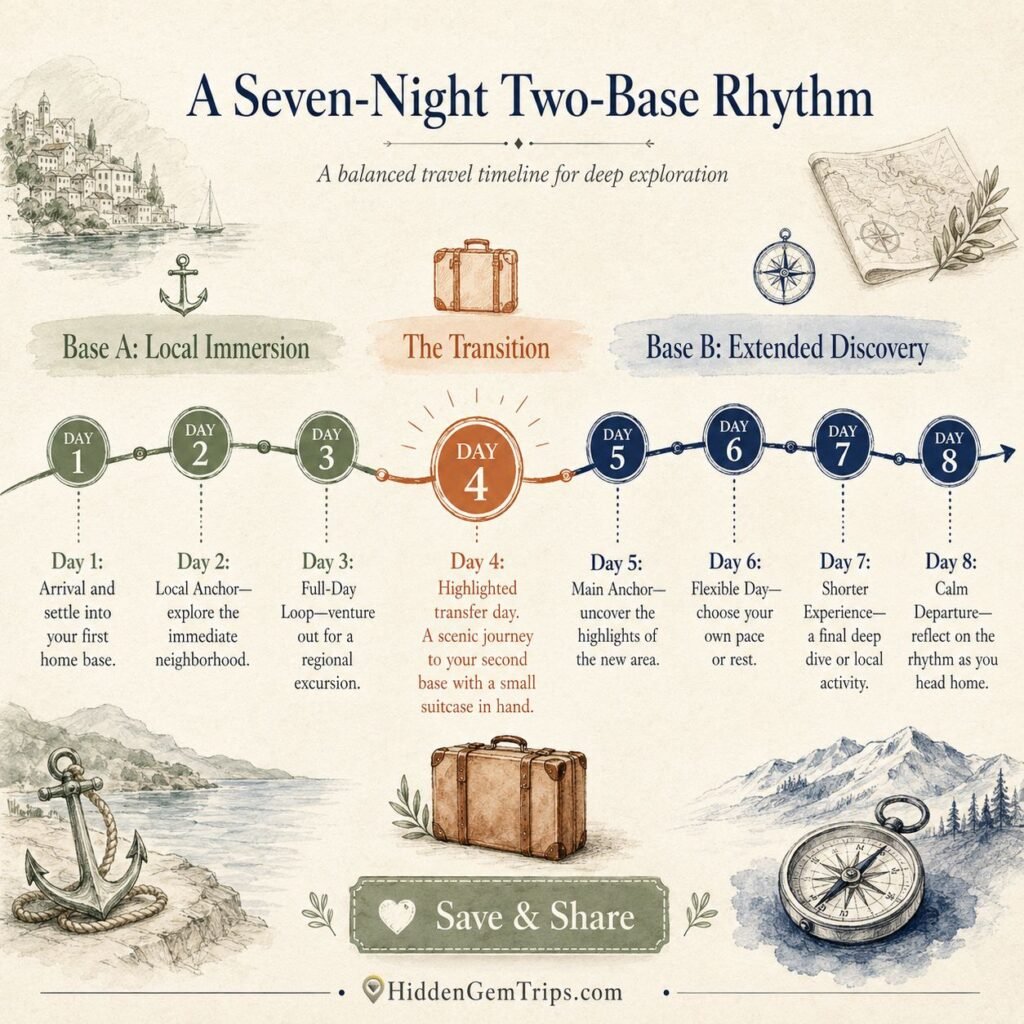
A Practical Seven-Night Two-Base Itinerary
The following template can be adapted to cultural regions, islands, valleys, and city-plus-nature trips.
| Day | Base | Recommended rhythm |
| 1 | Base A | Arrival, food, orientation walk, early night |
| 2 | Base A | Main local anchor close to the base |
| 3 | Base A | Full-day loop or physically active experience |
| 4 | Base A → Base B | Transfer, check-in, low-stakes local activity |
| 5 | Base B | Main anchor for the second area |
| 6 | Base B | Flexible day, weather-dependent trip, or local recommendation |
| 7 | Base B | Shorter experience, final meal, packing |
| 8 | Base B | Calm departure |
The template works because the major transfer occurs in the middle. Both sides receive enough time to function as genuine bases, while the final night remains in the departure-friendly location.
It is not mandatory to transfer on Day 4. A five-plus-two division may be appropriate when Base B is mainly a comfortable departure hub. Conversely, a three-plus-four division may be better when the second area has more activities.
The rule is simple: the number of nights should follow the trip’s logic, not a desire to make the table visually symmetrical.
Two-Base Itinerary Examples for Different Trip Styles
City and Countryside
Base A is a regional city with food, museums, markets, and transport.
Base B is a smaller agricultural, mountain, or village area with guided routes and quieter evenings.
This pairing works well when the city provides context and the rural base shows how the surrounding region actually lives. A route inspired by Colombia’s quieter coffee towns could use one connected town for orientation and another location for deeper farm and landscape access.
Coast and Inland Culture
Base A sits near the coast, harbor, or beaches.
Base B provides access to inland villages, food production, crafts, history, or highland scenery.
The contrast prevents a coastal trip from becoming seven visually similar beach days and prevents the cultural section from feeling like a rushed excursion squeezed between swimming plans.
Mountain Gateway and Valley Base
Base A offers transport, supplies, guides, and weather information.
Base B places the traveler inside or near the landscape.
A route through northern Laos’s river-and-mountain stops may require this logic because the most convenient arrival town is not automatically the best place for every regional experience.
Main Island and Secondary Island
Base A offers ferries, cash access, food, and easier accommodation.
Base B provides the quieter island experience.
This pairing succeeds only when the boat schedule is reliable enough and Base B has more than one worthwhile activity. Otherwise, the secondary island may be better as a day trip or removed entirely.
Remote Area and Recovery Gateway
Base A contains the demanding roads, trekking, wildlife, or river journey.
Base B provides comfortable accommodation, reliable internet, varied meals, and safer departure logistics.
This is often the best order for remote travel: meaningful difficulty first, practical recovery second.
When the Two-Base Method Is the Wrong Choice
The Two-Base Itinerary Method is useful, not universal.
Do not force it onto routes where movement is the experience.
Point-to-Point Road Trips
A road trip may naturally require multiple overnight stops because the landscape changes along a linear route. Two bases can create excessive backtracking.
The better question is whether each overnight stop supports the journey or merely breaks up an unrealistic driving day.
Multi-Day Treks and River Journeys
Treks, cycling routes, river expeditions, and sailing trips often move continuously. Attempting to preserve two fixed bases may contradict the structure of the experience.
Very Short Trips
A four-night trip may be better with one base unless the transfer is exceptionally easy and the two areas are genuinely different.
Changing hotels during a short break can leave both locations feeling unfinished.
Large Countries With Distant Priorities
Two bases cannot magically make a huge geographic plan sensible. If the priority destinations require domestic flights in opposite directions, the real solution may be two separate trips.
Trips With One Dominant Purpose
Travelers attending a wedding, conference, retreat, or major event may benefit from one stable base. Adding a second location can create unnecessary risk around the main commitment.
Regions With Weak Day-Trip Transport
A base loses value when every excursion requires a private car, long road, or uncertain connection. In that situation, a carefully planned linear route may be more efficient.
The method should serve the destination. The destination should not be bullied into serving the framework.
Budget, Safety, and Responsible Travel Considerations
Two-base planning can reduce avoidable spending, but it is not automatically cheap.
A centrally located hotel may cost more per night while saving repeated taxi fares. A private transfer may cost more than a bus while protecting a full afternoon. A rural homestay may be inexpensive but require a paid driver.
Compare the total route, not isolated prices.
The method may also distribute spending more meaningfully. Staying several nights creates opportunities to use local restaurants, guides, markets, transport providers, laundries, and small shops instead of spending most of the budget on movement between destinations.
However, staying longer does not automatically make a traveler responsible.
Before selecting a quiet community as Base B, examine whether it has appropriate accommodation, waste systems, water capacity, local consent, reliable transport, and experiences designed for visitors. Our guide to deciding whether a quiet destination is ready for tourism provides a more detailed assessment.
UN Tourism defines sustainable tourism as tourism that takes full account of its current and future economic, social, and environmental impacts, addressing the needs of visitors, the industry, the environment and host communities. Its sustainable tourism framework is a reminder that itinerary convenience should not be the only planning objective.
A responsible two-base trip should therefore:
- Use locally owned services where appropriate
- Avoid treating residential areas as unrestricted content locations
- Follow community rules and photography etiquette
- Confirm whether trails, ceremonies, beaches, and villages require permission
- Avoid publishing sensitive locations without context
- Reduce unnecessary transport while not romanticizing unsafe options
- Leave time to learn basic cultural expectations
Good pacing tends to improve behavior. Travelers who are not exhausted are more likely to listen, ask permission, spend thoughtfully, and respond patiently when local systems work differently from home.
That may not fit neatly into an itinerary spreadsheet, but it matters more than another colored cell.
Final Two-Base Itinerary Checklist
Before booking, answer the following questions.
| Question | Strong sign | Warning sign |
| Does each base have a different job? | Clear difference in access or rhythm | Similar activities and atmosphere |
| Will each base receive enough useful time? | At least two meaningful days | Mostly arrival and departure |
| Is the transfer worth its full cost? | New region or experience unlocked | Change made mainly for variety |
| Can priority day trips return reliably? | Several transport options | One fragile connection |
| Is the final base departure-friendly? | Reliable airport, rail, or road access | Weather-dependent final transfer |
| Is there flexibility? | One movable day or half-day | Every activity prepaid |
| Does the route work with realistic luggage? | Simple carrying and storage | Stairs, boats, and long walks with heavy bags |
| Can the route survive one cancellation? | Strong local alternatives | One failure ruins several days |
| Does local spending appear in both bases? | Local food, guides, stays, and services | Most money goes to transport chains |
| Is Base B truly necessary? | It changes access and understanding | It only creates another hotel photo |
A route that fails several questions should be edited before payment.
Removing a base may feel disappointing for approximately five minutes. Keeping an unnecessary base can remain annoying for an entire vacation.
Conclusion
The Two-Base Itinerary Method creates a middle ground between staying in one place for the entire trip and relocating every time a new attraction appears on the map.
Its strength comes from deliberate limitation.
Choose two bases with different jobs. Give both enough nights to become useful. Measure the entire transfer rather than the scheduled vehicle time. Build day trips around returnability. Put the more uncertain area where a delay causes less damage. Protect flexible time. Finally, run the FRICTION Audit before bookings become difficult to change.
The result is not a smaller trip.
It is a trip with fewer administrative interruptions, stronger regional contrast, better recovery, and more time inside the places you traveled to experience.
Two bases. One meaningful transfer. Far fewer mornings spent asking who packed the charger.
Frequently Asked Questions
1. How many nights should I spend in each base?
For a seven-night trip, three nights in one base and four in the other is usually the strongest allocation. A five-plus-two split can work when the second base functions mainly as a comfortable departure hub.
Try to give any experience-focused base at least three nights. Two nights usually provide only one uninterrupted day after arrival and departure logistics are considered.
2. Can I use the Two-Base Itinerary Method for a five-day trip?
Yes, but only when the transfer is short and the bases create clearly different experiences.
A three-night and two-night split may work for a city-and-coast combination connected by reliable transport. For remote roads, ferries, airports, or mountain regions, one base is often more sensible during a five-day trip.
3. Do the two bases need to be in different cities?
No. They can be two neighborhoods, villages, islands, valleys, or accommodation zones within the same broader region.
The important requirement is that changing base significantly improves access, experience, or departure logistics. Moving across the same city merely to stay in a trendier hotel does not automatically create a useful two-base itinerary.
4. Do I need to rent a car for a two-base trip?
Not necessarily. The method can work well with trains, ferries, buses, private drivers, bicycles, or a combination of transport. Public-transport routes may actually make the two natural bases easier to identify because travelers can build each section around a reliable station or corridor.
When priority locations are scattered, a rental car is handy, but the Transfer Tax needs to include parking, road conditions, insurance, tolls and one-way fees.
5. Is the Two-Base Itinerary Method applicable for families?
“Yep. Families may get an even bigger boost because each hotel change means more packing, more coordination, more planning for food, more emotional wiggle room.
Choose bases with groceries, simple meals, flexible local activities, and enough space for low-energy periods. Keep the major transfer straightforward, avoid late arrivals, and make the second base easy to reach from the final airport or station.
Travel and Affiliate Disclaimer
This article provides general travel-planning information and does not replace official transport schedules, government travel advisories, medical guidance, visa requirements, insurance documents, or professional safety advice.
Transport availability, road conditions, prices, opening hours, entry rules, weather, and local regulations may change without notice. Verify important arrangements directly with official operators and relevant authorities before departure.
Insurance products vary by country, age, residency, trip type, and medical history. Read the complete policy wording, exclusions, deductibles, eligibility rules, and coverage limits before purchasing. Some links in this article are affiliate links. HiddenGemTrips may receive a commission when readers make a qualifying purchase through those links, at no additional cost to the reader. As an Amazon Associate, we earn from qualifying purchases. Affiliate relationships do not guarantee a product’s suitability, availability, price, or insurance coverage for a particular traveler.