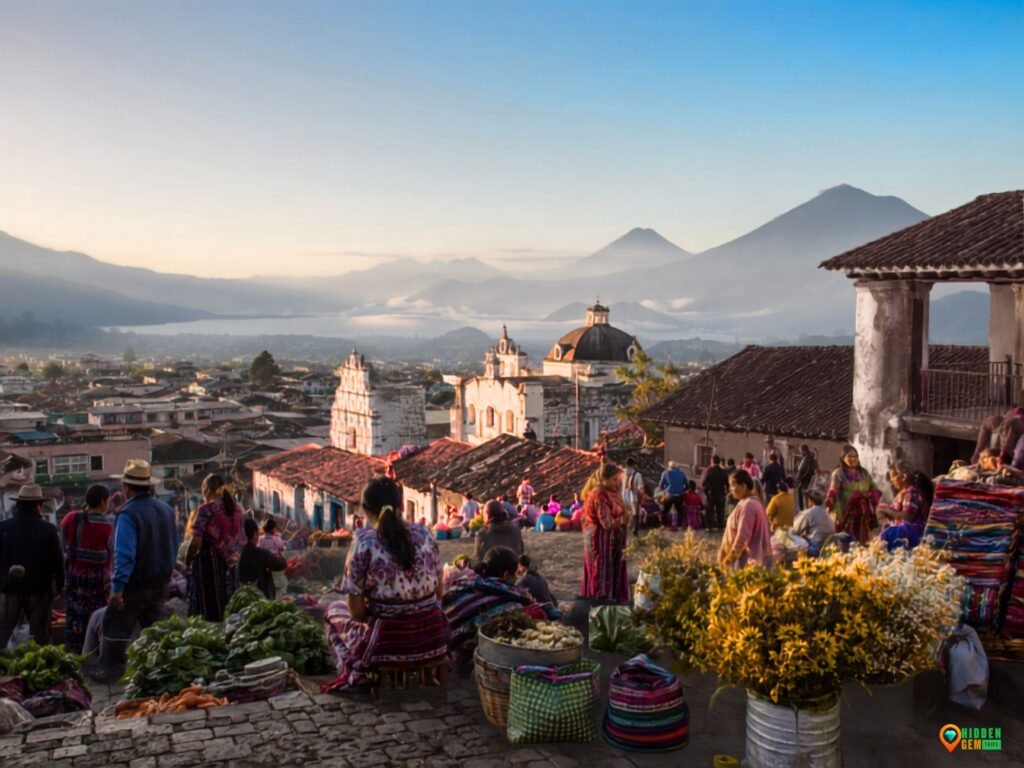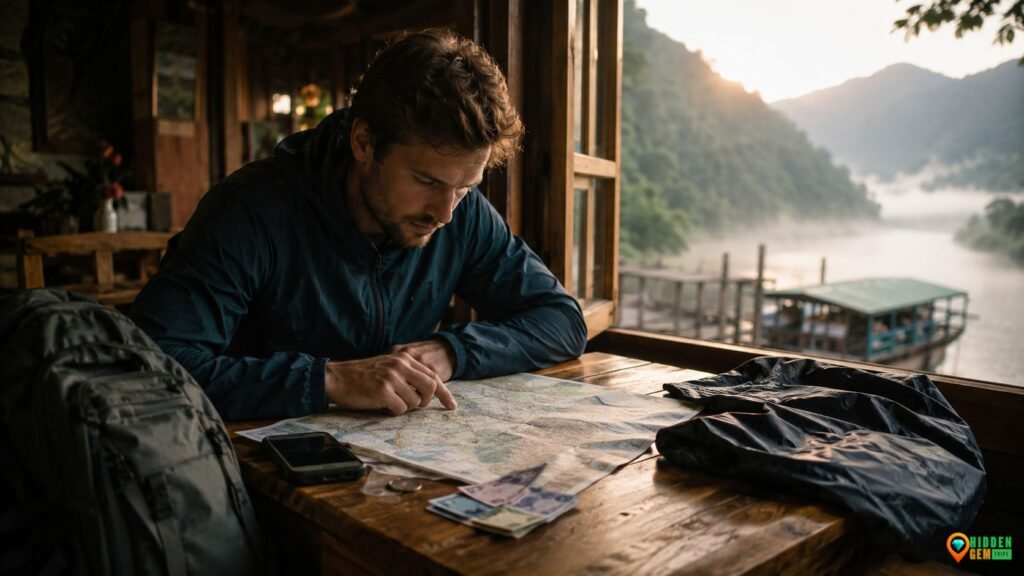

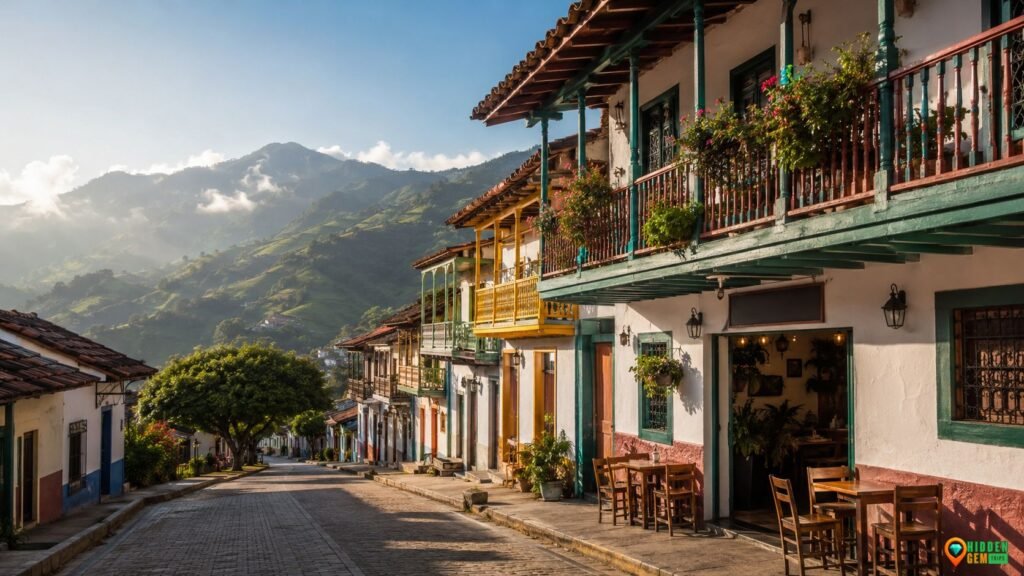
Colombia coffee towns are often introduced through the same shiny loop: land in Pereira or Armenia, rush to Salento, photograph wax palms in Cocora Valley, drink one farm coffee, and leave with a camera roll full of balconies. That can be beautiful, but it is also incomplete. The quieter side of the coffee region is not hidden because it has no value. It is hidden because its value is slower, more local, and less designed for the traveler who wants a checklist selfie before lunch.
This guide is built for travelers who want the coffee region to feel like a lived-in landscape, not a theme park with beans. The route below focuses on seven towns and small stops where coffee is still tied to family labor, mountain weather, public squares, balcony carpentry, bus schedules, and afternoon rain. Some are inside or near the UNESCO-listed landscape; others sit in wider Colombian coffee territory where the same cultural logic continues: slopes, smallholders, roadside bakeries, and conversations that rarely happen if you arrive in a rush.
The point is not to avoid every famous place. Salento, Cocora Valley, and the bigger gateway cities matter. But if the only story travelers tell about Colombia coffee towns is a postcard story, the region becomes flattened. A better route asks different questions: Where does the town wake up before the tour buses? Which cafe serves farmers, not just foreigners? Which viewpoint requires patience instead of a drone? Which coffee farm explains price, labor, climate, and water instead of only giving a cute tasting flight?
Before choosing these stops, it helps to understand the scale behind the scenery. The UNESCO-listed Coffee Cultural Landscape of Colombia includes a productive mountain landscape, six representative sites, and eighteen urban settlements that reflect coffee farming, architecture, and cultural adaptation in the Andes.
Colombia’s official tourism guide describes the coffee region across Caldas, Quindio, Risaralda, and Valle del Cauca as a place of towns, trails, mountain air, colonial facades, and coffee experiences.
The travel demand is real. ProColombia reported a record year for international visitors in 2024, with more than 6.9 million international visitors and a 12.5% increase from 2023.
Coffee itself is not a decorative background here. UPRA notes that about 549,000 coffee-growing families produce coffee across hundreds of Colombian municipalities, and most producing families are small coffee growers.
So yes, this is a travel guide. But it is also a small argument for better travel behavior. If you already read HGT with a hidden-gem mindset before you chase the next pin, this Colombia route will feel familiar: the best stop is not always the loudest stop.
Why Colombia Coffee Towns Deserve a Slower Route
A coffee town is not just a town with coffee. In Colombia, especially in the Andean coffee belt, coffee shapes the architecture, the daily timetable, the road network, the food culture, and the way families think about land. A church square may look like a pleasant place to sit, but it is also a dispatch point for motorcycles, farm workers, schoolchildren, vendors, and elderly men who know exactly which clouds mean rain before 3 p.m.
This is why the slow route matters. A fast coffee itinerary turns towns into scenic punctuation marks between one famous viewpoint and the next. A slower itinerary gives each town a chance to show its function. You notice whether the best cafe is the one with the best latte art or the one where a farmer leaves a sack on the floor while paying for breakfast. You notice whether the souvenir shops are replacing hardware stores. You notice whether the plaza is still a living room or has become a stage set.
For HiddenGemTrips readers, this guide connects directly with slow travel as a practical discipline, not a slogan. Slowness is not about doing nothing. It is about giving a place enough time to become legible.
There is also a practical reason to slow down: the roads. Coffee towns sit on folds of the Andes. Distances on a map can look tiny and still take longer than expected because roads twist around valleys, landslides occasionally affect routes, and buses follow local logic. A 32-kilometer journey can feel like a miniature expedition when fog drops and a chiva bus stops for packages, school bags, and somebody’s sack of plantains.
That is not a problem. That is the trip. The road is not dead time; it is the region explaining itself. You pass coffee plants, banana shade, bamboo groves, guadua bridges, roadside arepa stands, small churches, and sudden views that would be absurdly famous if they were in a more expensive destination. If you build a seven-day route that feels deep instead of rushed, Colombia’s coffee region starts to reward you in layers.
The key is to stop treating every town as interchangeable. Pijao is not Buenavista. Salamina is not Marsella. Jerico is not a backup version of Jardin. Each town has a different mood, elevation, road approach, coffee culture, and visitor pressure. The goal of this article is to help you choose with intention.
Quick Planning Table for 7 Quiet Local Stops
| Stop | Department | Best For | Stay Length | Why It Feels Quieter |
| Pijao | Quindio | Slow-town rhythm, architecture, coffee walks | 1-2 nights | Small scale, slower visitor flow, strong local identity |
| Buenavista | Quindio | Viewpoints, single-origin coffee, short scenic stay | Half day-1 night | Compact town, big views, fewer overnight travelers |
| Cordoba | Quindio | Rural roads, local plazas, farm landscapes | Half day | Often passed over between larger Quindio stops |
| Marsella | Risaralda | Historic streets, botanical garden, everyday coffee culture | 1 night | Close to Pereira but calmer than major gateways |
| Salamina | Caldas | Heritage balconies, mountain light, old-town atmosphere | 1-2 nights | More remote from the classic Armenia-Salento loop |
| Sevilla | Valle del Cauca | Working coffee-town life, music, long views | 1-2 nights | Less packaged for international first-timers |
| Jerico | Antioquia | Colorful streets, craft, coffee landscapes, cable-car views | 1-2 nights | Known locally, but still slower than headline destinations |
Use the table as a pacing tool, not a race sheet. Trying to “do” all seven in three days is how a slow route turns into a caffeine-fueled bus audition. A better plan is to choose three to five if time is short, or connect all seven over ten to fourteen days with proper pauses.
The 7 Quiet Local Stops in Colombia Coffee Towns
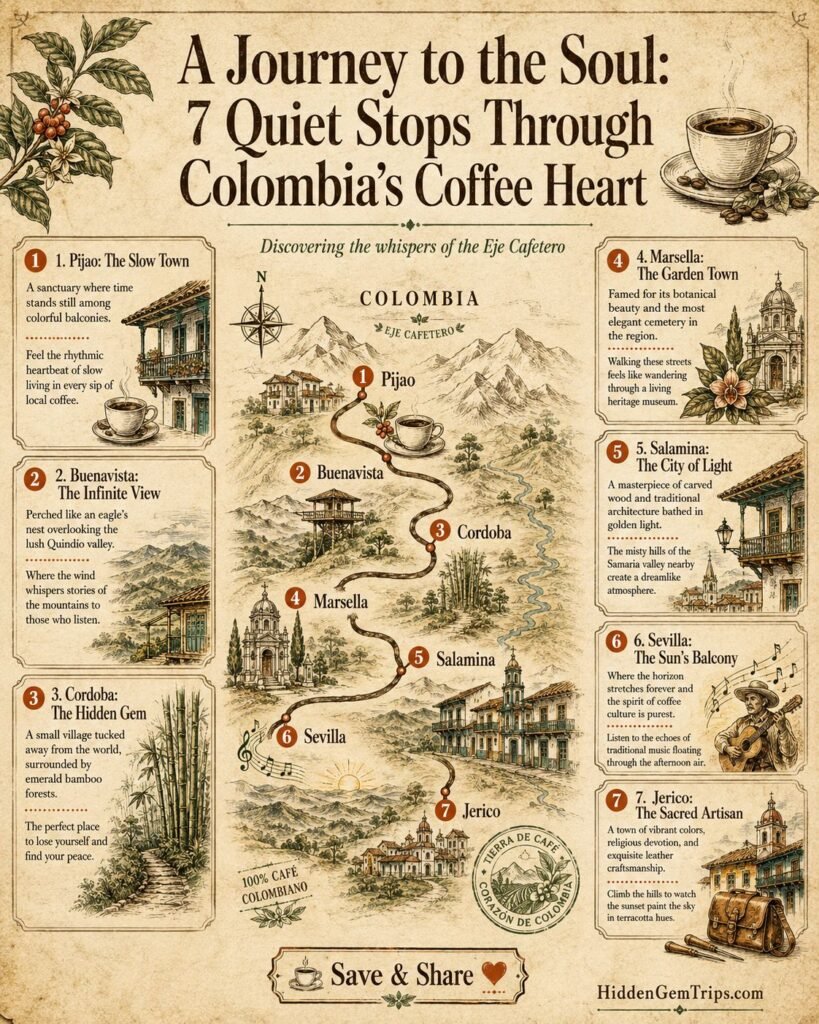
The seven stops below are not ranked from best to worst. They are arranged as a practical route logic: starting in Quindio, moving through Risaralda and Caldas, then widening toward Valle del Cauca and Antioquia. Travelers can reverse the order depending on flight prices, road conditions, and whether they start in Armenia, Pereira, Manizales, Cali, or Medellin.
1. Pijao, Quindio: The Slow-Town Test
Pijao is the town that quietly asks whether you are actually ready for slow travel. It is not a place that performs excitement on demand. Its appeal is in the way the mountains press close, the way balconies hold color without shouting, and the way the day seems to move by the temperature of the plaza. The international Cittaslow movement lists Pijao as a slow city in Quindio, and that label makes sense once you stop looking for a dramatic attraction every fifteen minutes.
The best way to experience Pijao is to arrive without stacking the day. Walk the square early. Watch how the town wakes up before visitors start asking for coffee tours. Find a small cafe and order slowly. Ask where the beans come from, but do not interrogate the barista like a detective with a reusable cup. If a farm visit is available, choose one that explains process, price, labor, water use, and harvest season rather than one that turns picking coffee into a costume photo.
Pijao is also useful because it helps recalibrate expectations. Many travelers arrive in Colombia’s coffee region with a fantasy of constant lushness and perfect weather. The real version is better: mist, mud, cracked paint, loud motorcycles, soft rain, laundry on balconies, and mountain roads that make you earn every view. That texture is the point.
Stay one night if you can. The town changes after day visitors leave. Evening is when the plaza becomes less of a backdrop and more of a neighborhood. The lights come on, conversations stretch, and you begin to understand why quiet towns should not be evaluated only by their daytime photogenic value.
Pijao pairs well with nearby Buenavista and Cordoba, but do not squeeze them into a frantic loop unless you have your own transport. Public transportation can work, yet it requires patience and a willingness to let the timetable decide part of the story. For this kind of route, packing light for uneven rural transfers is not optional; it is sanity preservation.
2. Buenavista, Quindio: A Balcony Above the Coffee Slopes
Buenavista has one of those names that risks sounding too obvious until you arrive and realize it is not lying. The town sits like a balcony over coffee slopes, with views that seem to open wider than the town itself. It is small, calm, and often used as a short stop, but that is exactly why it deserves more respect. A place does not need to be large to carry a complete travel memory.
This is a good stop for travelers who want a short, focused coffee experience without giving the entire day to a packaged circuit. The most meaningful visits here are not about drinking the most expensive cup. They are about understanding why altitude, slope, rainfall, processing, and human judgment all meet inside one small ceramic cup. World Coffee Research describes Colombia as one of the top arabica exporters, known for washed arabica coffees shaped by diverse microclimates and elevations.
The town’s strongest travel moment may be simple: sit with a view, drink coffee grown nearby, and do not rush to rate the experience. Coffee culture is not a tasting note contest. Sometimes the most respectful response is to ask fewer questions, listen better, and pay the full price without negotiating like the farmer personally invented inflation.
Buenavista is also a reminder that a “quiet stop” can still be popular at certain hours. If you arrive with a private driver at the exact moment several other visitors arrive, it may feel less local. Come early or stay later if possible. Let the day-trippers move on. The town becomes more interesting when it no longer has to host a parade of quick-view travelers.
Budget-wise, Buenavista is a place where small spending choices matter. Choose local cafes, small restaurants, and locally guided farm visits. That fits with finding value without turning every choice into a bargain hunt; the goal is not to spend the least, but to spend in a way that keeps the route healthy.
3. Cordoba, Quindio: The Small Road Between Farms and Forest
Cordoba is not usually the town that gets the loudest attention, which is exactly why it belongs here. It sits in the kind of landscape that many travelers pass through while aiming for somewhere more famous. That passing-through quality is the opportunity. If you slow down, Cordoba becomes a useful window into the ordinary geography of Quindio: coffee farms, green roads, small shops, school routes, and the daily practicality of mountain life.
The town works best as a half-day stop linked with Pijao or Buenavista. It is not a place where you should demand a long list of attractions. Instead, treat it as a living pause. Walk the central area, look for a simple lunch, and pay attention to how the town relates to the surrounding slopes. The hidden value is in the transition: Cordoba helps connect the postcard coffee region to the working coffee region.
If you travel with a driver, ask for slow stops rather than only photo stops. If you use buses, build extra time and avoid planning a tight same-day connection. In mountainous regions, time buffers are not wasted. They are how you prevent a beautiful route from becoming a spreadsheet with scenery.
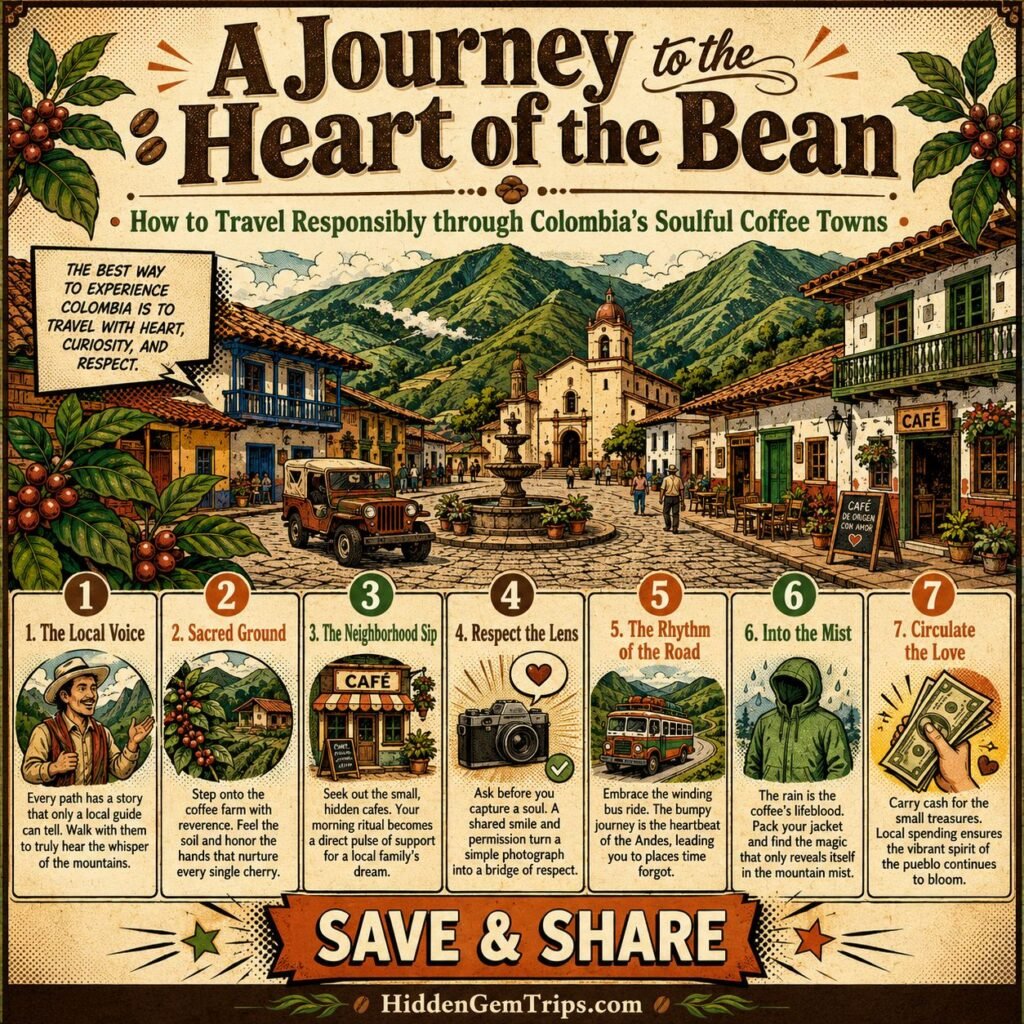
Cordoba is also a good place to practice responsible photography. Ask before taking close-up photos of people, avoid blocking small businesses for the perfect facade shot, and remember that not every balcony was built to become content. Travel writing loves the word “authentic,” but authenticity is not something locals owe us. It is something we notice when we stop performing as travelers for five minutes.
For route planning, Cordoba teaches a bigger lesson: the best hidden-gem itineraries often depend on connective tissue. Famous stops are the bones, but small towns like this are the joints. Skip every joint and the trip moves badly. HGT has explored similar logic in quiet valley travel, where why quiet places can still be complex tourism systems matters more than simply finding the emptiest road.
4. Marsella, Risaralda: Architecture, Botany, and Daily Coffee Life
Marsella is close enough to Pereira to be convenient, yet calm enough to feel like a reset after gateway-city logistics. Its streets, church square, and surrounding greenery offer a different coffee-region mood: less “look at me” and more “stay long enough and you will get it.” For travelers flying into Pereira, Marsella can be a smart first or last stop because it softens the transition between airport energy and mountain-town time.
One of Marsella’s strengths is the blend of town architecture and natural texture. You can move from the main square to botanical or garden spaces, then back into streets where the rhythm still feels local. It is a good reminder that coffee landscapes are not only farms. They include public buildings, schools, markets, gardens, roads, and the everyday infrastructure that keeps a town alive.
The ideal Marsella day is unglamorous in the best way. Start with coffee and bread. Walk without trying to “finish” the town. Visit a local garden or green space if open. Eat lunch somewhere that does not look engineered for Instagram. Spend the afternoon watching clouds change over tiled roofs. The slower you go, the more the town stops being a stopover and becomes a place.
Marsella is also a useful choice for travelers who want quieter access without feeling isolated. You are not deep in the backcountry, but you are far enough from the most repeated loop to feel the pace shift. For people arriving from international flights, it is worth building in recovery time. Colombia rewards alert travelers, not exhausted ones. That is why arriving rested after a long-haul flight can change the entire first week of the trip.
A small but important note: quiet does not mean risk-free. Ask locally about current road conditions, avoid late-night rural transfers when possible, and keep valuables understated. This is basic travel intelligence, not fear. The U.S. Department of State travel advisory for Colombia remains a useful starting point for understanding regional variation, though travelers should cross-check with local operators and their own government’s guidance before departure.
5. Salamina, Caldas: Heritage Balconies Without the Salento Rush
Salamina is one of the most rewarding towns for travelers who love architecture but do not want the whole day to feel like a queue for the same doorway. Its wooden balconies, carved details, steep streets, and mountain light create a strong sense of place. It is not unknown, but it sits outside the easiest Salento-Armenia loop, which naturally filters out some of the fastest travelers.
The town works beautifully as a one- or two-night stop. One night gives you the evening and morning mood. Two nights let you slow down, visit nearby highland landscapes, and understand why Caldas deserves more than a quick pass-through. This is the kind of town where you should resist the urge to over-plan. A good day may include coffee, a heritage walk, a viewpoint, a long lunch, a church square pause, and no heroic achievement whatsoever.
Salamina’s appeal is also historical. Towns like this show how coffee wealth, colonial-era settlement patterns, carpentry traditions, and mountain geography produced a visual language that travelers now associate with the Coffee Cultural Landscape. But the architecture should not be treated as frozen decoration. People live behind those balconies. They sweep floors, answer phones, argue with relatives, water plants, and sometimes probably wonder why strangers keep photographing their windows like they discovered wood.
For photographers and content creators, Salamina is a good ethics test. Take wide street scenes more often than invasive close-ups. Buy something before using a cafe as a set. Avoid turning older residents into props. If you want portraits, ask clearly and accept “no” without making it weird. A quiet town can absorb respectful attention; it cannot absorb endless extraction.
The road to Salamina is part of the experience, so plan it with patience. This is where how scenic roads change the pace of a whole trip becomes more than a pretty sentence. In Colombia’s coffee region, the road teaches you geography before the town teaches you culture.
6. Sevilla, Valle del Cauca: A Real Working Coffee Town With Big Views
Sevilla, in Valle del Cauca, gives travelers a different angle on the coffee story. It is not always on the first-time foreign traveler’s coffee itinerary, which helps it keep a more everyday atmosphere. The town has coffee identity, mountain views, local commerce, and a sense of scale that feels more working-town than boutique escape.
This is exactly why Sevilla is valuable. Some travelers say they want local life, then become disappointed when local life includes traffic, errands, banks, hardware shops, imperfect sidewalks, and a plaza that was not designed by a hotel stylist. Sevilla reminds you that real coffee towns are economies, not mood boards. Farmers need supplies. Young people need jobs. Families need transport. A traveler who only wants painted balconies may miss the deeper story.
Spend at least one night if you can. Walk the town, look for local cafes, and ask about nearby viewpoints or farms through reliable local contacts. If you are driving, check routes carefully and avoid treating mountain roads as casual shortcuts. If you are using public transport, confirm the last bus of the day and then confirm it again with someone who looks like they actually takes that bus.
Sevilla also belongs in this guide because it expands the idea of Colombia coffee towns beyond the most repeated social-media triangle. Quindio, Risaralda, and Caldas are central to the classic route, but Valle del Cauca is part of the official coffee landscape conversation and deserves attention that is not only attached to Cali. The broader your route, the less likely you are to repeat the same itinerary everyone else copied from everyone else. Very efficient, very boring. Next.
Travelers on a budget should think about distribution, not just savings. Stay in locally run accommodation where possible, pay for guides when they add real interpretation, and eat in town rather than hauling every snack from a city supermarket. That pairs well with local budget habits that keep money closer to the ground, especially in regions where small purchases add up for families.
7. Jerico, Antioquia: Color, Craft, and Coffee Beyond the Usual Axis
Jerico is more known than some stops on this list, but it still earns a place because it gives coffee travelers a wider Antioquia chapter beyond the standard Coffee Axis. The town is colorful, walkable, creative, and surrounded by mountain landscapes where coffee is part of the rural identity. It can be more polished than Pijao or Cordoba, but it still rewards slow travel when you leave space for side streets, markets, craft shops, and quiet viewpoints.
The key with Jerico is timing. Weekends and holidays can make almost any beautiful Colombian town feel busier. Midweek mornings are better for a softer rhythm. Start early, walk before shops fully open, then return to the center when the town wakes up. Look for locally made crafts, try regional food, and ask about coffee experiences that do not require a large group.
Jerico is especially useful as a final stop if your wider itinerary connects to Medellin. It gives the trip a satisfying closing note: color, hills, coffee, craft, and a sense that Colombia’s coffee culture is not locked inside one famous corridor. If Salento is the headline, Jerico is a different chapter. Read both and the story gets better.
This stop also works for travelers who care about creative communities. Coffee towns are not museums of rural nostalgia. They are places where younger residents may be opening cafes, design shops, small lodgings, and local tour projects while older generations maintain farms and household traditions. The best travel behavior is to support that continuity without demanding that the town stay “unchanged” for your aesthetic pleasure. Nobody wants to be trapped in your sepia filter, bos.
For travelers continuing across Latin America, Jerico can also help you compare coffee landscapes with other mountain or coastal routes. HGT readers exploring the Americas may find it useful to think about how to read a coastline beyond its obvious postcard angle, because the same skill applies inland: look beyond the first pretty surface and ask what system keeps the place alive.
How to Build a Slow Colombia Coffee Towns Route
A smart Colombia coffee towns route starts with the gateway, not the fantasy map. The most common access points are Armenia, Pereira, Manizales, Cali, and Medellin. Armenia works well for Pijao, Buenavista, and Cordoba. Pereira works well for Marsella and connections into Risaralda and Caldas. Manizales can support Salamina or highland extensions. Cali can open the Valle del Cauca side, while Medellin pairs naturally with Jerico.
For a seven-day version, do not try to cover all seven stops unless you enjoy turning breakfast into logistics. A more humane plan is Armenia or Pereira, two nights around Pijao or Buenavista, one night in Marsella, two nights in Salamina, and one buffer night near your exit city. That gives the region time to breathe. For a ten- to fourteen-day version, add Sevilla and Jerico with enough transit space between them.
Here is the quiet-travel rule: one meaningful stop per day is often enough. A town walk, a coffee experience, a proper lunch, a road transfer, and a viewpoint already make a full day in the Andes. When travelers add three more stops, they do not become more adventurous; they become more tired with better photos and worse memories.
If you are working remotely, choose fewer bases and stay longer. Rural Wi-Fi can be fine in some lodgings and weak in others. Ask before booking, bring backup mobile data, and do not assume a mountain town owes you uninterrupted video calls. Digital nomad life in small towns requires humility. The same thinking applies to river-and-mountain travel that rewards patience: the landscape sets the tempo, not your calendar app.
Travelers driving themselves should be comfortable with mountain roads, rain, sharp curves, motorcycles, and occasional confusing signage. Travelers using buses should embrace the slower rhythm. Private transfers cost more but can make sense for families, photographers carrying gear, or travelers with limited time. Whatever you choose, build buffer time. In this region, the buffer is not inefficiency. It is the difference between relaxed travel and a tiny nervous breakdown next to a bus terminal empanada.
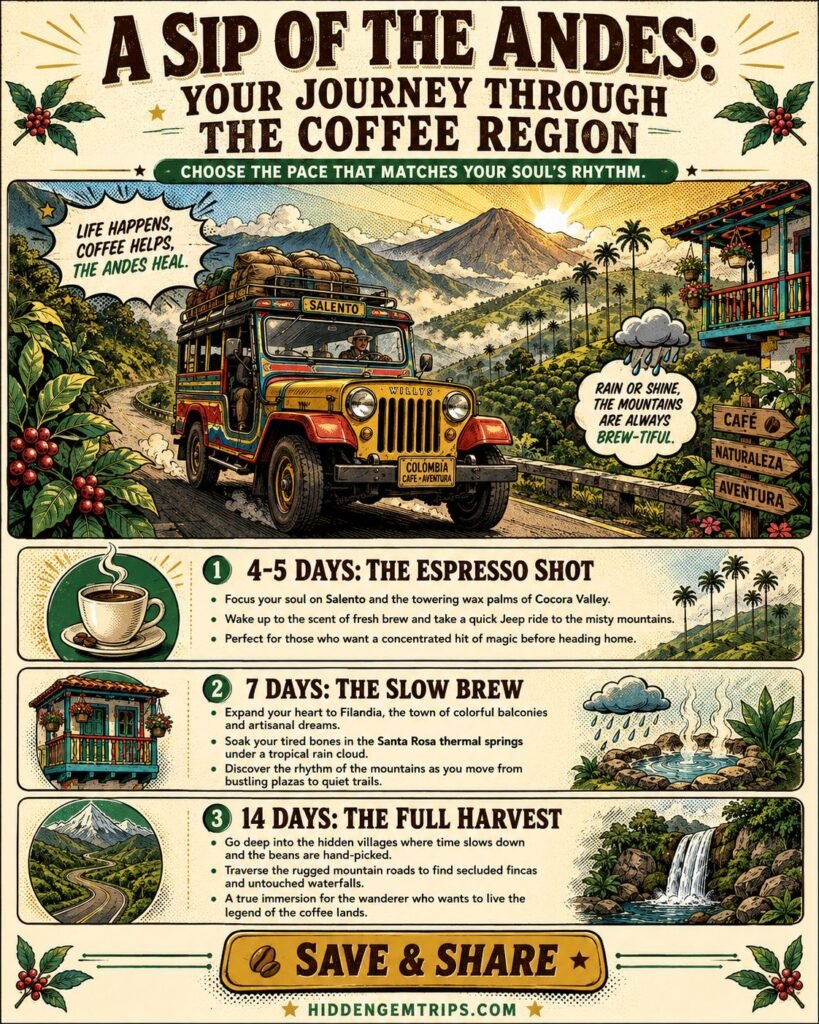
| Route Length | Best Town Mix | Who It Suits | Main Trade-Off |
| 4-5 days | Pijao, Buenavista, Marsella | First-time visitors with limited time | You skip the wider Caldas/Antioquia story |
| 7 days | Pijao, Buenavista, Cordoba, Marsella, Salamina | Travelers wanting depth without rushing | You need disciplined pacing |
| 10-14 days | All seven stops with buffer days | Slow travelers, writers, photographers, coffee lovers | More transport planning and road fatigue |
| Remote-work version | Two bases only, plus day trips | Digital nomads and creators | Less variety, more actual rest |
Responsible Coffee Travel: What to Do Before You Book a Farm Visit
Coffee tourism can be wonderful. It can also become shallow fast. A rushed farm visit often turns complex agricultural work into a cute performance: pick a few cherries, pose with a basket, drink a cup, buy a bag, leave. There is nothing wrong with a simple introduction, but travelers should remember that coffee is labor-intensive, climate-sensitive, and economically uneven. The cup may feel romantic; the work behind it is not always easy.
Before booking a coffee farm visit, ask who owns the experience, who guides it, and where the money goes. A locally owned small farm, cooperative, or community-based operator often gives a more grounded explanation than a generic tour built only for volume. Ask whether the visit includes environmental practices, processing methods, and farmer economics. If the answer is only “you will get beautiful photos,” keep looking.
Pay attention to group size. Smaller groups usually allow better conversation and lower pressure on family spaces. Avoid entering production areas without permission. Do not touch drying beans, equipment, plants, or animals unless invited. If you buy coffee, ask how to store it and whether it is roasted for local taste or export preference. Coffee is agricultural knowledge, not a souvenir with caffeine.
It is also worth asking how water is handled during washing and processing. Colombian washed arabica is globally respected, but water use and wastewater management matter. A good guide will not panic when asked about this; they will explain what they do, what is difficult, and what they are improving. Responsible tourism is not about demanding perfection. It is about rewarding transparency.
Climate is part of the conversation too. Coffee farmers around the world face pressure from changing rainfall patterns, pests, labor shortages, and price swings. The tourist version of coffee can look stable because the landscape is green. The farmer version is more complicated. If a guide mentions delayed harvests, unusual rains, or difficulty finding pickers, listen. That information is not a downer. It is the real story behind the cup.
Safety, Timing, Budget, and Transport Notes
Colombia is not one single safety reality. Conditions vary by department, road, neighborhood, hour, and current events. The coffee-region towns in this guide are generally part of well-traveled tourism circuits or adjacent rural routes, but travelers should still check current advisories, ask local accommodation owners about road conditions, avoid late-night rural travel when possible, and keep valuables low-key. Smart does not mean scared. Smart means you get to enjoy the trip without starring in your own preventable travel drama.
Solo travelers should be extra thoughtful with transfers, arrival times, and accommodation location. A beautiful cheap room outside town may not be ideal if you arrive after dark without reliable transport. Choose central lodging for the first night in a new town, save offline maps, and share route plans with someone you trust. If you want a deeper pre-trip framework, use solo safety decisions that start before the first booking as a planning lens.
The best time to visit is less about a perfect month and more about expectations. The coffee region can be rainy, lush, cloudy, bright, and muddy in the same day. Dry-season assumptions are risky in mountain climates. Bring a light rain layer, shoes with grip, quick-dry clothing, and patience. If you are carrying camera gear or laptops, waterproofing matters. Remote-road gear that actually earns its space is more useful than a suitcase full of outfits that only work on clean sidewalks.
Money-wise, Colombia coffee towns can be affordable, but do not make cheapness the personality of the trip. Pay fairly for guiding. Tip when service is strong. Buy from small producers. Use cash in smaller towns because card acceptance can vary. Carry small bills. The point is not to perform wealth; it is to avoid extracting value from places that already work hard to host visitors.
Connectivity varies. Larger towns are easier. Smaller rural lodgings may have weaker Wi-Fi, especially during weather disruptions. Download maps, booking confirmations, and translation phrases before transfers. Learn basic Spanish greetings and food words. Even a small effort changes the tone of interactions. “Buenos dias” is not advanced diplomacy, but it helps. Duolingo owl can relax.
Food is part of the route. Look for menu del dia lunches, bakeries, arepas, trout in highland areas, fresh juices, and simple breakfasts with eggs, arepa, cheese, and coffee. Do not judge every cafe by specialty-coffee standards. A town coffee counter serving farmers may not have pour-over theater, but it may tell you more about the local economy than the most polished cafe in the plaza.
What Makes a Coffee Town Feel “Quiet” Without Being Empty?
Quiet travel is often misunderstood. A quiet town is not necessarily empty, remote, or unknown. It is a place where the local rhythm is still stronger than the visitor rhythm. You can hear school bells, delivery motorcycles, church announcements, kitchen sounds, and afternoon conversations that are not staged for tourism. The town may still have visitors, but visitors do not dominate the emotional weather.
That is why the best time to judge a town is not Saturday afternoon. Visit early morning, a weekday lunch hour, or the hour after rain when streets start filling again. Those moments reveal whether the town still belongs to itself. If every storefront is a souvenir shop, every cafe has the same English menu, and every local seems to be waiting for tourists to move aside, the balance has shifted.
The seven stops in this guide are not untouched paradises. That would be lazy writing and probably false by breakfast. They are places where travelers can still find local texture if they move carefully. Some are already known domestically. Some are emerging. Some may become busier. The responsible move is not to gatekeep them dramatically, but to visit in ways that support local ownership, reduce crowd pressure, and avoid making one fragile street carry the weight of a viral trend.
This is the same reason HiddenGemTrips often argues against simplistic “skip this, go there” travel. A better question is: what kind of visitor does this place need? If the answer is “one who stays longer, spends locally, asks better questions, and does not block the sidewalk for a drone shot,” then congratulations, we have located the assignment.
Final Thoughts: Let the Coffee Town Stay Local
Colombia coffee towns are beautiful, but beauty is not the only reason to go. Go because coffee landscapes reveal how people adapt to steep land. Go because a plaza can teach you more than an attraction list. Go because small towns hold details that disappear when travel becomes a race. Go because the cup tastes different when you understand a little more about the road, the rain, the hands, and the family behind it.
The seven quiet local stops in this guide are invitations, not trophies. Pijao teaches pace. Buenavista teaches scale. Cordoba teaches connective travel. Marsella teaches everyday elegance. Salamina teaches heritage with restraint. Sevilla teaches working-town reality. Jerico teaches that coffee culture continues beyond the most obvious map.
If you visit, do not arrive like the main character of someone else’s hometown. Arrive like a guest. Stay longer where you can. Spend with care. Ask before photographing people. Choose guides who explain complexity. Let rain slow you down. Let a bus delay become part of the story. Let a town be more than content.
That is the real reward of a quiet coffee route: not that you discovered a place before everyone else, but that you learned how to travel without making the place smaller.
FAQ About Colombia Coffee Towns
1. What are the best Colombia coffee towns for a quieter trip?
For a quieter route, consider Pijao, Buenavista, Cordoba, Marsella, Salamina, Sevilla, and Jerico. They offer a broader view of coffee culture than a fast Salento-only itinerary, though each town can still feel busier on weekends or holidays.
2. Is Salento still worth visiting?
Yes, Salento can still be worth visiting, especially for first-time travelers who want access to Cocora Valley. The issue is not whether Salento is “bad.” The issue is that it should not be the whole coffee-region story. Pair it with quieter towns or visit midweek if you want a softer experience.
3. How many days do I need for Colombia coffee towns?
A focused trip can work in four to five days, but seven days is better for depth. Ten to fourteen days lets you connect Quindio, Risaralda, Caldas, Valle del Cauca, and Antioquia without rushing every transfer.
4. Do I need to rent a car in Colombia’s coffee region?
A car is not always an absolute necessity but it is useful if you want to link smaller towns efficiently. Buses and shared transport are available on many routes but involve more time and flexibility. If you are on a rural farm visit, photography trip or tight schedule, private drivers can be well worth the cost.
5. Are the Colombia Coffee Towns Safe for Travelers?
Many towns in the coffee region are frequented, but safety varies by route, time of day and current conditions. Check updated travel advisories, ask local hosts about roads, avoid late-night rural transfers where possible and keep your valuables understated. Solo travelers should pick central accommodation on arrival days and plan transfers carefully.
Disclaimer
This article is for general travel planning and editorial information purposes only. Conditions in Colombia may be subject to change due to weather, road works, security developments, local events or business closures. Always check current transport schedules, entry requirements, health guidance, safety advisories, farm-tour availability and local recommendations before booking. HiddenGemTrips advocates respectful, locally beneficial travel and makes no guarantees as to the safety, quality or availability of any particular route, operator, accommodation or experience mentioned in this draft.