
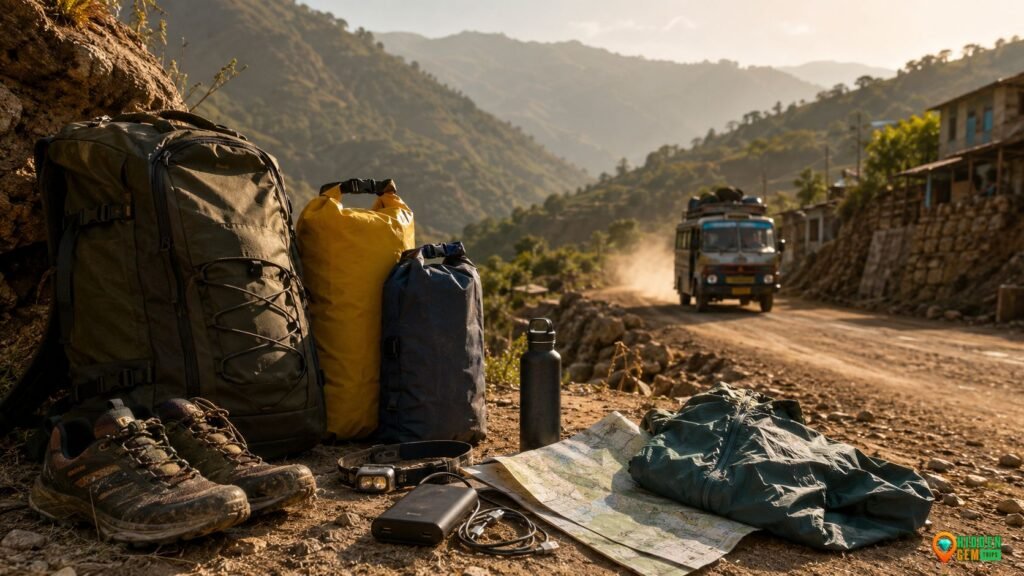
Remote travel gear is not about owning the fanciest gadgets online. It is about carrying equipment that still makes sense after eight hours on a broken mountain road, a dusty pickup transfer, a ferry delay, a village homestay with one power outlet, and a sudden rainstorm that treats your backpack like it has unresolved emotional issues. In remote places, gear is judged by use, not by unboxing drama.
The problem with most travel gear advice is that it is written for airports, city hotels, and clean sidewalks. That advice collapses quickly when the itinerary moves into highland villages, river corridors, rough island roads, or rural routes where luggage rides on roof racks and the nearest replacement cable may be several hours away. A roller suitcase that looks smart in a lobby can become tragic comedy on gravel. A single dead phone can turn from an inconvenience into a navigation, payment, translation, and safety problem. A water bottle without a treatment plan may work in a capital city, but become less convincing on a long, remote transfer.
This guide is built for the kind of traveler who reads HiddenGemTrips because they want the places beyond the obvious. It is for people planning routes such as river journeys through Borneo, highland trails in Sulawesi, remote beaches, rugged islands, mountain villages, and slow trips where culture and landscape are the focus. For broader trip planning, start with HiddenGemTrips’ practical approach to finding untouched places, then use this gear guide to ensure your packing list can withstand the realities of getting there.
The core idea is simple: pack for friction. Bad roads create friction. Remote transport creates friction. Heat, rain, dust, limited power, limited water, confidence issues, weak signal, and unpredictable schedules create friction. Good gear does not remove adventure, but it reduces preventable suffering. That matters because the best hidden-gem trips are not about looking rugged for a camera. They are about having enough comfort, safety, and flexibility to actually enjoy the place when you arrive.
There is also a sustainability angle. Buying less but choosing better is often more responsible than panic-buying a pile of single-use accessories before every trip. UN sustainable tourism guidance emphasizes the environmental, economic, and social dimensions of travel, including impacts on host communities and environments. A lighter, more durable kit supports that logic by reducing waste, lowering transport burden, and helping travelers avoid unnecessary consumption in places where waste systems may already be strained. UN guidance on sustainable tourism is not a shopping list, but it should influence how we think about what we bring.
Why Remote Travel Gear Needs a Different Standard
Remote travel exposes the gap between “nice to have” and “actually useful.” In a city, you can forget something and buy a replacement within an hour. In a remote village, you may not have that option. In a city, bad footwear is annoying. On a muddy hill path after rain, it can ruin a day. In a city, a drained battery means cafe charging. On a rough road between towns, it can mean no offline map, no contact with your driver, and no camera when the landscape finally opens.
Bad roads change gear priorities in five ways. First, impact matters. Items bounce, rub, drop, and get crushed. Second, dust and water matter. Dry-season roads can coat everything in powder; wet-season roads can turn a short transfer into a mud test. Third, redundancy matters. One cable, one battery, one pair of shoes, or one water plan is often too fragile. Fourth, comfort matters more than luxury. A breathable shirt, a headlamp, a stable backpack, and dry socks can affect your mood more than a premium suitcase brand. Fifth, road safety matters.
WHO’s Global Status Report on Road Safety 2023 estimated 1.19 million annual road traffic deaths worldwide, and travelers should not treat transport risk as background noise. WHO’s road safety report is a serious reminder that the road is part of the trip, not just a line between attractions.
The World Bank’s Rural Access Index measures the share of rural people living within two kilometers of an all-season road. That metric exists because road access is not just a travel inconvenience; it shapes health, trade, education, and daily life. Travelers often arrive in remote destinations as temporary guests in infrastructure conditions that local residents navigate every day. Understanding that context helps you pack with humility rather than main-character chaos. The World Bank’s Rural Access Index provides useful background on why “remote” often means limited access, not merely beautiful emptiness.
For HiddenGemTrips readers, this matters because the best destinations often sit beyond the smoothest roads. A trip into river communities, like the routes discussed in deep Borneo river travel planning, needs a different gear logic than a resort weekend. A cultural route through Sulawesi, with its landscape of megaliths, highlands, and local life, rewards travelers who pack light, stay flexible, and respect the local pace. Remote gear is not about fear. It is about not becoming the person whose suitcase, dead power bank, and wet socks quietly hijack the itinerary.
The Bad-Road Test: How to Decide What Deserves Space in Your Bag
Before buying anything, run the bad-road test. Ask whether the item still helps when the trip includes heat, rain, dust, bumpy transport, weak signal, limited shops, and unpredictable waiting. If the answer is no, it is probably a city travel accessory wearing a fake adventure costume.
A useful remote travel item usually passes at least three of these five checks: it protects something important, solves a recurring discomfort, reduces dependence on unreliable infrastructure, works without signal or constant power, and earns its space more than once. A compact headlamp passes. A fragile desk-style gadget probably does not. A strong rain shell passes. A giant “just in case” outfit for a hypothetical rooftop dinner in a village with no rooftop bar is packing delusion with zipper teeth.
This is also where HiddenGemTrips’ packing light for remote expeditions becomes important. Remote travel is not a permission slip to overpack. Heavy luggage makes rough transfers harder, slows you down, increases stress, and can create awkward moments when local drivers or boat crews have to lift your overbuilt suitcase. The best kit is usually compact, modular, repairable, and boring in the best way.
| Bad-road pressure | What it does to your gear | Smart response |
| Vibration and impact | Cracks screens, loosens caps, breaks cheap zippers, crushes rigid luggage | Use soft-sided luggage, protective sleeves, and internal pouches |
| Dust | Gets into camera gear, chargers, zippers, clothes, and toiletries | Use dry bags, zip pouches, lens cloths, and simple dust discipline |
| Rain and mud | Soaks clothes, documents, shoes, electronics, and bedding layers | Use dry bags, waterproof shell, quick-dry clothes, and backup socks |
| Limited power | Turns phone, navigation, payments, and communication into fragile systems | Carry safe power bank, short cables, adapter, charging routine |
| Weak signal | Breaks live maps, ride coordination, translation, and booking access | Download offline maps, save documents, carry local notes and addresses |
| Long waits | Creates fatigue, hunger, dehydration, boredom, and bad decisions | Carry snacks, water plan, layers, headlamp, and small comfort items |
The 11 Remote Travel Gear Essentials You Will Actually Use
1. A Soft-Sided Travel Backpack That Can Survive Roof Racks and Dust
The first decision for remote travel gear is luggage. For bad roads, a soft-sided travel backpack or duffel-backpack hybrid usually beats a hard-shell roller. Wheels are wonderful until the road becomes gravel, mud, stairs, boat planks, uneven village lanes, or a bus roof. Hard shells can crack, scrape, and become awkward to tie down. A soft bag can fit in vehicles, sit on a roof rack, fit in small boats, and move through narrow guesthouse corridors without sounding like a plastic drum solo.
A good remote travel backpack does not need to be huge. In fact, the sweet spot for many trips is 35 to 45 liters if you pack with discipline. Look for lockable zippers, a clamshell opening, a simple harness, compression straps, a strong grab handle, and weather-resistant fabric. It does not have to be waterproof on its own, because dry bags can do that job better. The bag should be easy to carry for 15 to 20 minutes without resentment. If you hate carrying it at home, you will despise it after a hot transfer.
This is where many travelers go wrong. They buy a bag for airport aesthetics, not field handling. Remote places prioritize weight distribution, ease of access, and durability. A bag that opens fully is easier to manage in basic homestays where floor space is limited. A bag with too many external straps can snag. A bag with no internal organization becomes a black hole. The goal is not to look like an expedition guide; it is to move calmly when the driver says, “We need to go now,” and your room currently looks like a laundry explosion.
For island routes, pair this with the thinking in HiddenGemTrips’ island-trip packing strategy, especially if the itinerary mixes boats, sand, and humid rooms. For mountain or inland routes, use the same logic but prioritize dust control and carry comfort. One excellent main bag can serve both worlds if your internal organization is smart.
2. A Packable Daypack or Sling for Market Walks, Village Visits, and Detours
Your main bag is for moving between bases. Your daypack is for actually living the trip. Remote travel often involves short walks that become longer than expected: a market visit, a rice-field path, a village ceremony, a coffee road stop, a waterfall detour, or a sudden viewpoint that your driver swears is “near.” In these moments, carrying your passport, phone, water, camera, snacks, rain shell, and small first-aid items in your pockets is pure clown logistics.
A packable daypack should be light but not flimsy. It should comfortably carry a one-liter bottle, have at least one secure internal pocket, and sit close enough to the body that it does not swing around on motorbike rides or in crowded markets. A sling can work for minimalists, but it needs enough structure to protect your phone and power bank. If you carry a camera, choose a daypack with a padded insert or use a small padded pouch inside.
The daypack also helps with respectful travel. When entering villages, homes, cultural sites, or local markets, you do not want to drag a giant pack through tight spaces. A smaller bag makes you less intrusive and more mobile. It also allows you to buy local snacks or crafts without having to juggle all that stuff like a street magician having a bad day.
For slow routes, this is in line with the 2026 slow travel manifesto: go with less noise, less rush and more attention. A small daypack carries the basics so you can devote more energy to noticing the place, not managing your own gear drama.
3. Dry Bags, Zip Pouches, and Dust Control Instead of One Giant Packing Cube Fantasy
Packing cubes are fine, but remote travel needs more than neat folded rectangles. Dry bags and zip pouches create layers of protection. Use one small dry bag for electronics, one for clean clothes, one for dirty or wet items, and a few transparent pouches for cables, medicine, toiletries, and documents. This system sounds boring until rain hits the roof rack or dust sneaks through every zipper seam. Then boring becomes genius.
Dust control matters on bad roads. Fine dust can coat camera lenses, charging ports, zippers, toiletries, and clothes. A small microfiber cloth, a soft brush, and resealable bags can prevent tiny problems from becoming daily irritation. Keep charging cables in a pouch, not loose at the bottom of your bag. Keep documents in a waterproof envelope or zip pouch. Keep one emergency dry layer protected, even if everything else gets damp.
The trick is modularity. Do not create a complicated packing system that requires twenty minutes every morning. Each pouch should have a clear job. Tech. Health. Toiletries. Clothes. Wet/dirty. Documents. When you arrive tired after a rough ride, you should know exactly where your headlamp, charger, or oral rehydration salts are. Searching a chaotic bag in a dim room is not an adventure; it is avoidable nonsense.
This is especially useful on routes involving boats or remote islands, such as the conditions readers may encounter after exploring HiddenGemTrips’ Banda Islands travel guide or Moyo Island planning notes. Water and dust are not rare exceptions in these places. They are part of the operating system.
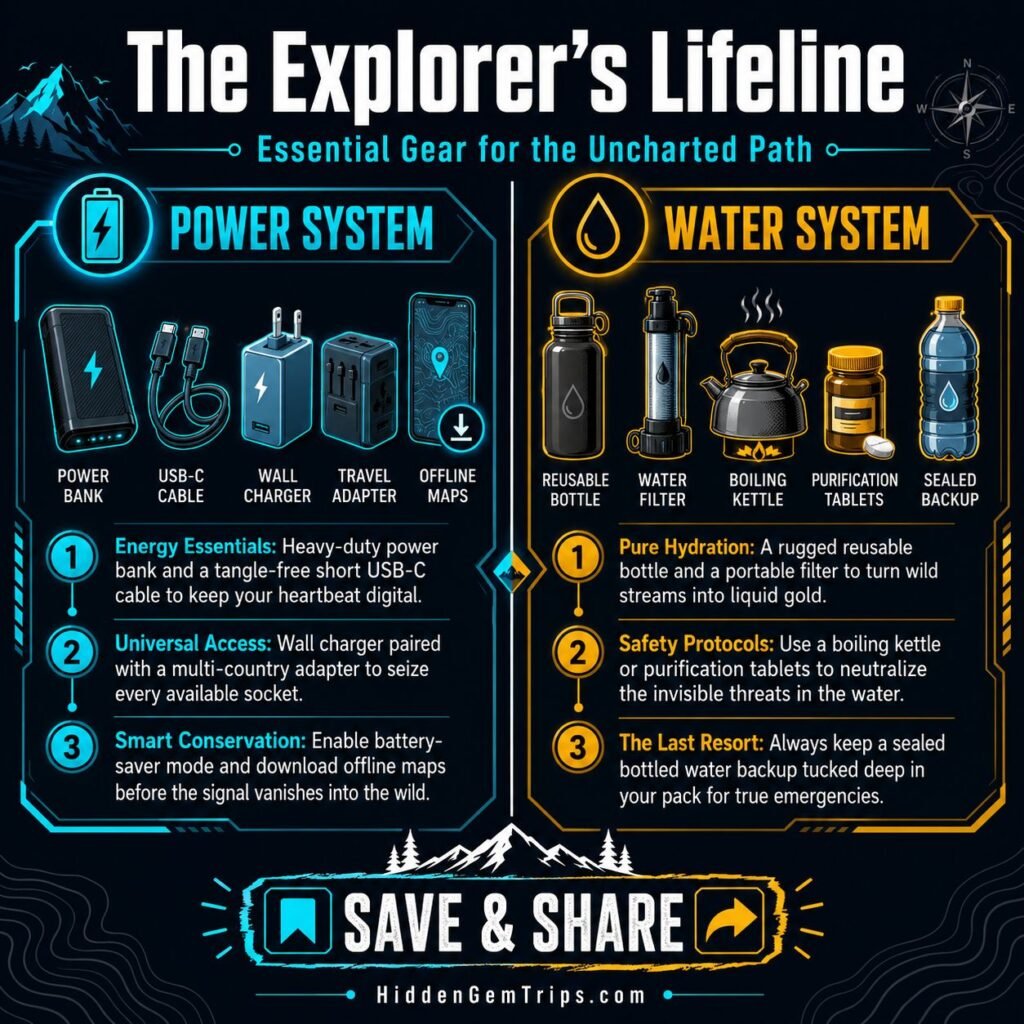
4. A Safe Power System: Power Bank, Cables, Adapter, and Charging Discipline
Remote travel gear must include a power system, not just a power bank. Your phone may be your camera, map, translator, booking folder, payment tool, emergency contact list, and entertainment during a six-hour delay. Treating power as an afterthought is asking one tiny battery icon to carry you through your entire trip. Bring a quality power bank, two short charging cables, one wall charger with multiple ports, a plug adapter if needed, and a simple habit: charge whenever reliable power appears.
Safety matters. The FAA states that spare lithium batteries, including power banks and cell phone charging cases, must be carried in carry-on baggage only, with terminals protected from short circuit. IATA also advises travelers to keep lithium-powered devices and spare batteries in hand baggage rather than checked baggage. Check the current airline and country rules before flying, as battery restrictions can change. FAA lithium battery guidance and IATA traveler battery guidance should be checked before packing, especially if you carry high-capacity power banks.
A practical setup for most travelers is one power bank under 100Wh, clearly labeled by the manufacturer, plus short USB-C cables and any device-specific connectors you still need. Avoid mystery-brand batteries with inflated capacity claims. They may be cheaper, but this is not the area to gamble. Also, avoid packing one giant cable nest. Use short, durable cables and keep them in a pouch so they do not become spaghetti with anxiety issues.
Power discipline is as important as the device. Download maps before leaving Wi-Fi. Keep your phone in battery saver during long rides. Do not use your flashlight app for long periods if you carry a headlamp. Turn off background apps you do not need. If you are on a long-haul route before the remote segment, HiddenGemTrips’ long-haul flight survival guide pairs well with this section because battery, sleep, hydration, and comfort all begin before you even reach the bad road.
5. Offline Navigation Tools That Do Not Panic When Signal Dies
Signal loss is not a travel failure. In remote places, it is Tuesday. Your navigation system should work before the network disappears. Download offline maps, save accommodation addresses, pin transport meeting points, screenshot booking confirmations, and keep important names written in the local language where possible. A phone is still useful offline if you prepare it. Without preparation, it becomes an expensive rectangle of regret.
Offline navigation also includes human navigation. Ask your guesthouse, guide, or driver to write down key place names. Save a photo of the accommodation entrance. Carry a small card with your destination and local contact number. In some areas, maps may be incomplete, road conditions may change, and local knowledge beats app confidence. The smartest travel tech is sometimes a saved note and a respectful conversation.
For hikers, motorbike routes, river transfers, or remote village visits, consider carrying a small paper backup or printed route summary. It does not need to be a full expedition map. A one-page note with town names, driver contact, lodge address, and emergency contacts can reduce stress. If you are traveling with a guide, ask what offline information they recommend carrying. Local operators often know which roads, bridges, and signals are unreliable before apps catch up.
This principle is useful across many HiddenGemTrips routes, from Sumatra to West Java weekend escapes beyond the obvious. Even when a place is not extremely remote, pockets of weak signal can appear at exactly the wrong moment. Offline preparation is small, unglamorous, and extremely adult. Annoyingly, adulting wins here.
6. A Headlamp, Not Just a Phone Flashlight
A headlamp is one of the most underrated pieces of remote travel gear. Phone flashlights work until you need both hands, want to save battery, or drop the phone while walking to a bathroom in the dark. A headlamp helps during power cuts, early departures, village paths, boat loading, guesthouse stairs, roadside repairs, night markets, and camp-style stays. It weighs little and earns its place quickly.
Choose a lightweight headlamp with adjustable brightness, a red-light mode if possible, and a rechargeable or easily replaceable battery system. Red light helps preserve night vision and is less harsh in shared rooms or quiet village settings. Keep it in your daypack, not buried in your main bag. The headlamp you cannot find in the dark is just a philosophical object.
Why not just carry a flashlight? A flashlight is useful, but hands-free light is better for travel tasks: packing, checking under beds, walking on uneven ground, handling water bottles, using a squat toilet at night, or helping someone else without sacrificing your grip. It also makes you less dependent on your phone battery, which should be protected for navigation and communication.
On wildlife-adjacent routes such as Tanjung Puting beyond wildlife cruises or remote coastal stays like Derawan’s island landscapes, light discipline matters too. Do not blast bright lights at wildlife, homes, or other travelers. Useful gear is only smart when used with respect.
7. Water Treatment Equipment for Remote Areas Bottled Water Is Not the Only Solution
Water planning is needed. In many remote areas, bottled water may be available, but depending on it alone can create plastic waste, financial problems, and hazards if delays occur. The CDC advises treating water when the safety is uncertain, noting that boiling is the best way to kill germs and that filtering followed by disinfection is the next-best option when boiling is not available. The CDC Yellow Book also recommends practicing water treatment methods before departure. Read the CDC guidance on water treatment for hiking, camping, and traveling, and the CDC Yellow Book water disinfection advice before relying on a method in the field.
A practical travel setup may include a reusable bottle, a compact filter, purification tablets or drops as backup, and awareness of what each method does and does not remove. Filters vary. Some are designed for bacteria and protozoa, but not viruses; chemical disinfectants vary by contact time and water clarity. Do not buy a filter because it looks rugged in a photo. Read its specifications and use it correctly. Remote travel is not the place to discover that your “survival straw” was mostly marketing poetry.
Boiling remains a strong option when you have access to clean fuel, a kettle, or a trusted kitchen. In guesthouses, ask politely whether boiled water is available. Many local accommodations already provide it. When buying bottled water, choose sealed containers and refill responsibly when safe, filtered water is available. The goal is not to perform wilderness cosplay. The goal is to stay hydrated without creating preventable risk or unnecessary waste.
This is especially important for hot regions, island-hopping, highland walking, and long, dusty rides. Dehydration can make every other problem worse: fatigue, headaches, poor decision-making, motion sickness, and heat stress. A water plan is comfort gear, safety gear, and sustainability gear all in one.
8. Footwear Built for Mud, Stone, Wet Boats, and Surprise Walks
Shoes can make or break a remote trip. Bad roads often lead to worse walking surfaces: gravel shoulders, muddy village paths, wet boat landings, uneven stone steps, slippery markets, and roadside stops where your “short walk” becomes a forty-minute detour. Bring footwear that can handle dirt, dry quickly, and stay comfortable after long days. Fashion-only shoes do not become practical because the scenery is beautiful.
For most remote trips, one pair of breathable trail shoes or sturdy walking shoes plus one pair of secure sandals is enough. The walking shoes should have grip, toe protection, and enough structure for uneven surfaces. The sandals should stay on your feet, not flip around like loose opinions. Avoid bringing brand-new shoes without testing them. Blisters in remote places are small villains with massive screen time.
Socks matter too. Bring quick-dry socks and rotate them. Wet cotton socks are misery factories. If the trip includes highlands, morning cold, or long walks, consider one warmer pair. Keep one dry pair protected in a pouch for emergencies. Foot comfort is not a luxury; it affects your pace, mood, safety, and willingness to say yes to the best detours.
This gear logic applies strongly to remote Indonesian routes such as Sumba’s rugged landscapes and cultural inland journeys. It also applies globally, from mountain regions to rough coastal roads. When in doubt, choose grip over glamour. The road will not care about your aesthetic. It has its own brand, and that brand is “uneven.”
9. Weather Protection That Works in Heat, Rain, Wind, and Dust
Remote weather protection is not only about cold. It is about heat, sun, humidity, sudden rain, wind on open vehicles, chilly highland mornings, and dust. A lightweight rain shell, a breathable long-sleeve layer, a compact warm layer, a hat, sunglasses, and a buff or scarf can cover a wide range of conditions without overpacking. The trick is layering, not carrying one giant jacket that only makes sense for 10 percent of the trip.
Bad roads amplify the weather. An open truck bed can feel cold at dawn and dusty by noon. A boat ride can soak your lower legs. A mountain road can shift from sun to fog. A tropical rainstorm can turn your “quick transfer” into a wet waiting game. Pack layers you can access quickly. If your rain shell is under everything in your main bag on the roof, it is not rain gear; it is a future regret.
Choose quick-dry fabrics and avoid heavy denim for remote travel days. Denim is durable but slow to dry, heavy when wet, and uncomfortable in heat. A long-sleeve sun shirt or lightweight overshirt can protect against the sun, mosquitoes, and dust while staying more breathable. A buff helps with dust, sun, sweat, and cold morning air. It is small, versatile, and dramatically less annoying than coughing up road dust for two days.
Weather gear should also respect local culture. In conservative or rural areas, lightweight, modest clothing can help travelers blend in more respectfully while staying comfortable. This aligns with HiddenGemTrips’ broader emphasis on local sensitivity when traveling in Indonesia like a local on a smarter budget, and on cultural routes where attention matters more than performance.
10. A Tiny Repair Kit That Saves Big Problems
A repair kit is not glamorous, but neither is watching a backpack strap fail on a transfer day. Carry a tiny kit with duct tape wrapped around a card or bottle, zip ties, a mini sewing kit, safety pins, a few rubber bands, a spare buckle if your bag uses one, and a small lens cloth. Add spare prescription glasses or contacts if you rely on them. Remote shops may not stock your specific solution, and the bad road does not pause for your supply chain.
The point is not to become a full-time mechanic. The point is to keep moving. Duct tape can patch a torn dry bag, temporarily secure a loose shoe sole, silence a rattling item, or protect a blister hotspot in a pinch. Zip ties can hold a broken strap, attach gear, or fix a loose cable setup. A sewing needle can repair clothing or a pouch. Safety pins can solve wardrobe and gear problems faster than dignity would prefer.
Keep the repair kit small. Overbuilt tool kits can become dead weight and may cause airport security issues if they include blades or multi-tools. Check airline rules before packing tools. For most travelers, tape, ties, needle, thread, and spare small parts are enough. The kit should fit in a pouch and be easy to find. If it becomes a heavy toolbox, you have lost the plot.
Remote trips like Yukon isolation routes or wild coastline and island planning make the value obvious, but even less extreme trips benefit. Gear failure usually happens at inconvenient times. A tiny repair kit buys time until a proper fix is possible.
11. A Practical Health and Road-Safety Kit
The final essential is a health and road-safety kit. Keep it practical: basic first-aid supplies, personal medication, oral rehydration salts, motion sickness medication if appropriate, blister care, insect repellent, sunscreen, hand sanitizer, a small pack of tissues, and any destination-specific health items recommended by a travel clinic. This is not medical advice; it is a reminder that remote travel reduces quick access to pharmacies and clinics.
Road safety belongs in the gear conversation because bad roads are not just uncomfortable; they can be dangerous. CDC Yellow Book guidance on travel injury discusses transport risk and helmet use, and WHO road safety data underscores the scale of global road trauma. If you travel by motorbike, boat, or local transport, carefully choose operators, wear helmets when appropriate, use seat belts when available, avoid overloaded vehicles when possible, and do not pressure drivers to operate vehicles more quickly. CDC travel injury guidance is a useful reference for risk awareness before international travel.
Where possible your kit should include offline emergency contacts, travel insurance details, copies of important documents and local emergency numbers. Store them digitally and physically. If you take daily medication, carry more than the exact number of doses, and keep it in your hand luggage during flights and transfers. A delayed bag or missed connection should not become a health problem.
This final category is where honest travel planning matters. Hidden-gem routes are rewarding because they demand more attention. That does not mean paranoia. It means preparing enough that you can relax. The traveler with the right small health kit, a charged phone, a water plan, and a realistic road mindset is freer than the traveler with an overloaded suitcase and vibes as their only strategy.
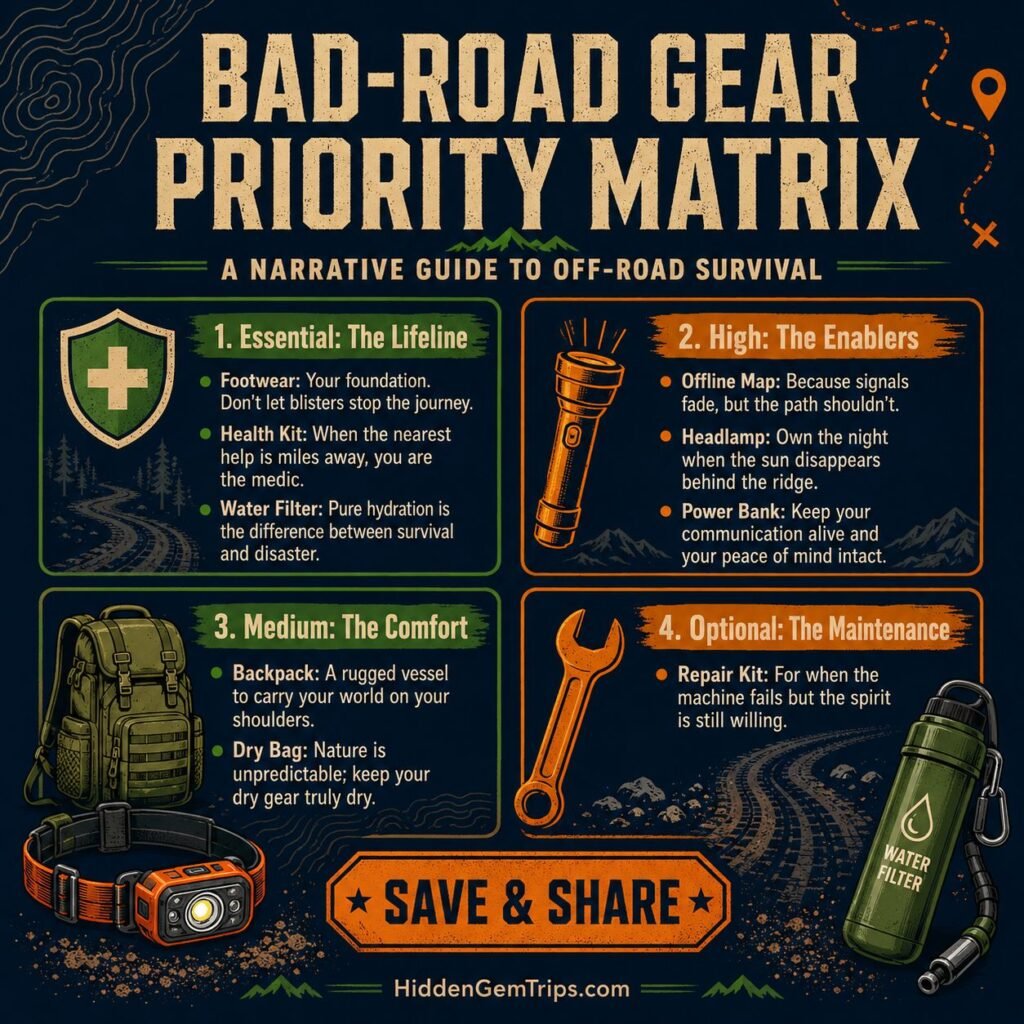
Remote Travel Gear Priority Matrix: What to Pack First
Not every traveler needs the same kit. A photographer, a solo traveler, a family, a motorbike traveler, and a slow traveler staying mostly in homestays will prioritize differently. But the priority matrix below helps separate “must pack” from “only if relevant.” Use it before shopping. Your backpack is not a shopping cart with shoulder straps.
| Priority | Gear category | Why it matters on bad roads | Pack recommendation |
| Essential | Soft main bag | Handles roof racks, small vehicles, stairs, boats, and uneven paths better than rollers | 35-45L backpack or duffel-backpack hybrid |
| Essential | Power system | Protects navigation, communication, translation, payment, and camera use | Quality power bank, short cables, multi-port charger, adapter |
| Essential | Water plan | Reduces dehydration and reliance on single-use bottled water during delays | Reusable bottle plus filter or purification backup |
| Essential | Footwear | Improves safety and comfort on mud, stone, gravel, and wet surfaces | Tested trail shoes plus secure sandals |
| Essential | Light source | Supports power cuts, early departures, basic bathrooms, and night walks | Small headlamp with extra charge or batteries |
| High | Dry/dust organization | Protects electronics, clothes, documents, and toiletries | Dry bags, zip pouches, waterproof document sleeve |
| High | Health kit | Remote areas may have limited pharmacies and slower medical access | Medication, ORS, blister care, first aid, sunscreen, insect repellent |
| High | Offline navigation | Signal gaps can break live maps and coordination | Downloaded maps, screenshots, printed/local notes |
| Medium | Repair kit | Prevents small failures from becoming itinerary problems | Tape, zip ties, safety pins, needle/thread, spare glasses |
| Medium | Camera protection | Dust, vibration, and rain can damage lenses and devices | Padded pouch, dry bag, lens cloth, silica gel |
| Optional | Luxury comfort item | Can improve long waits but must earn its space | Small scarf, inflatable pillow, e-reader, compact snack box |
Three Packing Setups for Different Remote Trips
The same principles for remote travel gear can be adapted to different trip styles. Below are three sample setups that keep the article useful beyond one destination. Use them as frameworks, not rigid rules.
Setup 1: The remote village and highland road kit.
Good for mountain villages, coffee roads, inland cultural routes and rural homestays. Emphasize walking shoes, breathable layers, rain shell, daypack, headlamp, offline maps, water treatment, dust pouches and a respectful clothing system. Pack a small warm layer for highland mornings. This kit fits the mindset behind routes like HiddenGemTrips’ underrated Indonesia destinations where access and culture matter as much as scenery.
Setup 2: The river, island, and boat-transfer kit.
This setup emphasizes dry bags, sandals with grip, quick-dry clothes, waterproof document storage, reusable bottle, seasickness support if needed, and electronics protection. It works for island hopping, river corridors, and coastal routes. Readers exploring Mahakam river travel, Banda Islands planning, or Derawan island routes should think in layers of water protection rather than relying on one “water-resistant” backpack claim.
Setup 3: The long-transfer slow travel kit.
This setup is for travelers moving slowly through several bases with long bus rides, shared vehicles, ferries, or rural roads. Prioritize comfort and redundancy: power system, snacks, water, layers, neck support, offline entertainment, headlamp, and a tiny repair kit. The goal is to arrive functional enough to enjoy the destination. It pairs naturally with HiddenGemTrips’ mid-range hidden-gem travel strategy because value is not only about price; it is about spending where it improves the actual trip.
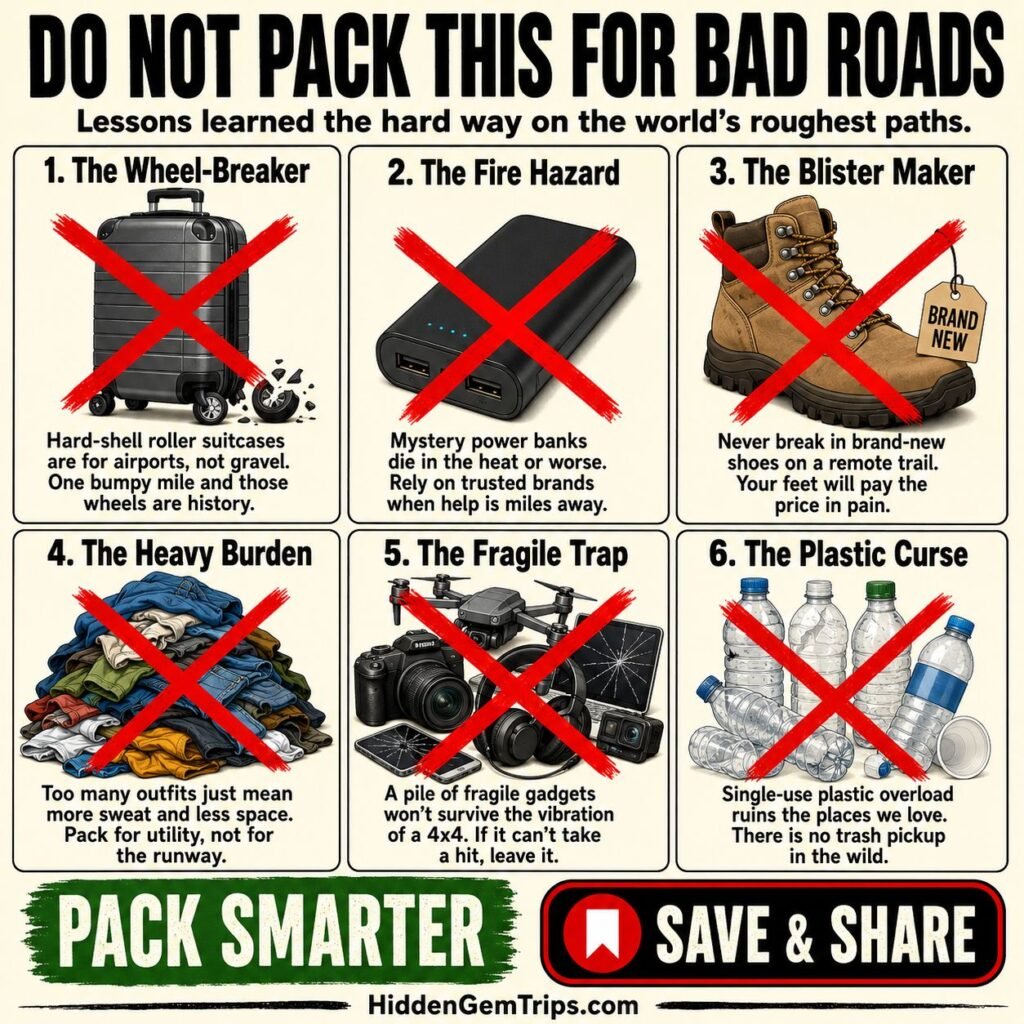
What Not to Pack for Remote Places with Bad Roads
Do not pack a giant hard-shell suitcase unless your itinerary is mostly paved and vehicle-assisted. Do not pack fragile gadgets that need perfect conditions. Do not pack five outfits for imaginary scenarios and zero dry socks for real ones. Do not pack one cable. Do not pack a mystery power bank with no visible capacity label. Do not pack new shoes and assume your feet will emotionally adapt. Feet do not care about optimism.
Avoid over-specialized gear unless the trip clearly requires it. Many travelers buy tactical-looking equipment for routes that simply need a good daypack, water plan, rain shell, and sensible shoes. Tactical overload can also look out of place in villages and cultural settings. Remote travel is not a costume. Good gear should make you quieter, lighter, and more capable.
Avoid bringing items that create local waste problems. Single-use wipes, disposable ponchos, cheap broken gadgets and excess plastic packaging can become a burden in places where waste infrastructure is limited. If you bring it in, be prepared to carry it out or dispose of it responsibly. Responsible gear begins before the trip and continues after the item breaks, runs out, or becomes inconvenient.
Responsible Gear Choices: Buy Less, Use Longer, Travel Lighter
A better remote travel kit is not necessarily more expensive. It is more intentional. Buy less, test before you leave, fix what you can, choose hard-wearing basics over trend-driven gadgets. Remote travel already asks a lot from host communities: roads, transport, water systems, waste management, local guides, and accommodation networks. Your gear should reduce strain, not add to it.
The responsible approach is to build a core kit over time. Start with luggage, shoes, water, power, and rain protection. Add specialized items only after real trips reveal a need. Borrow or rent when appropriate. Reuse what you already own if it works. A worn-but-reliable rain shell is better than a new one bought for aesthetics and abandoned after one reel.
This mindset fits the larger HiddenGemTrips editorial approach: travel beyond the obvious, but do it with respect. Whether the trip is a cultural highland route, a remote beach, a river village, or a mountain valley, the goal is not to conquer the place. The goal is to arrive prepared enough to listen, observe, support local economies, and leave fewer traces. Gear should serve that goal.
Conclusion: The Best Remote Travel Gear Is the Gear That Disappears Into the Trip
The best remote travel gear is not the gear you talk about all day. It is the gear that quietly works. The bag carries well. The shoes grip. The dry bag protects your clothes. The power bank keeps your phone alive. The headlamp saves your battery. The water plan keeps you hydrated. The repair kit fixes a small failure before it becomes a big one. The health kit sits quietly until needed. Nothing screams for attention, and that is exactly the point.
Remote places with bad roads reward travelers who prepare without overperforming. Pack light, but not carelessly. Pack smart, but not paranoid. Choose gear that enhances safety, comfort and respect. Then let the destination become the story, not your luggage problems.
A final test: if an item helps you handle dust, rain, weak signal, limited power, rough transport, basic rooms, long waits, or respectful village visits, it probably deserves space. If it only helps you look prepared, leave it behind. The road will quickly expose its fake usefulness, and it has no customer service department.
FAQ
1. What is the most important remote travel gear for bad roads?
The most important items are a soft-sided backpack, tested footwear, a safe power system, a headlamp, dry/dust protection, a water plan, and a basic health kit. These solve repeated problems rather than one rare scenario.
2. Is a hard-shell suitcase bad for remote travel?
Not always, but it is often less practical on rough roads, stairs, boats, gravel lanes, and roof-rack transport. For remote places with bad roads, a backpack or duffel-backpack hybrid is usually easier to carry and protect.
3. How big should my backpack be for remote travel?
For many travelers, 35 to 45 liters is enough if the packing list is disciplined. Longer trips do not automatically require larger bags, as laundry, layering, and modular packing can reduce volume.
4. Can I Bring a Large Power Bank on a Flight?
Battery rules vary by capacity and airline policies. FAA and IATA guidance generally requires spare lithium batteries and power banks to be carried in hand baggage rather than checked baggage. Always check current airline rules before flying.
5. Should I get a water filter for backcountry travel?
That depends on where you're going, where you're staying and how reliable water is locally. A filter or purification backup can be useful, but travelers must understand what the method removes and how to use it correctly. Boiling or properly treated water remains important when safety is uncertain.
Disclaimer
This article is for general travel planning and editorial information only. It is not medical, legal, aviation-security, or safety advice. Travel conditions, airline battery rules, road conditions, health risks, and local regulations can change. Always check official airline, government, destination, health, and travel insurance guidance before departure. For medical concerns, consult a qualified travel health professional.