
By Hidden Gem Trips Editorial | Research-Based Guide | Sources checked: 1 November 2026 | Field-tested: No
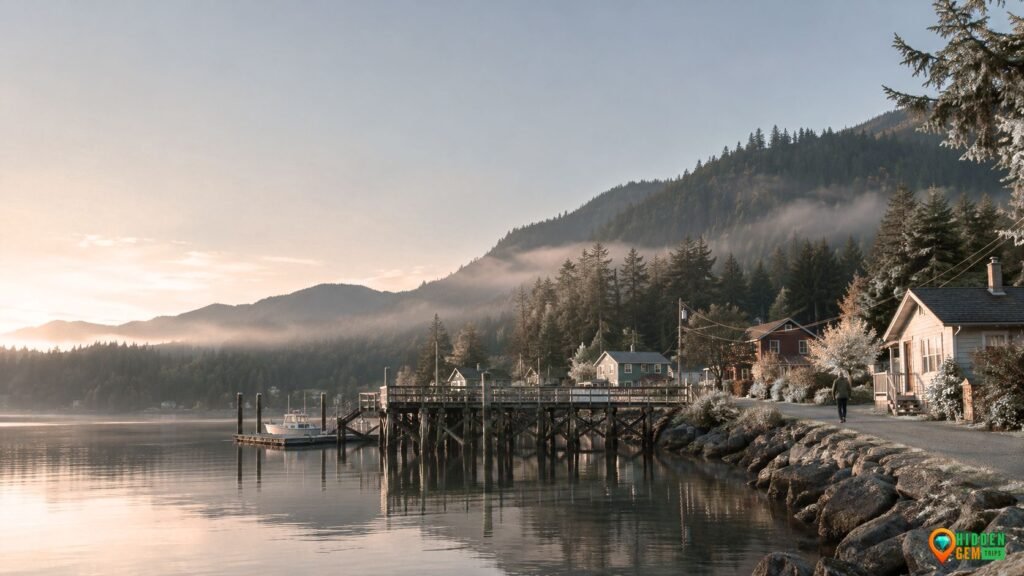
There is a particular kind of silence you cannot book with a hotel filter. It is the pause after a boat has crossed a bay, the way a lakeside street changes when the day-trippers leave, or the moment you realize your afternoon has no attraction to “complete.” The best underrated lake towns in Canada offer space for those moments—but not every pretty waterfront is quiet, and no community exists solely to provide strangers with solitude. If you want a slower trip, begin by asking whether a destination can welcome visitors without losing its everyday rhythm.
This guide brings together seven actual lakeside communities in British Columbia, Ontario, Québec and Alberta. They are not presented as undiscovered secrets, nor are they ranked by measured decibels. The practical focus is different: where you can walk without organizing a whole expedition, where boat traffic may change the soundscape, when a shoulder-season visit helps, and what needs checking before you arrive.
A useful caveat: “lake town” is a travel description, not an official legal designation. The seven stops include villages, a hamlet, municipalities, and a township. All have genuine lakefront connections; none is guaranteed crowd-free.
How to Find Underrated Lake Towns in Canada Without Mistaking Quiet for Empty
Quiet is a moving target. A remote cabin may be wonderfully still at dawn and thunder with outboard motors by lunch. A small town can feel peaceful on a weekday but host a festival that fills every room on Saturday. Conversely, a marina town may be an excellent choice for someone who wants shops, a bakery, and an evening stroll but does not need total isolation.
Think about the distinction made in Hidden Gem Trips’ village-centered lake travel and its quieter European valley journeys: geography matters, but daily rhythms and respectful visitor behavior matter just as much. In Canada, lake size, road access, wind, recreation schedules, and your room’s exact location make that distinction especially important.
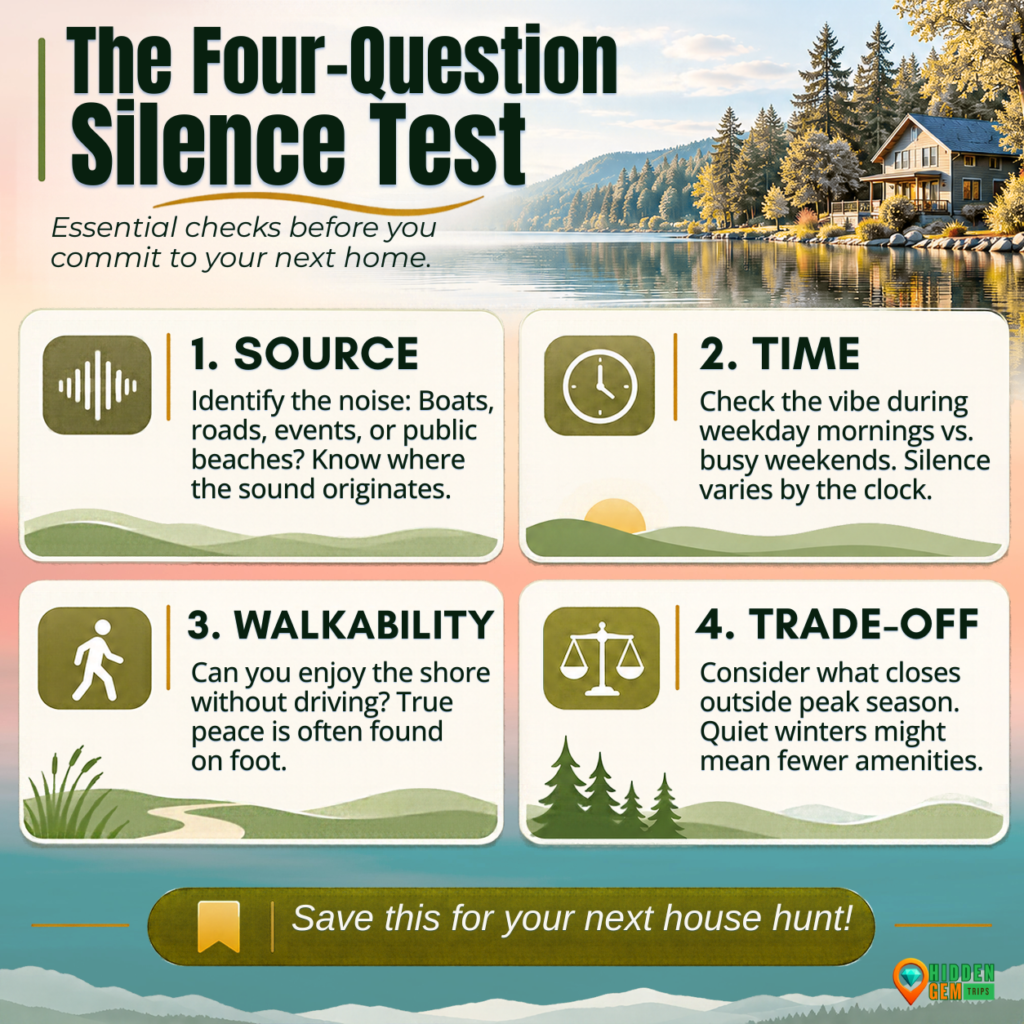
The four-question silence test
Before booking, ask four questions. First, what produces sound nearby: a boat launch, the highway, a public beach, a music venue, a rail line, or simply the neighbours? Second, when does it happen—sunrise, long weekends, weekday afternoons or late nights? Third, can you reach an enjoyable place to walk without driving to another attraction? Fourth, what is the trade-off if you stay outside peak season: shorter opening hours, cold water, fewer cafés, or limited park facilities?
None of this is a scientific noise rating. It is a decision tool for travelers who would rather have one lovely lakeside hour than a spectacular photograph taken in a crowded parking lot. It also makes “quiet” a choice instead of a marketing adjective.
At a Glance: Seven Lake Towns and the Kind of Quiet They Offer
| Community / province | Lake setting | Best reason to stay | Quietness caveat |
| New Denver / BC | Slocan Lake | Walkable shore + important history | Campground and summer beach use |
| Nakusp / BC | Upper Arrow Lake | Waterfront promenade + small-town services | Beach, marina and hot-springs visitors |
| Temagami / ON | Lake Temagami | Old-growth forest and paddling gateway | Motorboats, docks and seasonal outfitters |
| Larder Lake / ON | Larder Lake | Small working town + waterfront park | Marina activity and summer anglers |
| Piopolis / QC | Lac Mégantic | Short trails and a village-scale lakeshore | Boat rules, events and summer camping |
| Ville-Marie / QC | Lake Témiscamingue | Cultural streets + lakeside promenade | Active marina and family beach |
| Lac La Biche / AB | Lac La Biche Lake | Long lakefront walk + island forest | Busy recreation; check health advisories |
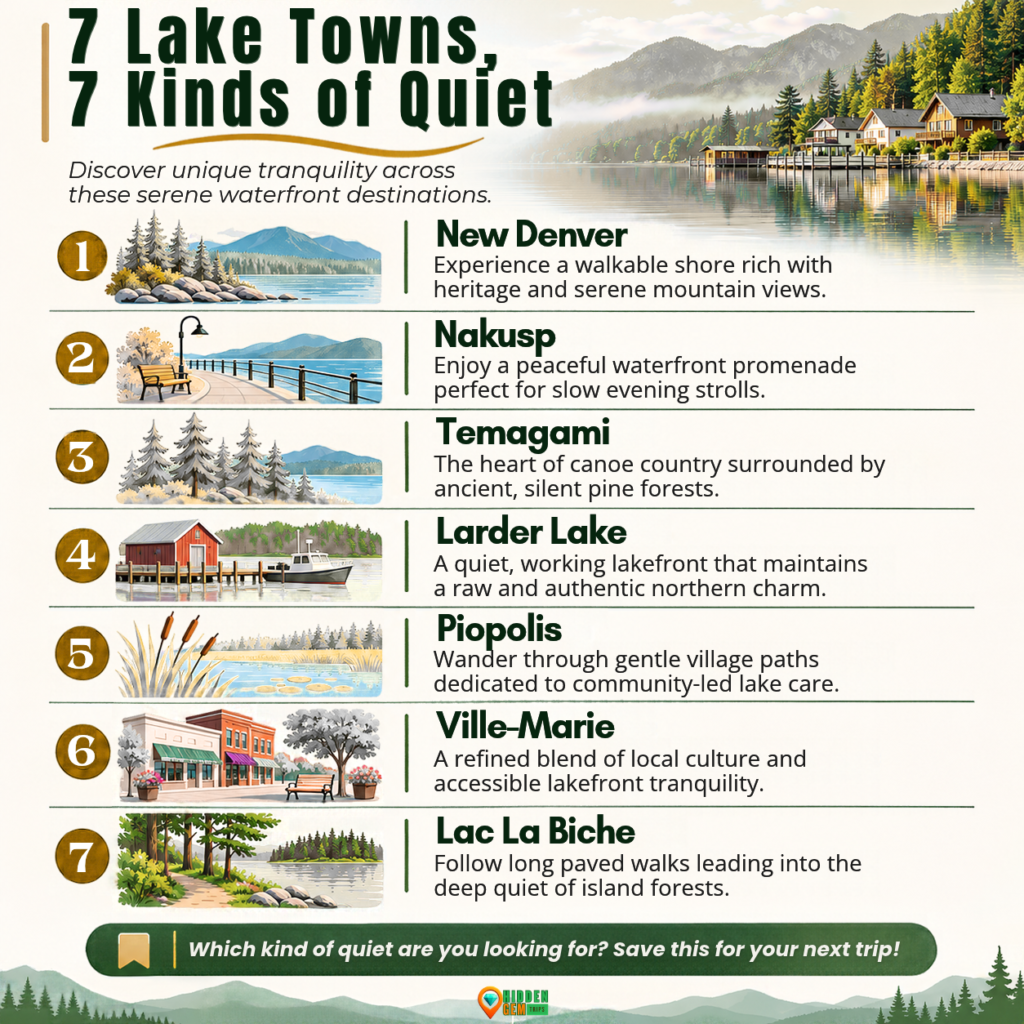
These are planning recommendations, not measured “least noisy” destinations. If sound sensitivity is important, call a prospective host about the nearest boat launch, event venue, and road before paying a non-refundable deposit.
Seven Canadian Lake Towns Worth Slowing Down For
1. New Denver, British Columbia — lakeside walks with difficult history
New Denver is a village on the eastern shore of Slocan Lake, framed by mountains and small enough to understand on foot. The village’s own visitor information describes a community of about 500 people and a 48-site Centennial Campground along the lakeshore. Those numbers do not prove silence. They do tell you this is a lived-in place with limited accommodation capacity rather than a resort machine.
For a low-pressure morning, walk beside the water before planning anything else. Then make time for the Nikkei Internment Memorial Centre, whose historical account of Japanese Canadian dispossession explains the wartime forced removal of more than 22,000 people from their homes on Canada’s west coast. A lake view cannot be the only story you take away from New Denver. The town’s beauty and its complicated history deserve the same attention.
Quiet plan: spend two nights, walk the village rather than constantly driving to viewpoints, and ask whether a lakeside stay faces the campground or a frequently used access point. If you want a comfortable room instead of a full wilderness setup, consider which accommodation comforts genuinely earn their price. This is a good match for travelers who like small-scale heritage and unhurried walking, not those expecting an empty beach at noon in August.
2. Nakusp, British Columbia — a walkable Arrow Lakes pause
Nakusp sits on Upper Arrow Lake and is a useful second base for a West Kootenay trip. Its appeal is reassuringly ordinary: a shoreline walk, a town centre, nearby trails and enough local services to make staying put feel easy. The village’s parks and trail information connects the waterfront walkway with the public beach and downtown park, so the lake can be part of your day rather than an excursion requiring a vehicle.
Here, the correct question is not “Is Nakusp undiscovered?” It is “Can I choose a quieter part of the day?” A public beach, marina, and nearby hot springs bring legitimate recreation traffic. Go for a weekday morning walk, buy something locally, and leave the busiest shoreline hours to people who have come to swim or socialize. You do not have to defeat the town’s summer life to enjoy it.
Quiet plan: pair Nakusp with New Denver rather than adding a third distant town. A two-base approach to longer trips reduces constant repacking and leaves room for weather or an unexpectedly good afternoon. Road conditions and wildfire smoke can change quickly in this part of British Columbia, so treat arrival day as a flexible buffer.
3. Temagami, Ontario — wilderness access, not guaranteed silence
Temagami is the place to choose when you want the landscape to feel bigger than the town. It is also where careless “quiet getaway” advice can become dangerous. Ontario Parks describes more than 2,000 interconnected lakes in the region and approximately 2,400 kilometres of paddling routes in its Finlayson Point activity guide. Those figures refer to the broader Temagami area—not a single easy paddle from a hotel dock.
You can enjoy a short town waterfront stop, a guided outing, or forest walking without pretending to be an expert backcountry paddler. Lake Temagami also supports motorboats and dock activity. If the goal is minimal sound, ask an outfitter which suitable sheltered route avoids busy launches and matches your ability. Do not assume a long shoreline automatically means a safe or empty one.
Season note: Finlayson Point’s published 2026 operating schedule ran from 15 May to 12 October. A November trip should not be planned around summer campground services. For a calmer holiday, build in one genuinely free day, borrowing the pacing principles of a seven-day itinerary that leaves space for detours.
4. Larder Lake, Ontario — a working lakeside town
Larder Lake has the opposite appeal of a famous cottage-country postcard. It is a community where the waterfront belongs to residents, anglers and families as well as visitors. The township says its public marina has 38 slips and that they fill during summer; the municipal marina description also confirms a public boat launch beside the beach. This is unusually useful evidence for a silence-focused traveler: a small town can have a very active water edge.
Come for the slower pace of an ordinary northeastern Ontario town, not for an invented image of a deserted landscape. A morning park walk may feel completely different from a midday visit when fishing boats are coming and going. Choose a room away from the launch if you are sensitive to engines. Enjoy the local services that remain available, and be respectful around private docks and properties.
Quiet plan: make Larder Lake a two-night stay only if you enjoy a little uncertainty and have confirmed lodging, meals, and seasonal openings ahead of time. For travelers who equate “remote” with guaranteed serenity, the more useful comparison is our northern wilderness reality check: distance can increase logistical work without eliminating local activity.
5. Piopolis, Québec — a tiny lakeshore village with rules that matter
Piopolis occupies a small stretch of the western shore of Lac Mégantic in Québec’s Estrie region. Tourism Mégantic’s village profile describes short forest-and-marsh walking routes, a municipal campground with 36 serviced sites, and the Scotch Cap trail, whose summit takes roughly 30–45 minutes to reach. That is plenty for a two-night reset. You can fill a day without turning the village into a checklist.
There is a second reason Piopolis belongs here: local lake care. Municipalities around Lac Mégantic reported nearly 2,500 watercraft washes during summer 2025, while their 2026 boat-access notice directed users to registration information for the following season. The number is a reported station-use count, not a visitor total. Still, it tells a meaningful story: protecting the lake is a visible part of the visitor experience, not a boring rule to skip.
Quiet plan: arrive on a weekday outside a major local event, walk the marked paths, and check municipal watercraft rules before bringing your own kayak or boat. Treat residential streets as homes, not a film set. Our practical approach to visiting small communities respectfully applies as much in rural Québec as in a village halfway around the world.
6. Ville-Marie, Québec — a lakefront with room for culture
Ville-Marie sits beside Lake Témiscamingue, a broad body of water along the Québec–Ontario border. It is a good choice for travelers who want quiet without giving up a real town centre. Regional tourism describes an 86-slip municipal marina close to downtown, near Parc du Centenaire. A marina that size is useful infrastructure, but it also means the most peaceful hour is unlikely to match the busiest boating hour.
The best way to experience Ville-Marie is on foot: explore the historic streets, take a lakeside pause, eat at a local business, and leave time to watch the light change. You need not fill every hour with a rental or an activity booking. If your preferred evening is stargazing, look at the cloud forecast and nearby artificial lighting first; the basics of planning genuinely dark-sky experiences are more useful than assuming any remote-looking lake automatically qualifies as a certified dark-sky site.
Quiet plan: choose a midweek stay, ask about lakeside event calendars, and consider a room set back from the marina. This is the most appealing choice on the list for travelers who like a little town life mixed with unhurried waterfront time.
7. Lac La Biche, Alberta — trails, island forest and active water-safety checks
Lac La Biche is not a tiny village, and that is part of its value. The region publishes a 15-kilometre paved lakefront walking route linking residential areas, McArthur Park and the direction of Sir Winston Churchill Provincial Park. You can plan a relaxed day around a walk and a picnic instead of driving between viewpoints. The park’s island forest adds a different texture to the experience.
This destination also illustrates why a practical lake guide needs date-sensitive health information. Alberta Health Services issued a water-quality advisory for Camper’s Beach on 21 August 2026. An advisory issued then does not establish the water’s status today, and an older “lifted” notice about a different season must not be used as clearance. Before swimming anywhere around Lac La Biche, check the current official health status, posted beach signs, and any algae information. If conditions are uncertain, plan a shore walk instead.
Quiet plan: treat the hamlet’s shoreline as a public, social space; choose early walks for more separation, and ask about seasonal park access before booking. This is a strong fit for a traveler who wants woodland and water with services nearby, not someone seeking a private lake.
Build a Quiet-Lake Trip Around Timing, Not Mileage
Three nights in British Columbia, rather than seven towns in seven days
The seven communities above are not a single sensible road trip. Canada is enormous, and stringing four provinces together just to collect seven lake photographs would turn a quiet-travel story into a fuel-and-hotel-transfer story. A more coherent first visit is three or four nights around New Denver and Nakusp. Spend the first night settling into one base, give Slocan Lake a full morning, then move once and enjoy Arrow Lakes at walking pace. The best moment might be when you stop checking the clock.
For Ontario, make Temagami and Larder Lake separate choices rather than automatic consecutive stops. In Québec, Piopolis and Ville-Marie sit in different regions and are not a casual short-break pairing. Lac La Biche works best as its own northern Alberta stay. Compare not only the room rate but fuel, groceries, activity bookings, cancellation rules, and the extra travel day: a realistic remote-trip budget catches costs that a nightly hotel price will not.
The lodging and sound checklist
Before pressing “reserve,” send your host one short message: “We are looking for a quiet stay. Is the room close to a boat launch, marina, busy road, seasonal event space or late-night gathering area?” Then ask whether windows open toward the lake or the road, and whether a weekday is materially calmer. A lakeside view can be lovely and still face a parking lot.
Pack a warm layer, dependable footwear, offline maps, essential medication, insect protection for the season, and a simple power plan. The full remote-travel gear checklist and lighter-packing method help prevent bringing an expedition’s worth of luggage for a slow lakeside weekend. If you need to keep your offline map and reservations available between small towns, a compact backup power bank may be useful; check airline battery rules and actual device compatibility before buying.
Essential Safety and Responsible-Lake Rules for 2026–27
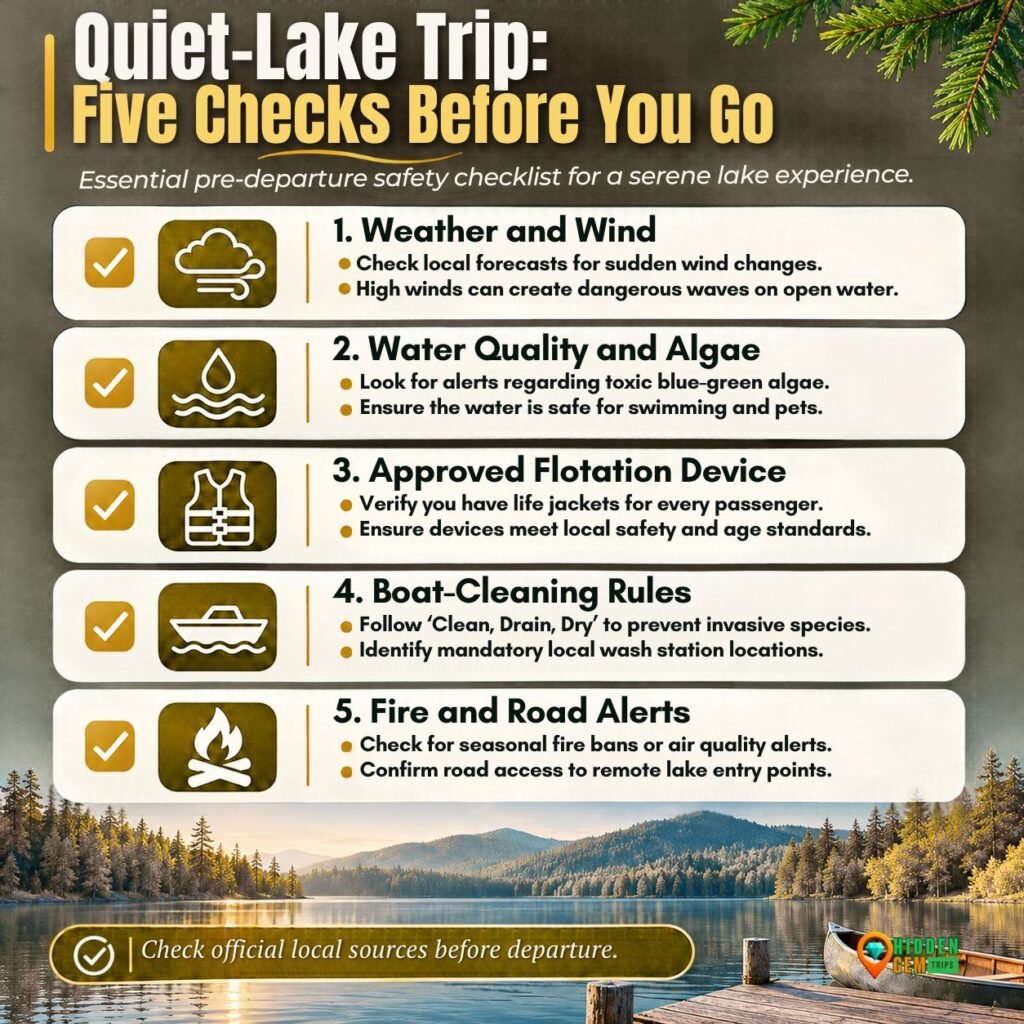
On a Canadian lake, calm-looking water is not a safety certificate. Before a paddle or shoreline outing, read the latest Environment and Climate Change Canada alerts and the exact park or municipal notice for your location. Wind can strengthen quickly, water stays cold long after the air warms, and remote shorelines can be hard to reach in an emergency.
Wear a properly fitted, approved flotation device on the water. Transport Canada’s lifejacket and PFD guidance explains why cold-water shock is a serious risk; do not substitute confidence for equipment. Book a guided trip if you lack lake-navigation experience, tell someone your return plan, and choose a route suited to your actual skills.
If you are heading to British Columbia, check the BC Wildfire Service situation map and local road advisories before leaving. Smoke can make a beautiful lake day unpleasant or unsafe, even if the fire isn’t near your accommodation. In Ontario, follow the provincial cleaning requirements and invasive-species precautions when moving paddling equipment between lakes. Québec and Alberta have their own local rules and advisories, so verify them rather than assuming a Canada-wide uniform system.
Finally, avoid turning quietness into a demand placed on residents. A local boat, a family gathering, and the sound of children at a public beach are not evidence a town has failed. What you can control is where you stay, when you visit, and how much noise you contribute yourself.
The Bottom Line: Pick the Soundscape You Actually Want
If you want walkable shoreline and a deeper historical layer, choose New Denver. For a small-town promenade with services, choose Nakusp. If your attention keeps returning to forests and canoe country, investigate Temagami with realistic safety planning. Larder Lake is for people comfortable with an ordinary working town; Piopolis offers village trails and a useful lesson in lake stewardship; Ville-Marie blends culture with waterfront space; Lac La Biche rewards the traveler who likes long walks and checks the water notices first.
Silence is not a destination’s permanent setting. You can make it more likely by choosing an appropriate weekday, staying more than one night, keeping plans light, and accepting that people live beside the places you hope to enjoy. That slower mindset is the real value behind traveling with less rush and more attention.
Frequently Asked Questions
1. Which of these underrated lake towns in Canada is best without a boat?
New Denver, Nakusp and Ville-Marie make good starting points because they offer town-based lakeside walking and services. Lac La Biche also has a published paved lakefront route. Check accessibility, surfaces and seasonal opening hours for the specific walk you plan.
2. Are these Canadian lake towns genuinely crowd-free in summer?
No. Boat launches, campgrounds, festivals and beaches can be busy, particularly on summer weekends. This guide identifies communities worth considering for slower travel; it does not claim measured low visitor numbers or silence at all hours.
3. What months are best for a peaceful lakeside trip?
Weekdays in late spring and early fall often offer a better balance of quieter streets and open services, depending on the province and year. September can be attractive, but check weather, wildfire smoke, water temperature, seasonal closures and local event schedules before committing.
4. Can I swim or kayak on every lake mentioned here?
Not automatically. Confirm permitted access, current beach-water advisories, boat-washing rules, weather, cold-water conditions and operator requirements. A safe lakeside walk is a perfectly good alternative when water conditions are unsuitable.
5. Is it practical to visit all seven towns on one Canadian road trip?
Not as a relaxed short trip. They are spread across British Columbia, Alberta, Ontario and Québec. Choose one province or a geographically coherent pair of bases, then protect time for ordinary mornings and weather delays.
Disclaimer and Research Transparency
This is a research-based editorial guide, not a first-hand account of visits to all seven communities. We reviewed municipal, provincial, regional tourism, and public-health information on 1 November 2026. Population approximations, activity-route distances, campground counts, marina capacity, park operating dates and 2025 watercraft-wash figures are attributed in the linked text and may change. Descriptions of likely quietness are qualitative planning judgments, not acoustic measurements or guarantees. Always check live weather, access, wildfire, water-quality, park and boating notices; observe local and Indigenous community protocols and private-property boundaries.
Affiliate disclosure: Some gear links may be affiliate links. If you purchase through an eligible link, HiddenGemTrips may earn a commission at no additional cost to you. Affiliate relationships do not replace official safety guidance or determine which communities are included in this guide.