


A couple trip itinerary has to work at 4 pm when one of you wants to go and see the old town and the other wants to just take their shoes off. Imagine a train pulling in 40 minutes late. The restaurant booking’s still possible if you just leave your bags at the hotel and go straight back out. Then one of you will say “Right, can we just get something nearby?” The sensible decision was the one you could have made before either of you got on the train.
Start with one priority each, one thing you both want to do, and a clear agreement about what drops when time is short. Give arrivals a light plan, protect a block that stays open, and make sure either one of you can call for a change. A quiet afternoon can be a long lunch or a swim. A full day can be a hike you both chose. The pace can vary from day to day as long as you both know what the day is asking of you.
By Dian Herdiana for Hidden Gem Trips. Research based guide. The sample itinerary and conversations are illustrative.
1. Choose one priority each before sharing the map
Sit separately for five minutes and write down one experience you would be sad to miss, one condition that makes travel easier for you and one thing you would be happy to do on your own. Be specific. “I want a restful trip” could be a hotel where you can just eat after 8 p.m. without having to take a taxi. “I want adventure” could be a single early hike and the chance to just hang about at the top. Both of those could easily be in the same week. They become very difficult to square when the itinerary has five early starts just because one person wanted to go on a hike.
Read the lists out loud before you open the map. Give each person’s priority a place in the calendar and then pick one shared outing separately. For each priority ask yourself what it is that you’re really after. If the appeal of the market is that you get to eat something you’ve never eaten before then a neighborhood food hall might still work if the market day moves. If the appeal is that you get to go to a particular family stall then you need to check when that stall actually opens. That’s the distinction that will tell you which of the bookings you can actually lock in.
Make a short agreement you can actually use
Write the agreement into a shared note. One traveller is after a quiet swim (where the conditions and local guidance allow it), the other is after a long market breakfast. Together they’re after a small workshop run by a local host. One of them needs to start late (after travel), the other wants to start early in the morning for photography. Decide who is going to check each booking and agree that the person who needs to start late can meet the photographer later. A guide to checking local customs prior to committing is of course useful if the activity is one that’s governed by rules around dress, photography or how visitors are received.
An older study on shared novelty and relationship quality provides a very weak justification for choosing to do something new together. Aron et al reported immediate gains on the study measures following a seven minute novel and stimulating task in three separate lab experiments. The experiments were all very brief and took place in a non-holiday context. A new pastry, a guided sketching walk or a craft session could provide you both with something to discover together, with no need at all to treat it as a relationship intervention.
2. Pick a base that works on a low-energy day
Think about accommodation from the point of view of the person who just wants to get in and get to bed. Can they get dinner in the vicinity? Can someone return on their own in the daytime without the only car they have? If one of the travellers needs a lift, step free access or a guaranteed place to sit, ask the property about the full route from the street to the room. A property that’s marked as accessible may well have a steep lane or a single step at the door which isn’t actually accessible. Always ask for the detail that will determine whether the room is going to work for you.
Try a 15 minute map check as a starting point. From the front door, go and trace out three actual routes to a meal you could eat on arrival, a low effort outing and transport you both could use. Check the ground, the days it’s open and the walking route. 15 minutes is just an example, either one of you could set a shorter time limit.
The idea is to work out whether a fairly normal evening can work whilst the other one is out, taking a call or has the keys. The small getaways around Amed in East Bali are a good example of what a coastal base can offer in terms of different ways to spend a morning. Canada’s quiet lakeside towns provide another good comparison as the season and access will dictate what you can do once you get there.
Price the easier location for two people
Compare the room price with the journeys you’re likely to take. Take the example of a remote room at $80/night and a more convenient room at $100/night. Over four nights that’s a difference of $80. Four hypothetical $24 round trips would add $96 to the cost of the remote room if you needed to make them. In that example the more convenient room would cost $16 less overall and would also give you the option to head back separately.
If you were going to walk every day then the remote room may in fact be the cheaper option. Always work out the number of rides you’re actually going to take before you make your choice. For locations where replacement transport is in short supply you’ll need to budget for the costs that are easily overlooked on remote routes.
Start with a four night break from a single accommodation unless a move gives you something that both of you would genuinely prefer. For a longer trip you’d use the two overnight base comparison method to work out whether a second location is worth the transfer. Always ask what each of you will be able to do on foot/independently once you get there. On a remote stretch you need to be sure that the transport and guest services you’re relying on are actually there.
3. Give every outing an exit before you give it a start time
Add three bits of detail to each significant outing: when you can still leave for it, when you intend to turn back and what you’d consider a reasonable short version. An early museum slot is pretty simple if the hotel is just down the road. A village lunch two connections away is a very different proposition, particularly if the return services get pretty thin later in the day.
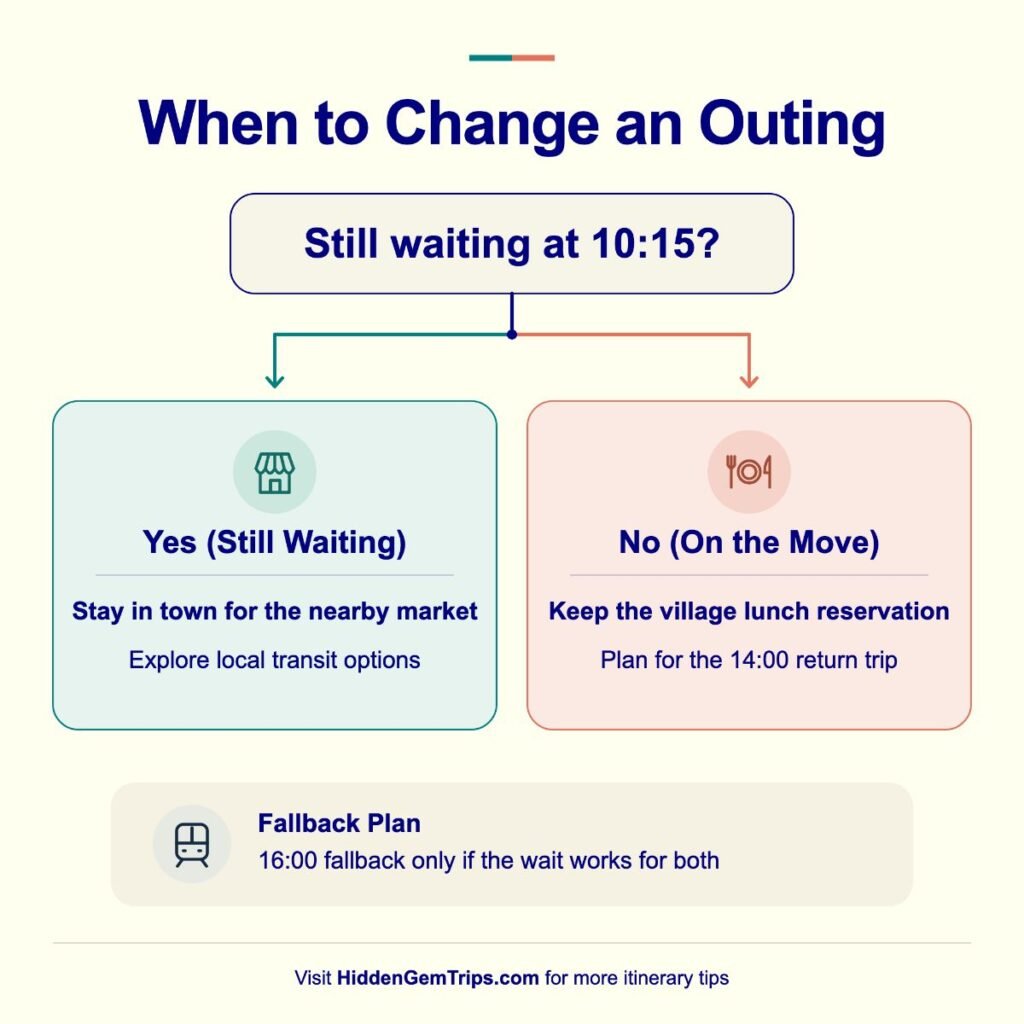
Suppose the outward journey is at 9:00 and the returns are at 14:00 and 16:00 on a fairly typical timetable. Take 14:00 as the return you intend to make and then ask yourself what would make 16:00 a viable fallback. If missing the 9:00 connection leaves you with only 20 minutes to eat before the 14:00 return then you’d just go to the local market and be on with the afternoon. If the 16:00 return requires you to be out in the heat with no seats at all then it may well fail the fallback test even though it is on the schedule.
In places like the Fiji villages that are ferried you’d want the crossing schedule and the local arrangements to be the ones that determine the whole of the trip from the outset.
Put the change point where both people can see it
Write something like “If we’re still there at 10.15 we stay in town”. Agree in advance as to who is going to be the one to check for a disruption and what the other person is going to do whilst that person is checking. One person can look up the timetable whilst the other goes and finds somewhere to sit with the bags. Use the operator’s most up to date schedule, their cancellation terms and their departure point.
The U.S. Department of Transportation’s airline dashboard is a useful tool for comparing the commitments of the various US carriers in respect of disruptions which they themselves can control. For a particular ticket you need to check what the carrier actually says applies to your itinerary. A pre-purchased basket of commitments can turn a minor delay into a full-blown crisis long before the delay in fact impacts on the trip.
You can apply the same logic to a hike or a guided visit. Set your turnaround point with the guide or venue as appropriate and agree on a shorter alternative that works for both. Check that it’s actually possible to end early. A shared boat tour or a point to point trek may well give you fewer options as to how you can leave on your own. That’s important if either one of you is a bit unsure about the outing. Keep that outing provisional until you’ve worked out how it works.
4. Count transfers and decisions as part of the day
A two hour train journey will take up half a day. 35 minutes to pack and check out, 25 to get to the station, 30 to find the platform and wait, two hours on the train, 25 to get to the hotel and 25 to leave the bags and get back to the room. That’s four hours before lunch or an unforeseen delay. If the bag drop isn’t available you have another problem to solve with a suitcase in your hand. Write the whole chain out on the calendar before you even consider whether you can cope with a fixed booking after it.
There’s an invisible second itinerary. Someone is watching the boarding time, remembering which bag has the charger and checking whether the room will be ready. Give each piece of that work an owner. One person can be in charge of the tickets and transport alerts and the other of the accommodation and arrival meal. Whoever has the task in hand gives the other a summary and passes on the confirmation numbers. You can swap roles on a subsequent day if it feels like the arrangement is unbalanced. If both of you have an offline copy of the key details then either of you can take over should the other need a break.
Keep arrival useful and simple
On the first evening, get settled as a priority. A meal or a walk can be an easy option to slot in. The CDC Yellow Book on jet lag explains the impact of jet lag on sleepiness and concentration. Plan your essentials for the day you’re actually going to have and use these long haul flight planning tips when you’re putting together your list of things to take before you get to your room. Keep everyone’s own essentials within reach and make sure each person knows which bag they’re in.
If you’re sharing luggage then split up what you each need for the first night so a late bag drop or an early outing doesn’t necessitate a full repack. An existing pouch is ideal for this. If you already need replacements then you can go and compare the compression packing cubes on Amazon (paid link). As an Amazon Associate I earn from qualifying purchases. If it’s a small boat or mixed baggage limits situation with island transfers then do check out the packing trade-offs before you decide what you’re going to carry.
5. Protect recovery time from the backlog
A blank afternoon can just vanish before you even get to breakfast. The museum you missed yesterday is now in the schedule. A friend emails in a restaurant. Someone else suggests a quick detour on the way. By lunchtime you’re effectively booking dinner around three things that were never intended to be on the agenda. Give the break a proper place in the calendar and work out how you’re going to use it before you start slotting in all the other things you’ve missed.
Give the week two different kinds of open time
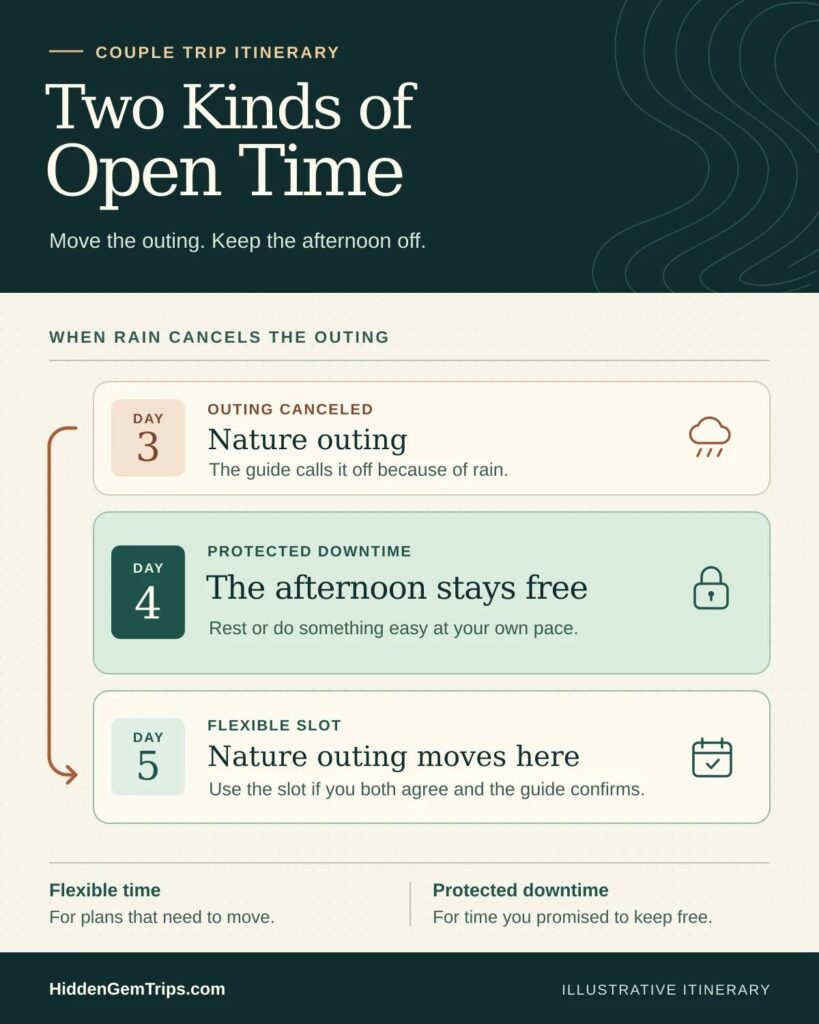
Use one of the flexible slots for a weather sensitive priority if the supplier are able to move it. Protect a separate block for downtime. If the Day 2 boat outing moves into the flexible slot on Day 5 then Day 4’s free afternoon remains free. On a three day break you could have two small blocks. One might be a walk that can be moved from Saturday to Sunday morning. The other might be the hour after Saturday lunch when you can both go back to the room or go off on your own. When you’ve got just one slot left, you’ll need to decide together what it’s for and if necessary remove the other booking.
A 2025 meta-analysis of vacation and employee well-being (looking at 256 effect sizes from 32 studies) found a significant improvement in employee well-being as a result of taking vacation. Another analysis of 8 studies looked at the activities and recovery experiences and found that psychological detachment from work and physical activity may be the key to the benefits. The studies are all about employee well-being and don’t really establish what the ideal amount of time off is or what the ideal schedule is for couples. For your trip an open block would allow one person to go for a walk and the other to have a bit of time to leave work messages unread.
This is something you can easily envisage on a slower visit to Karimunjawa where a change of conditions can totally throw your water based itinerary. Anywhere you go, you’ll want to go with the optional local activity if that’s what’s available that day.
If you’re being hosted by a village club, a workshop or indeed a household then you need to keep those local commitments just as carefully as your own. Do your homework on asking for permission and on how to visit the villages in a respectful manner prior to assuming that a host will just take you in on short notice. If you have to cancel then do so as far in advance as you can and respect the terms you’ve agreed.
6. Agree on when either person can change the plan
At breakfast ask each other what’s manageable and what would make the day more difficult. “I can do the market if we take a taxi back” is far more useful than “I’m fine”. Agree in advance that either of you can opt out of an optional activity. If it’s shared transport, safety or a guide booking that means you have to stay together then you need to agree on a version that both of you can manage. Keep the check-in as short as possible so that you’ll still do it when breakfast is a bit late.
Decide how shared costs and solo time work
Agree on an amount above which you check with each other before spending any of the shared money. Agree on a specific way to spend on ease (e.g. taking a taxi home for the final leg which would otherwise be a long wait). If one of you wants a guided visit and the other would prefer to have the time to themselves then you can discuss the cost and whether the other can just make their own plans.
A walk in the vicinity of the hotel, a trip to a bookshop or a quiet booked table at a restaurant can all work if the place is right and you both know how to meet up again. Agree a meeting point and a fallback if your mobile data drops. A partner who chooses the courtyard at the hotel still has a say in what they have for dinner.
If it’s a prepaid outing then check what can be refunded, what can be moved and what can be used by one person. Two non-refundable $45 tickets would mean the $90 is already gone. The additional $30 for a taxi only makes sense if the rest of the outing is worth the ride to whoever is going. If one person would rather just stay back then you need to discuss the ramifications of splitting up before you make a decision.
The money is important and so is the rest of the day. The slow travel approach of spending time in one place is much easier to adopt when dropping one plan leaves you with other viable options in the vicinity.
7. Keep the last evening close to your departure route
Work backward from the most difficult deadline. Confirm the airport/station, that the first connection actually runs on that day, and how you will deal with check out and baggage if you have to leave early. If you’re doing a trip with uncertain crossings or a potentially disrupted route then you need to build in sufficient time to get to the departure area whilst there are still alternatives. The buffer you need is dependent on the schedule, the weather, the booking and the consequences of missing the connection. Two people can make a far calmer decision if they both have the same return plan in front of them.
Put one small memory in an easy place
Choose your final meal, a bakery visit or a return to a place you’ve already liked. Put it somewhere near where you’re going next and make it as easy as possible to just drop. One person might want to spend the last hour of the day just photographing a square, the other might want to go and get tomorrow’s snacks and check the early taxi. Give each of those tasks a finish time so that the person looking after the departure stuff gets part of the evening back. For broader route design see how to give a 7 day trip a workable rhythm.
A seven-day couple trip itinerary you can adapt
The example below is for one lodging base over six nights with a waterfront walk and indoor options nearby. It’s based on a reliably connected departure point. If you’re using a remote base and the return is in any doubt then use Day 6 to move to a departure hub and have the final meal there. Times and activities are purely illustrative. Check your dates, your transit and your accessibility prior to booking.
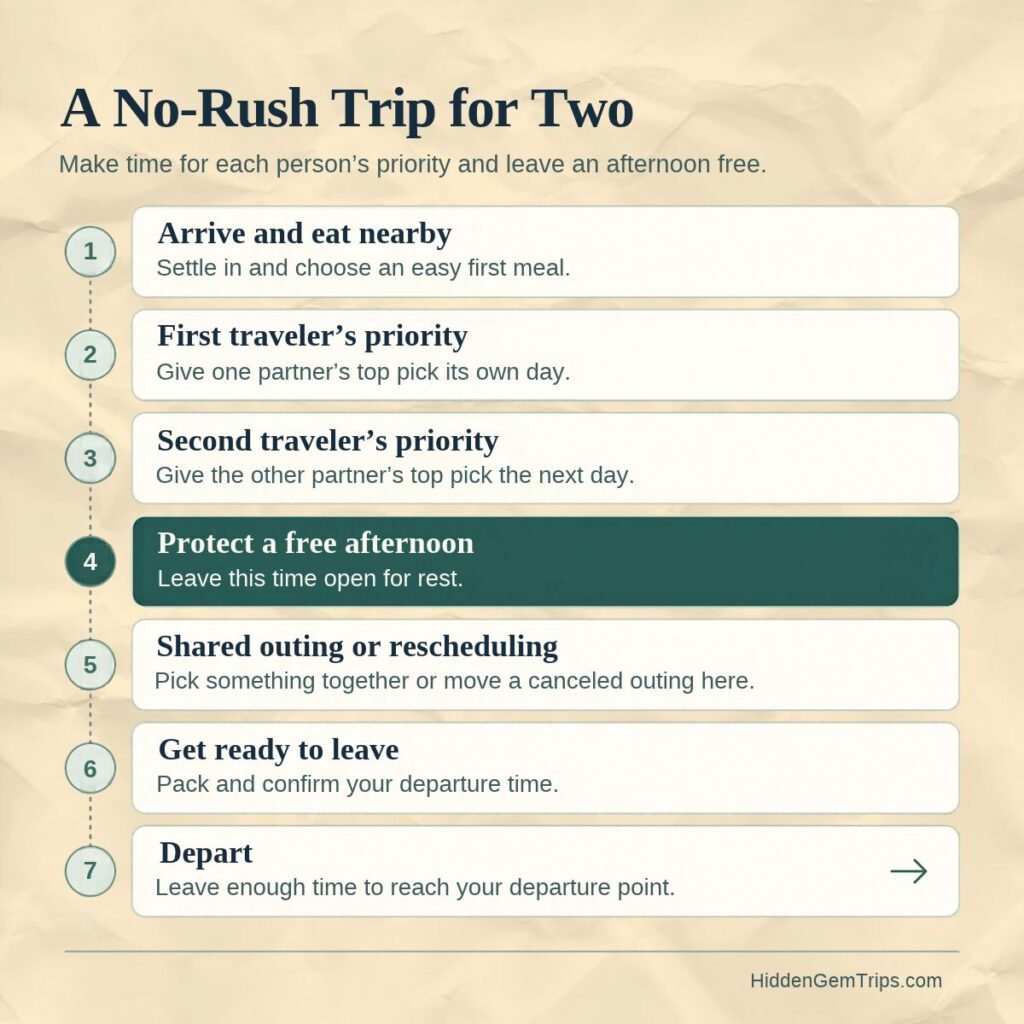
| 1 | Arrival and food | Check in and choose dinner within easy reach | Use the nearby takeaway option |
| 2 | One traveler’s priority | Long market breakfast | Visit a local food hall or have breakfast nearby |
| 3 | The other traveler’s priority | Short, guided nature outing with a defined return | Take the accessible waterfront route if conditions allow |
| 4 | A protected afternoon | Meet for lunch, then each choose how to spend the afternoon | Keep the break and let the outing backlog go |
| 5 | A shared experience and room to reschedule | Take a locally run workshop with flexible booking | Use the flexible slot for the missed nature outing if agreed, and choose a simple shared activity later |
| 6 | Predictable departure logistics | Confirm tomorrow’s ride and revisit a favorite spot | Move to a departure hub if the route calls for it |
| 7 | The onward connection | Check out and leave with time for the confirmed transfer | Use your verified backup transport if needed |
What happens when Day 3 gets wet
Imagine the guide cancels as the trail is not suitable. First of all check whether Day 5 is available and whether both people still want to go. If the workshop can be moved or cancelled in accordance with the agreed terms and the guide confirms then go ahead and book the new slot. Pick a small shared activity that can be done after the outing or save it for another trip. Leave Day 4’s afternoon open. If the guide can’t move the booking then decide whether the waterfront is suitable or go with the indoor option. The calendar changes in one place only. Tomorrow is as it was.
For a shorter trip you can keep to one base and have the shared trip simply overlap with one person’s priority if both are happy with that. A second base can make sense over a 10 day period if each person is getting something of value and the departure route still works. In either case you add the change point to your bookings as soon as you make them. A shared note with the operator, the reservation number, the cancellation deadline and a simple alternative is all that’s required to deal with most ordinary changes without having to go through a long conversation at the station.
Take a plan you can both change
Before you book, read the itinerary out loud from arrival to departure. Who’s doing the work on each fixed day? What would both of you be happy to keep? Which afternoon would you be happy to protect if something slipped? If you can’t answer that without opening five tabs then shorten the shared note and make the key decisions as clear as possible. The evening your train gets in late “Dinner around the corner?” can be the whole decision. You can go to the old town in the morning.
Frequently asked questions
1. How many activities should couples actually plan for per day?
Start with one outing/booking which will set the pattern for the day, then tack on something you can easily skip. A museum and lunch next door can be one outing. A tasting which takes two buses and has a fixed return can easily take up most of the day on its own. Just assess the effort, time and exit options as a package.
2. Can we travel slowly on a three day weekend?
Yes. Pick a place that’s reasonably accessible from home, sleep in one place and leave a useful chunk of daylight. An easy way to get there and a full day for the experience you’re after can make the trip feel very much complete. A late check out can be worth it if it gives you a decent place to wait before you leave.
3. What if only one of us likes the planned activities?
Let the planner deal with the details for one agreed priority. Let the other person decide how much gets done around that. Pick a time for the optional stuff (e.g. after breakfast) so the planner knows when to stop waiting for a reply. Share the basics even if one person would rather leave the rest open.
4. Should we pre-book the meals and tours?
Book experiences with limited availability that both travelers genuinely want. Check deadlines and whether the booking survives changes to your arrival time. For ordinary meals, save two suitable places near the accommodation and check their hours. Reserve in advance if dietary needs, limited local options or a celebration makes it important.
5. How can a couple travel at different physical paces?
Agree on distance, surfaces, rest stops and access before you choose an outing. Some days an accessible shared visit fits both people. On other days you may each choose your own activity and meet later at a place you both know how to reach. Confirm practical details with the venue or operator and plan around each traveler’s stated needs.
Travel disclaimer
This research-based guide provides general trip-planning information. Times, prices and scenarios are illustrative. Confirm schedules, accessibility, local requirements, weather and booking terms with current relevant sources. For personal health or travel insurance decisions, consult a qualified professional or licensed provider as appropriate.