
Research-based travel guide • Last checked: 5 November 2026 • Field-tested: No
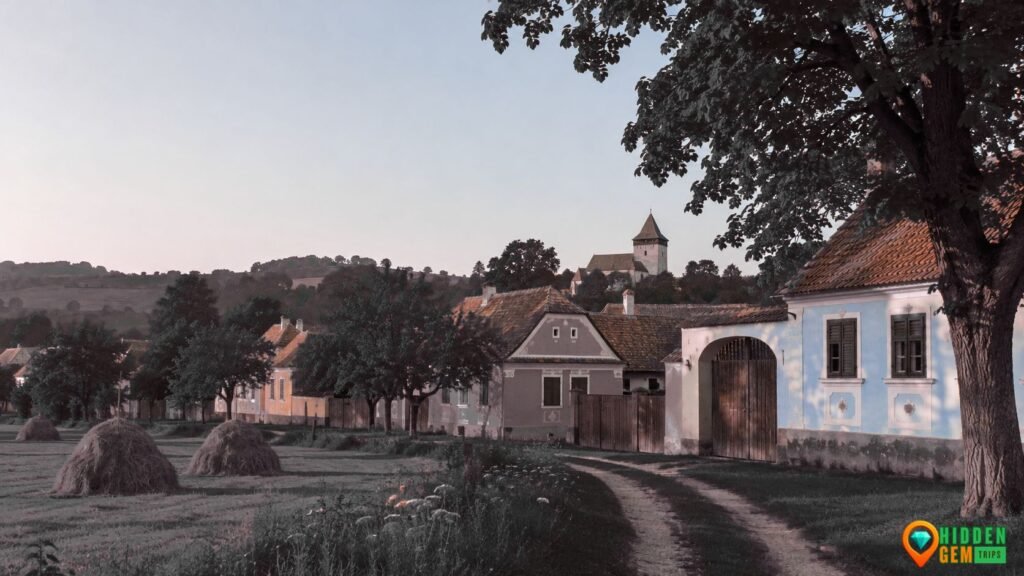
The road slips behind a ridge, a church tower appears above red roofs, and a meadow opens beside the village. This is the appeal of Romania’s Saxon Villages: not a sequence of grand castles, but a living landscape where buildings, gardens, orchards and working grasslands still belong together. A convincing trip gives equal time to what stands in stone and what happens quietly around it.
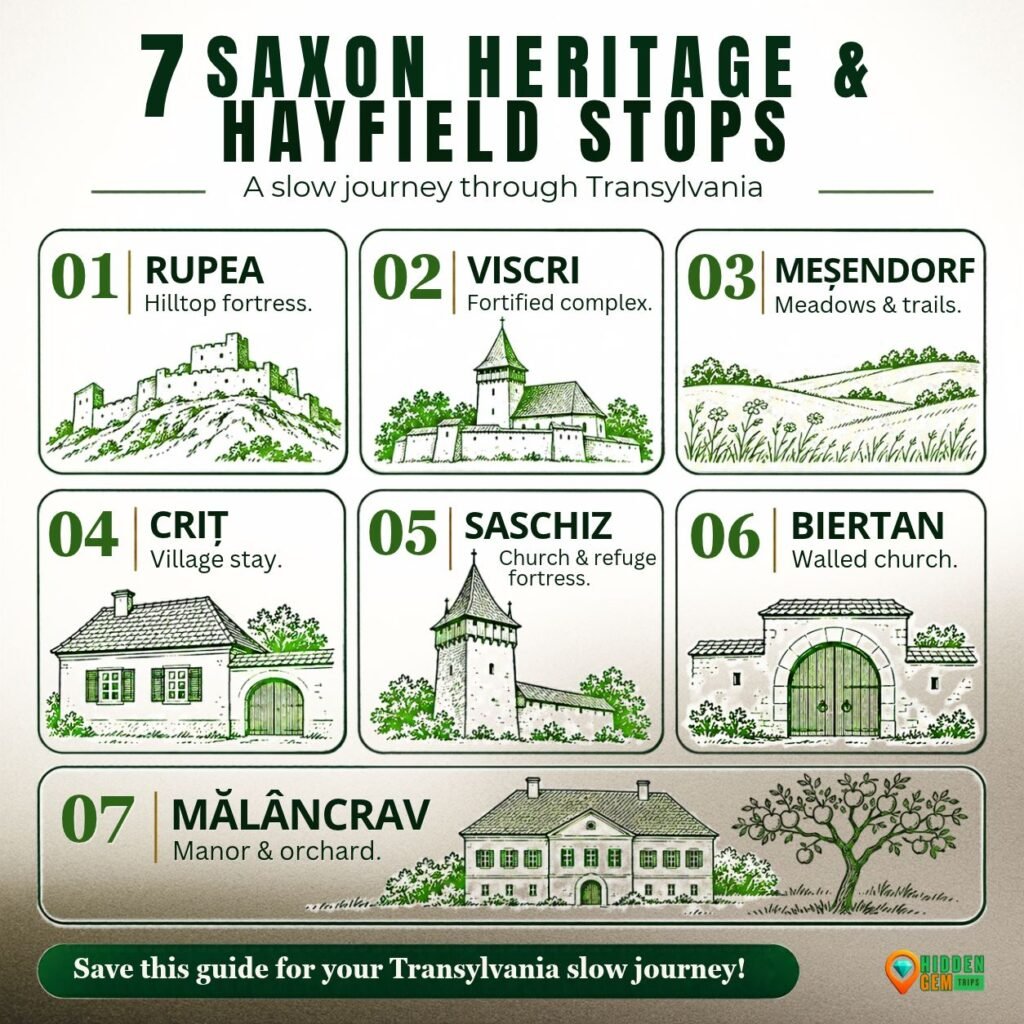
This seven-stop journey follows the historic Saxon belt between Rupea, Sighișoara and the villages west of the town. It favors an easy three-day pace over a checklist sprint. You will encounter a hilltop fortress, fortified churches, a noble manor, and seasonal hayfields—but these are not seven UNESCO sites, nor seven castles in the architectural sense. That distinction matters if you want an accurate understanding of Transylvania.
For an overview of the site’s wider travel philosophy, start with the case for slowing your itinerary down; this guide puts that idea into a specific route with current access limitations.
Why Romania Saxon Villages Are More Than Castle Stops
UNESCO’s description of the fortified-church villages emphasizes more than architecture: settlement layout, family farmsteads and land use form the heritage landscape. The serial World Heritage property contains seven component villages; it was first inscribed in 1993 and expanded in 1999. Our itinerary uses three UNESCO-associated village stops—Viscri, Saschiz and Biertan—alongside other worthwhile places, rather than claiming that all seven stops hold the designation.
The churches were often the community’s defensible refuge, not a noble family’s private residence. Thick walls, towers, and storage spaces tell a different story from the palace imagery commonly sold through castle itineraries. Rupea supplies the dramatic fortress silhouette; Saschiz adds a separate defensive hilltop site; Mălâncrav offers a restored manor. Together they make the “castles and hayfields” promise both interesting and precise.
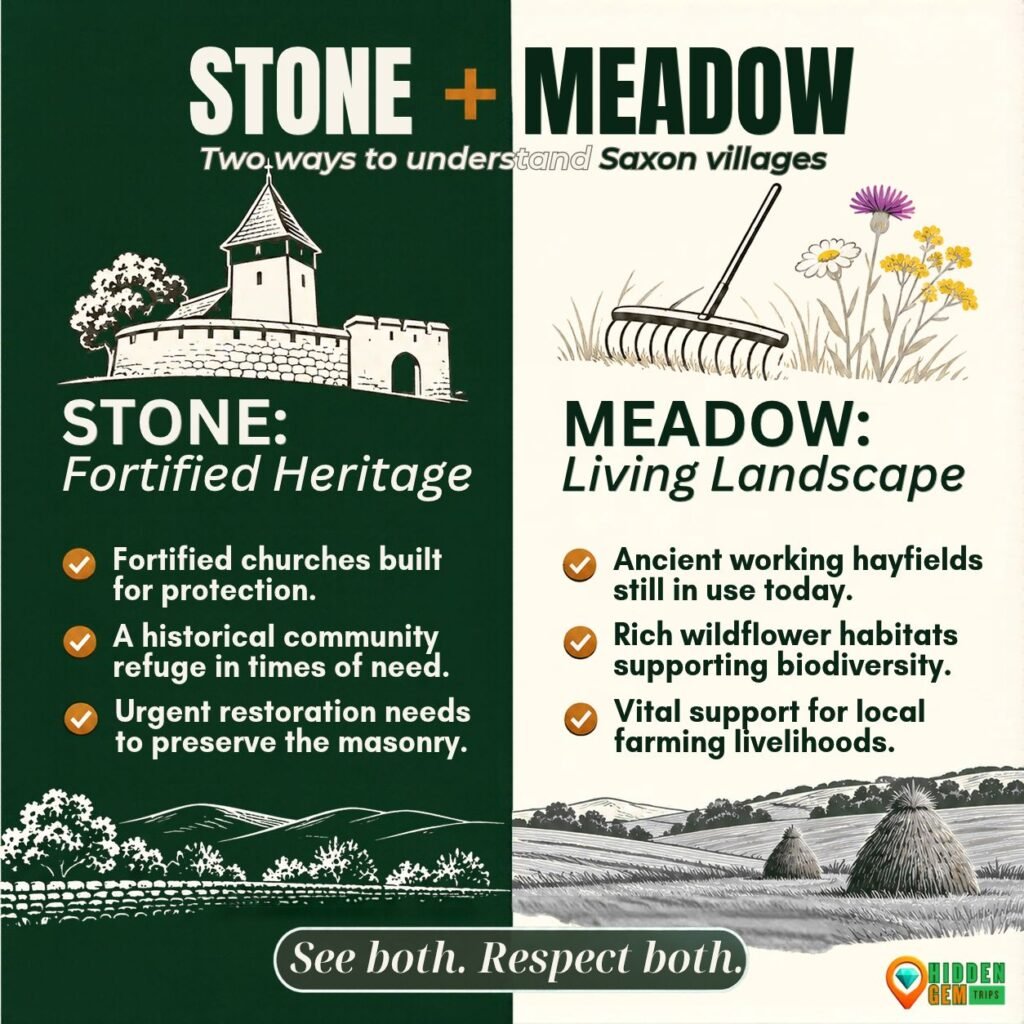
The two-lens test: stone and meadow
At every stop, ask two questions. First, what did people build to protect or organize village life? Second, what landscape helped people earn a living? This simple pairing prevents a familiar problem: photographing the church and leaving before seeing the village that gave it meaning. It also avoids treating ordinary homes and farmland as outdoor museum sets. The broader challenge is explained in our challenge of deciding whether a quiet place is ready for visitors.
Seven Fortresses, Churches and Hayfield Stops
| Stop | Best reason to pause | Practical reality |
| 1. Rupea | A true hilltop fortress and landscape overview | Allow 60–90 minutes; separate from the UNESCO village property |
| 2. Viscri | Saxon streets and fortified complex | Main church and main tower closed for restoration in late 2026 |
| 3. Meșendorf | A meadow-and-forest walking or cycling base | Plan routes with local advice; church access may be arranged |
| 4. Criț | Village life, a fortified church and overnight atmosphere | Better as a gentle pause than a rushed photo stop |
| 5. Saschiz | Fortified church and restored peasant fortress | Hilltop access on foot; autumn 2026 weekend-only timetable |
| 6. Biertan | Imposing triple-walled religious complex | Seasonal official opening hours; a strong heritage anchor |
| 7. Mălâncrav | Murals, Apafi manor and traditional orchard | Plan ahead for access; not a walk-in guarantee |
1. Rupea Fortress — Start With the View, Not the Dracula Myth
Rupea is your orientation stop. From the road, the defensive complex rises in tiers above the surrounding settlement, making it easier to read the region’s geography before getting lost in its small lanes. The local tourism destination profile traces the fortress’s documentary history to 1324 and its role in the area’s medieval defensive network; its dramatic walls are not a substitute for the everyday village story still ahead.
Treat Rupea as a Saxon-region gateway, not as one of the UNESCO-listed fortified-church villages. The regional heritage profile of Rupea Fortress provides the historical baseline. On a clear day, linger long enough to observe the roads and fields below. A practical traveler will also notice how much of this region’s charm depends on modest distances, rather than a constant succession of headline attractions.
Allow roughly an hour or more, depending on mobility. Weather on exposed fortifications can be very different from a sheltered village street, and access conditions should be checked locally.
2. Viscri — Famous Village, Unfinished Restoration
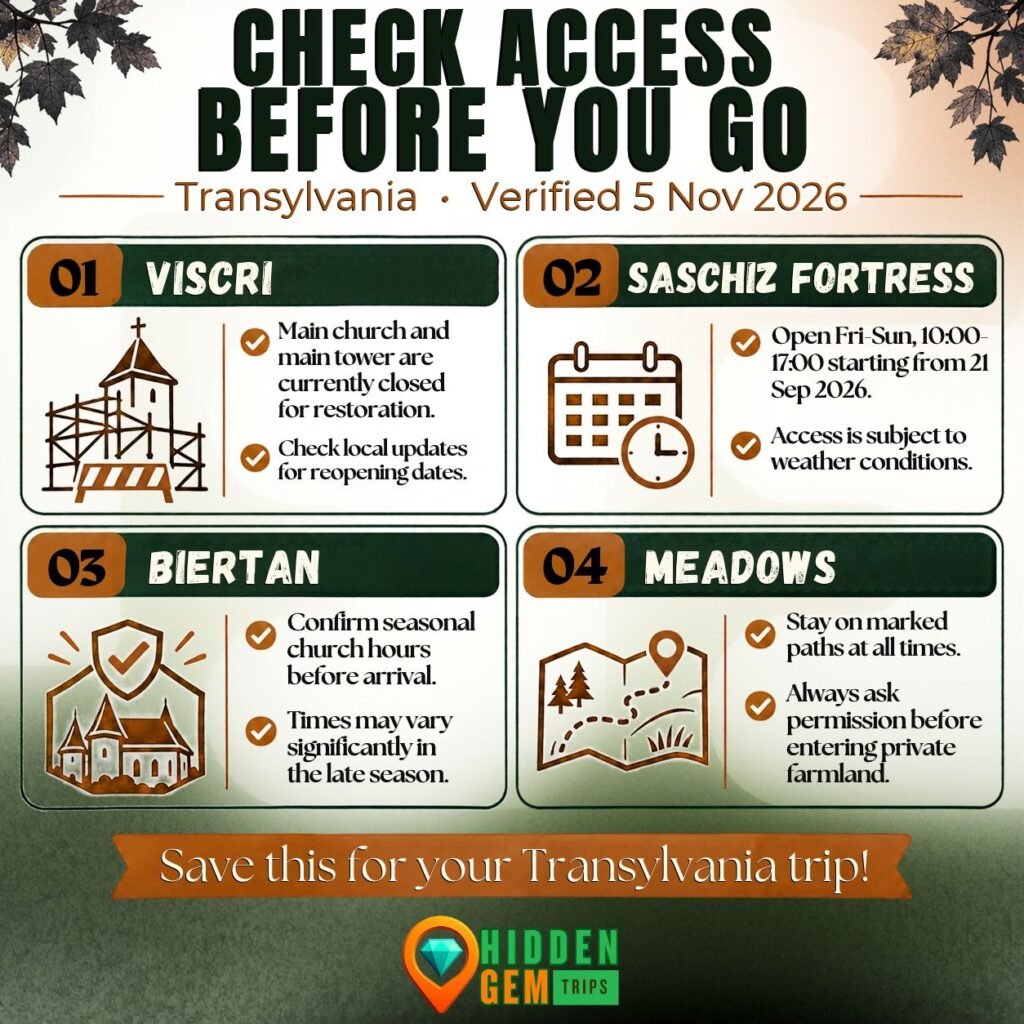
Viscri is the best-known name on this route, and for good reason: a long street of farmhouses leads toward one of Transylvania’s most recognizable fortified complexes. Yet arriving expecting a fully accessible church interior in November 2026 would be a mistake. The church operator’s September 2026 restoration bulletin says the main church closed on 14 September and the main tower remains shut; works were then expected to continue into 2027. The local heritage museum, terracotta display, South Bastion viewpoint and Bacon Tower remain among the accessible elements.
A better visit is patient. Walk publicly accessible streets at a respectful pace, buy something from a local producer if genuinely useful, and let the houses and courtyards be lived-in spaces rather than photo props. If the church interior is your priority, rearrange the day instead of relying on old guides. Similar expectations can affect the experience of lesser-known European village escapes, where seasonal access shapes the trip as much as the scenery.
For late-autumn visits, the official Viscri visiting timetable lists 10:00–16:00 from 26 October to 31 March for the accessible complex, with exceptions for worship and events. Confirm the latest status before departure.
3. Meșendorf — Choose a Meadow Walk Over Another Checklist
Meșendorf turns the camera away from towers and toward the Târnava Mare landscape. The village is a useful base for walking or cycling through forest edges, grassland and old agricultural routes. The point is not to find an empty field for a perfect photo; it is to recognize these as productive spaces with seasonal owners, livestock, and sensitive plants.
The locally developed Transilvania Bike Trails network links eight Saxon villages and Sighișoara. Fundația ADEPT describes approximately 107 km of trails built in the region and warns that weather damages surfaces, making regular maintenance necessary. That number refers to the overall network—not a recommended single-day ride. Choose one manageable segment, use an up-to-date route file, and ask about closures or grazing activity before entering.
For the best atmosphere, stay in or near the village for a morning. Try an officially marked track instead of crossing a cut meadow. If you love the quieter side of European landscapes, our Slovenia valley guide explores the same idea in a different setting without claiming these destinations are interchangeable.
4. Criț — A Village That Rewards an Overnight Stay
Criț can look like a minor stop on a map, which is precisely why an overnight stay may be more rewarding than a ten-minute drive-through. The village retains Saxon architectural cues, a fortified church, and a scale where the rhythm of a meal, a short walk, and a conversation with a host can shape the day.
Do not arrive assuming that every church door will be unlocked. Smaller rural sites often rely on local caretakers or variable visiting arrangements; a guesthouse can help ask about legitimate access. Support a locally run stay or meal if available, but never assume that residents want their houses or family activities photographed. Our practical etiquette checklist for visiting communities offers useful behavior rules that apply well beyond Romania.
If your trip spans only one night in the region, choose between Criț and Meșendorf as the rural base; trying to sleep in both adds packing and transfer time without much gain. The two-base itinerary offers a useful way to decide.
5. Saschiz — Two Layers of Defense, One Important 2026 Update
Saschiz is the strongest place on this itinerary for contrasting a fortified village church with a separate refuge fortress on the hill. The church tower makes an impressive landmark from the main road; the upper defensive site requires a walk. It is worth the extra effort for travelers who can manage an incline, but visitors should not confuse historic drama with unrestricted access.
The operator’s official late-2026 visitor notice says that from 21 September 2026 the peasant fortress opens Friday to Sunday, 10:00–17:00, while the weather allows; Monday to Thursday it is closed. Later, visits may be by appointment for groups larger than ten. It is approximately 2 km on foot from the village center or about 700 m from the access-road barrier. In other words, a Monday climb without confirmation is not an itinerary—it is a gamble.
Make Saschiz your heritage-focused half-day and leave space for something less monumental: a short village walk, a local craft conversation if offered, or lunch sourced locally. On a wet day, prioritize a safe, open ground-level visit over the uphill fortress. The same caution belongs in any travel plan built around remote roads and variable conditions.
6. Biertan — The Architectural Anchor of the Western Half
Biertan is the most visually commanding fortified-church complex on this route. As you ascend through its enclosed access, you move from village lanes into a place built for both worship and communal protection. The high walls and layered defensive system offer a meaningful contrast with the gentler farmstead scale of Viscri and Criț.
The Sibiu County tourism authority’s Biertan entry describes three defensive precincts, six towers and three bastions. It currently lists seasonal hours, including Tuesday–Sunday 11:00–15:00 in November–March, with Mondays closed. These details are more useful than timeless advice to “visit anytime,” but local religious events and staffing can still override advertised schedules.
If you can budget one extended architectural visit, make it Biertan. Do not race from bastion to bastion; read the settlement from the churchyard and then return to street level. The pleasure is in understanding how a major landmark fits inside a working village, not separating it from that setting.
7. Mălâncrav — Finish With a Manor, Murals and Orchard Paths
Mălâncrav is a quiet but particularly revealing ending. Rather than adding another generic fortress photo, it brings together religious art, rural history, and cultivated land. The fourteenth-century Evangelical church is known for its wall paintings, while the restored Apafi manor introduces the noble-residence thread that the word “castle” usually implies.
The Mihai Eminescu Trust’s cultural-route project links the Evangelical, Orthodox and Roman Catholic churches, Apafi manor, and an orchard trail featuring traditional fruit varieties. This is a richer frame than calling the village “untouched.” Heritage here has been actively maintained, restored and interpreted by people, and the orchard is part of that story.
Do not promise yourself admission to every interior; ask locally about appointments and whether particular spaces are being used for private stays or community activities. If a door is closed, a respectful lane or orchard-path walk can still complete the itinerary. That flexibility is a key principle of planning a meaningful week, rather than filling every hour.
How to See the Hayfields Without Treating Them as Scenery
The meadow is not an accessory to a medieval backdrop. Traditional mowing, grazing and small-scale farming have shaped a habitat mosaic of grassland, hedges, scrub, woods and orchards. Fundația ADEPT’s high-nature-value landscape overview explains why these farmed environments can hold exceptional biodiversity. A “natural” meadow may depend on careful human management; abandoning it can change its ecological character.
What the 2025 conservation reporting actually tells us
A 2025 project report on the Târnava Mare area describes how unfertilized, wildflower-rich hay meadows continue to be managed through traditional practices. The LIFE TransilvaCooperation project summary notes improved local conservation conditions at project completion, while warning that farming economics, abandonment, pasture conversion and overgrazing remain long-term pressures. This is evidence about the region’s management, not a promise that every meadow will be blooming when you arrive.
One of the most useful travel insights follows from that finding: a photograph of hay drying beside a road records a farmer’s work as much as a beautiful view. Purchase food or a locally guided experience rather than wandering through productive land without permission. Before choosing a trail, ask whether the meadow has been recently cut, whether a herd is nearby, and whether the way is public.
Seasonal rhythm: what you may find
| Season | Likely emphasis | Planning caution |
| Late spring | Fresh growth and flower-rich grassland in suitable areas | Respect active fields, nesting wildlife and variable rain |
| Summer | Harvest activity, cut hay and longer daylight | Do not walk on cut hay or cross mowing operations |
| Early autumn | Changing light, orchards and quieter rural roads | Shorter hours and weather-sensitive fortress access |
| Winter | Church architecture and village atmosphere | Snow, ice and limited services make meadow routes less reliable |
The seasonal descriptions above are planning tendencies, not guarantees of specific flowers or harvest dates. Weather and management choices vary each year. If the outdoors is the main reason for your trip, choose one or two well-supported walks rather than building the whole visit around a single “perfect” viewpoint.
A Realistic Three-Day Romania Saxon Villages Itinerary
Three days is a sensible working minimum if you want all seven stops without turning the entire trip into highway transfers. The route below assumes a car or a private driver and an arrival near Brașov, Rupea or Sighișoara. It does not assume that all interiors will be open; reverse the order when operating days require it.
| Day | Sequence | Stay / priority |
| 1 | Rupea → Viscri → Meșendorf | Sleep near Meșendorf or Criț; keep Viscri’s restoration limits in mind |
| 2 | Criț → Saschiz → Sighișoara area | Sleep near Sighișoara; Saschiz hill access depends on opening day |
| 3 | Biertan → Mălâncrav | Choose a quieter exit toward Sibiu or return to Sighișoara |
This is a sequence, not a promise of fixed driving times. Check the live map before leaving, especially after heavy rain. If you have only two days, drop one or two villages rather than squeezing a seven-stop circuit into daylight hours. The same thinking helps with understanding overlooked costs in a remote-trip budget, from parking and fuel to small cash donations and last-minute taxis.
Practical Planning: Transport, Opening Hours and Costs
Car versus public transport
A car is the most flexible option for small-village access, but it is not the only one. The seasonal UNESCO Bus Red Line lists a May–October route from Brașov through Viscri, Criț, Saschiz, Sighișoara and Biertan, operating by advance online reservation on selected days. It will not cover every stop in this seven-stop itinerary, and it is not a dependable November substitute. Independent public transport between minor villages is fragmented, so base yourself carefully or hire a licensed local guide.
For drivers, verify the national-road rovinieta rules on Romania’s electronic toll portal before departure; a hire car may already have a valid vignette, but do not assume it does. Keep your phone’s map available offline, and treat narrow village lanes as local living space rather than shortcuts.
Packing, weather and road safety
Bring shoes with firm grip, a light rain layer, water and a small amount of cash in Romanian lei. No special expedition kit is required for a village-based itinerary, but good footwear matters on cobbles and a wet incline. Our short guide to packing only what remote travel needs helps you avoid carrying unnecessary equipment. Travelers arriving after a long international journey can also use these practical long-haul flight recovery ideas before setting out on rural roads.
For winter driving and legal requirements, check the current UK government road-safety guidance for Romania alongside advice relevant to your own nationality. This guide intentionally avoids rigid weather or route assurances, since hill paths and local services can change with conditions.
Where the budget should go
Spend first on locally operated accommodation, food and authorized site admissions. A smaller guesthouse may provide more useful advice than an elaborate itinerary app; the best mid-range choice is often the one that reduces unnecessary driving. For readers weighing comfort against cost, our guide to thoughtful mid-range travel choices explains the trade-off without suggesting that a village needs to be luxurious to be memorable.
Travel insurance is worth considering for a multi-country itinerary, but policies differ. Compare current SafetyWing travel-cover options before departure, then review benefits, exclusions, eligibility, and activity limits in the provider’s published policy documents. Purchase only if coverage genuinely suits the trip. This is an affiliate link; Hidden Gem Trips may earn a commission at no additional cost to you.
The Bottom Line: Leave Space for the Living Landscape
These Romanian Saxon villages reward curiosity more than speed. Rupea shows the defensive horizon; Viscri demonstrates the complicated reality of caring for fragile heritage; Meșendorf and Criț offer a slower view of farmed hills; Saschiz and Biertan explain communal protection; Mălâncrav ties art, a manor and an orchard into one landscape. The best route leaves time for an unplanned conversation, a closed door handled gracefully, and a meadow observed from a legitimate path.
If you remember only one rule, make it this: the houses belong to residents, the fields belong to working communities, and historic buildings may need repairs more than visitors need another selfie. That is how a little-known destination remains worth visiting.
Frequently Asked Questions
1. Are the seven stops all UNESCO World Heritage villages?
No. Viscri, Saschiz and Biertan are UNESCO component villages featured on this route. Other stops were selected for regional heritage, quiet village life or landscapes; Rupea is a fortress gateway, not a UNESCO fortified-church village.
2. Are there real castles in Romania’s Saxon villages?
There are fortresses, fortified churches and some noble residences, but they are different building types. Rupea and the Saschiz refuge fortress are defensive sites; Biertan and Viscri are fortified church complexes; the Apafi residence in Mălâncrav is a manor.
3. Can I enter Viscri’s church in late 2026?
The main church and tower are closed for restoration under the operator’s mid-September 2026 notice. Other parts of the fortified complex remain available, subject to posted hours and special events. Check directly before traveling.
4. When should I visit for flower-rich hayfields?
Late spring and early summer can be attractive, depending on weather and local mowing. There is no universal bloom date. Use marked paths, follow grazing rules, and do not enter working fields without permission.
5. Is this route doable without a rental car?
Partly, with careful planning. A seasonal reservation-only tourist shuttle covers several villages, but it does not serve every stop or operate year-round. For all seven, combine a suitable base with taxis or a licensed local guide, and check timetables before committing.
Disclaimer
This is a research-based destination guide, not an account of a personal visit. Opening hours, restoration work, trail conditions, weather, transport schedules, and admission fees can change. Confirm information with official operators and local authorities before travel. Respect private property, worship, farmland, community customs and protected habitats. Insurance links may be affiliate links; compare terms and exclusions independently before purchase. No particular service, attraction, or route is guaranteed to be available.