
Look up tonight. Depending on where you live, you might see a handful of faint stars struggling against an orange, artificial haze, or you might see absolutely nothing but the reflection of streetlights on low-hanging clouds. In a time when urban glow has taken over 80% of our night skies, the Star-Gazing Passports idea has become the ultimate badge of honor for the modern explorer.
We are rapidly losing our view of the universe, and with it, a profound sense of perspective. This Star-Gazing Passports guide is not just about looking up; it is about reclaiming our ancestral connection to the cosmos in 2026. For thousands of years, humans used the Milky Way to navigate oceans, plant crops, and build mythologies. Today, experiencing that same raw, unpolluted sky requires intentional travel to the remote edges of the earth.
Whether you are a seasoned astronomer hauling heavy equatorial mounts or a curious traveler hoping to spot your first shooting star, these Star-Gazing Passports will lead you to the most pristine Dark Sky Reserves left on Earth. If you have been desperately finding untouched paradises to escape the chaotic pace of modern life, the deep, silent expanse of a certified dark sky is the ultimate sanctuary.
The 2026 Astro-Tourism Phenomenon: Why We Need Passports to the Stars
The Star-Gazing Passports movement will be more important than ever by 2026, when light pollution will be a global issue. The relentless expansion of LED streetlights, illuminated billboards, and sprawling suburbs has created an invisible dome of light over our cities. People are no longer satisfied with crowded city lights; they are seeking “Celestial Solitude”.
The Eradication of the Night: Understanding Light Pollution
According to data compiled by NASA Science observational programs, an estimated 83% of the global population now lives under a light-polluted sky. For urban dwellers in North America and Europe, the Milky Way is completely hidden from view. This loss is not merely aesthetic; it disrupts human circadian rhythms and severely impacts the migratory patterns of nocturnal wildlife.
As we talked about in our detailed Solo Female Travel Map 2026, safety and calm are the new luxury. Nothing gives you more peace than a completely dark sky.
Your Star-Gazing Passports let you find your way across a planet that is quickly fading. It works like a carefully chosen map to the last shadows on Earth. This is a safe and life-changing trip into the heart of darkness, the good kind. Astro-tourism is quite similar to our study of the Sumba Revolution, which looks at unexplored geographic frontiers. It focuses on protecting the environment while showcasing the stunning grandeur of the Milky Way.
The Bortle Scale: How to Read Your Star-Gazing Passports
It’s very important to know the darkness levels before you prepare your things. DarkSky International is the world’s leading organization on this issue. They work hard to safeguard the night sky through a strict certification process.
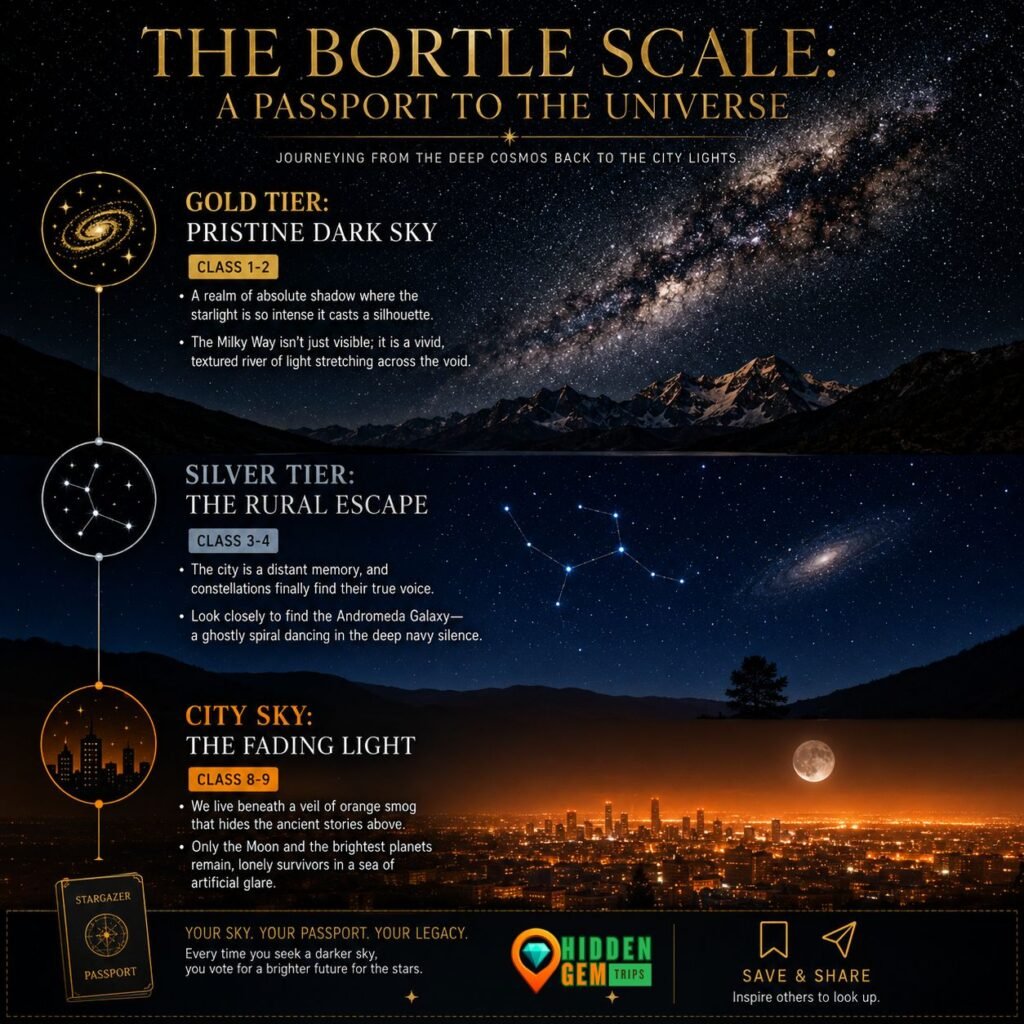
Not all dark places are the same. The Bortle Scale, which goes from Class 9 (City Sky) to Class 1 (Excellent Dark Sky), assesses the quality of the sky. Knowing your target tier helps you establish the correct goals for your trip.
Putting Celestial Clarity into Categories from Bronze to Gold
When making your bucket list, you should aim for the following levels of desire:
- Class 1-2 skies are in the Gold Tier: Located in exceptionally remote regions like the high-altitude peaks of the Andes or the desolate expanses of the Namib Desert. In a Class 1 sky, the Milky Way is so bright it can actually cast a faint, eerie shadow on the ground.
- Class 3 sky in the Silver Tier: Places in the country where there aren’t many light domes on the horizon. You will easily spot the Andromeda Galaxy with the naked eye, and complex constellations stand out clearly.
- Class 4 skies are in the Bronze Tier: Great for folks who are using their first Star-Gazing Passports. These are typically accessible rural areas or national parks located a few hours’ drive from major metropolitan centers.
The Top 10 Dark Sky Reserves for Your 2026 Star-Gazing Passports
Your Star-Gazing Passports will only get you a stamp if the place has more than simply “dark skies”. We strive to deliver the best mix of clear skies, easy access, and a wonderful experience you can’t get anywhere else. Here is your ultimate 2026 celestial itinerary.
1. NamibRand Nature Reserve, Namibia: The Silent Gold Tier
NamibRand is widely considered the absolute crown jewel of any Star-Gazing Passports collection. This privately owned conservation area is one of the few International Dark Sky Reserves in Africa. For hundreds of miles in every direction, there is complete darkness that is almost never disturbed by people.
- The Experience: When night falls, the towering red sand dunes turn into deep black shapes, creating a striking, jagged backdrop for the Milky Way. The atmospheric stability here is so pristine that the starlight feels incredibly dense; the Milky Way is so thick you could reach out and touch it.
- Safety & Stay: This place is very popular with people who follow our Solo Female Travel Map 2026 because its luxury eco-camps are secluded and very safe.
2. Aoraki Mackenzie, New Zealand: The Southern Mirror
New Zealand has long been a pioneering leader in sky preservation, making it a mandatory destination for Star-Gazing Passports holders. This reserve encompasses the Aoraki/Mt Cook National Park and the Mackenzie Basin.
- The Experience: Located deep in the heart of the South Island, this massive reserve offers crystal-clear views of the Magellanic Clouds (satellite galaxies of our own) and the iconic Southern Cross. The reflection of the stars on the calm, glacial surface of Lake Tekapo creates a breathtaking “sky mirror” effect that defies description.
- Nomad Link: This is a lifestyle peak for those pursuing our Digital Nomad 2.0 Guide, where you can work during the day with dramatic Southern Alps views and gaze at the vast cosmos by night.
3. Hanle, Ladakh (India): The Himalayan High-Tech Peak
Hanle is an absolute dream for “High-Tech Nomads” within the Star-Gazing Passports community. At a staggering altitude of 4,500 meters, the atmosphere is incredibly thin and hyper-dry, drastically minimizing light distortion and atmospheric boiling.
- The Experience: Hanle is home to the Indian Astronomical Observatory, one of the highest operating optical observatories in the world. Here, the stars do not just twinkle gently; they shine with a steady, piercing brilliance due to the lack of atmospheric moisture.
- Adventure: As one of the safest under-the-radar cities (or rather, remote nomadic villages) in India, Hanle offers high security due to strict border region military monitoring.
4. Jasper National Park, Canada: The Wild Frontier
If you fiercely love the combination of raw wildlife and deep astronomy, Jasper must be on your Star-Gazing Passports list. To understand the rigorous environmental guidelines required to maintain this status, you can review the extensive frameworks provided by the National Park Service Night Skies program.
- The Experience: This is one of the largest and most accessible dark sky preserves globally. Imagine setting up your smart telescope on the edge of a pine forest while a massive moose calmly wanders by in the distance.
- Events: Every October, Jasper hosts a massive dark-sky festival that attracts thousands of Star-Gazing Passport holders from across the globe. It features keynote speeches from astronauts and symphony concerts held directly under the stars.
5. Pic du Midi, France: The Cloud Piercer
For a distinctly European-flavored Star-Gazing Passports stamp, Pic du Midi in the French Pyrenees offers a highly futuristic, comfortable experience. If you are looking for an alternative to the crowded Alps, this observatory is breathtaking.
- The Experience: You will ride an exhilarating, steep cable car to a historic observatory at the mountain summit, often above the cloud layer. This provides a view of the universe that is perfectly clear and reliably free of fog, ground light, or air pollution.
- Luxury: This is a lifestyle peak that offers overnight stays at the summit, complete with exquisite French gourmet dining and exclusive, guided observation sessions with resident astronomers.
6. Wadi Rum, Jordan: The Martian Night
Wadi Rum provides a Star-Gazing Passports experience that genuinely feels like a journey to another planet. The sheer sandstone monoliths jutting out of the red sand evoke images of Mars.
- The Experience: Staying in transparent, climate-controlled “Martian Domes” allows you to stargaze directly from the comfort of your bed. The ancient, profound silence of the desert adds a spiritual depth as you easily spot the Andromeda Galaxy hovering over sandstone cliffs.
- Authenticity: This is one of the ultimate hidden gems for solo female travelers, offering the legendary hospitality of local Bedouin tribes who deeply prioritize guest safety and comfort.
7. Atacama Desert, Chile: The Driest Clarity
No Star-Gazing Passports collection is considered complete without a pilgrimage to the Atacama. With nearly 300 guaranteed cloudless nights per year, it is arguably the most consistent place on Earth for high-level stargazing.
- The Experience: Near-zero humidity means there are absolutely no water particles in the air to refract or blur incoming starlight. The clarity is so terrifyingly sharp that you can clearly see the intricate details of lunar craters and Saturn’s rings with even a simple, portable telescope. If you want to know how to pack such delicate equipment safely, refer to our secrets for packing light for remote expeditions.
8. Galloway Forest Park, Scotland: The Celtic Twilight
Proving you don’t strictly need a bone-dry desert to earn a Star-Gazing Passports Gold Tier stamp, this massive park was the very first in the UK to officially receive Dark Sky Park status.
- The Experience: Surrounded by ancient, rolling green hills and hidden, mirror-like lochs, the night sky here has a powerful, almost mythical Celtic aura. It is absolutely perfect for those seeking a safe and transformative journey in the rugged Scottish wilderness.
9. Yeongyang Firefly Eco Park, South Korea: The Dual Glow
This unique destination offers a highly unusual Star-Gazing Passports experience by beautifully combining light from both heaven and earth.
- The Experience: During specific humid seasons, you can see thousands of glowing fireflies on the ground that seem to perfectly mirror the dense scatter of stars in the Yeongyang sky. It is a rare, poetic fusion of terrestrial biology and deep-space astronomy.
10. Great Barrier Reef, Australia: The Oceanic Void
For your final, most awe-inspiring Star-Gazing Passports stamp, you must head out to sea. The ocean provides a natural buffer against urban light pollution that no landmass can replicate.
- The Experience: On a stable floating pontoon moored dozens of miles from the Queensland coast, you will experience true, absolute darkness. With no city lights on the horizon, the stars appear to rise directly from the ocean’s edge, providing an uninterrupted 360-degree perspective of the cosmos.
The Slow-Mading Connection: Working Under the Cosmos
Can you actually work and stargaze simultaneously? Absolutely. As explored in our comprehensive Digital Nomad 2.0 Guide, “Slow-mading” in regions with high-altitude clarity is the absolute new peak of remote work.
By adopting the principles of our 2026 Slow Travel Manifesto, you transition from being a rushing tourist to a mindful resident. Imagine finishing your intense corporate Zoom call in a heated yurt, closing your laptop, and simply stepping outside to see the Andromeda Galaxy with your naked eye. This seamless blend of productivity and profound natural beauty is the ultimate remote work lifestyle for 2026.
Essential Gear: Equipping Your Star-Gazing Passport Journey
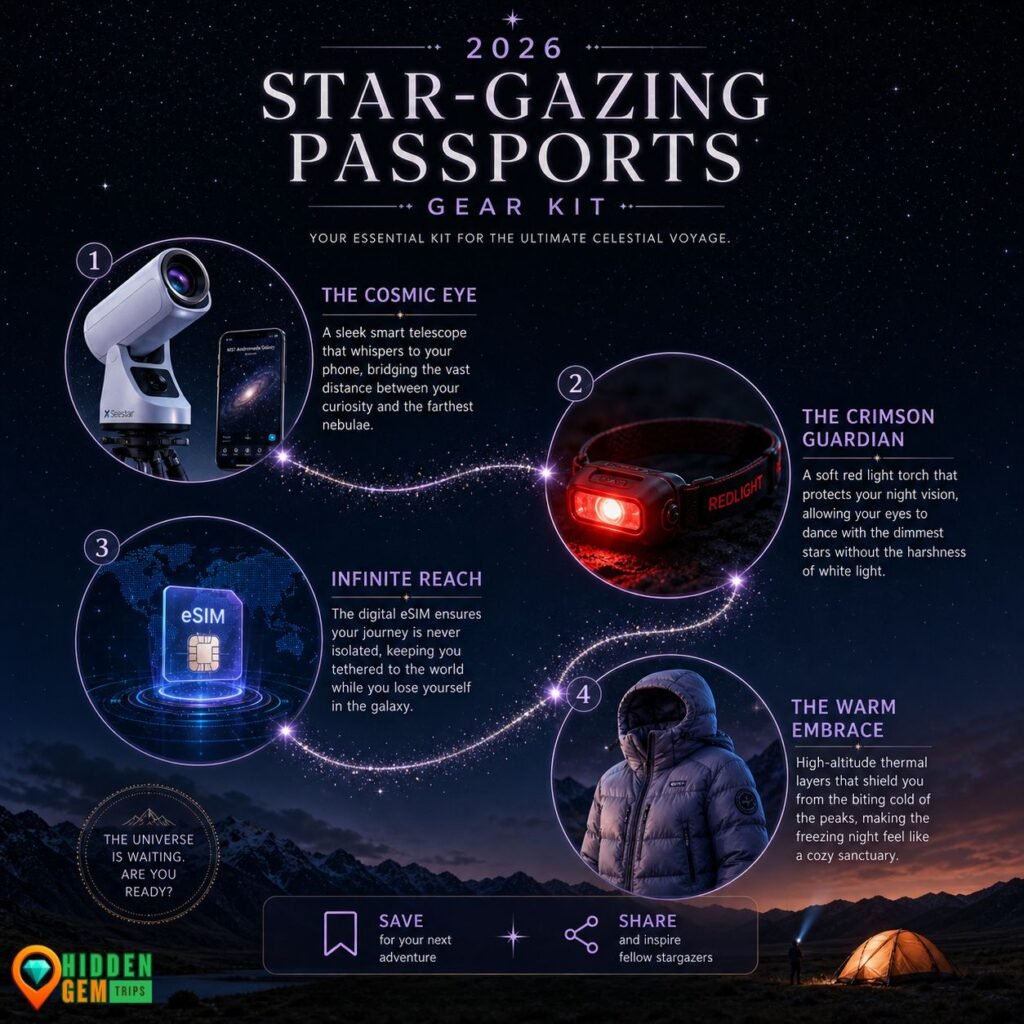
In 2026, exponential technological advancements have made deep-space stargazing accessible to everyone, not just professional astrophysicists. However, curating the right equipment is vital. When organizing your must-have travel gear for island or remote trips, your Star-Gazing Passports kit should include specific optical and digital tools.
Smart Optics and Digital Connectivity
- Smart Telescopes: Heavy, complex equatorial mounts are a thing of the past for travelers. Brands like Unistellar and Vaonis now offer highly portable, AI-assisted sky-mapping telescopes that connect directly to your smartphone. They automatically stack light exposures to reveal vibrant nebulas in seconds.
- Connectivity: You cannot rely on local Wi-Fi in a desert. Use a global Airalo eSIM to seamlessly download real-time star charts and weather patterns even in the most remote reserves.
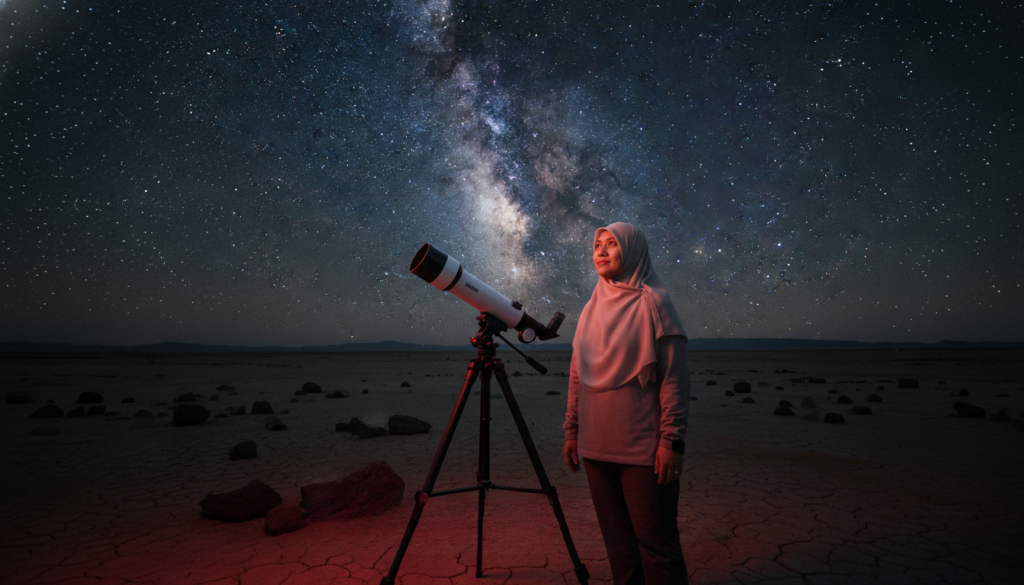
- Red Light Torches: This is an absolute necessity to maintain your sensitive night vision (rhodopsin levels) while navigating Dark Sky Reserves safely in 2026. White light instantly destroys your eye’s dark adaptation.
- Insurance: Adventure in remote, high-altitude areas requires serious protection. We strongly recommend comprehensive providers like SafetyWing for all Star-Gazing Passports expeditions.
The Economics of Astro-Tourism: Budgeting for the Dark
Is astro-tourism vastly more expensive than standard vacations? Not necessarily, especially if you use genius budget hacks to find hidden gems. Let’s look at the baseline 2026 estimates to understand the value proposition.
Budget Comparison: Star-Gazing Passports vs. Standard Travel
- Accommodation: Standard City Hotel ($150/night) vs. Remote Eco-Dome/Yurt ($250/night). While the eco-dome is pricier, it offers affordable opulence combined with an exclusive celestial show.
- Activity Fee: Standard Museum/Tour ($50) vs. Private Telescope/Guide ($120).
- Gear Investment: Standard ($0) vs. Smart Optics ($500 – $2,000).
- Peace of Mind: Standard City (Low/Crowded) vs. Astro-Tourism (Infinite/Dark & Quiet).
The return on investment for a Star-Gazing Passports trip is measured in psychological clarity, not just financial expense.
Regenerative Astro-Tourism: Preserving the Night Sky
A core, unshakeable pillar of the Star-Gazing Passports movement is the commitment to regenerative travel. The night sky is a highly fragile resource. Every single time you visit a certified reserve, you are actively voting with your wallet to keep the lights off.
The financial influx from astro-tourism proves to local governments that preserving darkness is more profitable than developing illuminated commercial zones. We passionately encourage travelers to support local lighting ordinances and educate others on exactly why “Darkness is a Resource”.
The universe is a vast, terrifyingly beautiful place, but we can only truly see it when we make the conscious choice to turn off the lights. Using your Star-Gazing Passports in 2026 is much more than a vacation; it’s a silent protest against the noise of modernity and a profound celebration of the quiet.
If you could have a front-row seat to any planet in our solar system tonight, which one would it be? Please tell us about your fantasy astro-destination in the comments. Let’s help the Star-Gazing Passports community flourish by sharing our best images of the night sky, gear hacks, and travel suggestions.
Frequently Asked Questions (FAQ) About Astro-Tourism
1. What is the absolute best time of year for stargazing?
For most Dark Sky Reserves in 2026, traveling during the “New Moon” phase is essential. A full moon acts as a massive light polluter, washing out the Milky Way. Always check the official NASA Lunar Calendar before booking your flight or accommodation.
2. Can I actually see the Milky Way with my naked eye?
Yes! If you are positioned at a Gold-Tier destination in your Star-Gazing Passports, the Milky Way will be so dense and bright it can actually cast a faint shadow on the ground beneath you.
3. Is it safe for women traveling alone to go astro-tourism?
Yes, of course. You can choose established reserves that have very safe, gated eco-lodges and properly confirmed native astronomy guides by following the tips in our Solo Female Travel Map 2026.
4. Do I need an expensive telescope to enjoy a Dark Sky Reserve?
No. While smart telescopes enhance the experience, a Class 1 or 2 Bortle sky is breathtaking to the naked eye. If you want optical enhancement on a budget, a high-quality pair of 10×50 binoculars is more than enough to spot star clusters and lunar craters.
5. Why use a red light torch instead of a regular flashlight?
Human eyes take roughly 30 to 45 minutes to fully adapt to total darkness (building up a chemical called rhodopsin). A single flash of white LED light from a phone or standard flashlight instantly destroys this night vision. Red light preserves your dark adaptation, allowing you to see the stars clearly while navigating the ground safely.
Disclaimer
This Star-Gazing Passports guide is intended solely for educational and inspirational purposes. Hidden Gem Trips maintains strict editorial independence; we do not utilize affiliate links, and all destination, gear, or insurance recommendations are based on our own rigorous assessment. Night travel in remote frontiers involves inherent environmental risks, including wildlife encounters, extreme temperatures, and severe navigation challenges in total darkness. We strongly advise all travelers to hire certified local guides when visiting unfamiliar Dark Sky Reserves and to verify current weather patterns and safety protocols prior to departure.