
Research-based travel guide | Last checked: 12 November 2026 | Field-tested: No
A local customs travel guide is most useful when it helps you prepare for one real encounter, not when it offers a country-sized list of rules. A visit to a neighborhood market, a family-run homestay, a village ceremony, and a religious site can each call for different questions, even when they are in the same destination.
This article sets out seven research steps for checking those details. It is designed for travelers who want to be considerate without pretending that one website can speak for an entire community. We reviewed current official guidance, cultural-heritage principles, destination resources, and travel-publishing examples on 12 November 2026. This is a research-based guide, not a firsthand trip report.
A useful reason to keep the question specific: after its 2025 session, UNESCO reported 849 living-heritage practices across 157 countries on its lists. Those inscriptions are a curated record, not a complete inventory of every local custom. They do show why a single “national etiquette” summary cannot represent every place or practice. UNESCO’s current list overview also explains that living heritage is carried by communities, not by a guidebook alone.
Why Local Customs Research Starts With a Specific Situation
“What are the customs in this country?” is too broad to produce a reliable answer. It mixes law, social convention, venue policy, and individual preference. It also hides the details that change the answer: which town, which event, what time of year, whether you are a guest or a customer, and whether you plan to observe, participate, film, or publish.
A better research question names an encounter: “We plan to visit the Saturday market in this district with a local guide. Are visitors welcome to photograph stalls, and are there current restrictions on access?” That question can be checked. It leaves room for the possibility that a vendor welcomes conversation while another person nearby prefers not to be photographed.
The distinction matters in places that receive visitors for cultural experiences. Hidden Gem Trips has already published a village travel checklist focused on visitor conduct. This new guide sits earlier in the journey: it is about how to research and judge information before you decide what to do.
The Custom Research Card
Before opening search results, write a short card for the activity you are considering. This keeps research from drifting into generic cultural trivia.
| Research field | What to write down |
| Place and setting | Country, region, town, named venue, and whether the setting is public, private, sacred, or community-managed. |
| Planned action | The exact thing you may do: enter, eat, attend, ask, photograph, record, buy, or share. |
| Timing | Travel date, time of day, season, festival period, or other timing that may affect access. |
| People affected | Who may be involved: residents, workers, hosts, practitioners, children, guides, or other visitors. |
| Decision needed | What you need to know before acting, and what you will do if the answer is unclear. |
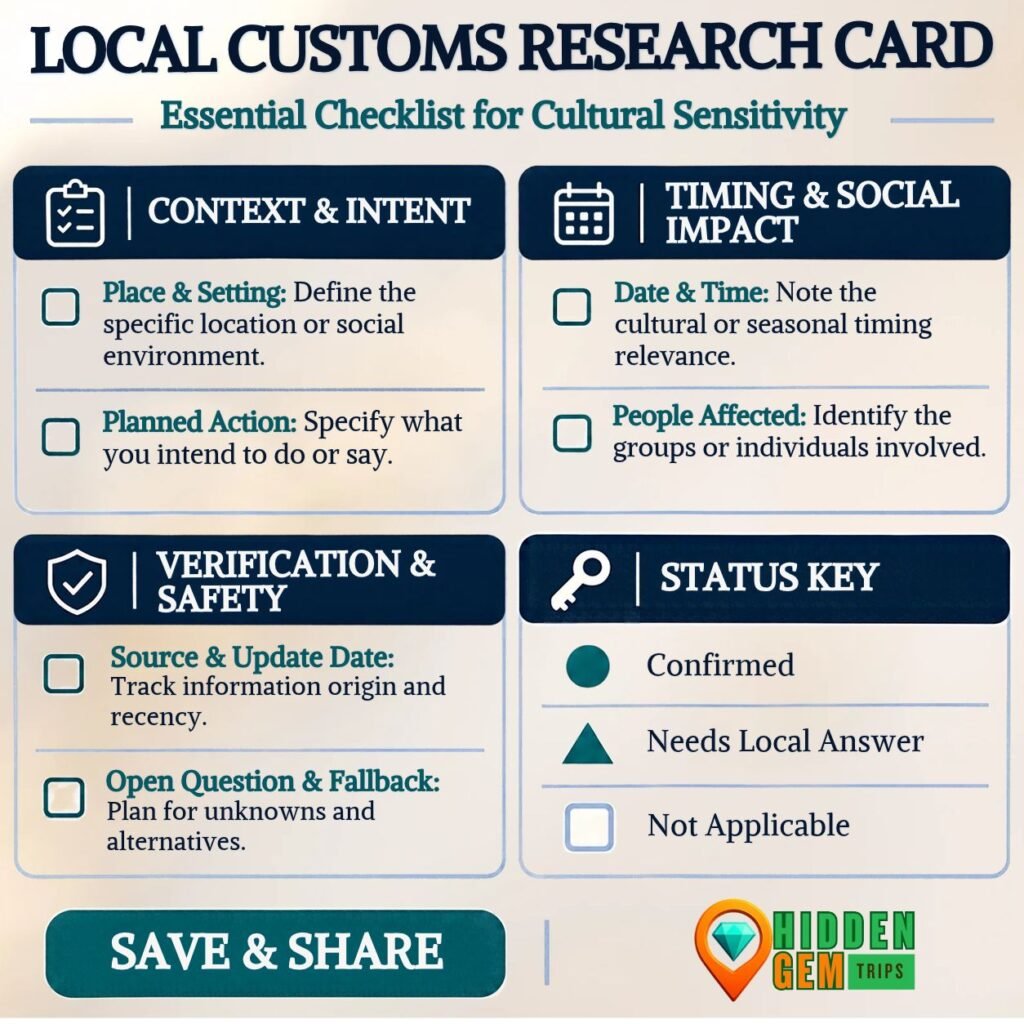
This card is intentionally small. A traveler does not need to become an amateur anthropologist. The aim is to notice which detail must be verified and who is in a position to answer it.
Seven Research Steps for a Local Customs Travel Guide
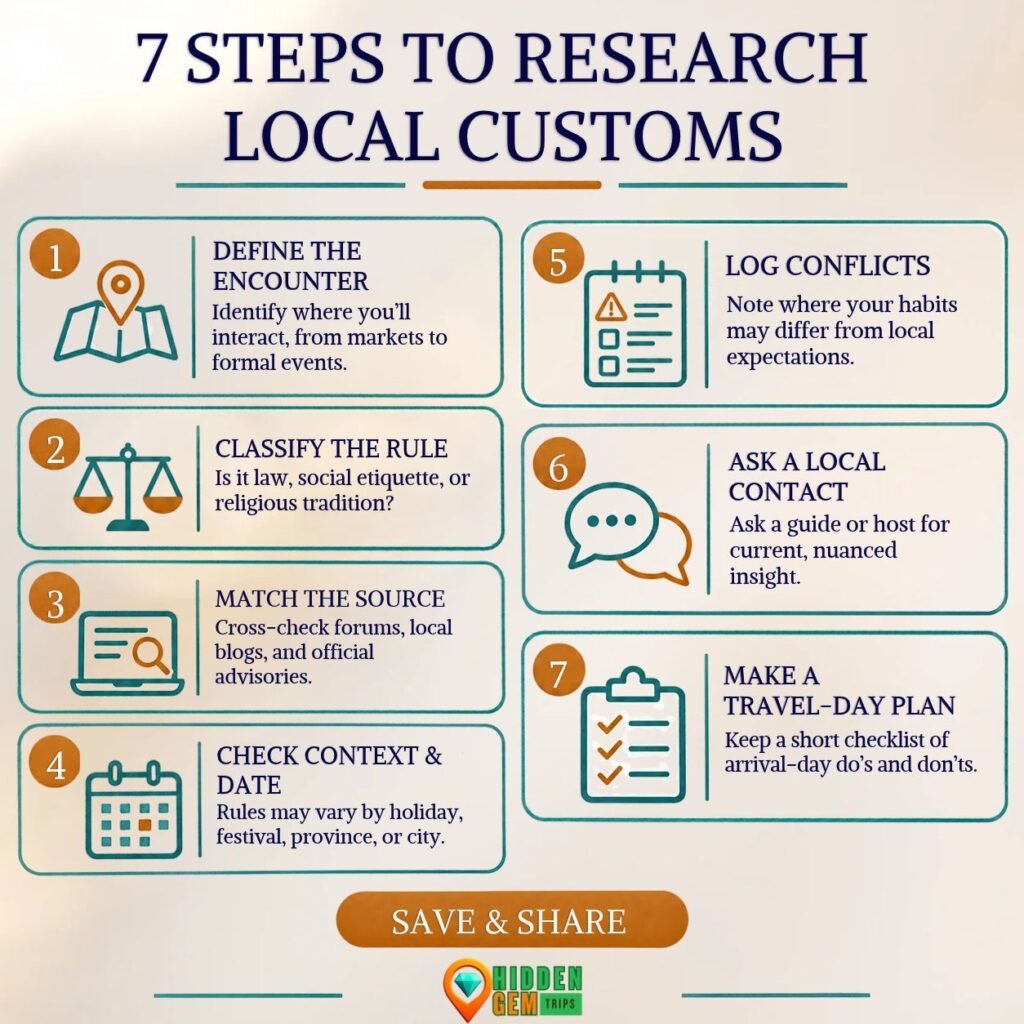
1. Define the exact encounter
Start with a place, activity, date, and intended action. “Visit a village” is not specific enough. “Join a two-hour walk through a village on a weekday morning, including a stop at a family compound” gives you something concrete to verify. Add the purpose of the visit: sightseeing, worship, a meal, shopping, a workshop, or attendance at an event.
Then separate what you control from what you do not. You can choose whether to enter a space, book a guide, ask before taking a photograph, or leave. You cannot assume that a public road makes every nearby home or ceremony open to visitors. That kind of distinction also matters in destination planning. For example, a Tana Toraja route guide treats ceremonial access as something to check locally rather than a guaranteed attraction.
If the trip has several cultural stops, make a separate card for each one. The extra minute is useful because a rule that applies at a museum may not apply at a family workshop a few blocks away.
2. Separate law from venue rules and social expectations
A search result may call all guidance “custom,” but the source and consequence can be very different. Sort every claim before relying on it.
| Claim type | What it governs | Best first check |
| Law or regulation | Conduct that can lead to a fine, detention, denied entry, or another formal consequence. | Current government travel advice, local authorities, or the named legal authority. |
| Venue or operator rule | Entry, clothing, photography, food, route, or timing at one site or service. | The venue, operator, event organizer, or posted rule in its current version. |
| Community practice | A shared or customary expectation that may depend on place, occasion, or community decision. | Community-recognized guidance, local cultural institutions, and a knowledgeable local contact. |
| Personal preference | What one host, worker, or individual is comfortable with. | Ask the person involved and accept their answer without generalizing it to everyone. |
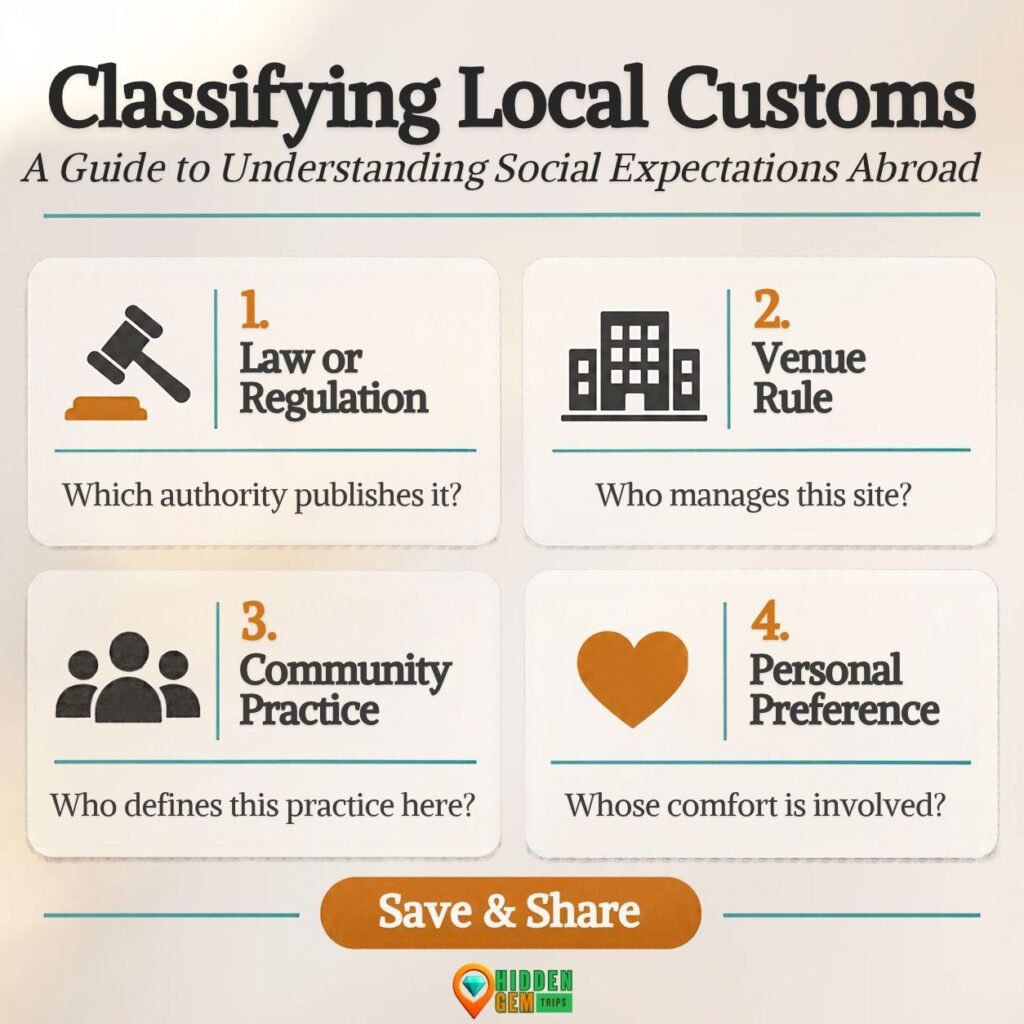
Government pages are important for legal exposure. The U.S. Department of State’s guidance on laws abroad explains why travelers should check local rules, including when an issue seems ordinary at home. A government page is not a complete cultural interpreter, though. For a ceremony or community-led visit, it should be one part of the research rather than the final word.
When a rule is legal, record the actual requirement and the official source. When it is a community norm, do not rephrase it as a law. The distinction protects the traveler from bad advice and keeps local practice from being misrepresented.
3. Match each question to the right source
There is no single source ladder that answers every question. Use the source that has authority over the kind of claim you are checking.
For laws and safety, begin with current official advice for your nationality and destination. Compare it with the destination’s own public information when that is available. The UK Foreign, Commonwealth and Development Office advice for Indonesia, for example, separates legal matters and time-sensitive cultural differences, and directs travelers to seek current local advice for some details.
For a site’s operating rules, go to the site or its current operator. For a community-led event, look for guidance from its organizers or a recognized local cultural body. For background, use museums, universities, local researchers, and organizations rooted in that place. For the meaning of a living-heritage practice, UNESCO’s ethical principles for intangible cultural heritage put communities and practitioners in a primary role and call for transparent collaboration and informed consent.
Local guides and hosts can help translate broad guidance into the day’s conditions. Treat them as informed contacts, not as representatives of every resident. Published traveler accounts, forums, and social media can point to useful questions, but they often lack the date, location, or context needed to settle a decision.
Community-led travel is growing in different forms. UN Tourism reported 319 rural destinations in its Best Tourism Villages network in 2026, spread across 65 countries. That is the size of one specific program, not a count of all community tourism. It is a reminder to look for the people and organizations who manage a particular visitor experience, such as in a Fiji village and ferry route plan or a Vanuatu outer-island itinerary.
4. Check where, when, and for whom a claim applies
A claim is only useful when its boundaries are clear. Check its location, date, audience, and activity. Does “visitors should cover their shoulders” apply to a particular temple, the whole district, or a specific ceremony? Was the guidance written for tourists, residents, staff, or pilgrims? Does it refer to ordinary opening hours or a festival day?
Look for a named author or organization, a publication or update date, citations, and a description of how the information was gathered. If the advice comes from a translated page, consider whether a local name or distinction may have been flattened in translation. “The locals do this” is a warning sign when the writer never identifies which locals, where, or when.
Destination guides can help you formulate better questions. A Guatemala Highlands guide to markets and volcano stops or a Lake Toba village guide can introduce a traveler to the setting, but neither replaces a current answer from a particular market, host, or community. The same goes for a Wakatobi island visit, where a general regional note may not describe every island or village.
Keep a small note beside each claim: “applies to this venue,” “applies during the event,” “general background,” or “not confirmed for our visit.” Those labels are more honest than turning a narrow observation into a timeless rule.
5. Compare sources and record uncertainty
When sources disagree, do not settle the question by counting search results. Compare their authority, recency, geographic scope, and directness. A venue’s current notice usually answers its entry rule better than a travel blog from five years ago. A local cultural organization may explain a community practice more accurately than a generic official tourism page. A national law still matters even when a host describes what people commonly do.
Record the disagreement instead of smoothing it away. A simple source log can use five columns: the claim, its category, who published it and when, the place or situation it covers, and what action you will take. Add “unknown” when the evidence does not answer the question.
For example, one page may say photography is allowed at a cultural site while a recent event notice says recording is restricted. The statements may refer to different areas or different kinds of images. Ask whether the restriction covers buildings, performers, identifiable people, or the event as a whole. Until you have a clear answer, plan for the narrower permission.
This is particularly useful when comparing a broad visitor guide with a more specific route. A Tanjung Puting guide that includes village life and a North Bali village itinerary may suggest where cultural context matters, while current host or organizer guidance answers what is appropriate on a particular date.
6. Confirm sensitive details with a local contact
Once desk research has narrowed the issue, ask a person who is connected to the place or activity. That may be a host, licensed guide, event organizer, tourism office, site manager, or community cultural organization. Choose someone whose role relates to the question. A hotel receptionist may know opening hours; a ceremony organizer is better placed to say whether visitors may attend.
Ask a short, answerable question. For example: “We are considering a visit to [place] on [date]. Is this activity open to visitors that day? Are there any entry or clothing instructions? May visitors take photographs, and are there parts where recording is not allowed?” If the answer is uncertain, ask who can confirm it.
Do not ask one person to explain an entire culture. Make the request easy to decline, and do not treat a paid guide’s time as an unlimited consultation. If you are planning a local experience, a slow visit to Amed’s salt farms and coastal communities is a useful reminder that work and everyday life can be part of a visitor route without becoming a performance on demand.
When the question touches living heritage, the underlying principle matters. The UNESCO Convention calls for the widest possible participation of communities in safeguarding and managing their heritage. Its Article 15 on community participation is one reason a visitor should seek community-defined guidance where it exists, instead of assuming that a listing or photo gallery grants access.
7. Turn the research into a travel-day plan
A page of bookmarks is not yet a plan. Convert your findings into a short note that you can use on the day. Keep only the details that could change what you do: the confirmed rule, the source and date, the contact who can clarify, and the fallback if access is closed or a person declines.
Separate confirmed details from open questions. A practical note might say: “The visitor center confirms entry is available until 4 p.m. The organizer has not yet replied about recording. We will leave the camera away unless the organizer gives clear permission.” This is easier to follow than a paragraph of broad advice saved in a browser tab.
Recheck information that can change close to departure and again when you arrive. Official travel pages, event schedules, opening hours, weather-related access, and local instructions may be updated. A remote travel budget plan should also include slack for local transport or a guide if the situation calls for one. For longer trips, keep the wider itinerary flexible; the two-base itinerary method can make it easier to shift a visit when a local date or access window changes.
For general trip preparation beyond cultural questions, travelers may also review current travel medical coverage options from SafetyWing. Check current terms and destination eligibility directly. Insurance does not replace local instructions.
A Worked Example for a Village Visit
Imagine that you want to attend a small community festival during a trip. The search phrase “festival etiquette” may surface useful background, but it cannot tell you whether this event welcomes visitors or whether photography is acceptable this year. Use the research card instead.
First, name the event, location, date, and intended role. Then sort the questions: Is attendance legally permitted? Are there guidelines for organizers? Is it a community-run event? Are there personal boundaries around filming? Check official travel advice for legal restrictions, the organizer for access and schedule, and a local cultural source for context. Note each source’s date and the precise activity it covers.
If published sources conflict, contact the organizer through an official channel. Ask whether visitors may attend, whether there is a contribution or registration process, and whether recording is allowed. Put the reply in your travel note. If no one confirms that outsiders are welcome, do not turn silence into permission. Choose another activity or ask your guide to suggest an appropriate alternative.
That process works for a ceremony, but it also helps with a meal in a home, a craft workshop, a village walk, or a market. The specific answer will change; the way you verify it can stay consistent. Travelers who want more time for local conversations can also use Hidden Gem Trips’ slow-travel planning approach.
Conclusion
Good customs research does not promise that every interaction will feel effortless. It gives you a clearer picture of what is law, what belongs to a venue, what a community has chosen to share, and what still needs a direct answer.
Keep the question small enough to verify. Use sources that fit the question, check their date and boundaries, and write down uncertainty before it gets lost in a full itinerary. If a person or community says no, let that answer shape the plan. The goal is a visit that can adapt to the people who live there.
Frequently Asked Questions
1. How do I research local customs before a trip?
Start with the exact place and activity. Examine official sources for safety and legal information, the venue or organizer for the most recent operating guidelines, and local sources for cultural background. Please note the publishing dates and have a local source check any urgent items.
2. Are local laws and customs the same?
No, a law or rule has formal legal consequences. A venue regulation is a rule that governs entry to a specific location or service. A custom is a community or social expectation that may change with the situation. Identify the source properly so that you know what is needed and who can provide clarification.
3. How up-to-date should travel etiquette information be?
Please check the latest official advice before you book. Then, right before you leave, check the laws, schedules, closures, and directions for events. While historical background or long-established customs may be less urgent, you still need to understand their local scope.
4. What if the sources don’t agree?
Check each source for its publisher, currency, and whether it covers the same place and action. If the response impacts consent, safety, or access, ask the appropriate venue or organizer. Choose the more restrictive option, or if that won’t fix the problem, change the strategy.
5. Will a native guide be able to explain me every custom?
A good guide can point you in the direction of the right authority and offer important context. Not every community or resident can be represented by one person. Ask about the guide’s responsibilities, respect their boundaries, and listen to those directly involved.
Research Disclaimer
This article offers general travel-planning information, not legal advice or permission to enter a site, attend an event, or photograph people. Laws, venue policies, and community practices vary and can change. Verify current requirements with the relevant authorities, organizers, and local contacts. This article includes a tracked SafetyWing partner link; Hidden Gem Trips may receive a commission if you buy through it, at no additional cost to you. The link is included for general trip planning and does not affect the customs guidance above.