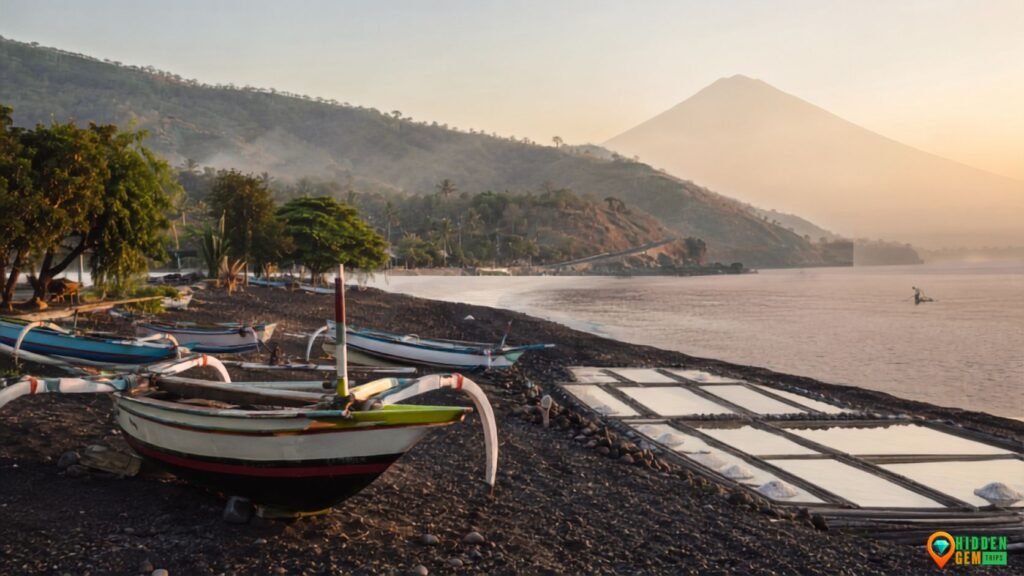

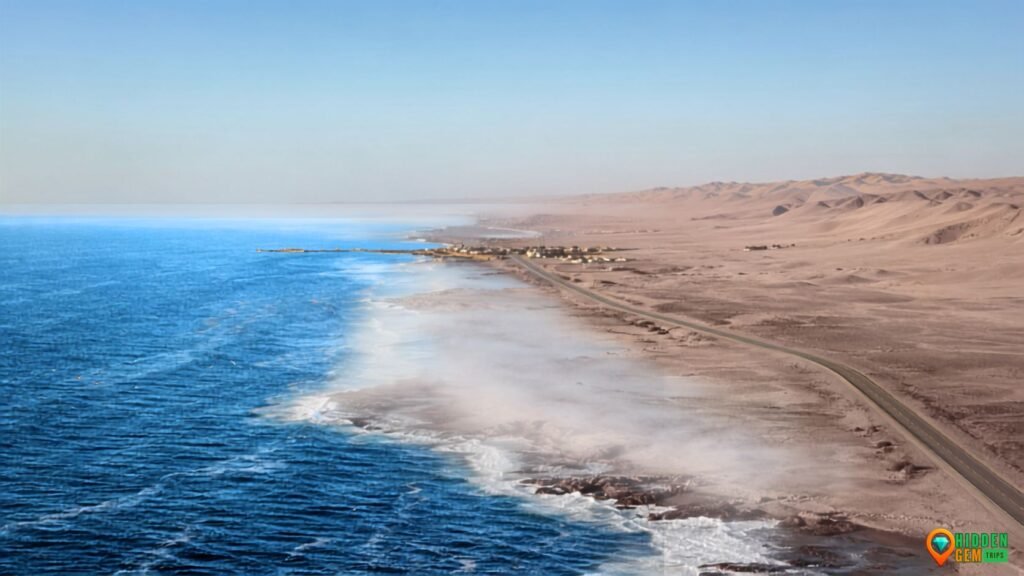
Namibia coastal towns do not behave like ordinary beach destinations. The Atlantic is cold, fog often erases the horizon, dunes rise where palm-lined promenades might be expected, and long distances turn simple detours into decisions. The reward is a coastline with a rare sense of scale: working ports, diamond-era history, wetlands full of birds, tiny holiday settlements, and park outposts that feel almost detached from the modern world.
This guide is for travelers who prefer patient observation over a checklist. It follows seven stops from the Orange River mouth in the far south to Terrace Bay inside Skeleton Coast Park. It also corrects one of the most common planning mistakes: this is not a continuous beach road. Restricted land, national parks, and vast empty sections mean the coast works better as a series of modules than as one uninterrupted drive.
Before building the route, it helps to plan trips that leave room to breathe and to test whether a remote place is genuinely visitor-ready. Namibia rewards curiosity, but it punishes casual assumptions about fuel, road time, access, and ocean conditions.
| Affiliate disclosure: This article includes one affiliate link. If you purchase through it, HiddenGemTrips may earn a commission at no extra cost to you. Recommendations remain editorially independent. |
Why Namibia Coastal Towns Feel Unlike Normal Beach Destinations
The coast is shaped by a collision of systems. The cold Benguela Current cools the air and supports marine productivity, while the Namib presses against the ocean from the landward side. UNESCO describes the Namib Sand Sea as the world’s only coastal desert with extensive dune fields influenced by fog. The World Heritage property covers 3,077,700 hectares, with an additional 899,500-hectare buffer zone. Fog is not merely atmospheric decoration here; it is a major water source for organisms adapted to hyper-arid conditions.
That ecological story changes the feel of a coastal trip. Mornings can begin in muted gray, midday can sharpen the dunes into hard-edged geometry, and evening can return the shoreline to cold mist. A town that looks sleepy at breakfast may feel bright and exposed by lunchtime. Packing only for “African heat” is one of those decisions that sounds logical in an airport and ridiculous on a windy jetty.
The protected areas also matter. Dorob National Park covers 7,800 square kilometers around the central coast and includes Swakopmund, Henties Bay, and Wlotzkasbaken. The ministry records 270 bird species in the park and highlights its extensive lichen fields. Farther north, Skeleton Coast Park stretches for roughly 500 kilometers. Farther south, Tsau //Khaeb protects much of the former diamond-restricted landscape.
In practical terms, the coast offers three different kinds of quiet. There is social quiet in small settlements such as Wlotzkasbaken. There is landscape quiet on the Lüderitz Peninsula or the open beaches north of Henties Bay. And there is logistical quiet at Terrace Bay, where limited facilities and controlled access reduce the number of people. They are not interchangeable, so the best stop depends on what kind of stillness you actually want.
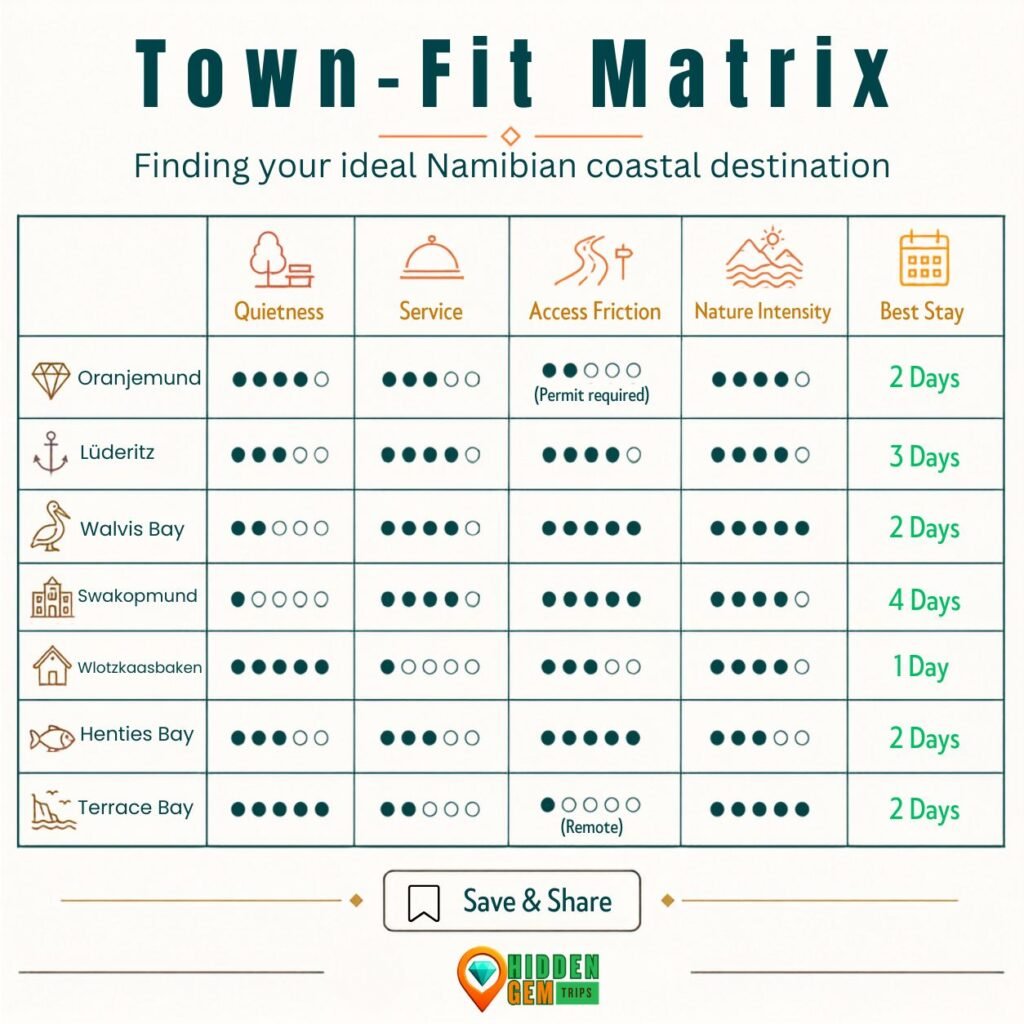
Quick Comparison of the 7 Namibia Coastal Towns and Stops
| Stop | Quietness | Service level | Access friction | Best for | Suggested stay |
| Oranjemund | High | Moderate | Medium | River mouth, local history, transition landscapes | 1–2 nights |
| Lüderitz | High outside the center | Good | Medium | Architecture, peninsula drives, maritime history | 2–3 nights |
| Walvis Bay | Medium | High | Low | Wetlands, birds, marine trips, Sandwich Harbour gateway | 2 nights |
| Swakopmund | Medium | High | Low | Museums, cafés, architecture, soft landing | 2–3 nights |
| Wlotzkasbaken | Very high | Very low | Medium | Short pause, photography, lichen awareness | Day stop |
| Henties Bay | High | Moderate | Low | Fishing culture, beach walks, slower holiday rhythm | 1–2 nights |
| Terrace Bay | Very high | Very low | High | Remote park atmosphere, angling, dunes, isolation | 1–2 nights |
7 Quiet Desert-Sea Stops Along Namibia’s Coast
1. Oranjemund: River-Mouth Calm at the Edge of the Diamond Coast
Oranjemund sits near the place where the Orange River reaches the Atlantic, giving the town a greener, softer edge than travelers may expect from southern Namibia. For decades it functioned as a controlled diamond-mining town. The Oranjemund Town Council says it officially opened to the public in 2017, ending the old entry-permit requirement. The council reports a 2023 population of 7,441 residents, small enough for the town to retain an unusually contained rhythm.
The appeal is not a dense attractions list. It is the contrast between river, ocean, mining history, and an inhabited town at the edge of vast protected land. Look for local museum interpretation, the river-mouth environment, and wildlife that sometimes moves surprisingly close to the urban grid. Oranjemund works best when treated as a place to understand transition: fresh water into salt water, private company town into public municipality, and diamond economy into a broader local future.
A slow day here can be simple. Start with the town’s history, spend the cooler hours near the river or coast, eat locally, then leave time for an unplanned conversation. This is not a stop that rewards aggressive scheduling. It rewards noticing how a remote town sustains ordinary life.
The major planning warning is geographic. Oranjemund and Lüderitz are not linked by an open public road that traces the beach. Much of the coast lies inside Tsau //Khaeb, formerly known as the Sperrgebiet. Official park information describes restricted access in Tsau /Khaeb National Park and notes that places such as Bogenfels are reached through concession tours. Build the southern section around legal inland roads and confirmed local access, not a fantasy line drawn along the ocean.
Best fit: repeat visitors to Namibia, road trippers entering from South Africa, travelers interested in post-mining town transitions, and anyone comfortable with a destination whose value is atmospheric rather than attraction-heavy.
2. Lüderitz: Wind, Maritime History, and a Peninsula of Empty Bays
Lüderitz looks as though several eras washed ashore together and never completely left. Bright early-20th-century buildings sit against granite, fishing vessels work the harbor, and the wind moves through streets that can feel animated one moment and abandoned the next. It is more visually dramatic than Oranjemund, yet it still becomes quiet quickly once you leave the small center.
The peninsula is the real reason to give Lüderitz more than a single night. Scenic roads lead toward coves, lagoons, Diaz Point, and exposed viewpoints where the Atlantic feels close and unwelcoming. The experience is not about finding a warm swimming beach. It is about watching wind, rock, seabirds, and cold water negotiate the coastline.
Town history deserves context rather than nostalgia. Colonial architecture is photogenic, but the region’s story also includes dispossession, forced labor, racial separation, extractive mining, and the communities that lived through those systems. Visit museums and historic houses with a critical eye. Treat Kolmanskop as evidence of a boom-and-abandonment economy, not merely a fashionable sand-filled photo set.
Lüderitz also works as the practical base for controlled excursions into restricted areas. Do not assume that a rented vehicle allows independent access to Bogenfels, Pomona, or every ghost settlement visible on a map. Book authorized operators and verify what is open.
For travelers comparing quiet coastal routes, the peninsula offers a very different mood from the lush scenery in another quiet-coast road model. Here, emptiness is created by wind, conservation boundaries, and industrial history rather than forests and small farming communities.
Best fit: architecture and history travelers, photographers, birders, travelers who like strong weather, and people who prefer a real working town to a polished resort.
3. Walvis Bay: A Working Port with a Quiet Wetland Side
Walvis Bay is the least obviously quiet stop on this list. It is a major port, an industrial center, and a logistics hub. Heavy vehicles, warehouses, and marine businesses are part of the landscape. Yet the lagoon side of town changes the pace completely. Flamingos feed in shallow water, pelicans cross the sky, and the long esplanade creates an easy walking route beside one of southern Africa’s significant coastal wetlands.
The Ramsar listing for Walvis Bay records a wetland area of 12,600 hectares. Numbers of birds vary with season, tide, and conditions, so avoid treating flamingo sightings like a scheduled show. The better approach is to walk slowly, use binoculars, and give feeding birds distance.
Walvis Bay is also the most practical base for marine excursions and Sandwich Harbour. The temptation is to book every available activity: catamaran, kayaking, dunes, oysters, 4×4, and a sunset drive. That creates a busy destination that contradicts the point of this article. Choose one major excursion and keep the other half of the day open.
Sandwich Harbour sits within Namib-Naukluft Park and is environmentally sensitive. Official park information for Namib-Naukluft notes that the area is part of a vast conservation landscape, while ministry permit guidance says access to Sandwich Harbour and certain other areas requires prior authorization. A qualified local operator is usually the most sensible choice because tides and dune driving are not forgiving classrooms.
For a quieter Walvis Bay day, walk the lagoon early, eat away from the busiest excursion windows, and watch how a port town and a wetland occupy the same bay. That tension—industry beside internationally important habitat—is more revealing than pretending the industrial side does not exist.
Best fit: birders, travelers who need strong services, families, first-time Namibia visitors, and anyone who wants one comfortable base for both coast and dunes.
4. Swakopmund: Find the Slow Town Beneath the Adventure Branding
Swakopmund is marketed as Namibia’s adventure capital, which can make it sound like a conveyor belt of skydiving, sandboarding, quad bikes, and scenic flights. Those activities exist, but they are not the only way to experience the town. Beneath the adrenaline branding is a walkable coastal settlement with museums, bakeries, old civic buildings, a jetty, residential streets, and a daily rhythm shaped by fog.
The slow version of Swakopmund begins on foot. Walk before tour vehicles gather. Notice the shift from damp morning air to brighter afternoon light. Visit a museum rather than stacking two dune activities. Sit in a café long enough to hear local languages and daily conversations instead of treating the town as a service station between desert attractions.
Swakopmund is also the best place to reset logistics. Laundry, vehicle checks, groceries, medical needs, and weather updates are easier here than at smaller northern stops. That makes it a useful anchor in a long itinerary. The mistake is using its convenience to schedule even more movement.
A two- or three-night stay fits the logic of the two-base itinerary method: use Swakopmund as one stable base, Walvis Bay or Henties Bay as the second, and avoid repacking every morning. This reduces driving fatigue and creates time for weather-dependent decisions.
The coast around town is environmentally regulated. Stay on legal roads and marked routes, especially near dunes and gravel plains. Tire tracks can damage crusts, lichens, and habitats that recover slowly. “Empty” does not mean impact-free.
Best fit: first-time visitors, travelers without camping equipment, solo travelers who value services, café-and-museum travelers, and anyone needing a gentle transition between remote sections.
5. Wlotzkasbaken: A Small Settlement in a Fragile Lichen Landscape
Wlotzkasbaken is not a conventional town break. It is a small coastal settlement north of Swakopmund, known for its sparse layout, distinctive houses, water tanks, and a sense that the desert has simply allowed a few structures to remain. Services are limited. The value is in the pause.
This is the stop most likely to be damaged by travelers who confuse emptiness with freedom. The surrounding gravel plains and lichen fields are ecologically sensitive. Some lichens become visually vivid with moisture, but that does not make them a surface for walking, parking, drone takeoffs, or improvised tracks. Keep to authorized access and existing roads.
A short visit is enough for most travelers. Photograph respectfully, observe the relationship between settlement and desert, and continue without turning private residential space into an open-air attraction. Wlotzkasbaken is not a content set. People live and holiday here.
The quiet is genuine because there is little commercial performance around it. No one needs to package the silence for you. That also means you should arrive prepared, avoid expecting cafés or visitor infrastructure, and leave no waste.
Before this section of the trip, prepare for rough coastal roads and carry water, tire equipment, warm layers, and offline navigation. The useful gear is the boring gear—the kind that prevents a minor issue from becoming a very long afternoon.
Best fit: careful photographers, slow-road travelers, architecture observers, and visitors who understand that a 45-minute stop can be more appropriate than an overnight claim on a tiny place.
6. Henties Bay: Angling Culture and Long, Unhurried Shorelines
Henties Bay is a holiday and angling town with a practical, unpolished feel. It is quieter than Swakopmund, better serviced than Wlotzkasbaken, and easier to linger in than Terrace Bay. That middle position is its strength.
Fishing culture shapes local life, but non-anglers still have reasons to stop. Long beach walks, open skies, the Omaruru River mouth, and access to the central coast’s protected landscapes create an easy rhythm. The town does not demand constant activity. It gives you permission to have breakfast late, watch weather move across the water, and choose one outing.
Travelers should be careful with the language of “empty beaches.” Beaches can be habitat, fishing grounds, access routes, and dangerous marine environments at the same time. Do not drive wherever tire marks already exist. Existing damage is not a permit.
Henties Bay also works as a staging point for Cape Cross and the southern edge of the Skeleton Coast, but those should not become rushed boxes. A seal reserve is a sensory wildlife experience, not a ten-minute photo stop. Wind direction, smell, noise, and animal density are part of the reality.
If your itinerary includes several isolated stops, estimate the road-trip costs travelers often forget. Fuel detours, tire repairs, park fees, activity deposits, groceries, and one unplanned night can matter more than the headline room rate.
Best fit: anglers, self-drivers, repeat Namibia visitors, travelers who want ocean access without Swakopmund’s activity menu, and anyone seeking a practical pause before the more controlled northern park section.
7. Terrace Bay: The Remote Northern Outpost
Terrace Bay is less a town than a remote park outpost with accommodation and essential facilities. It sits inside Skeleton Coast Park, surrounded by dunes, wind, and a coastline that feels larger because human infrastructure is so limited. This is the stop that most clearly delivers isolation, but it also requires the most planning.
The Ministry of Environment states that Skeleton Coast Park covers 16,390 square kilometers and extends roughly 500 kilometers along the coast. The official page notes more than 100 lichen species, 306 recorded bird species, and entry tied to a booking for the Terrace Bay area. It also states that a fishing license must be obtained before entering for angling.
Current accommodation information should be checked directly with Namibia Wildlife Resorts’ Terrace Bay page. Facilities are intentionally limited compared with a normal town. That is part of the appeal, not a service failure. Book early, confirm meals and fuel arrangements, and carry backup supplies even when your reservation includes food.
The best Terrace Bay experience is not a race through shipwreck coordinates. It is waking to wind, walking only where permitted, watching light move over the dunes, and accepting that the landscape sets the schedule. Fishing may be central for some guests, but photographers, birders, and quiet travelers can also appreciate the outpost.
Do not romanticize remoteness into recklessness. Fog reduces visibility, distances are long, mobile coverage can be weak, and help may not be close. Share your route, start early, and do not improvise off-road detours.
For the broader packing strategy, pack lighter for isolated journeys while protecting the essentials: water, warmth, tire tools, first aid, paper or offline route information, and food that does not depend on perfect refrigeration.
Best fit: experienced self-drivers, anglers, landscape photographers, travelers comfortable with basic facilities, and visitors who want the strongest sense of distance on this list.
How to Plan a Namibia Coast Road Trip Without Rushing
Understand the Route Is Modular, Not Continuous
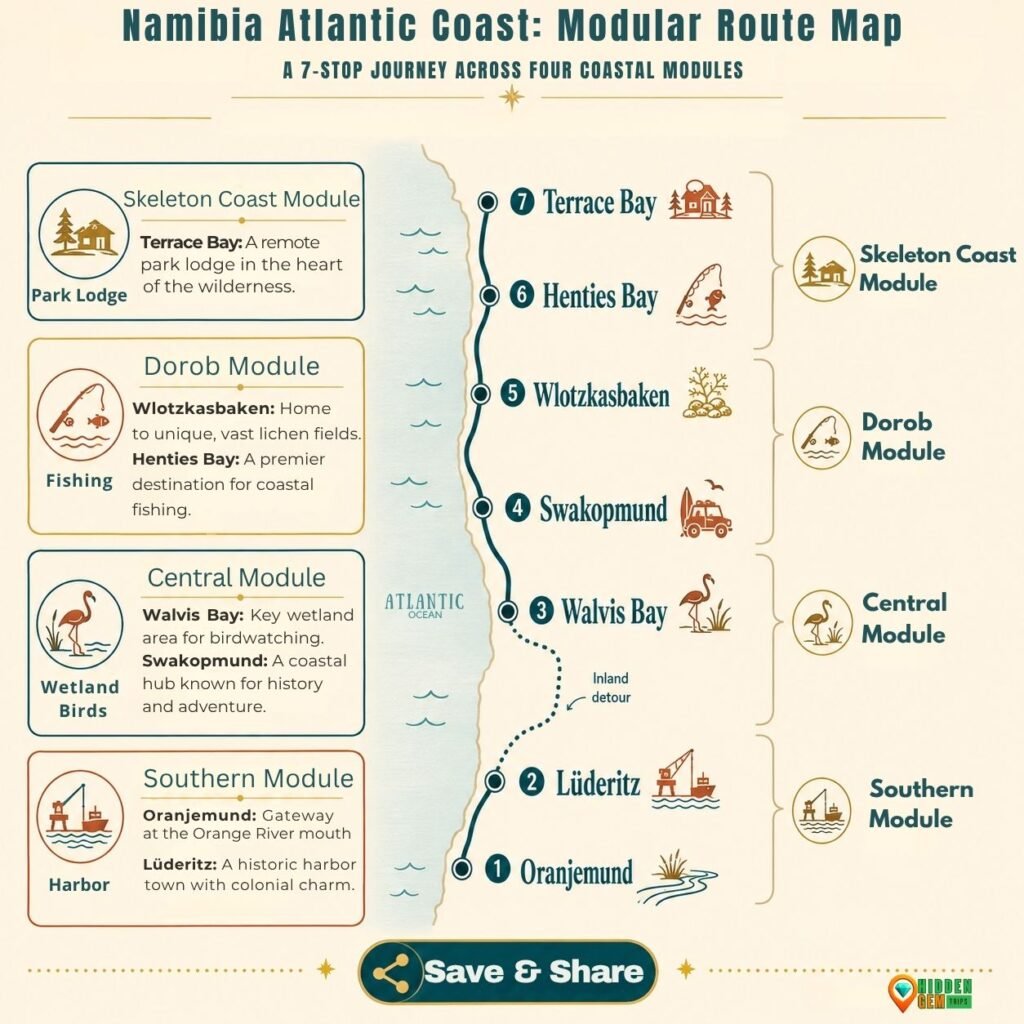
The article’s seven stops run south to north, but the itinerary should not be read as a single shore-hugging road. Restricted diamond areas and protected landscapes interrupt the public route. A realistic plan separates the journey into modules:
- Southern module: Oranjemund and Lüderitz, connected through legal inland roads and optional authorized concession tours.
- Central module: Walvis Bay and Swakopmund, the best-serviced section and the easiest place to use two bases.
- Dorob module: Wlotzkasbaken and Henties Bay, with careful driving inside a protected coastal landscape.
- Skeleton Coast module: Terrace Bay, which requires advance booking, park compliance, and a stronger supply plan.
Trying to connect every dot in a single fast itinerary creates too much driving and too little coast. Use the principles in a seven-day deep-trip framework even when your trip is longer: fewer anchors, realistic transfer days, and one unscheduled buffer.
Choose the Right Vehicle and Driving Rhythm
A high-clearance vehicle is helpful on gravel roads, but a 4×4 does not replace route judgment. Many standard approaches are possible in a suitable two-wheel-drive vehicle under normal conditions, while specific dunes, concessions, and park routes may require 4×4 capability or a guide. Rental contracts may also restrict beach driving and certain roads.
Ask the rental company exactly where the vehicle may go. Photograph existing damage, understand tire coverage, carry the correct jack and tools, and learn how to use them before the road is empty. Reduce speed on gravel and increase following distance. A schedule that requires consistently fast gravel driving is a bad schedule.
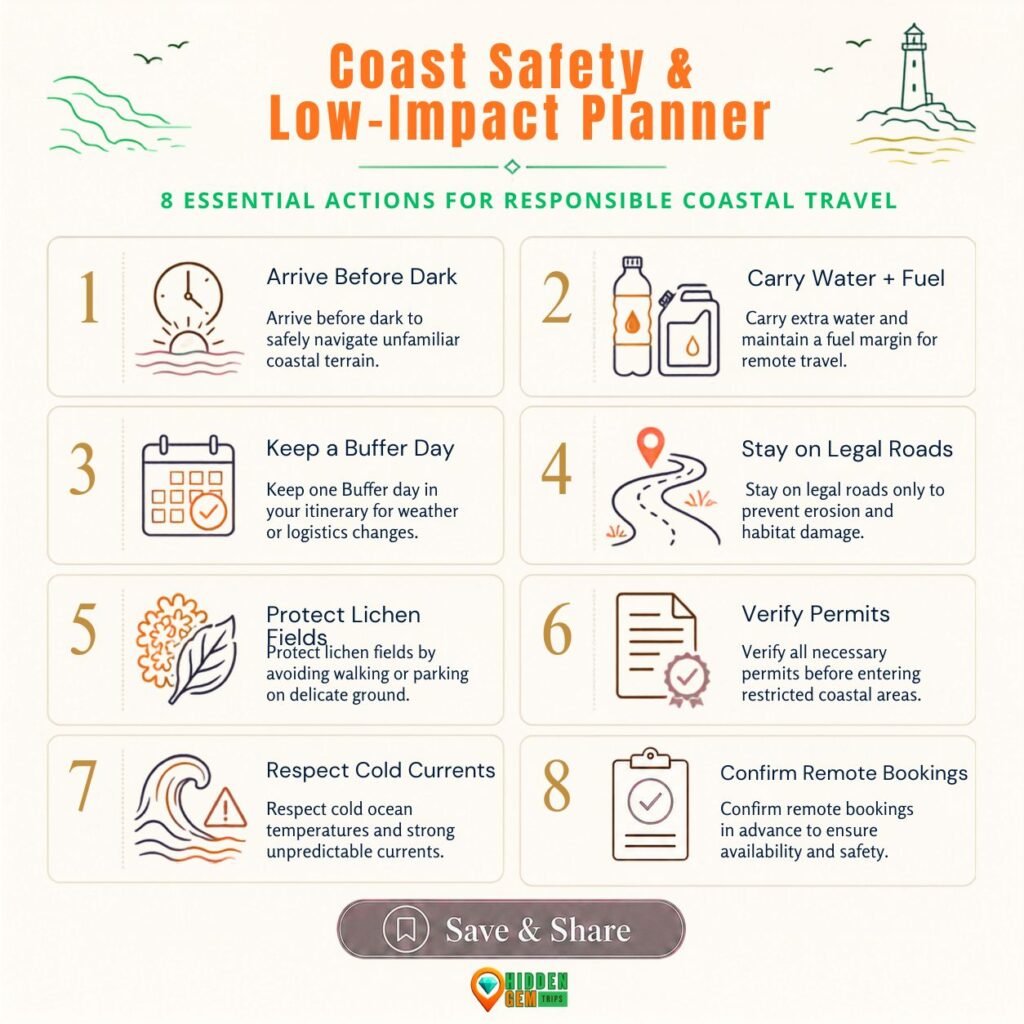
Fog is another reason to avoid late arrivals. It can flatten contrast and make distances deceptive. Plan to reach small settlements and park gates with daylight to spare.
Best Time for Namibia Coastal Towns
There is no single perfect month because the coast and inland Namibia can feel like different countries on the same day. The coast is often cooler and foggier than the interior. Southern summer holidays can also make popular towns busier, especially Swakopmund, Henties Bay, and Walvis Bay.
For many self-drivers, the dry months from roughly May to October offer comfortable inland travel and clearer route planning, but mornings on the coast can still be cold. Summer can be a nice change from the interior temperatures, but there may be more demand for accommodation around holidays. Check local forecasts for each segment rather than using Windhoek weather as a proxy for the ocean.
Bring a wind-resistant layer and pack for temperature swings. The same logic used to choose island-ready layers and dry bags applies here, except the priority is wind, dust, cold spray, and camera protection rather than tropical rain.
Budget and Booking Strategy
The central coast can be planned across several price levels, but the remote sections have fewer choices. Terrace Bay and concession-based southern excursions should be booked first. Then reserve Lüderitz, Oranjemund, and Henties Bay. Swakopmund and Walvis Bay usually offer more flexibility, although peak periods can still tighten availability.
Budget for fuel with a margin, not an optimistic calculation. Include park entry, guided access, laundry, groceries, vehicle cleaning, tire-related costs, and a contingency night. Remote travel becomes expensive when a plan has no slack.
Self-catering can control costs, but do not arrive at a tiny settlement assuming a full supermarket. Restock in Lüderitz, Walvis Bay, or Swakopmund before moving into thinner-service areas.
Safety, Insurance, and Cold-Ocean Reality
Namibia’s coast is beautiful partly because it is physically demanding. Cold water, strong currents, fog, wind, long road distances, and limited rescue capacity are not background details. Treat swimming as a local-conditions decision, not a default beach activity. Ask locally, obey warnings, and avoid entering unfamiliar water alone.
Check the latest official park permit guidance before you go. Permitting requirements vary by park and activity, and sensitive areas may require permits or guided access.
Travel insurance should be for the activities you plan to do, not just the country you plan to visit. Check exclusions for self-driving, off-road travel, sandboarding, kayaking, medical evacuation and trip interruption. HiddenGemTrips readers can check out this option for travel medical and trip protection before comparing to other policies. Read the current policy wording and eligibility rules rather than relying on summaries.
Long-haul fatigue also affects road judgment. Use these strategies to survive the long flight to southern Africa and avoid collecting a rental car for an ambitious gravel drive immediately after an overnight arrival.
A Realistic 10-Day Namibia Coastal Towns Itinerary
| Day | Base or stop | Plan | Why this pace works |
| 1 | Oranjemund | Arrive, orient, local history, sunset near the river or coast. | No long excursion after a transfer. |
| 2 | Oranjemund | Slow town morning; depart only if the next leg is confirmed and comfortable. | Protects the southern module from becoming a token stop. |
| 3 | Lüderitz | Transfer via legal inland route; evening walk. | Treats distance as part of the trip. |
| 4 | Lüderitz | Peninsula drive, historic center, museum or authorized excursion. | One full day for weather and context. |
| 5 | Walvis Bay | Transfer or flight/route connection according to the wider Namibia itinerary. | Acknowledges the coast is not continuously drivable. |
| 6 | Walvis Bay | Lagoon walk plus one major marine or Sandwich Harbour excursion. | Avoids stacking activities. |
| 7 | Swakopmund | Short transfer, walking day, museum, café, logistics reset. | Uses the town as a base rather than an activity machine. |
| 8 | Henties Bay via Wlotzkasbaken | Careful day stop at Wlotzkasbaken; continue to Henties Bay. | Keeps the tiny settlement from being overused. |
| 9 | Terrace Bay | Early park drive with confirmed booking; settle in before late fog. | Builds daylight and contingency into the remote leg. |
| 10 | Terrace Bay / onward | Quiet morning, approved walk or fishing, then continue according to gate and booking rules. | Ends with landscape time, not a dawn dash. |
Ten days is still ambitious if the coast is only one part of a wider Namibia trip. Travelers starting in Windhoek, adding Sossusvlei, or continuing to Etosha should consider choosing either the southern module or the central-northern module, not both.
This selective approach is consistent with how travelers can see how small towns change the pace of a trip: the point is not to collect town names, but to notice how different settlements organize work, weather, food, and public space.
Responsible Travel on Namibia’s Fragile Coast
Responsible travel here is less about dramatic gestures and more about disciplined restraint. Stay on legal roads. Do not create tracks across gravel plains. Keep vehicles off vegetated areas and sensitive shoreline zones. Avoid walking over lichens. Give birds and seals space. Do not collect stones, shells, historical objects, or plant material from protected areas.
Use local guides when access, tides, dunes, history, or wildlife interpretation requires expertise. A guide is not merely a driver; the right guide can prevent environmental damage and explain what a visitor would otherwise misread.
Spend money beyond the headline attraction. Eat in town, use local accommodation, visit museums, and buy useful locally made products instead of imported souvenirs. Ask before photographing people, homes, boats, or working areas.
The same ethics apply when you plan remote culture stops with more care or explore another African slow route. Quiet places are not empty stages waiting for a visitor’s story. They are lived-in environments with ecological limits and local priorities.
Finally, resist geotagging fragile off-road spots that lack visitor infrastructure. Share the town or official attraction rather than an informal track. A “hidden gem” should not become a damage map.
For a wider framework, use this guide to find less obvious places responsibly—without turning low visitor numbers into proof that a place is ready for unlimited exposure.
Conclusion: Choose Fewer Stops and Stay Longer
The best Namibia coastal towns are not necessarily the ones with the longest activity lists. Oranjemund offers transition and river-mouth calm. Lüderitz combines wind, history, and empty bays. And the tension between the port industry and the wetland life is apparent in Walvis Bay. Swakopmund gives comfort and a slower urban layer beneath its adventure image. Wlotzkasbaken is a brief lesson in scale and restraint. Henties Bay offers an unhurried holiday rhythm. Terrace Bay delivers the deepest isolation.
Trying to include all seven in one rushed loop misses the point. Choose the module that fits your wider trip, build in daylight and weather buffers, and allow at least one place to become familiar. Namibia’s coast is not a backdrop that performs on demand. It is a system of cold water, fog, sand, work, wildlife, and distance. The quieter you travel, the more of it you will actually notice.
Frequently Asked Questions
1. What are the best Namibia coastal towns for first-time visitors?
Swakopmund and Walvis Bay are the easiest starting pair because they have strong accommodation, food, activities, vehicle services, and access to both desert and marine experiences. Add Henties Bay for a quieter contrast. Lüderitz is highly rewarding but requires more route commitment.
2. Can I drive the entire Namibian coast?
No. A map may suggest a continuous shoreline journey, but protected areas, restricted diamond zones, and the absence of public roads interrupt the coast. Plan legal inland connections and use authorized concessions or guided access where required.
3. Is swimming safe along Namibia’s coast?
The Atlantic is cold and can have strong currents and surf. Conditions vary by location and day. Do not assume a sandy beach is suitable for swimming. Ask local authorities or accommodation staff, follow signs, and avoid entering unfamiliar water alone.
4. Do you need a 4×4 when visiting the coastal towns of Namibia?
While you won’t need it in every town, you’ll be more comfortable and safer on the gravel roads in a high-clearance, four-wheel drive vehicle. Certain areas such as dune routes, concessions, and parks may have restrictions requiring either a 4×4 or a guided vehicle. Prior to departing, confirm with your rental agency if there are any restrictions regarding which vehicles can be used in these areas.
5. How many days do you need for the Namibia coast?
Allow at least four to six days for the Walvis Bay–Swakopmund–Henties Bay section. Lüderitz deserves two or three nights, and Terrace Bay requires at least one carefully planned overnight. Covering both far-southern and northern stops usually needs a longer Namibia itinerary with transfer days.
Travel and Affiliate Disclaimer
Travel conditions, park rules, road access, fuel availability, border hours, activity requirements, and accommodation operations can change. Verify details with Namibia’s official authorities, park offices, accommodation providers, tour operators, and your vehicle rental company before travel. This article is informational and does not replace professional medical, legal, insurance, or safety advice.
The article contains an affiliate link. HiddenGemTrips may earn a commission if a reader purchases through that link, at no additional cost to the reader. Always compare policy terms, exclusions, coverage limits, and eligibility independently.