
Some destinations sell you beaches. Vanuatu sells you ghosts.
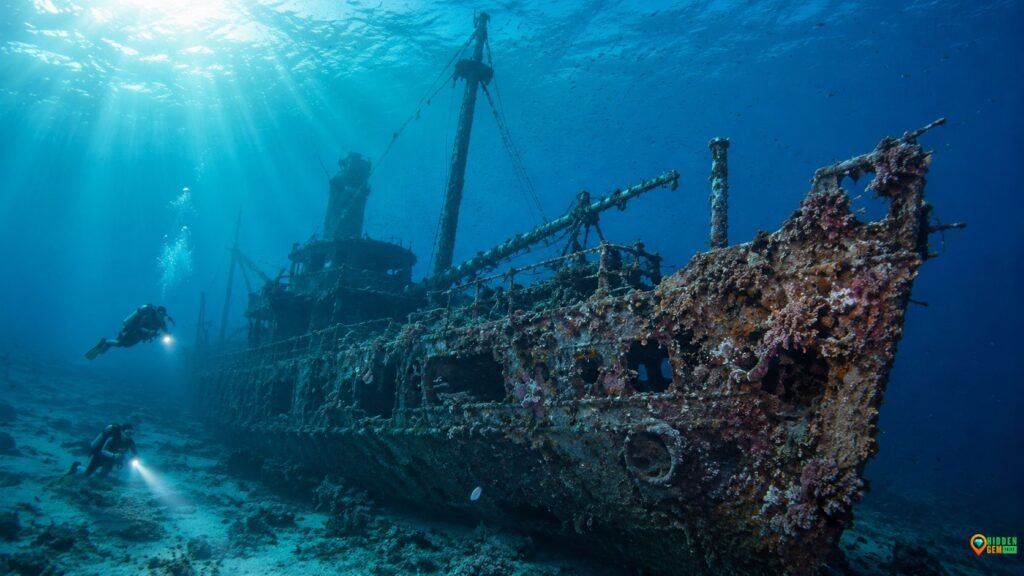
Not horror-movie ghosts. Not the cheap haunted-house kind. I mean the heavy, salt-covered kind of history that sits quietly under the Pacific: troop ships, dumped military machines, old traders, war leftovers, coral-covered metal, and cargo holds that feel less like tourist attractions and more like accidental museums.
That is what makes Hidden Vanuatu shipwrecks so different from the usual tropical dive brochure. You are not just dropping into blue water to look at fish. You are descending into a layered story: World War II logistics, colonial history, local memory, coral recovery, volcanic geology, and the strange human habit of leaving our biggest mistakes at the bottom of the sea.
Most travelers still treat Vanuatu as a side note to Fiji, New Caledonia, and the Solomon Islands—a big mistake. For divers, especially wreck divers, Vanuatu is one of the South Pacific’s most underrated heavyweight destinations. According to the official Vanuatu diving guide, the country offers reefs, caves, drop-offs, dugong encounters, and a remarkable concentration of wrecks across Efate, Espiritu Santo, and Tanna.
But here is the catch: Vanuatu is not the place to show up careless, hungover, undertrained, and overconfident. Some wrecks are beginner-friendly. Others are deep, dark, psychologically intense, and technically demanding. The ocean does not care how cinematic your GoPro angle is. Brutal, but fair.
This guide is for travelers who want more than a checklist. We will go beyond “dive the SS President Coolidge, take a photo, leave.” We will unpack the wrecks, the islands, the skill levels, the hidden context, the responsible travel angle, and the uncomfortable truth: some of the most epic dives in Vanuatu are also reminders of war, waste, and how quickly paradise can become a scrapyard.
If you are mapping your next Pacific route through our Australia & Oceania hub, Vanuatu deserves a serious place on the shortlist because it combines remote-island atmosphere with real historical depth.
Why Hidden Vanuatu Shipwrecks Hit Different
Vanuatu is not a single-island destination. It is an archipelago of volcanic islands with rocky shorelines, fringing reefs, steep drop-offs, underwater caves, and lava-shaped swim-throughs. That underwater geography matters. It means the dive landscape is not flat or predictable. One day, you are drifting past giant sea fans. The next day, you are finning through the remains of military history.
The obvious star is the SS President Coolidge, one of the world’s most famous wreck dives. But the deeper magic of Vanuatu is not only in its marquee wreck. It is in contrast.
On Espiritu Santo, you can dive a massive converted luxury liner that sank during World War II. Nearby, you can swim over piles of dumped military equipment at Million Dollar Point. Around Efate, the wrecks are smaller but more accessible, often paired with coral gardens and caverns. On Tanna, the dive experience shifts again: volcanic blue holes, swim-throughs, reef walls, and a small cargo wreck framed by an island better known for Mount Yasur, one of the world’s most accessible active volcanoes.
This is why Vanuatu works beautifully for HiddenGemTrips readers. It is not just “beautiful.” Plenty of places are beautiful. Vanuatu is textured. It has scars. It is silent. It has dive sites that ask you to slow down and pay attention.
If your usual travel style leans toward remote islands and uncrowded cultural routes, Vanuatu aligns with the mindset of our Banda Islands travel guide, where isolation, marine biodiversity, and history collide in a way that mass tourism has yet to fully digest. It also aligns with the philosophy behind our 2026 Slow Travel Manifesto: move more slowly, stay longer, and treat the destination as a living place rather than a content backdrop.
The Real Story Beneath Vanuatu’s Wrecks
A WWII Base, a Luxury Liner, and an Underwater Time Capsule
To understand Vanuatu’s wreck diving, you need to understand Espiritu Santo.
During World War II, the island became a major Allied base in the South Pacific. Vanuatu, then known as the New Hebrides, supported a large American military presence. That wartime role is directly tied to famous underwater sites such as the SS President Coolidge, USS Tucker, and Million Dollar Point, as explained in Vanuatu’s official guide to diving Vanuatu.
The SS President Coolidge has the kind of backstory that sounds fictional until you realize history is usually messier than fiction. It began life as a luxury passenger liner before being converted for wartime use. UNESCO’s historical note on the SS President Coolidge records that the ship sailed toward New Caledonia and Espiritu Santo in October 1942. On October 26, 1942, it struck an American mine near the entrance of Segond Channel and sank. Nearly all of the thousands of officers and men on board were saved.
That last detail matters. Many wrecks are graves. The Coolidge is not remembered in the same way because the loss of life was relatively limited compared with the number on board. Still, it is not just a playground. It is a military site, a historical artifact, and a place where respect should come before content creation.
The wreck now rests in recreational and technical depth ranges. Some sections are accessible to trained recreational divers, while deeper sections require advanced or technical preparation. That “accessible” label can be misleading. Accessible does not mean easy. It means you can reach parts of it from shore and explore sections as a trained diver. It does not mean you can safely improvise your way through deep corridors, silted passages, or decompression profiles because you watched three YouTube videos and bought a new mask.
Why These Wrecks Are Not Just “Dive Sites”
A shallow reef can be beautiful without explanation. A wreck asks for context.
Vanuatu’s wrecks are physical evidence of global conflict, resource waste, colonial-era trade, and Pacific island geography being pulled into world history. Million Dollar Point, for example, is visually strange because it is not a shipwreck in the classic sense. It is an underwater dump of vehicles, machines, and military equipment left after the war. The official Vanuatu diving guide identifies it as one of Santo’s key WWII-linked dive sites.
That creates a very different emotional response from a coral reef. It is fascinating, yes. It is photogenic, yes. But it is also absurd. You are floating over the waste of war, watching coral and fish slowly reclaim machines that humans once considered valuable.
That is the secret angle most generic travel articles miss: Vanuatu wreck diving is not only about adrenaline. It is about the afterlife of human decisions.
This is also where Vanuatu connects to the bigger ethical travel question we explored in Socotra 2.0: Is Tourism Destroying Earth’s Last Alien Island?. Hidden places are powerful because they feel untouched, yet many already carry the weight of history, extraction, conflict, or ecological stress. The job of a responsible traveler is not to pretend those layers do not exist. The job is to notice them.
7 Hidden Vanuatu Shipwrecks and Wreck-Style Dive Sites Worth Planning For
1. SS President Coolidge: The Giant Everyone Knows, But Few Truly Understand
Let’s be honest: calling the SS President Coolidge “hidden” is a stretch. Among divers, it is famous. But among mainstream travelers, it is still massively under-discussed compared with Fiji’s reefs, Bali’s manta sites, or Thailand’s island routes.
And even among divers who know the name, many underestimate the scale.
The SS President Coolidge is one of Vanuatu’s signature wreck dives. Divers often spend several days exploring it, starting with orientation dives and gradually progressing to deeper, more complex sections only when training and conditions allow. This is not a “one dive and done” site. It is closer to an underwater city.
What makes the Coolidge special is its layered identity. It was not built as an ugly war machine. It began as a luxury liner. That means you are not just seeing military cargo. You are also seeing traces of design, comfort, class, and pre-war glamour buried inside a wartime tragedy.
The most famous visual icon is “The Lady,” a porcelain relief of a woman riding a unicorn. It sounds almost ridiculous until you are there. A mythical figure inside a sunken troopship in the South Pacific? That is not a dive site. That is a metaphor wearing fins.
Best for: Advanced Open Water divers and above, with guided progression.
Why it matters: One of the world’s great accessible wreck dives, combining WWII history, luxury-liner details, military artifacts, and marine life.
HiddenGemTrips angle: Do not rush it. Plan several dives. Treat it like a vertical museum.
Because Coolidge-focused trips require more thoughtful gear planning than casual beach travel, this is a natural moment to review our guide on packing light for remote expeditions. Wreck diving is already gear-heavy; your land-based travel setup should not be chaotic, too.
2. Million Dollar Point: The Most Haunting “Junkyard” in the Pacific
Million Dollar Point is not elegant. That is the point.
Near Luganville on Espiritu Santo, this site is a surreal underwater field of dumped military equipment. Trucks, machinery, and other war leftovers sit under the sea, gradually becoming reef-like structures. It is one of those places where the word “attraction” feels slightly wrong, because what you are really seeing is the physical residue of wartime logistics.
This is where Vanuatu gets morally complicated in the best possible way.
Many dive destinations sell untouched nature. Million Dollar Point shows the opposite: a place where human waste became an accidental underwater attraction. It is epic, yes, but it is not pristine. It is a reminder that travel writing should not always sound like a perfume ad.
The dive itself is generally more accessible than the deepest sections of the Coolidge, although conditions, visibility, and guide judgment still matter. It is especially powerful for divers who care about history, photography, and the strange way marine life can soften even the ugliest human leftovers.
Best for: Certified divers with good buoyancy and interest in WWII history.
Why it matters: A rare underwater landscape of dumped military machinery.
HiddenGemTrips angle: Visit it as a cautionary tale, not just a photo-op.
This site also fits the responsible exploration framework behind Hidden Gem Trips’ homepage philosophy, where the goal is not simply to chase beautiful places, but to travel smarter, slower, and with greater respect for place.
3. USS Tucker: The Deeper, More Demanding Santo Wreck
The USS Tucker is less famous than the Coolidge, and that is exactly why serious wreck divers should pay attention.
The destroyer USS Tucker also sank after striking a mine near Espiritu Santo during World War II. It is usually treated as a more advanced dive than the common recreational portions of the Coolidge or Million Dollar Point. Conditions can be more challenging, access may depend heavily on operator capability, and depth profiles require more planning.
For many travelers, the Tucker will not be the first wreck they dive in Vanuatu. Nor should it be. It is better to approach it after you have warmed up to local conditions, dialed in your weighting, and developed trust with your dive operator.
The appeal here is not comfort. It is serious. You go because you want a less crowded wartime wreck with a harder edge.
Best for: Advanced and technical divers, depending on conditions and operator assessment.
Why it matters: A less mainstream WWII wreck that adds depth to Santo’s military history.
HiddenGemTrips angle: This is not for checklist divers. Build up to it.
Before planning deeper or more complex wreck dives, review Vanuatu scuba operator accreditation standards, especially around certification checks, diver logging, emergency oxygen, and operating standards. That kind of document is not sexy, but it is exactly the kind of boring thing that keeps people alive.
4. Star of Russia: Port Vila’s Forgotten Sailing Ship
Efate is often treated as the “arrival island” because it is home to Port Vila, Vanuatu’s capital. Many travelers pass through, do a resort dive, maybe visit Hideaway Island, and move on. That is lazy travel behavior. Don’t be that person.
Efate has its own wreck personality.
The Star of Russia is one of the most interesting wrecks around Port Vila. The official tourism guide identifies it as an older sailing ship wreck, giving Efate a different historical tone from the WWII-heavy sites of Santo.
That alone makes it different from the Santo wrecks. Instead of military machinery, you are dealing with a much older maritime story. It connects to the sailing era, trade routes, and the Pacific’s long history of movement before modern tourism turned every island into a hashtag.
This is not a shallow beginner wreck. It is better for advanced divers who are comfortable with depth, controlled descents, and no-decompression limits.
Best for: Advanced divers interested in the history of older maritime history.
Why it matters: A rare sailing-ship wreck in Vanuatu’s dive portfolio.
HiddenGemTrips angle: Perfect for divers who want something quieter than the Coolidge hype.
If this kind of overlooked maritime history appeals to you, you will probably enjoy the same “history below the postcard” energy in our Banda Islands travel guide, where spice-route history and underwater biodiversity shape the entire travel experience.
5. Semele Federesen: The Quiet Trader Wreck for Experienced Divers
The Semele Federesen is another Efate wreck that deserves more attention than it gets. It is not the kind of wreck that dominates Instagram captions, but that is exactly what makes it interesting.
Not every wreck needs to be a giant troopship or a dramatic war story. Trader vessels are part of the everyday maritime life of island regions. They carried goods, connected communities, and supported the kind of inter-island movement that rarely makes it into glossy travel marketing.
This is a wreck for divers who appreciate small details: structure, coral growth, fish behavior, and the way working vessels become part of the reef.
Because of its depth and profile, this should not be treated casually. Depth increases gas consumption, reduces bottom time, narrows the margin for error, and increases the importance of planning.
Best for: Advanced divers with deep-diving experience.
Why it matters: A quieter working-vessel wreck that adds texture to Efate diving.
HiddenGemTrips angle: Less famous does not mean less meaningful.
A nice location to remember the underlying attitude behind the 2026 Slow Travel Manifesto is here: The best travel moments typically happen when you stop seeing destinations as trophies and start seeing them as stories.
6. Bonzer Wreck: The Beginner-Friendly Wreck With Real Character
Not every wreck dive in Vanuatu needs to feel like an exam.
The Bonzer Wreck, near Hideaway Island in Port Vila, is often used as a more approachable wreck-style dive. It gives newer divers a chance to experience structure, mood, and marine life without immediately entering the psychological intensity of deeper wrecks.
This is the site I would recommend for divers who want to build wreck confidence before taking on more serious Santo dives. It gives you structure, atmosphere, and a controlled way to practice buoyancy around metal without throwing you into deep overhead environments.
The bonus is the surrounding reef. Instead of a pure metal-and-history dive, Bonzer offers a blend of wreck and coral garden. That makes it especially good for mixed groups where one diver loves wrecks, and another wants pretty fish and color.
Best for: Open Water divers, new wreck divers, refresher dives.
Why it matters: Accessible wreck experience near Port Vila.
HiddenGemTrips angle: Use it as a skill-builder, not a throwaway dive.
For travelers combining diving with tropical island movement, your packing strategy matters. Keep your setup practical by reviewing HiddenGemTrips’ Gear & Tech travel guides before you go, especially if you are moving between islands with limited luggage space and unpredictable boat logistics.
7. Tanna’s Small Cargo Wreck and Lava-Formed Blue Holes
Tanna is not primarily a wreck-diving island. It is better known for volcanic landscapes, clear waters, walls, caves, swim-throughs, and the active Mount Yasur volcano. But that is exactly why it belongs in a hidden Vanuatu wreck guide: it adds contrast.
The official tourism guide notes that Tanna offers clear waters, colorful hard corals, swim-throughs, blue holes, vertical walls, reef sharks, turtles, tuna, barracuda, and wreck-style diving. This is not the place to chase a single famous wreck. It is the place to combine wreck curiosity with volcanic underwater architecture.
The experience feels more elemental. Santo is history. Efate is an accessible variety. Tanna is geology with teeth.
If you want a trip that feels less like a dive package and more like an expedition, Tanna helps. You can dive lava-shaped swim-throughs during the day and experience the island’s volcanic energy on land. The wreck becomes part of a wider story, not the headline.
Best for: Divers who want mixed terrain, caves, swim-throughs, and a remote-island atmosphere.
Why it matters: Combines volcanic underwater topography with lesser-known wreck interest.
HiddenGemTrips angle: Go for the total island experience, not just the wreck count.
For readers who love wild isolation, Tanna’s mood pairs well with our article on the breathtaking isolation of Yukon. Different climate, different continent, same emotional reward: silence, scale, and nature that refuses to perform politely for tourists.
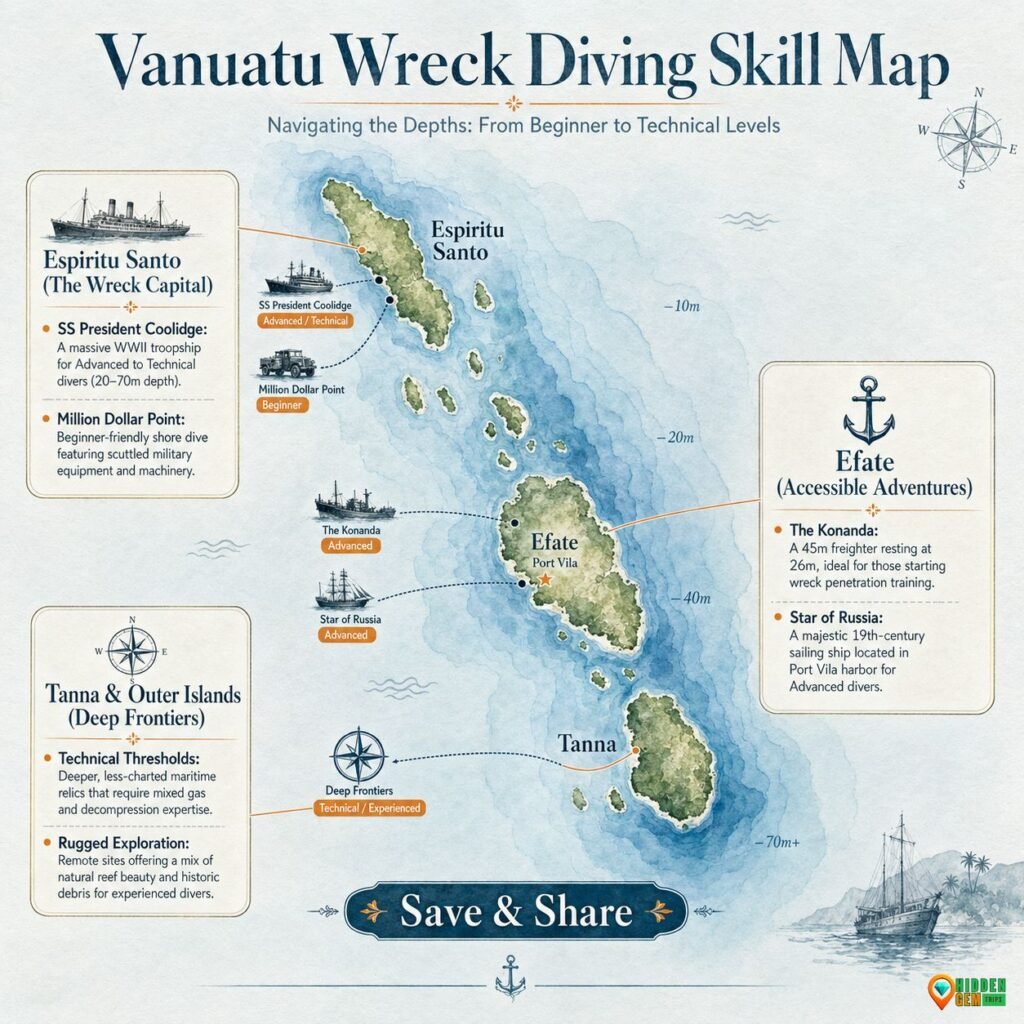
Before choosing a dive site, use this quick skill-level map to understand which Vanuatu wrecks fit your certification, comfort level, and risk tolerance.
Best Vanuatu Islands for Wreck Diving
Espiritu Santo
Espiritu Santo is the heavyweight.
If your dream is Vanuatu wreck diving, Santo should be your base. It gives you the SS President Coolidge, Million Dollar Point, the USS Tucker, coral gardens, technical dive support, and a strong concentration of operators around Luganville.
Santo is best for travelers who want to dive for multiple days. Do not fly in, do one rushed dive, and leave. That is like going to a library, reading one sentence, and claiming you finished literature.
Plan several days of diving if the Coolidge is your priority. The wreck is too large to understand in one dive. You need time to learn the layout, adjust to local conditions, and progress safely.
For a wider Oceania wilderness mindset, the same patience that makes the Kimberley Australia Guide useful applies here: do less, look more closely, and let distance become part of the experience.
Efate
Efate is easier, more convenient, and more varied for mixed-skill groups.
Because Port Vila is the main gateway, Efate works well for first-time visitors, beginner divers, or travelers who want wrecks, reefs plus resort comfort. It is also a good starting point if you want to warm up before heading to Santo.
Efate is not as iconic as Santo, but that is not a weakness. It is the right island for building confidence before deeper wrecks.
Tanna
Tanna is the moodiest option.
It is more remote, more volcanic, and less focused on classic shipwreck fame. But for HiddenGemTrips readers, that is the appeal. Tanna is for travelers who want the wreck to be part of a wider island narrative: volcano, reef, caves, blue holes, and a stronger sense of being away from polished tourism loops.
When to Dive Hidden Vanuatu Shipwrecks
Vanuatu diving is possible year-round, but timing still matters. The official tourism guide notes that Vanuatu has warm tropical waters, with warmer months generally in the early part of the year and cooler conditions around midyear. Rainy season can affect travel logistics, though deep drop-offs and local conditions mean visibility does not always behave like it would in flatter coastal regions.
A practical breakdown:
April to November is often the cleaner choice for many travelers because it avoids the wettest stretch and tends to feel more comfortable for multi-day dive planning.
January to May can offer warmer water, but the early part overlaps with the rainy season.
December to March can still be diveable, but travel logistics, weather flexibility, and cyclone-season awareness become more important.
For serious wreck diving, the “best” time is not only about visibility. It is also about your body, schedule, and safety buffer. Leave no-fly time after diving. Build rest days. Avoid stacking deep dives aggressively just because your itinerary looks prettier that way.
If you are trying to balance remote adventure with sensible spending, our Affordable Opulence guide pairs well with this section, as Vanuatu rewards travelers who prioritize safety, operators, and time over surface-level luxury.
Safety, Certifications, and Who Should Not Dive These Wrecks
This is where the article needs to be blunt.
Vanuatu’s wrecks are epic, but not all of them are suitable for every diver. The Bonzer Wreck may work for newer certified divers under supervision. The SS President Coolidge can be introduced to recreational divers progressively, but deeper sections require advanced training and careful planning. The USS Tucker and deeper Efate wrecks are not for casual vacation divers.
Vanuatu’s own scuba diving operator accreditation standards emphasize proof of certification, diver logging, oxygen availability, and adherence to recognized scuba training standards. That is important because the operator you choose matters as much as the site you choose.
A good guide does not just show you the wreck. A good guide says no when needed.
Before any advanced wreck trip, review Divers Alert Network’s safe diving guidance. DAN repeatedly highlights issues such as dive planning, buoyancy control, staying within training, gas management, gear maintenance, and personal responsibility. Those mistakes become much more serious around wrecks because metal structures, depth, silt, overhead conditions, and psychological excitement can quickly stack risks.
Use this quick reality-check table before booking any deeper or overhead wreck. If two or more rows describe you, choose a refresher dive, a shallower site, or extra training first. This is not fear-mongering; it is how good wreck divers stay alive.
| Red flag | Why it matters |
| Poor buoyancy control | You can kick up silt, lose visibility, damage coral, or drift into metal structure. |
| Uncomfortable with depth | Many Vanuatu wrecks become more demanding as depth, gas use, and narcosis risk increase. |
| Panic in enclosed or dark spaces | Wreck corridors and low-light sections can quickly trigger disorientation. |
| Long break from diving | A refresher dive is cheaper than a bad decision underwater. |
| Casual attitude toward dive computers | Depth, bottom time, ascent rate, and no-fly planning are not optional details. |
| Chasing content over safety | The best footage is worthless if the dive plan collapses. |
| Ignoring local guide limits | Local operators know site-specific hazards, access conditions, and safe progression routes. |
Bottom line: the ocean does not reward ego. It invoices it.
Responsible Wreck Diving in Vanuatu
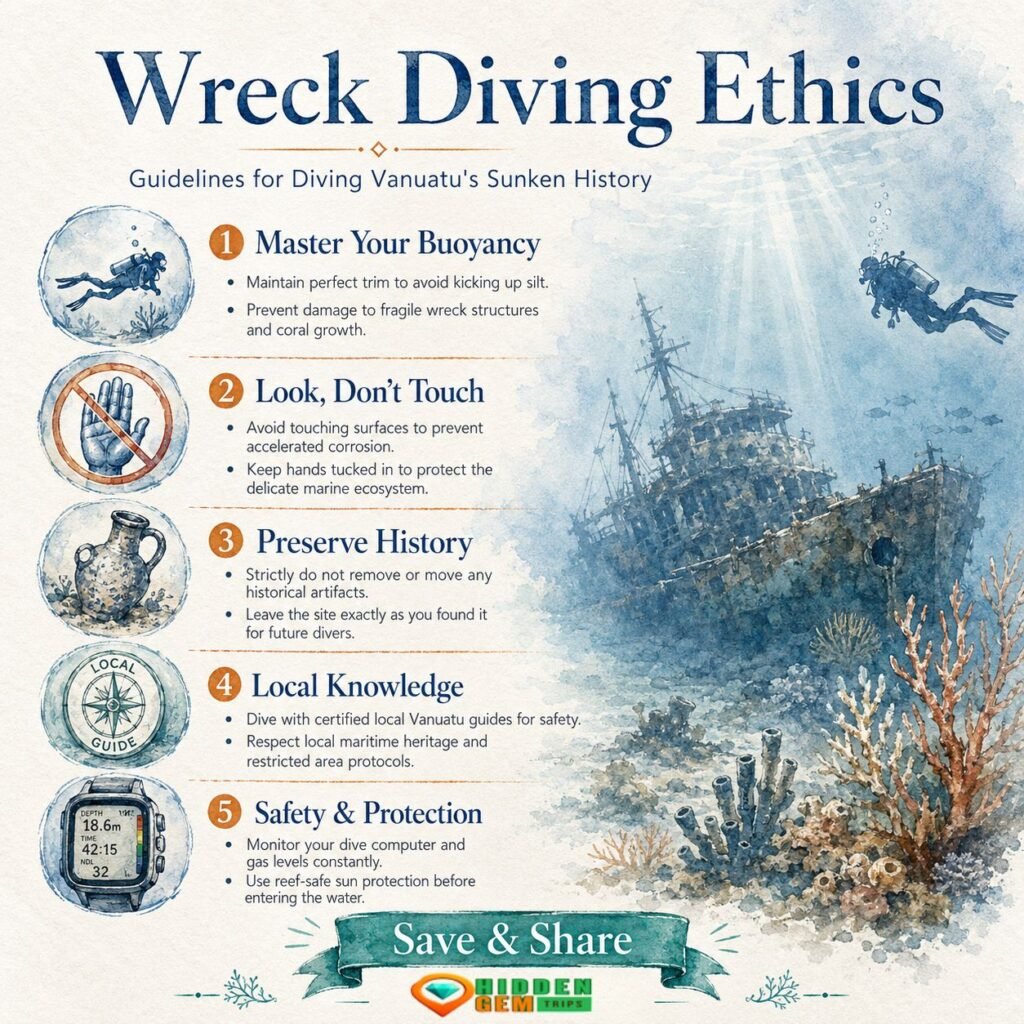
Responsible wreck diving means more than “do not touch coral.” That is the kindergarten version.
In Vanuatu, responsible diving includes respecting history, local communities, marine ecosystems, and the fact that many coastal areas are culturally and economically important. Vanuatu’s national biodiversity reporting through the Convention on Biological Diversity connects marine conservation with local livelihoods, traditional importance, and community management.
That wording matters because it connects conservation to people. Marine protection is not just about pretty reefs for tourists. It is about food systems, local identity, community governance, and long-term resilience.
Marine science initiatives such as Blue Prosperity Vanuatu also show how reef data, coastal planning, and marine spatial planning are becoming increasingly important for the country’s ocean future.
For divers, this means your behavior is part of the destination’s future.
Use the checklist below as your on-site operating code. It keeps the wrecks intact, protects the reef, and respects the communities whose waters you are entering.
| Responsible action | What it protects |
| Never remove artifacts | Historical integrity and future divers’ experience. |
| Avoid overhead entry without training | Your safety and the safety of the guide or buddy who may need to assist you. |
| Maintain neutral buoyancy | Coral growth, silt visibility, and fragile wreck surfaces. |
| Do not chase or crowd marine life | Natural behavior of turtles, reef fish, sharks, and other species. |
| Use reef-safe sun protection where appropriate | Water quality and sensitive reef organisms. |
| Use licensed, safety-conscious operators | Emergency preparedness, local responsibility and professional standards. |
| Ask about conservation fees and community rules | Local governance, kastom importance, and long-term stewardship. |
| Pay fair prices | Operator safety standards and community benefit, not bargain-basement risk. |
This is also why our 2026 Slow Travel Manifesto belongs naturally in the conversation. Wreck diving in Vanuatu is not a race. The slower you travel, the more responsibly you dive.
Save this checklist before booking a dive. The best wreck divers are not the boldest ones — they are the ones who come back safely and leave nothing damaged behind.
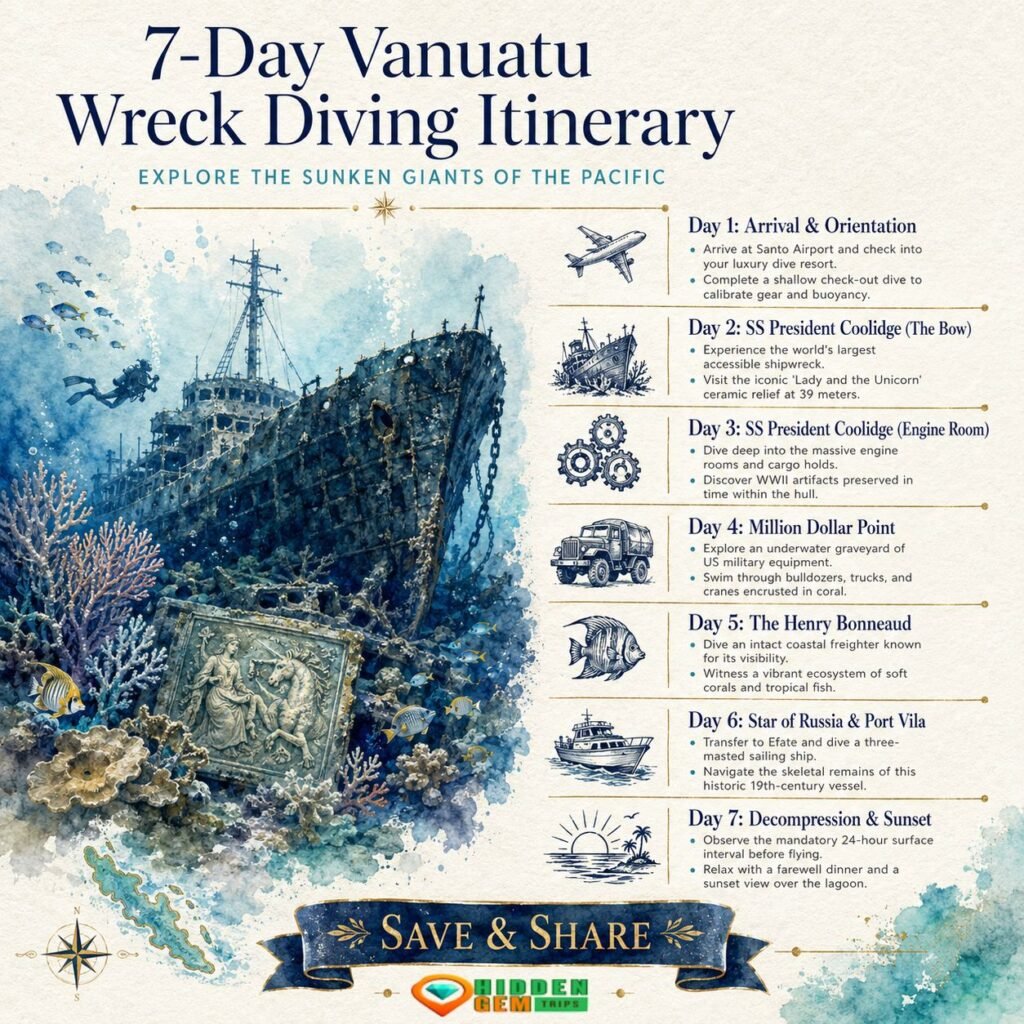
Suggested 7-Day Hidden Vanuatu Wreck Diving Itinerary
This itinerary assumes you are already certified, medically fit to dive, and willing to adjust based on operator advice.
Solo divers should also think beyond the dive boat: the Solo Female Travel Map is useful for building safer habits around transport, accommodation, and late-day movement in under-the-radar destinations.
Day 1: Arrive in Port Vila, Efate
Do not dive immediately after long-haul travel if you are exhausted. Settle in, hydrate, check your gear, confirm your dive plans, and resist the urge to treat your itinerary like a military operation.
Optional: light snorkeling or sunset walk.
Day 2: Bonzer Wreck and Reef Warm-Up
Start with the Bonzer Wreck near Hideaway Island or another easy Efate site. Use this as a buoyancy check, camera check, and comfort reset.
This is especially helpful if you have not dived in several months.
Day 3: Advanced Efate Wreck or Cathedral Cavern
If your certification and conditions allow, consider Star of Russia, Semele Federesen, or the Cathedral. The goal is not to “collect” sites. The goal is to build confidence gradually.
Day 4: Fly to Espiritu Santo
Move to Luganville. Do not force a deep dive on a travel day if timing is tight. Visit local operators, confirm Coolidge progression, and ask detailed questions about routes, depths, gas planning, and safety procedures.
Day 5: SS President Coolidge Orientation Dives
Start with shallower sections. Let the wreck introduce itself.
A good Coolidge experience is progressive. First, understand the layout. Then go deeper or more complex only when appropriate.
Day 6: SS President Coolidge Deeper Sections or Million Dollar Point
Depending on your skill level, do another Coolidge dive or switch to Million Dollar Point for a completely different emotional experience.
Million Dollar Point is especially strong for underwater photography and historical reflection.
Day 7: Final Dive, Rest, and No-Fly Buffer
Choose a lighter dive if your schedule allows, and then follow the no-fly guidance. Do not end a serious wreck trip by gambling with decompression safety because you wanted one more reel.
What to Pack for Vanuatu Shipwreck Diving
You do not need to pack like you are invading the Pacific. Please don’t. But you do need to pack smarter than a casual beach tourist.
Use this packing table as a practical baseline. Adjust it with your dive operator if you are planning deeper, technical, night, or penetration dives.
| Essential item | Why it earns space in your bag |
| Certification cards and dive log proof | Operators may need to verify training and recent experience. |
| Diving computer | Measures depth, ascending rate, bottom time and no-fly planning. |
| Whistle and surface marking buoy | Improves visibility and signalling if isolated from boat or group. |
| Reef-safe sunscreen or sun-protective clothing | Reduces reef stress and protects you between dives. |
| Rash guard or exposure suit | Keeps you comfortable in warm tropical water across multiple dives. |
| Backup mask strap or spare mask | A tiny item that can save an expensive dive day. |
| Dry bag | Protects electronics, documents, and dry layers during boat transfers. |
| Motion sickness tablets | Useful for boat-sensitive divers and rough inter-island crossings. |
| Scuba-covering travel insurance | Standard travel insurance may exclude diving or deeper profiles. |
| Dive torch | Required for approved low-light, night, cavern, or wreck sections. |
| Personal save-a-dive kit | Small spares can prevent a minor gear issue from ending the day. |
For deeper or technical diving, discuss equipment with your operator before arrival. Do not assume gases, rebreather support, or specialized rental gear are available for your exact needs without confirmation.
For general remote-island preparation, use our “Packing Light for Remote Expeditions” guide as your guiding philosophy. For diving trips, the trick is not to pack less at random; it is to pack fewer unnecessary items so your safety-critical gear has room.
For tropical island-specific choices, pair that with our 12 Best Travel Gear for Island Trips guide so your dry bags, sun protection, footwear, and small safety tools match real island conditions.
Here is a simple visual version of the route if you want to plan the trip without turning your notes app into a crime scene.
Final Verdict: Are Hidden Vanuatu Shipwrecks Worth It?
Yes, if you are the right traveler.
Hidden Vanuatu shipwrecks are not for people who want soft luxury with zero friction. They are not for divers who treat certification levels as polite suggestions. They are not for travelers who want every experience sanitized, simplified, and served with a poolside cocktail.
But if you want the Pacific with depth, Vanuatu is extraordinary.
The SS President Coolidge gives you a sense of scale. Million Dollar Point gives you moral discomfort. USS Tucker gives advanced divers a sharper challenge. Efate’s wrecks give you an accessible variety. Tanna gives you volcanic strangeness. Together, they form one of the most compelling wreck-diving routes in the South Pacific.
The secret is that no one knows Vanuatu has wrecks. Divers know. The real secret is that most travelers still do not understand what those wrecks represent.
They are not just things underwater; they are history, with coral growing on them, war leftovers turned into marine habitats, and reminders that paradise is never simple. That tension is exactly why Vanuatu belongs on a hidden gem travel list: it is beautiful, but it refuses to be shallow.
For readers who love underwater destinations with more than surface-level beauty, continue with our Banda Islands travel guide or explore the marine-rich world of the Derawan Islands. Different oceans, different stories, same rule: the best places are rarely the easiest ones.
FAQ
1. What is the best shipwreck dive in Vanuatu?
The SS President Coolidge is the most famous and widely regarded as Vanuatu’s signature wreck dive. It is enormous, historically important, and in parts accessible to competent recreational divers, although the deeper places require more advanced planning.
2. Is Vanuatu ideal for novice scuba diving?
Yes, however, beginners should select appropriate sites. Port Vila and Hideaway Island areas offer easier reef and wreck-style dives, such as the Bonzer Wreck. Deep wrecks like the SS President Coolidge’s lower sections, Star of Russia, Semele Federesen, and USS Tucker are not beginner dives.
3. When is the best time to dive Vanuatu shipwrecks?
Diving is possible year-round, but April to November is often a practical choice for many travelers because it avoids the wettest part of the year and usually gives more comfortable planning conditions.
4. Do I require advanced certification for Vanuatu wreck diving?
Open Water certification should be sufficient for shallow wrecks with proper supervision. Deeper wrecks may require advanced certification, deep-diving experience, wreck training, or technical training, depending on the site and operator.
5. Can I salvage items from shipwrecks in Vanuatu?
No. Never remove artifacts from wrecks. Wrecks are of cultural, ecological and historic importance. Responsible divers leave everything in place and avoid damaging coral, marine life, or wreck structures.
Disclaimer
This article is for general travel inspiration and informational purposes only. Scuba diving, wreck diving, deep diving, cavern diving, and technical diving involve real risks, including decompression sickness, entanglement, disorientation, equipment failure, and injury or death. Always dive within your certification, training, health condition, and comfort level. Conditions in Vanuatu could be affected by weather, currents, visibility, operator access and local rules. When booking or before you dive, contact licensed local dive operators to learn about current conditions at the dive sites, equipment availability, trip insurance coverage, and compliance with recognized diving safety standards. This material is not a substitute for professional dive training, medical advice, local briefings or official safety advice.