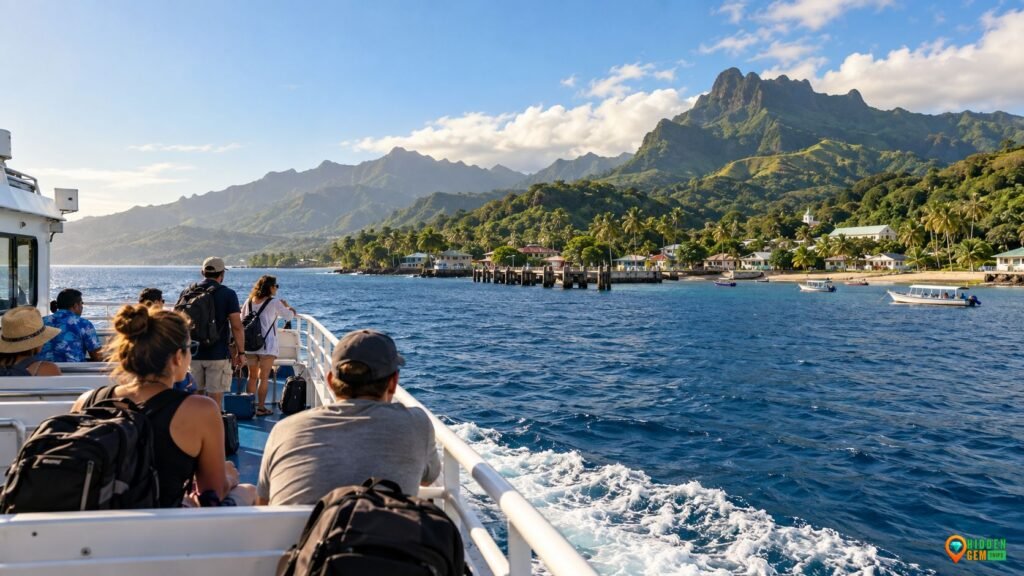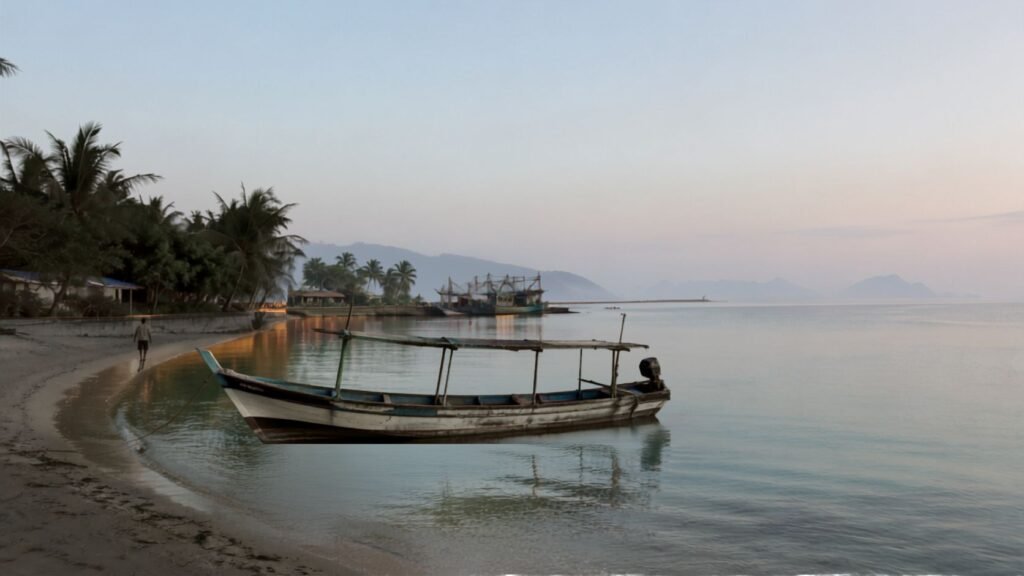

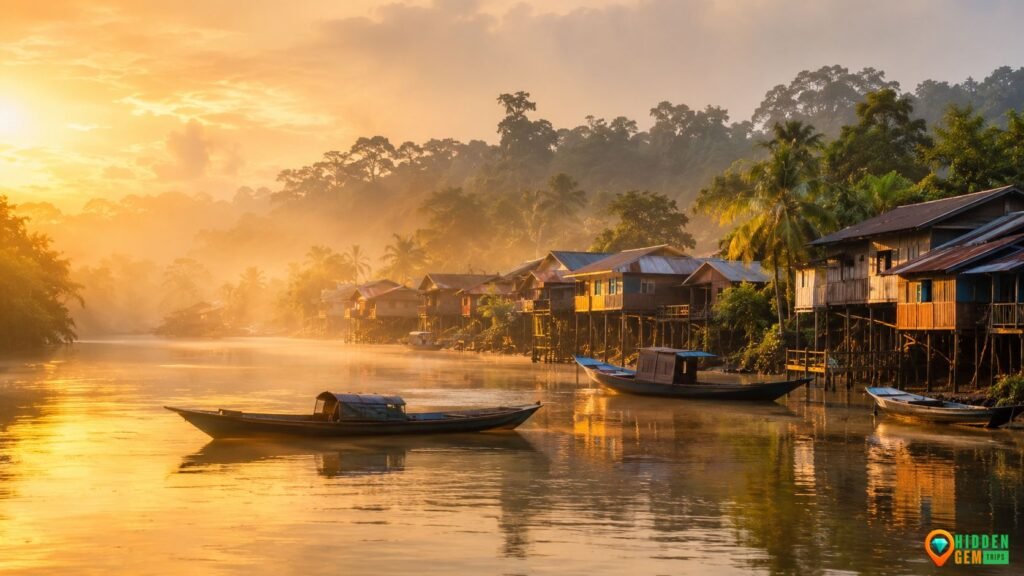
Most visitors arrive in Borneo looking for one big headline: orangutans, rainforest, diving, or a long river cruise that sounds heroic on paper. But the real travel map of Indonesian Borneo is quieter and more useful than that. It is built around Kalimantan River Towns, the working towns where boats leave before sunrise, markets wake up on the water, children cross muddy banks to school, and the forest is not a backdrop but a daily neighbor.
This guide is for travelers who want Borneo without turning it into a checklist trophy. The focus is not the most remote village or the most extreme expedition. The focus is the practical middle: seven river towns and gateway stops across Indonesian Kalimantan where you can feel the island’s water-based life while still making responsible choices about access, timing, local benefit, and ecological pressure.
The angle matters because Kalimantan is often flattened into one word: jungle. That is lazy travel writing. Kalimantan is also port culture, Dayak river memory, Malay trading towns, Banjar floating markets, coal-barge realities, peat-swamp edges, mangrove deltas, sultanate history, and small ferries that still shape how people move. If you already use our hidden gem travel framework, think of this as the river version: less about finding somewhere empty, more about reading whether a place can welcome you without being bent out of shape.
A quick warning before we romanticize the water: rivers in Kalimantan are not theme-park scenery. They carry food, fuel, waste, prayers, timber memories, mining scars, school commutes, and family histories. A good river-town trip should make you more observant, not louder. The strongest Borneo travel moments often happen when you stop hunting for ‘untouched’ places and start noticing how a town actually functions.
Why Kalimantan River Towns Are the Real Borneo Travel Map
Kalimantan’s rivers are not side attractions. They are the old road system. Before airports, paved highways, and ride-hailing apps shaped the travel map, rivers connected inland forests with coastal trade, farming villages with markets, and upstream communities with administrative towns. Even now, in places where roads exist, the river still decides rhythm: what time the market opens, when boats can pass, which neighborhood floods, how fish arrives, and how far a traveler can realistically go without turning a trip into a logistical flex.
That is why Kalimantan River Towns make better entry points than isolated bucket-list pins. A town gives you layers. You can walk the waterfront, watch a market, take a short boat ride, eat local food, speak with a guide, and understand the next step before committing to a multi-day route. It gives local operators a chance to benefit from visitors who sleep, eat, buy, hire, and learn in town rather than parachuting into one famous attraction and leaving.
The data context also supports a slower, more distributed approach. Official tourism data for Indonesia are currently recorded through yearly publications such as BPS International Visitor Arrival Statistics 2024 and domestic travel studies such as BPS Domestic Tourism Statistics 2024. Those datasets matter for a simple reason: when national travel demand rises, lesser-known regions need better visitor behavior, not just more promotion.
Borneo also carries global ecological weight. WWF describes Borneo as the world’s third largest island, holding a remarkable share of global biodiversity in its tropical forests, while the Heart of Borneo overview frames the central forested highlands as one of the largest remaining transboundary rainforest landscapes. A river-town traveler should therefore see rivers not only as routes but as living corridors that connect headwaters, peat swamps, mangroves, markets, and coastal ecosystems.
This is also where responsible travel stops sounding soft and starts sounding practical. If the headwaters are degraded, river towns feel it. If peatlands burn, river towns breathe it. If waste management is weak, river towns see it floating by. WWF’s Heart of Borneo climate report stresses the importance of central Borneo’s forests and headwaters for clean water and settlements downstream. That is not a distant conservation slogan. It is the plumbing of daily life.
Kalimantan River Towns Snapshot: The 7 Stops
| Stop | River base | Best for | What makes it real | Travel caution |
| Pontianak | Kapuas and Landak | First-time river-city orientation | Equator city, port layers, coffee culture, waterfront life | Do not treat it as only a transit city |
| Palangka Raya | Kahayan and Sebangau edge | Peat-swamp learning and easy river cruising | Urban riverfront meets blackwater ecology | Avoid vague wildlife promises from operators |
| Pangkalan Bun / Kumai | Kumai and Sekonyer | Tanjung Puting gateway and klotok routes | The town behind the famous orangutan cruise | Choose ethical operators and respect distance |
| Banjarmasin | Barito and Martapura | Floating markets, canals, Banjar culture | A river city where trade still floats | Go early and keep expectations local, not staged |
| Samarinda / Tenggarong | Mahakam | Urban river cruise and upriver gateway | Bridges, weaving villages, old kingdom traces | Coal traffic and industrial views are part of reality |
| Tanjung Selor / Tarakan | Kayan, Sesayap, mangrove channels | North Kalimantan gateway feel | Borderland rivers, delta towns, less-packaged routes | Check transport reliability before building tight itineraries |
| Tanjung Redeb / Berau | Segah and Kelay | River-to-reef transition | Inland river base leading toward Derawan and Maratua | Do not skip the town just to chase islands |
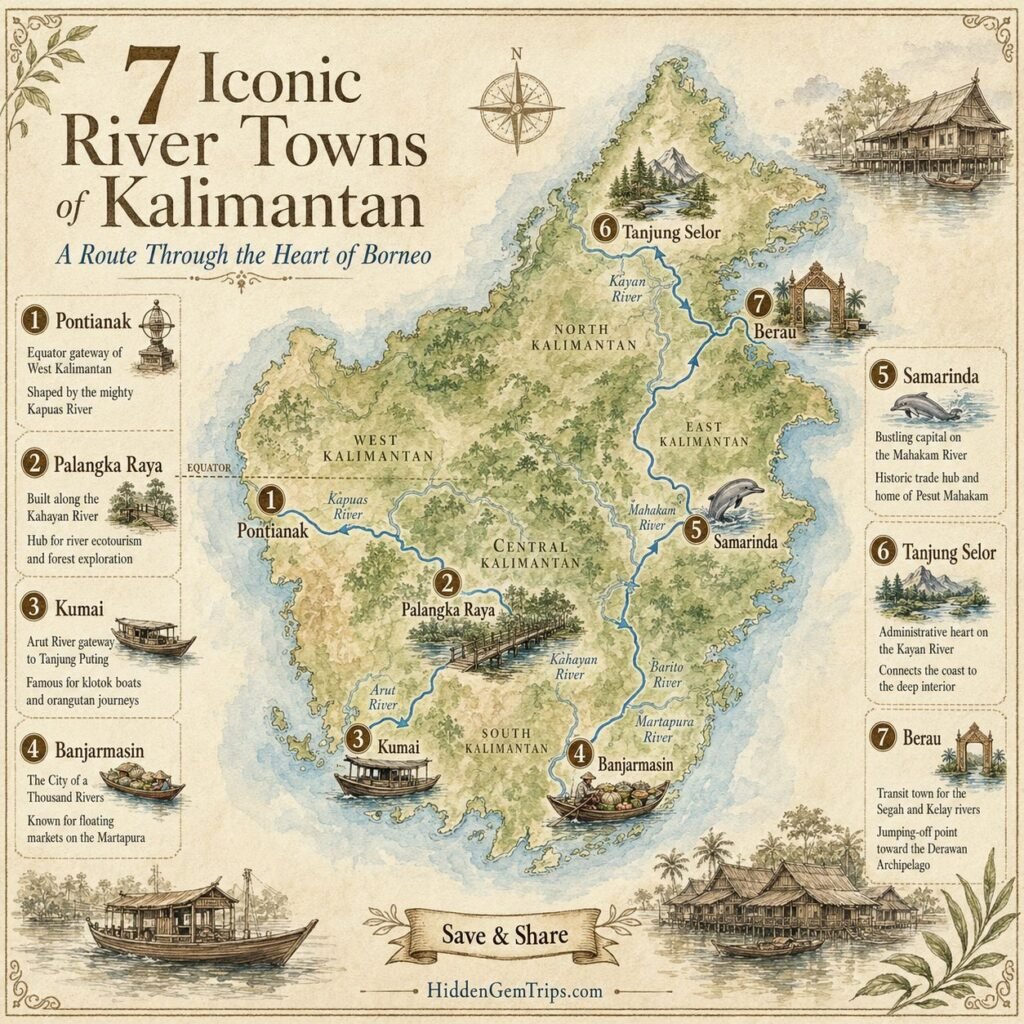
These are not ranked from best to worst. They form a practical map. Pontianak is the easiest western river-city starter. Palangka Raya and Kumai show Central Kalimantan from two different water systems. Banjarmasin reveals the most visibly river-shaped urban life. Samarinda and Tenggarong open the Mahakam. North Kalimantan gives you a rawer borderland feeling. Berau connects river settlement with the marine world people usually associate with Derawan.
If you want to turn this into a route, use our seven-day deep-trip rules as a pacing check. Kalimantan distances look simple on a map and then casually humble you like a delayed ferry with no apology. The trick is to choose two or three river bases per trip, not all seven unless you have time, patience, and a healthy respect for weather.
1. Pontianak: Start Where the Kapuas Becomes a City
Pontianak is the cleanest starting point for travelers who want Kalimantan River Towns without immediately entering expedition mode. The city sits around the Kapuas and Landak rivers, and it teaches an important first lesson: Borneo’s river life is not always deep jungle. Sometimes it is a waterfront coffee shop, a busy bridge, a mosque dome across the water, a slow boat, a Chinese-Indonesian food stop, and a neighborhood that has learned to live with humidity, tide, and trade.
Many travelers underrate Pontianak because it does not match the fantasy image of Borneo. That is exactly why it is useful. It breaks the postcard. It gives you a real provincial capital with working docks, traffic, heat, rain, river breezes, and a food culture that feels more layered than most quick travel lists admit. The Equator Monument is the famous stop, but the better memory may be an evening along the Kapuas when the sky turns copper and the city starts reflecting on the water.
Use Pontianak as an orientation town. Spend your first day walking slowly rather than rushing into a boat itinerary. Notice how the river divides and connects neighborhoods. Try local coffee and snacks. Ask a hotel or trusted local contact which river cruise or waterfront walk is currently reliable. Small decisions matter here because river conditions, local events, and seasonal rain can change the feel of a simple outing.
The responsible angle is not complicated. Do not photograph people at close range as if riverbank life is a museum. Buy from local stalls. Avoid dropping plastic into drains or waterways. Treat the waterfront as a lived-in place, not a content set. If this sounds basic, good. Basic manners are premium travel tech; they never run out of battery.
Pontianak also works as a soft bridge into West Kalimantan’s inland possibilities. Travelers with more time can look toward Kapuas Hulu, Lake Sentarum, or Dayak cultural routes, but those deserve careful planning and local guidance. For a first river-town article route, Pontianak’s role is simpler: it shows that the Kapuas is not a line on a map. It is a city-maker.
2. Palangka Raya: Kahayan River, Peat-Swamp Edges, and a Slower Kind of Wild
Palangka Raya is one of the most underrated river-town bases in Kalimantan because it does not try too hard to perform wilderness. The Kahayan River runs through the city, while the wider region points toward peat-swamp ecosystems, blackwater landscapes, and Dayak cultural memory. It is accessible enough for cautious travelers but still different enough to feel like Borneo has changed the rules.
The provincial multimedia center describes the Kahayan as a long river with broad sections and distinctive riverbank settlements, and the Central Kalimantan Kahayan river report frames river cruising as a way to see Palangka Raya from the water. That local perspective matters because the best thing about Palangka Raya is not one dramatic viewpoint. It is the gradual shift from city to river to wetland mood.
A short Kahayan cruise can be enough for a first visit. Look for floating houses, river traffic, bridges, and the soft border between urban life and watery forest. If you continue toward the Sebangau side, do it with guides who are honest about what is possible. Wildlife is never guaranteed, and any operator promising effortless orangutan sightings from every corner deserves a raised eyebrow big enough to have its own passport.
The wider Central Kalimantan page from Indonesia Travel highlights the province’s nature, Dayak culture, and Tanjung Puting as a major attraction, while also mentioning river-based access and traditional villages. In other words, Palangka Raya is not only a standalone stop. It can be the calmer educational base before or after the more famous Kumai and Tanjung Puting route. Read it as context, not just transit.
Palangka Raya is also a good place to talk about peat without turning the article into a lecture. Peat-swamp landscapes store carbon, hold water, and support biodiversity, but they are fragile when drained or burned. Travelers do not need to become scientists before visiting, yet they should understand that boardwalks, blackwater channels, and smoky-season warnings are all part of the same story. This is where river travel becomes climate literacy with sandals on.
For HiddenGemTrips readers who enjoyed the village pacing in our North Bali village rhythm, Palangka Raya offers a rougher but equally valuable lesson: a quiet destination does not need to be polished to be meaningful. It needs clear access, local benefit, and visitors who can handle a slower tempo.
3. Pangkalan Bun and Kumai: The Town Behind the Orangutan Cruise
Pangkalan Bun and nearby Kumai are often treated as mere launch pads for Tanjung Puting. That is understandable but incomplete. The famous klotok cruise into Tanjung Puting National Park may be the headline, but Kumai’s riverfront, harbor routine, boat crews, provisioning stops, and small-town rhythm are part of the experience. If you skip the town mentally, you miss the human infrastructure that makes the wildlife route possible.
Indonesia Travel’s Tanjung Puting page notes Camp Leakey’s long role in orangutan preservation and describes the park as habitat for monkeys, orangutans, crocodiles, and more than 220 bird species. Those facts explain why the route is famous. They also explain why traveler behavior must be better than the average selfie stampede.
The best way to experience Kumai is to arrive with enough time to breathe before boarding. Spend a night if your schedule allows. Walk near the waterfront, talk to your operator about waste handling, confirm what is included, ask how food is sourced, and understand the route. A good klotok trip should feel transparent before it feels magical. You are entering a sensitive ecosystem, not booking a floating hotel with bonus apes.
Ethical questions matter here. Keep distance from wildlife. Do not demand closer encounters. Do not pressure guides to bend rules. Avoid feeding animals outside regulated contexts. Use operators who explain park etiquette clearly. If an operator sells the forest like a guaranteed stage show, choose another one. Borneo is not a vending machine where you insert cash and receive orangutan content.
For a fuller companion angle, our Tanjung Puting village-and-river layer looks beyond the wildlife-cruise headline into villages, rivers, and local life. In this broader Kalimantan River Towns guide, Kumai’s role is to remind travelers that conservation tourism is also a supply chain: boat builders, cooks, guides, porters, guesthouses, drivers, and park staff all shape the outcome.
A practical note: build buffer time into flights and transfers. Weather, schedules, river conditions, and seasonal demand can change plans. If you only have one tight window and no emotional capacity for delays, this may not be the moment to force the trip. River travel rewards flexible people. Control freaks may need snacks and personal growth.
4. Banjarmasin: The River City Where Trade Still Floats
Banjarmasin may be the most visually obvious river town in Kalimantan. Its identity is built around water, canals, floating markets, and Banjar trading culture. Indonesia Travel calls Banjarmasin a major port city of Kalimantan and describes its famous floating markets, including Muara Kuin on the Barito River, where traders sell produce and daily goods from boats. The Banjarmasin destination page is a useful official starting point for understanding why the city is more than a photo stop.
The first rule of Banjarmasin is wake up early. Floating markets do not wait for travelers who negotiate with their alarm like it is a hostile government. Go before the heat sharpens. Watch without blocking boats. Buy something small. Let the market be a market. The worst version of floating-market tourism is when visitors arrive expecting a performance and feel disappointed that local people are busy doing local things. That is the point, bos.
Banjarmasin works best when you combine the classic market visit with slower river observation. Look at houses on stilts, small boat taxis, riverside mosques, bridges, and how commerce moves through water. If you have more time, the wider South Kalimantan route can include Lok Baintan, Martapura, or cultural stops linked to Banjar history. Indonesia Travel’s South Kalimantan overview also points to Lok Baintan as a traditional river market where traders use jukung boats.
The originality of Banjarmasin is not that it has a floating market. Plenty of articles say that. The more interesting point is that Banjarmasin shows how a city adapts when water is not ornamental but operational. Roads exist, malls exist, hotels exist, but the river memory has not disappeared. That makes the city valuable for travelers interested in urban culture, not only nature.
Responsible travel here means resisting the urge to over-stage the morning. Do not shove cameras into vendors’ faces. Do not haggle aggressively over tiny purchases for sport. Do not stand in a boat in ways that make the boatman nervous just because your reel needs ‘movement.’ Pay fairly, tip when service is good, and ask before photographing people. The river may be photogenic, but people are not props.
For readers comparing Indonesian water-based destinations, Banjarmasin gives a useful contrast to the slower maritime pattern in our Wakatobi local-island pacing. Wakatobi is reef-and-island patience; Banjarmasin is market-and-canal rhythm. Both reward travelers who stop rushing.
5. Samarinda and Tenggarong: Mahakam Without the Myth Filter
The Mahakam is the giant in the room. Many travelers who say they want Borneo river travel are actually picturing the Mahakam: longboats, Dayak villages, dolphins, lakes, forest edges, and multi-day upriver movement. Samarinda and Tenggarong are the practical lower-river bases for entering that story without pretending the river is untouched wilderness from the first minute.
A local Samarinda reference describes the Mahakam River as an icon of the city, with a length of about 920 kilometers, broad widths, and growing river-tourism activity through boats such as Pesut Mahakam. See the Samarinda Mahakam river cruise reference for details on city routes, bridges, villages, and operating patterns. ANTARA’s Mahakam river tourism report adds a useful phrase: the river is the pulse of Samarinda, not just a view.
That pulse includes beauty and industry. You may see bridges glowing at night, woven craft villages, mosques, ferries, barges, and commercial traffic. Travelers who only want fantasy may feel confused. Travelers who want reality will find the mix more honest. The Mahakam is not a museum river. It is a working artery, and working arteries carry more than pretty reflections.
Tenggarong adds historical texture through Kutai heritage, riverfront spaces, and access to nearby river attractions. It can work as a gentler cultural extension from Samarinda, especially for travelers who do not have the time or stamina for a long upriver expedition. If you do go farther upriver, plan carefully. Distances stretch. Boat comfort varies. English-speaking support can be limited. Medical access changes quickly once you leave larger towns.
For the extended route, our deeper Mahakam upriver companion is the natural next read. This article keeps Samarinda and Tenggarong in the seven-town framework because not every traveler needs to chase the farthest point. Sometimes the more responsible choice is to understand the accessible lower river deeply before turning the trip into a personal endurance documentary.
The Mahakam also teaches a broader HiddenGemTrips principle: real destinations contain contradictions. A place can be culturally rich and environmentally pressured. It can be beautiful and industrial. It can be worth visiting and still require caution. That is why the secret-destination readiness filter matters here. A destination being ‘real’ does not automatically mean it is ready for every visitor, every season, or every travel style.
6. Tanjung Selor and Tarakan: North Kalimantan’s Borderland Water Routes
North Kalimantan is where the river-town map becomes less packaged. Tanjung Selor, Tarakan, and nearby water routes do not have the same international travel fame as Tanjung Puting or the Mahakam, but that is precisely why they deserve careful attention. This is borderland Kalimantan: closer to Malaysia, shaped by deltas, mangroves, trade movement, and routes that feel more practical than promotional.
The Kayan and Sesayap systems, plus the coastal channels around Tarakan and surrounding areas, create a different mood from southern and central Kalimantan. Instead of a single obvious attraction, you get a gateway region. Travelers may use Tarakan as an air entry, Tanjung Selor as an administrative river base, and onward routes depending on local transport, weather, and current access. This is not the place for copy-paste itineraries written by someone who has never checked a boat schedule.
What makes this stop valuable is the frontier feeling without forcing an irresponsible frontier fantasy. You can observe a younger province’s movement, river crossings, food culture, mangrove edges, and the practical role of small ports. You can also learn humility: not every place needs to be aggressively packaged for travelers to be meaningful. Some destinations are still better approached as living regions, not fixed attractions.
Planning here requires direct verification. Check flights, ferry departures, road conditions, and local advice close to travel dates. Avoid building a schedule where one missed boat ruins the next three days. Choose accommodation with reliable communication. Have backup cash. Prepare for language gaps. Use local operators where available and be honest about your comfort level. Adventurous does not mean chaotic; it means you planned enough to stay calm when the plan changes.
North Kalimantan also works as a mental bridge to other river-and-mountain destinations beyond Indonesia. If you liked the structure of our Northern Laos river-and-mountain model, this region offers a comparable lesson: rivers are not only scenic, they are logistics, culture, and timing. The difference is that North Kalimantan feels rawer and less smoothed by international backpacker infrastructure.
For now, treat Tanjung Selor and Tarakan as a research-forward stop. It may not be the first choice for a nervous first-time Kalimantan visitor. But for travelers who have already done the classics and want to understand the island’s northern edge, this is a serious candidate.
7. Tanjung Redeb and Berau: The River Town Before the Reef Dream
Many travelers know Berau only because it leads to Derawan, Maratua, Kakaban, and Sangalaki. That is fair; the marine attractions are genuinely powerful. But Tanjung Redeb, the regency capital, deserves more than a pass-through glance. It sits around river systems such as the Segah and Kelay, functioning as a practical inland base before travelers move toward the coast and islands. This is where the river-to-reef transition becomes visible.
The East Kalimantan provincial tourism page describes Derawan as a marine tourism destination in Berau Regency, known for its islands and underwater appeal. That source is useful, but the HiddenGemTrips angle is slightly different: before the reef dream, there is a river town with supplies, transport decisions, local meals, and people whose work makes island tourism possible.
Spend at least a little time in Tanjung Redeb if your schedule allows. Eat locally, check your island transfers carefully, and talk to operators about sea conditions, turtle etiquette, reef-safe behavior, and waste. If you are heading onward, our Derawan reef extension can help frame the marine side, but do not let the islands erase the mainland story.
Berau is also a reminder that Kalimantan travel is not one ecosystem. A single trip can move from riverbank town to mangrove channel to reef wall. That diversity is the magic and the planning challenge. Your packing, pacing, footwear, weather expectations, and ethical responsibilities shift as the environment changes. One day you are dealing with river heat and muddy landings; the next you are thinking about coral, currents, and sunscreen choices.
If you are building a longer Indonesian quiet-route portfolio, Berau’s river-to-reef bridge can sit beside our Tana Toraja slow-culture approach as another example of why travel regions need more than one headline. Toraja is not only funerary culture. Berau is not only Derawan. Kalimantan is definitely not only orangutans. The internet loves shortcuts; good travelers do not have to.
How to Choose the Right Kalimantan River Town for Your Trip
The best Kalimantan River Town for you depends less on what looks dramatic online and more on your tolerance for heat, delays, ambiguity, insects, boat time, and imperfect infrastructure. For a first-timer, Pontianak, Banjarmasin, Palangka Raya, or Samarinda are easier. For wildlife-focused travelers, Kumai makes sense. For repeat visitors, North Kalimantan and Berau bring fresher angles. For travelers who want everything in five days, reality would like a word.
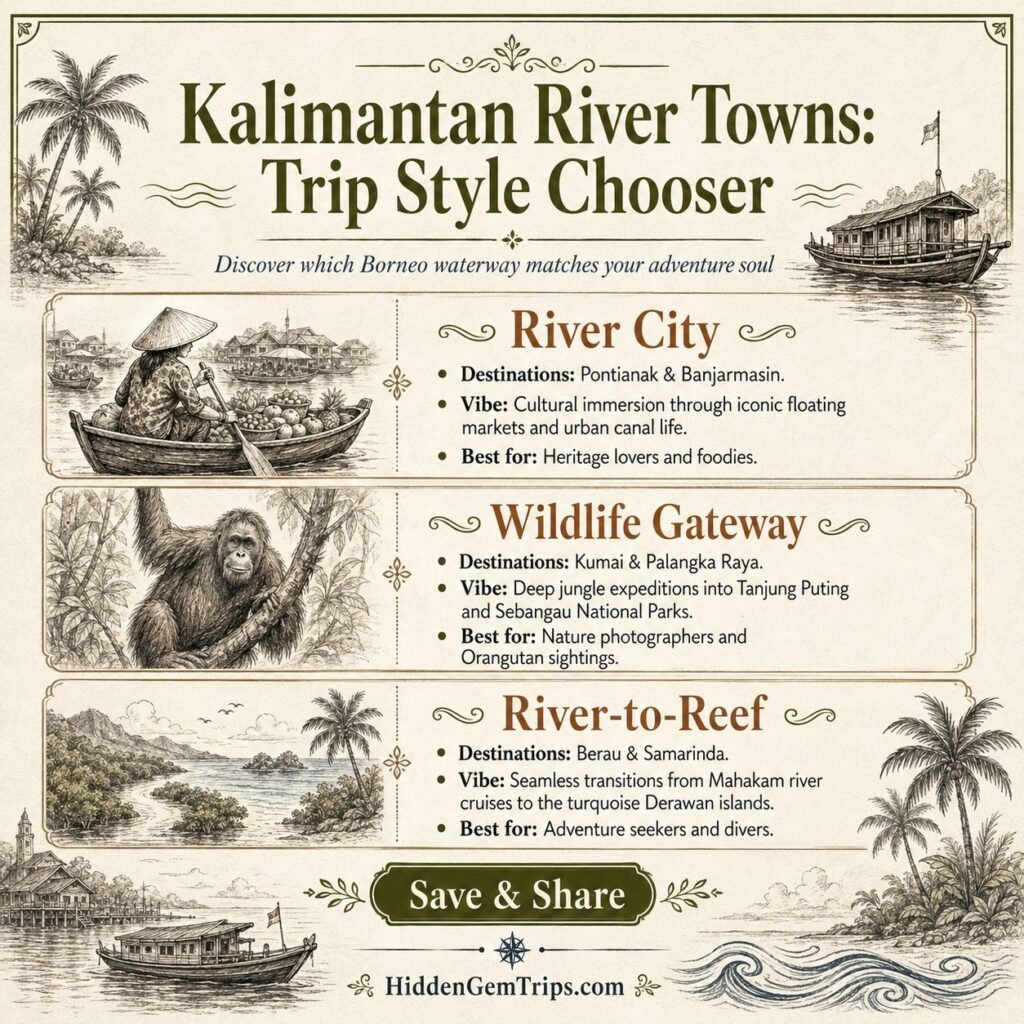
Choose Pontianak if you want a soft landing into Kalimantan with food, river views, and an urban equator identity. Choose Banjarmasin if you want the most visible river-commerce culture and do not mind early mornings. Choose Palangka Raya if peat-swamp context and quiet river observation appeal to you. Choose Kumai if Tanjung Puting is the anchor. Choose Samarinda and Tenggarong if the Mahakam is calling but you want a realistic lower-river base. Choose North Kalimantan if you are comfortable with under-documented routes. Choose Berau if you want the rare river-to-reef transition.
The common mistake is trying to force too many stops because they all sit on one island. Kalimantan is massive. Transfers can be slow. Roads can feel longer than their distances. Flights may route through hubs. Boats may depend on demand, daylight, tide, or weather. If your trip is one week, pick two bases. If you have ten to fourteen days, pick three or four. Save the rest for another journey. Slow travel is not a moral pose; it is a survival strategy with nicer photos.
Use a simple readiness test before adding any stop: Can you sleep locally without stressing the community? Can you reach it without dangerous improvisation? Is there a clear local benefit from your visit? Can you behave respectfully without needing constant supervision? Are you prepared for waste, weather, and wildlife rules? If the answer is no, the destination may be interesting, but your trip plan is not ready.
For comparison, our Garut highlands weekend benchmark shows how a shorter Indonesian escape can still feel deep with the right pacing. Kalimantan is not a weekend equivalent for most travelers, but the logic is the same: fewer stops, better attention, less performance.
Suggested 7 to 12 Day Route Ideas
| Route type | Best for | Suggested bases | Why it works | What to skip |
| First Kalimantan river sampler | Travelers new to Borneo | Pontianak + Banjarmasin | Two strong river-city identities without expedition pressure | Do not add Kumai unless flights align cleanly |
| Central Kalimantan nature route | Wildlife and peat-swamp learners | Palangka Raya + Kumai | Combines Kahayan/Sebangau context with Tanjung Puting access | Do not chase guaranteed wildlife |
| Mahakam culture route | Travelers focused on East Kalimantan | Samarinda + Tenggarong + optional upriver | Balances city river cruise, Kutai history, and deeper river options | Do not underestimate boat time |
| River-to-reef route | Travelers who want contrast | Berau + Derawan extension | Shows how inland river logistics connect to marine tourism | Do not rush the town completely |
| Repeat-visitor frontier route | Experienced Indonesia travelers | Tarakan + Tanjung Selor + onward local route | Less packaged, more research-driven, strong borderland feel | Do not build tight connections |
The sweet spot for most readers is a two-base route. For example, Palangka Raya plus Kumai gives you a strong Central Kalimantan story: one city river and peat-swamp edge, one famous national-park gateway. Banjarmasin plus Samarinda gives you two different urban river cultures: Banjar floating-market life and Mahakam city movement. Berau plus Derawan gives you environmental contrast, but only if you treat Berau as more than a hotel night.
A three-base route can work if flights cooperate. Pontianak, Banjarmasin, and Samarinda create a river-city trilogy across west, south, and east Kalimantan. Palangka Raya, Kumai, and Banjarmasin build a Central-to-South water route with wildlife, peat context, and market culture. For a glimpse of Mahakam history before the river to reef transition, Samarinda, Tenggarong and Berau are better options.
Do not copy these routes blindly. Use them as architecture. The final plan should depend on flight schedules, local holidays, rain, operator quality, and your own energy. Good travel planning is less about squeezing value from every hour and more about leaving enough space for the trip to stay human.
When to Visit Kalimantan River Towns
Kalimantan is hot and humid year-round, but rainfall patterns, haze risk, river levels, and local travel conditions can affect the trip. In practical terms, many travelers prefer relatively drier months, yet river destinations are not as simple as beach destinations. Too little water can affect some smaller routes; too much rain can slow roads, blur visibility, and make landings muddy. Ask local operators what conditions are like now, not what a generic climate chart says.
Early mornings matter more than season in many towns. Floating markets, soft light, lower heat, and active river traffic often happen before the day becomes heavy. Afternoon cruises can work in cities like Pontianak, Palangka Raya, or Samarinda, especially for sunset and skyline views, but wildlife-oriented routes usually require more careful timing.
Watch for school holidays, Indonesian public holidays, Ramadan timing, Eid travel surges, and local festivals. A destination can be calm one week and crowded the next. Accommodation availability, prices, and boat demand can shift quickly. The ‘hidden gem’ move is not to find a place nobody knows. It is to choose timing that respects both the place and your sanity.
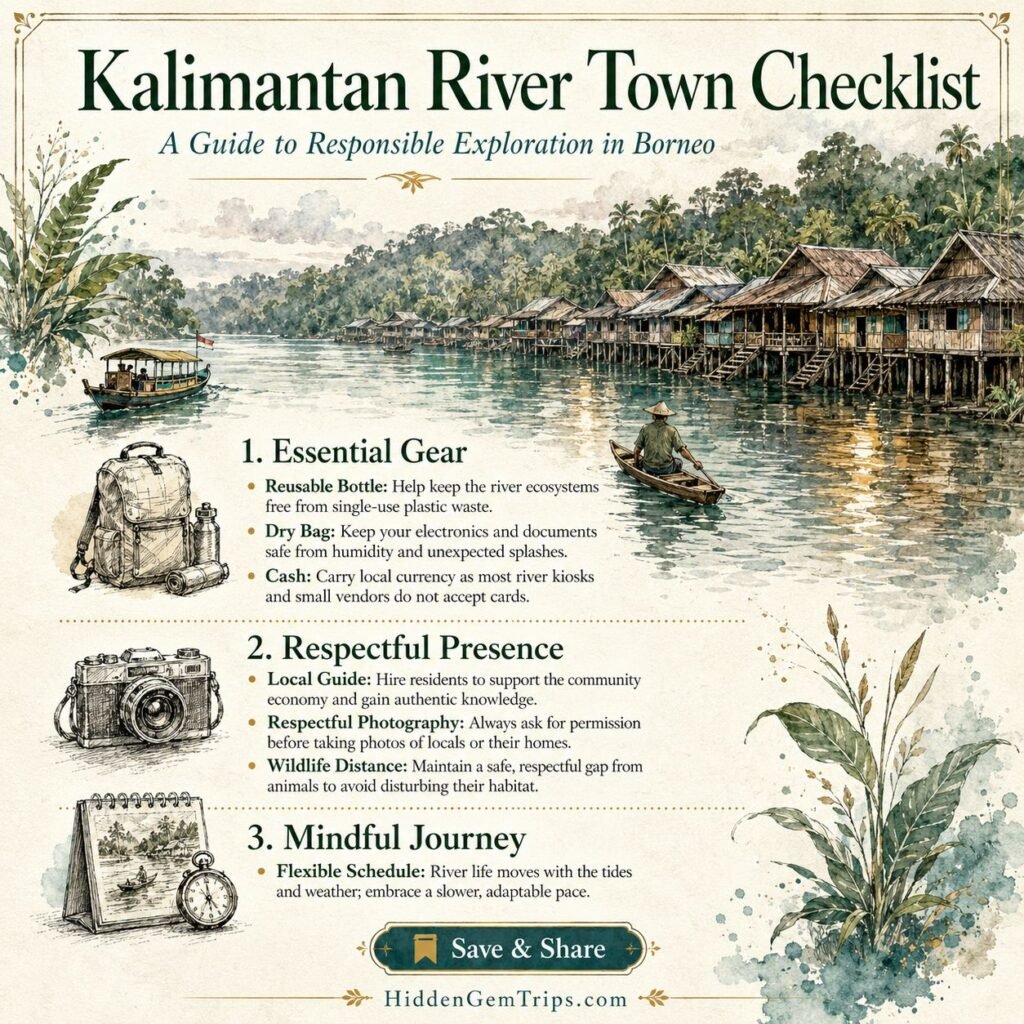
For packing, assume heat, rain, boat spray, and imperfect roads. Use quick-dry clothing, a dry bag, sandals or shoes you can clean, mosquito protection, a power bank, small cash, and a lightweight rain layer. For rougher transfers, our bad-road packing baseline is a practical companion. Fashion is allowed, but Kalimantan will humble any outfit that cannot survive sweat.
Responsible River-Town Travel: What Good Visitors Actually Do
Responsible travel in Kalimantan River Towns is not about posting a solemn caption under a dramatic forest photo. It is about small actions repeated consistently. Use local guides where the context requires it. Pay fair prices. Ask before photographing people. Bring back your trash. Refill water where possible. Avoid single-use plastic when practical. Choose operators who explain rules clearly. Do not treat wildlife sightings as a personal entitlement.
In river towns, noise matters. Boat engines already create enough sound; travelers do not need to add speaker energy to every ride. Dress modestly around villages and religious sites. Learn basic Indonesian greetings. Be patient with changes in schedule. Remember that many riverside communities are not tourism sets; they are residential spaces with their own privacy, routines, and social codes.
Do not reward unethical wildlife behavior. If someone offers to bait animals, chase proboscis monkeys, crowd orangutans, disturb nesting turtles, or promise guaranteed close contact, walk away. The cheapest tour can become expensive when it damages the place you came to see. Conservation is not only the park’s job. It is also a purchasing decision.
The Colombia coffee-town pacing and Morocco quiet-valley contrast guides follow the same principle: slower routes make better stories because they let people, weather, food, and local work appear. Kalimantan’s river towns deserve that same patience.
What Makes This Route Different from Generic Borneo Guides
Most Borneo guides organize the island by attractions: orangutans here, diving there, rainforest somewhere else, Dayak culture if there is space. That structure is easy for search engines but not always useful for travelers. A river-town structure is different because it starts with human geography. Where do people live? Where do boats leave? Where does trade happen? Where can visitors enter without pretending the rest of the region does not exist?
This article also refuses the word ‘untouched’ as a compliment. Pontianak is touched by trade. Banjarmasin is touched by commerce. Samarinda is touched by industry. Kumai is touched by conservation tourism. Berau is touched by marine demand. Palangka Raya is touched by peatland pressure. North Kalimantan is touched by border logistics. None of that makes them less real. It makes them more honest.
The original angle is not simply ‘visit these seven places.’ It is: use river towns as ethical gateways. Let towns slow you down before you enter fragile ecosystems. Let markets and ports teach you how the region works. Let practical logistics shape your route instead of fantasy. This is how hidden-gem travel grows up.
There is still room for wonder. You may see the Kapuas widen under an orange sky, the Kahayan turn dark and glassy, the Sekonyer narrow into forest, the Barito wake with jukung boats, the Mahakam glow under bridges, the Kayan region feel like a frontier, or Berau open toward sea islands. But the wonder is stronger when it is attached to knowledge. Pretty without context is decoration. Pretty with context becomes memory.
Conclusion: The Real Borneo Stop Is the One You Understand Better
Kalimantan River Towns are not a shortcut to ‘authentic Borneo.’ That phrase is overused and usually suspicious. They are better than that: they are practical, layered gateways into Indonesian Borneo’s river-based life. They show you how towns form around water, how culture travels by boat, how conservation depends on everyday logistics, and how a traveler can move more carefully through a place that is both beautiful and pressured.
For a first trip, choose one or two towns and go deeper. Pontianak and Banjarmasin make a strong urban river pair. Palangka Raya and Kumai make a strong Central Kalimantan nature pair. Samarinda and Tenggarong make a strong Mahakam pair. Berau rewards travelers who want the river-to-reef connection. North Kalimantan is best for experienced visitors who can handle ambiguity without turning every delay into drama.
The real Borneo stop is not always the most remote one. It is the one you understand better after leaving: how people move, what the river gives, what the river carries, what tourism helps, and what tourism can harm. Travel like that and Kalimantan will not feel like a checklist. It will feel like a place that kept speaking after the boat engine stopped.
FAQ About Kalimantan River Towns
1. What are the best Kalimantan River Towns for first-time visitors?
Pontianak, Banjarmasin, Palangka Raya, Kumai, and Samarinda are the easiest first choices because they have clearer access, accommodation options, and established river experiences. Don’t try to do the whole island in one trip, start with one or two.
2. Is Kalimantan safe for solo travellers?
Many river towns are accessible to solo traveler with careful planning, good accommodation, confirmed transport and respect for local customs. More remote routes require reliable local guides or operators. The main risks are logistics, weather, language barriers, road conditions and overconfidence.
3. Should I book a river cruise in advance?
For simple city river cruises, you may be able to arrange locally. For Tanjung Puting, Mahakam upriver routes, or remote transfers, advance planning is strongly advised. Confirm route, inclusions, waste practices, wildlife rules, cancellation terms and who is actually operating the boat.
4. Which town is best for orangutan-related travel?
Kumai and Pangkalan Bun are the standard gateways for Tanjung Puting National Park. Palangka Raya can also connect travelers to broader Central Kalimantan peat-swamp and conservation context, but wildlife sightings should never be treated as guaranteed.
5. Can I combine river towns with islands or diving?
Yes. Berau and Tanjung Redeb are useful mainland bases before continuing toward Derawan, Maratua, Kakaban, or Sangalaki. Keep enough buffer time between river logistics and island transfers, and follow reef-safe and wildlife-safe practices once you reach the marine environment.
Disclaimer
This article is a travel-planning guide, not a safety guarantee, legal advisory, conservation permit, or live transport schedule. River conditions, flight routes, local regulations, accommodation quality, access rules, operator standards, health risks, and weather can change. Never expect or be forced to see wildlife. Be responsible for your actions and adhere to park rules, local customs and environmental guidelines. Check the latest information on trusted operator and government websites before you book or travel.