


An expensive destination budget doesn’t have to start with crossed out dreams. It has to start with a more useful question — what parts of this trip make it expensive and which of those costs buy you a better experience? A place that is known for high hotel prices or expensive meals or premium transport can still be worth visiting. The mistake is treating every advertised price as fixed property of the place rather than consequence of route, dates, neighborhood and choices around it.
Imagine arriving in a beautiful city after finding the cheapest flight you could find. The airfare looks like a win until you remember late arrival requires taxi; rental is far from where you want to go and early departure takes one day off the trip. None of those expenses were hidden somewhere. They all lived in different search tabs. Cheap ticket = expensive travel day.
In this guide you will find seven connected ways to spend less (but keep the parts of your trip that matter most). The method is for expensive cities, high demand islands mountains and other places where a small decision can have big downstream effect. It uses whole trip comparison not miracle deals promise. You’ll also get a fully labeled hypothetical example; formulas; questions to ask before paying a deposit.
The recommendations aren’t hotel reviews or that the author has tried every route. Prices, eligibility requirements, tourism taxes, local transport and travel-insurance terms can change. Check the numbers for your dates, citizenship, needs and actual itinerary.
Affiliate disclosure: This guide has one optional travel-insurance referral link. If you buy a qualifying product through it HiddenGemTrips.com may earn a commission at no extra cost to you. The link does not change our planning advice or replace an independent comparison of coverage.
Why an Expensive Destination Budget Requires a Different Strategy
Some places really do have a higher underlying cost base. Eurostat’s comparison of household consumption price levels 2025 (June 2026) showed Denmark at 140% of EU average, Ireland at 136%, Luxembourg 132%. Bulgaria was 63% and Romania 65%. These are household consumption price levels not the exact cost of a visitor’s room, dinner or seven-day trip but they serve as useful reminder that spending environment can be very different across neighboring countries. Read the official European price-level comparison before taking a universal “$100 a day” claim for granted.
What matters is the difference between what you can’t control (price level) and what you can (trip design). You can’t negotiate an entire country’s wage structure or make a mountain railway free. Where you sleep — if your route needs 3 transfers, which parts of sightseeing go first — which experiences deserve paid admission? Sometimes the strongest saving isn’t discount but expense you didn’t create.
A useful mental model is 3 layers. First destination premium (cost of being there); second itinerary premium (extra because timing and geography made your plan so different from others’; third friction premium (money spent when choices create inconvenience — last minute taxis, duplicate tickets, baggage you don’t need or meals bought in rush). A realistic expensive destination budget separates all three instead of thinking every high price is unavoidable.
This isn’t a race to get the lowest price from local businesses. It isn’t an invitation to trade accessibility, personal safety, cultural respect or rest for something else. It’s stripping out low value spending so that there is room for things you really want to do.
Build the Entire Trip Cost Before Comparing Deals
Start with the same trip definition for each option: same number of people, same nights, similar cancellation terms and essential experiences or else the cheaper one will quietly offer less. Use one currency to plan (write down exchange rate and date); treat conversion as working estimate not guaranteed settlement rate.
| Budget line | Include before you compare | Typical blind spot |
| Getting there | Flights or rail, mandatory charges, chosen baggage, arrival and departure transfers | A low fare with inconvenient airport times |
| Sleeping | Nightly rate, mandatory property charges, taxes, cleaning fees, necessary breakfast or kitchen access | A low nightly rate with a costly final checkout total |
| Getting around | Local transit, regional trips, parking, tolls, relevant passes | A remote hotel that creates two paid journeys daily |
| Eating and drinking | Realistic meal pattern, groceries, drinking water as appropriate, service charges | Planning every meal at the lowest possible price |
| Experiences | Admission, reservations, local guides, equipment, compulsory access fees | Buying a pass that includes attractions you will never visit |
| Protection and friction | Payment fees, essential gear, connectivity, appropriate insurance | Currency-conversion markups or uncovered travel risks |
| Reserve | Money kept available for genuine changes and problems | Treating a reserve as permission to spend more |
The working formula is this: planned trip cost = transport + lodging + local movement + food + experiences + fees and protection needed. Then have a separate contingency reserve. A reserve is money in the bank not a predicted purchase. If you don’t use it then it isn’t money spent.
Before you buy anything nonrefundable work out the two biggest lines of flexible budget. For most city trips these are lodging and travel dates; for remote route they might be flights and transfers. Don’t polish tiny savings while a major expense is still not resolved. If you are planning a genuinely isolated route then our explanation of costs that disappear from ordinary travel estimates goes into logistics more deeply but this guide focuses on decisions that change the total price of an expensive destination.
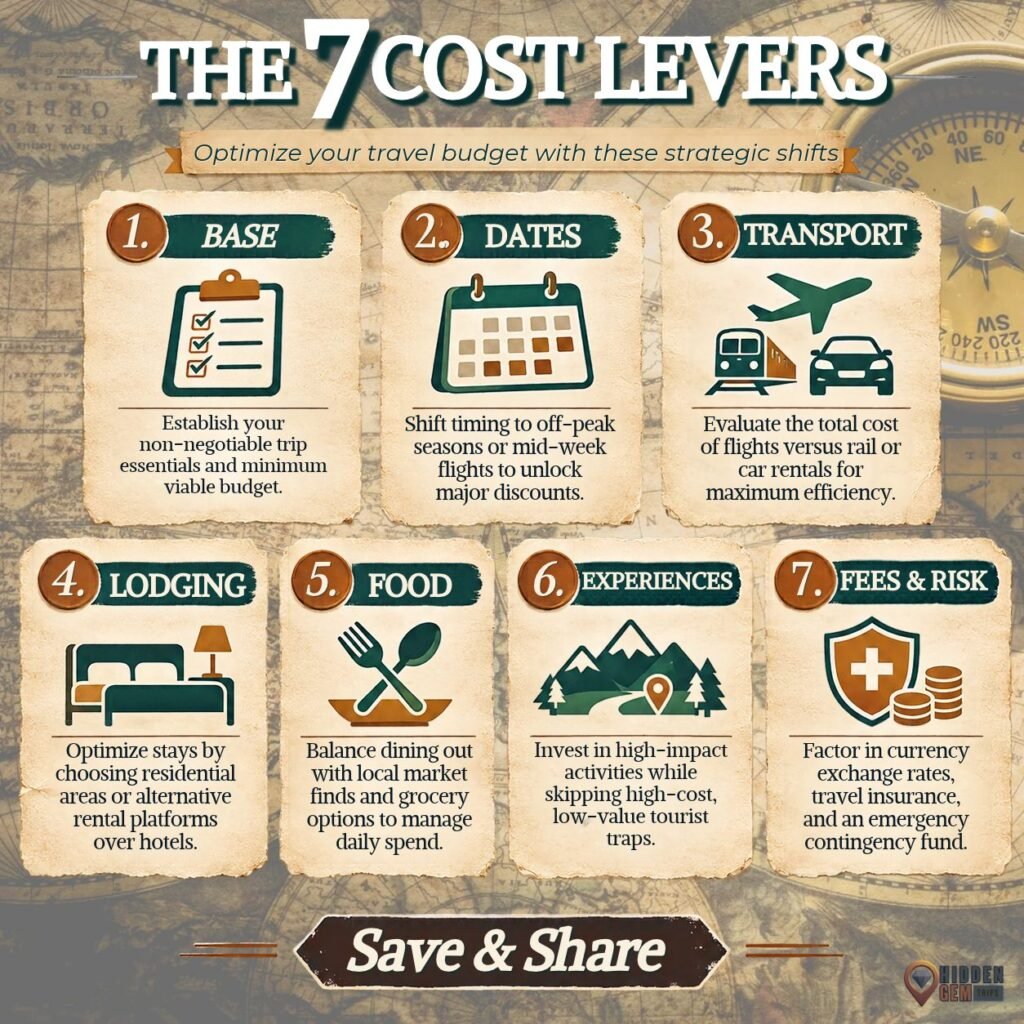
1. Change Your Base, Not Necessarily Your Dream Destination
A popular attraction doesn’t mean sleeping next to its entrance. The most famous central neighbourhood, resort strip or lakefront address has a price premium too. But moving too far away replaces hotel savings with transport costs and lost time. The better question is which base has the lowest practical cost for the experiences I care about?
Compare a neighborhood by its full daily cost
Say Hotel A is $210 a night and you can walk most things. Hotel B is $160 but two people would spend $26 a day getting in and out of it. Over six nights the headline lodging difference is $300. If you need that $26 transfer on five sightseeing days then cash difference narrows to $170 before counting time spent. If cheaper room also has no usable food option or late returns hard there may not be much choice anymore. These are examples only, quoted rates not.
Have a short list of three bases rather than forty hotel tabs. For each one check airport door-to-door access; grocery and restaurant options; evening transport; proximity to the two or three experiences you don’t want to miss (compare trip cost from that base not just cost per night). Accessibility needs; local safety considerations; how reliably transport operates after dark.
If you’re looking for a cross country replacement then swapping out the famous capital for another is one thing but moving within the same country is another. An architecture and café person might use our guide to the character of Tbilisi to see what else there is other than an itinerary. A cheaper substitute isn’t culturally equivalent — go there because you want to go there not because a listicle says it’s “cheap version” of somewhere else.
Test a gateway town without romanticizing remoteness
A second-tier town near the landscape you want might be cheaper to stay in and nicer to spend your evenings at — but thin bus schedules, difficult roads or limited medical access too. Our checklist for judging whether a less known place is ready for visitors is worth applying before committing. An affordable room isn’t an affordable trip if getting in and out is private vehicle only.
Decision rule: don’t choose the alternative base just because its room rate is cheaper. Saving based on daily logistical luck is not a strong saving.
2. Move Dates After Comparing the Total, Not Just the Airfare
Timing of travel can change more than the flight price. A big festival, school holiday, conference, national holiday or high demand weekend could all impact accommodation availability, ticket availability, restaurant reservations and transport frequency at once. The best “off peak” dates aren’t always the cheapest dates; they are dates when the experiences you came for are still safe and reliable to operate.
Use a three-window price comparison
Price the same seven day itinerary in three windows: your preferred dates, a nearby shoulder period option and another window a few weeks away. For each add airfare or train travel; six nights comparable lodging; known high cost activities. A $100 cheaper flight isn’t a deal if the rooms are $50 more per night for six nights.
A quick example illustrates how the problem is made clear. Window A has a $600 flight and six nights at $180 — that’s $1,680 before other expenses; Window B has a $500 flight but six nights at $240: $1,940. If you change dates so you save $100 on aircraft then your combined travel-and-room cost goes up by $260. All these are hypothetical figures — arithmetic counts.
Weather and access windows first. Cheap date out of hiking season, unsafe river crossing period or when boats don’t run isn’t a bargain. Neither is a winter city break if all you care about is what the city has to offer in winter. The framework for building a realistic one week travel rhythm can help keep your seven days comparable across those three windows.
Pay attention to the first and last usable days
An early flight might mean an extra night at the airport; midnight arrival might need private transfer. Count how many usable destination days you are giving up (not just total calendar dates on ticket). If cheaper route takes away almost full day — is that saving really serving your goals? This matters especially if time off work or family obligations are inflexible.
Decision rule: buy the cheapest whole trip price that fits your season, activity and comfort profile. Don’t let a flight-sale banner decide when you vacation for you!
3. Design a Transport Chain Instead of Collecting Cheap Tickets
Transportation isn’t a pile of fares. A separate ticket itinerary may look cheap until you miss a connection and now you need another ticket, accommodation night or transfer. Renting a car looks convenient until parking restrictions, insurance conditions, tolls, fuel prices and location restrictions are taken into account. Public transport can be good value when the timetable fits your trip — bad value when your itinerary requires impossible connections.
Compare door-to-door routes
For every major travel day write down start point, final destination, scheduled travel time, transfer and waiting time, baggage obligations, arrival hour and fallback option. A 40 minute flight with two hour airport approach and expensive final transfer may not be as attractive as direct train whereas a train that requires multiple changes won’t work for someone who can’t walk far or has lots of luggage.
The U.S. Department of Transportation says the advertised airfare must include mandatory government charges as well as carrier imposed surcharges (optional baggage, seat selection and onboard services may be extra). The DOT lesson on buying airline tickets is compare fare with extras you’d buy. Don’t assume lowest fare displayed is final price.
A two-base itinerary is usually easier to budget accurately than one that changes accommodation every night. Our guide on choosing two complementary travel hubs goes into route design in detail but here the budgeting question is whether one transfer is cheaper than several return journeys and check ins? Base or two bases not necessarily better than other base(s). Plot the journeys first.
Protect connections before trying to optimize pennies
Self-transfers are expensive (especially if you’re flying on different airlines or in and out of airports) so allow a connection margin for the journey and know which carrier is responsible. If eligible flights European passenger rights rules may assist, reroute, reimburse or compensate in some disruption (route, operator, cause & circumstances apply), check official EU air-passenger rights guidance rather than budget for compensation as if it were guaranteed.
Long haul travel has another tradeoff: arriving exhausted will start convenience spending and turn the first day into recovery. Our advice on making a long flight more manageable is helpful when looking at an itinerary with an uncomfortable connection or time zone jump.
Decision rule: the best transport option is the one whose total cost, reliability and usable time fits the trip (not always ticket with smallest number beside it).
4. Price Accommodation at Checkout and Measure Its Useful Access
Accommodation is where small nightly differences become big totals. Start with the final bookable rate for the exact room, number of guests and nights. Check mandatory fees (local taxes), cleaning charges, deposit terms, payment timing and cancellation rules. Some amounts may only be payable on arrival but they still belong in budget. Don’t compare refundable room to nonrefundable room as if they were interchangeable.
Run a lodging break-even check
Let’s say there are two six-night options. Central place is $1,170 after mandatory charges; outer place is $960 but will cost $30 a day to transport for five days (active days). Cash difference is $60 — central place may be shorter walk (late night access), more time in the neighborhood you want to explore. A $210 booking page gap becomes a $60 trip level gap. Those numbers are just examples and don’t take into account personal comfort differences.
In the US, the FTC rule on unfair or deceptive fees requires covered short term lodging providers to show total prices that include required fees (exceptions and disclosure requirements apply). The FTC explanation of upfront lodging prices is an important consumer reference but not a promise that every property everywhere does it the same way so always read final breakdown.

Buy useful comfort, not a label
You may not need a luxury view but you might need quiet room, elevator, kitchenette, private bathroom, heating or step free access. Things that let you cook one meal walk to activities sleep well are budget value. A cheaper room without basic requirement is bad deal. If you’re considering upgrades our guide on choosing comfort that really does earn its price covers another (but complementary) decision: when paying more is worth it.
Read the room description not just the property photos. Some gallery images show amenities for other categories of rooms. Read back through comments to see if there are recurring logistical problems (but don’t confuse opinions with policies). For apartments or homestays check whether kitchen equipment is included, linens utilities check-in arrangements etc.
Decision rule: divide total cost of accommodation and unavoidable commuting by number of useful nights and days then compare comfort requirements. A room is cheap only if it passes those tests.
5. Create a Food Routine Instead of Trying to Find the Cheapest Meal
Food gets its own plan because it’s both a cost and the main reason to travel. A destination isn’t just eating crackers next to a supermarket — sensible goals are saving money for a few meals and making ordinary eating easy enough that you aren’t forced into expensive last-minute choices.
Build three categories of meals
First you need to know what your anchor meals are — one local dinner that sticks in the mind; market tasting with guide; restaurant whose cuisine interests you. Second plan everyday meals (café lunch; neighbourhood restaurant; accommodation breakfast) into routine. Third find those convenience situations (late arrival, early train, remote excursion) where access to food may be limited and plan ahead.
What works is not “always eat cheaply”. It’s “spend deliberately”. Two travelers could set aside a fixed amount for one special meal and then modest breakfasts and lunches on other days. A room with kitchenette may be useful if you shop and prepare food; not so much if every day is full of tours and you never open the fridge.
If you’re traveling in Indonesia ideas on how to find everyday local food and transport respectfully are useful but don’t assume that local vendors should discount their work because you’re visiting on a budget — posted prices, fair compensation and respectful conversation matter more than “winning” a negotiation; if village visits or cultural settings are part of your itinerary then check out our primer on researching local expectations before you go.
Watch the spending pattern, not only the menu price
Restaurants near attractions are more convenient but repeated convenience purchases (bottled drinks where safe refill is available, taxi rides to scattered restaurants or breakfast bought at station every day) can add up to more than one carefully chosen dinner. Check local tap water guidance now not later when you refill — if food allergies/dietary needs/health requirements apply they take precedence over saving money.
Decision rule: keep the meals that make the place memorable and predictable routine meals. Budgeting well should sharpen your attention to local food — not destroy it.
6. Pay for the Experiences You Will Actually Use
A city card, museum pass, rail pass or packaged excursion can look like a bargain because the individual prices add up to such an enormous total. But what you’re comparing is not how much each attraction costs them (marketing value) but what you would pay otherwise for those specific experiences you actually want to use (reservations and other charges).
Calculate the pass break-even point
List your essential paid activities first. Add up admission and transport prices for each date you will visit them (divide by the number of dates). Compare that sum with the pass price plus any mandatory reservations or excluded segments. A pass is only a saving if usable coverage exceeds what you would otherwise buy — or convenience is worth the extra price to you.
Switzerland shows us why that comparison matters. Official Swiss Travel Pass info says included public transport, museum access and discounts on many mountain excursions but warns “some panoramic journeys require seat reservations or supplements”. A traveller who goes out on long trips consecutively might value such a pass differently than someone staying in one valley going for short walks. Check prices, eligibility and route coverage before booking — just because there’s a discount doesn’t mean the pass is saving!
Choose a few expensive highlights and many low-cost encounters
You don’t have to buy a ticket every morning for a rich week. Parks, public viewpoints, neighbourhood walks, some free museum periods, locally authorized cultural events and ordinary markets can provide context around the paid highlights. Check whether access is public, if permit or guide required and whether fragile site can take visitors.
Our post on traveling slowly enough to notice everyday details is a good counterweight to attraction-counting — more time in fewer places means less duplication of transport and rushed admission fees but also more meaningful encounters (as long as you don’t treat local life like free entertainment). Use our respectful village-visit principles here to help make that distinction.
Decision rule: buy the experience not the theoretical “value” printed on the pass advertisement. It’s your itinerary, not a brochure’s longest possible attraction list that saves you money.
7. Stop Small Fees and Big Risks From Eroding Your Savings
The last lever is not glamorous but more often the most important: protect what you worked for. A good hotel can be undermined by card fees galore, baggage charges you didn’t need, equipment purchases you didn’t want or disruption you couldn’t take. Not every protective product offered at checkout needs to be bought. Real exposures have to be identified and proportionate responses chosen.
Know how your payment will be converted
If a foreign card terminal or ATM offers to charge you in your home currency it may display dynamic currency conversion (Visa says that this is the conversion rate plus fees/markup; cardholders should be able to accept or decline). See Visa’s explanation of dynamic currency conversion and compare with terms on your own card. Paying in local currency avoids the merchant’s markup but your bank might still charge a foreign transaction fee — its combined cost matters.
Check how much cash withdrawals cost, whether an ATM operator charges a fee and how often you actually need cash. Carrying too many notes has security trade-offs of its own. A small sensible mix of payment options usually makes more sense than trying to optimize for one exchange rate ignoring access or safety.
Pack for the fare and destination you actually booked
Don’t buy an expensive “travel essential” because a shopping list makes it seem like you need to have it. Baggage is just one example: if the things you really need to take with you cost more than your airfare does then you lose out (wet destinations or island crossings? see our island packing approach for practical essentials). Bad roads, power outages or unreliable transit? Remote travel gear that solves real problems on bad roads rather than gadget haul.
The best packing question is “What expensive problem could this item prevent? And is there a simpler alternative I already own?” That keeps luggage and shopping bills in check.
Keep a risk reserve and review insurance exclusions
Trip cancellation vs medical treatment vs evacuation vs baggage loss vs missed connections are different risks. The 2026 Yellow Book says travel-disruption insurance and travel-health coverage aren’t the same thing as medical-evacuation insurance; its evidence-based overview of travel insurance types suggests checking what you already have (coverage), destination needs (exclusions), payment arrangements (how payments will be made). It doesn’t recommend any insurer.
If you want a commercial option to compare after that independent review then check the current SafetyWing plan terms and eligibility (this is an affiliate referral link — not a recommendation one plan fits all travelers). Check age and residence eligibility, covered destinations, activities existing medical conditions deductibles claim procedures evacuation provisions. Don’t treat a policy as covering an activity unless the actual documents say so.
A buffer should be realistic for your route and financial situation — there is no universal percentage that guarantees safety. For an ordinary city trip a small buffer may be all you need; weather dependent ferries, remote logistics or booking restrictions might require a bigger accessible buffer. Money set aside for emergencies isn’t an excuse to spend it all anyway. If an essential safety arrangement makes a trip unaffordable then postpone/ redesign that element rather than delete it.
Decision rule: remove avoidable transaction fees; carry only useful gear; insure risks according to your circumstances. False economy is still expensive.
A Worked Expensive Destination Budget for Two Travelers
The table below shows how this works for two adults going on a seven day six night trip to an unspecified high cost destination. The numbers are invented planning inputs — not 2026 market averages or hotel quotes or predicted discounts. Both versions assume similar essential activities and the same number of nights. Insurance and travel docs may vary traveler by traveler; no universal premium is implied here.
| Cost category for two adults | First draft (USD) | Revised plan (USD) | Change |
| Round-trip travel | $1,200 | $1,120 | −$80 |
| Six nights of lodging, including required fees | $1,440 | $1,140 | −$300 |
| Airport, regional, and local transport | $520 | $340 | −$180 |
| Food and non-alcoholic drinks | $780 | $570 | −$210 |
| Paid experiences | $420 | $310 | −$110 |
| Essential fees, gear, and insurance allowance | $240 | $220 | −$20 |
| Planned spending subtotal | $4,600 | $3,700 | −$900 |
| Separate 10% contingency reserve | $460 | $370 | −$90 |
| Spending plus reserved cash | $5,060 | $4,070 | −$990 |
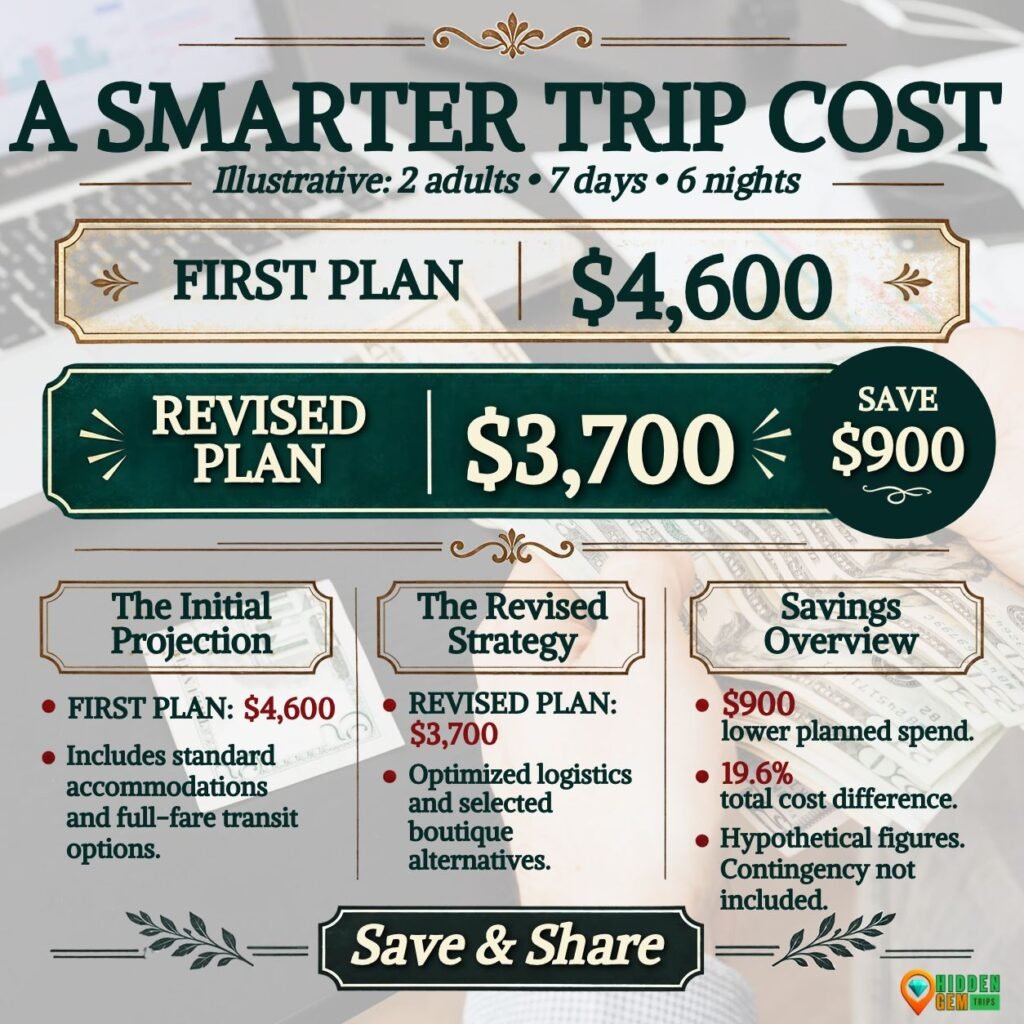
The new planned spending subtotal is $900 lower ($4,600 – $3,700) or 19.6% less than the original $4,600. The $90 difference between the two reserve allocations is not additional guaranteed saving — it’s just a change in cash set aside. If neither reserve is used then the expected spending comparison is still $4,600 versus $3,700. Nothing in this model says that every reader can save 19.6%, nor that these prices are available in any destination right now.
Here’s how a credible revision might happen. You move dates around after comparing flight and lodging prices. Base is walkable not transfers. Everyday meals are built around ordinary local options but one dinner is left alone. Underused attraction pass replaced by individual tickets. Flight baggage option chosen so it fits what you will actually carry. No spectacular loophole.
A second calculation: the cost per usable day
If the first itinerary gets you five reasonably usable days at $4,600 planned spend that’s $920 per usable day for the group. If the revised option saves money but forces a very late arrival and very early departure so only four usable days are left then its subtotal of $3,700 becomes $925 per usable day. It’s cheaper overall and virtually no cheaper per usable day. That doesn’t mean the revised option is wrong — just shows the trade-off more clearly. Time is part of your travel budget even if it never appears on a receipt.
So that’s why an effective savings plan tracks both expected cash spend and usable travel time. The two numbers stop attractive discounts from quietly deleting the experience you came for.
A 60-Minute Planning Audit Before You Book
You can do all seven strategies in one focused review. First ten minutes define non-negotiables: nights, experience you care most about; mobility and dietary needs — what you can afford without borrowing. Next ten minutes to three date windows; transport costs plus lodging costs not separate “deals”.
The next fifteen minutes are spent comparing three practical bases (commuting likely; airport transfers); ten minutes choosing transport connections and any risky self-transfer or late arrival; five to a food pattern; five to the two or three paid highlights. Five minutes in the last five are checkout fees, card costs, documents required, weather, cancellation rules and contingency. This is planning not an assertion that every complex trip can be researched in an hour.
If the trip involves long walks, multiple bags or specialist outdoor conditions our packing-light method for demanding travel will avoid unnecessary purchases and too much luggage. Save your comparison in a simple table or note. An elaborate spreadsheet is only useful if it helps you make a decision.
Before you click Book ask another question: What would have to happen for this cheaper option to become more expensive? If the answer is shaky connection, no late bus, unverified room amenity or activity being open against the odds — price that risk honestly or plan something stronger.
When Spending Less Is the Wrong Choice
Not every cut is worth it. Don’t give up legal entry requirements, travel advisories for someone with mobility needs; local guides required by conservation rules or community wishes; weather restrictions; food safety or access to care. Cheap unofficial excursion that ignores conservation rules or community wishes isn’t good budgeting. Saving $25 by making trip unsafe or exploitative is a bad trade.
So emotional value too — if this is a rare family trip paying for a room everyone can sleep in or direct connection that makes the trip manageable may be more important than getting the lowest total. The point of the framework is to know why you’re paying more. Informed spending beats automatic austerity.
Conclusion: Keep the Destination, Remove the Waste
An expensive destination budget works best when you stop treating the place’s reputation as a personal spending forecast. Prices are real but waste is often optional. Pick a smart base, compare whole trip dates, put together a coherent transport chain, check lodging, plan food spending, pay for activities you will use and protect savings from avoidable fees and unmanageable risks.
Don’t expect one perfect trick to halve every travel bill. The stronger strategy is slow and not flashy: find your expensive assumptions one by one, test them, keep the choices that preserve what you want from the journey; you can travel wisely in a costly place without pretending that everything enjoyable should be free.
Frequently Asked Questions
1. Can you really go to an expensive place on a shoestring budget?
Often yes — but only if the budget available covers the unavoidable costs of the trip as well as your needs (shorter stay, different dates, better connected accommodation might reduce cost). Some destinations are still outside realistic budget once transport, permits, safety requirements and contingency are taken into account. Delaying a trip is better than planning on an unsafe or unworkable plan.
2. What is the biggest mistake when budgeting for expensive destinations?
Comparing one price to the whole trip is a common mistake. Cheap flight adds airport transfers and lost time; cheap hotel adds daily transport; attraction pass can cost more than what you’d actually buy. Put every option into the same itinerary and compare total cost vs usable days.
3. Is it cheaper to stay outside a famous city centre?
Sometimes. Total cost of room + commuting needed + late night access + value of your time. Quiet area near good transit connection may be great value. Far away place that needs taxis can eat up the nightly savings. Accessibility and local safety are part of it too.
4. Are travel passes always worth buying in high-cost countries?
No. Check how the pass fits your actual routes and attractions (booking conditions, supplements, eligibility); a multi-day pass may be for frequent long distance travel; tickets may suit slow itinerary based on one location only. Don’t add unwanted attractions just so that the pass looks worthwhile.
5. How much emergency money should I have in an expensive destination budget?
There’s no one right percentage. Think about access to medical and transport in destination, weather reliability of your bookings, flexibility of insurance cover, ability to get emergency funds etc. Don’t lump contingency into planned spending — don’t assume insurance will pay for every problem; check current policies and official travel advice before you go.
Disclaimer
This article is for general travel-planning and budgeting information, not individual financial, legal, medical, insurance or safety advice. Statistics are sourced by source and period; destination costs, fares, taxes, immigration rules, transport schedules, weather, availability and insurance terms may change. All worked cost examples are hypothetical and do not represent actual quotes, guaranteed savings or first hand testing. Check prices and rules directly with official authorities, carriers, operators and insurers before making commitments. Some commercial links may generate commissions (as disclosed above) without extra cost to readers.