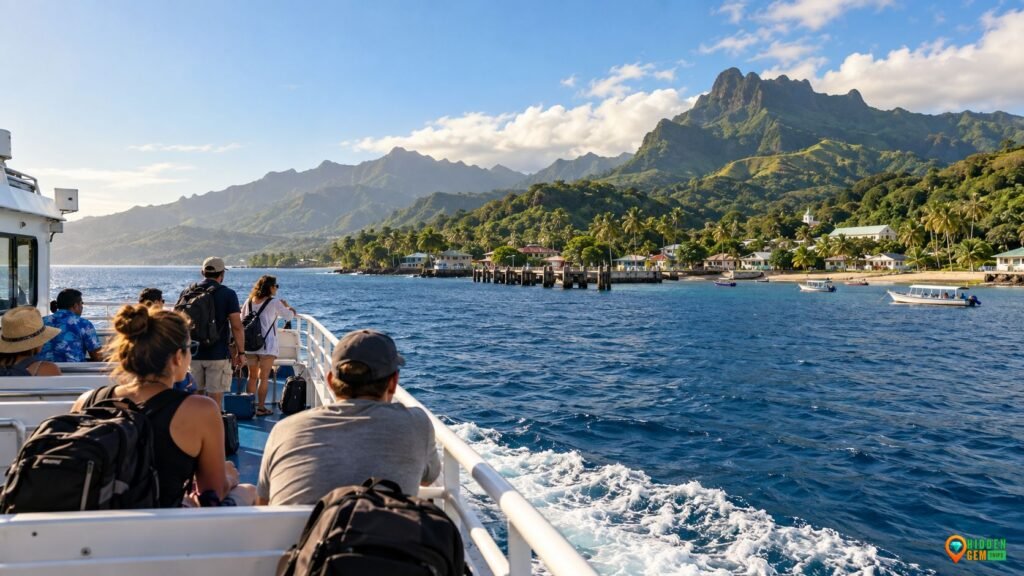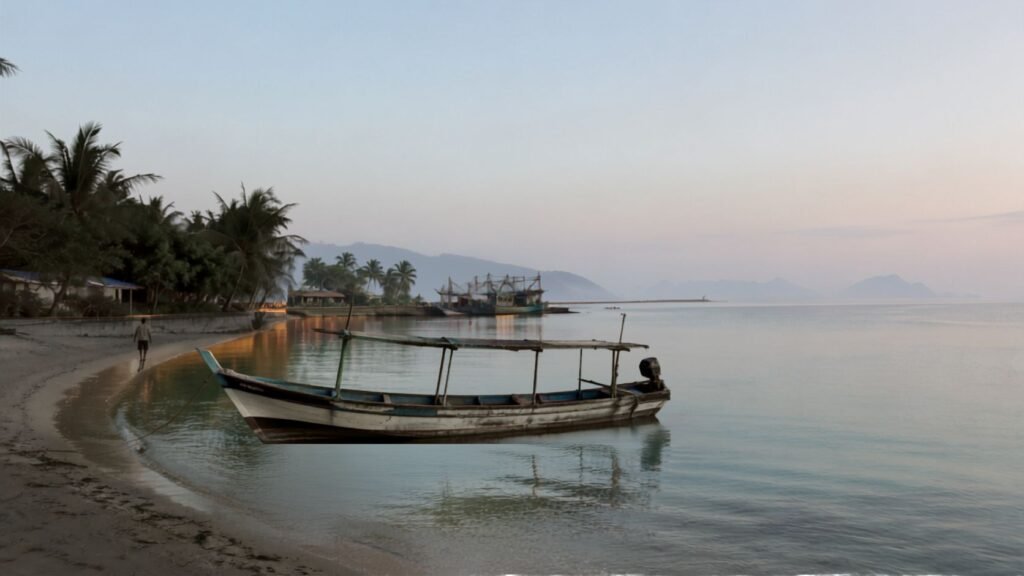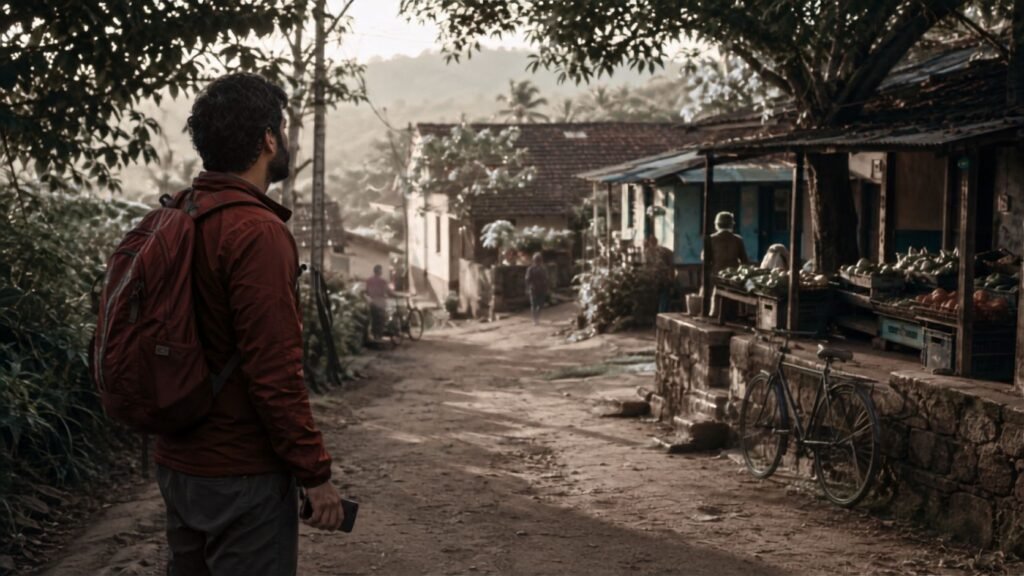

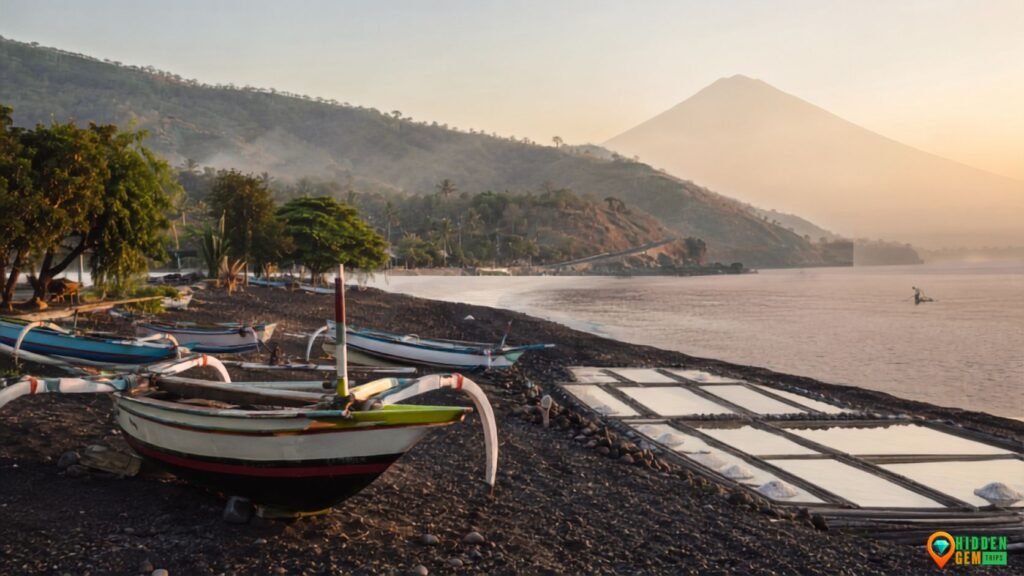
The story is stronger than the area’s reputation suggests. Amed is not all diving. Yes, this section of East Bali is famous for reefs, freediving, black sand entry and the surrounding wreck in Tulamben. But if you come to Amed for the sea alone, you miss the part of town that makes it feel different: mornings ruled by fishing boats, salt made on a thin strip of coast, tiny bays linked together by a road that won’t rush you, and villages that are working long before the tourists have finished breakfast.
This is not an attractions collecting guide. It’s a guide to reading the coast.
That line will matter in 2026. Bali is not waiting to be ‘discovered’. Direct foreign visitor arrivals to Bali in June 2026 were recorded at 605,013, up 4.63% from May, according to BPS-Statistics Indonesia. Amed is still more low-key than the jam-packed southern sections of the island, but to call it deserted or pristine is lazy travel writing. A good incentive to go is that its geography naturally lends itself to a slower pace.
If your version of Bali is less about beach clubs and more about place, work, food, road texture, and the hours before 9 a.m., this coast gives you plenty to do without a tank on your back.
Amed Beyond Diving: Why This Coast Works Best Slowly
Travelers commonly refer to “Amed” as if it were one unified beach town. On the ground it feels more like a ribbon, a string of bays, hamlets, fishing beaches, guesthouses, warungs, dive shops, temples and hillside slopes along the northeast edge of East Bali.
That linear form changes how you should plan the stay. You do not need a giant sightseeing list. You need time windows.
The official Karangasem tourism description of Jemeluk–Amed highlights not only the underwater landscape but also fishing life, traditional salt production, and the dramatic east-coast road. Indonesia’s Ministry of Tourism similarly points visitors toward local fishing practices, jukung boats, and salt farming.
The valuable tip: Amed’s non-diving draw isn’t buried behind a ticket booth. Much of it appears in the way the coast-line works.
If you love the idea of traveling with fewer “must sees,” the site’s case for lowering your trip pace is a fantastic companion principle. That idea gets done in Amed. One road, short hops, good morning light, and enough variation to make a slow day feel full, not hollow.
1. Start With the Hours Amed Uses Before Tourists Wake Up
Amed is east-facing enough so sunrise is not an added decoration. It belongs to the daily logic of the coast.
Before breakfast service is popular, beaches might feel like offices. Jukung outriggers rest on black or pebbled sand. Fishers go home or put gear out. Sweepers clearing out doorways. Offerings show up. Scooters are for carrying supplies. Temperature is easier. Mt Agung, sea, boats and volcanic shore make for a stark contrast frequently at its clearest.
The mistake is waking up early to rush to a photo spot.
Try another rule: the first hour is for walking, not arriving.
Find the closest beach to your location. Walk carefully enough to see what is private, what is commercial, what is definitely someone’s working day. Keep your camera down when individuals are changing clothing, sorting catch, praying, handling money, or working close up. Do not take pictures of people without their consent.
This is where a broader respectful village travel checklist becomes more useful than any “Instagram spots” list. A working beach is not a set.
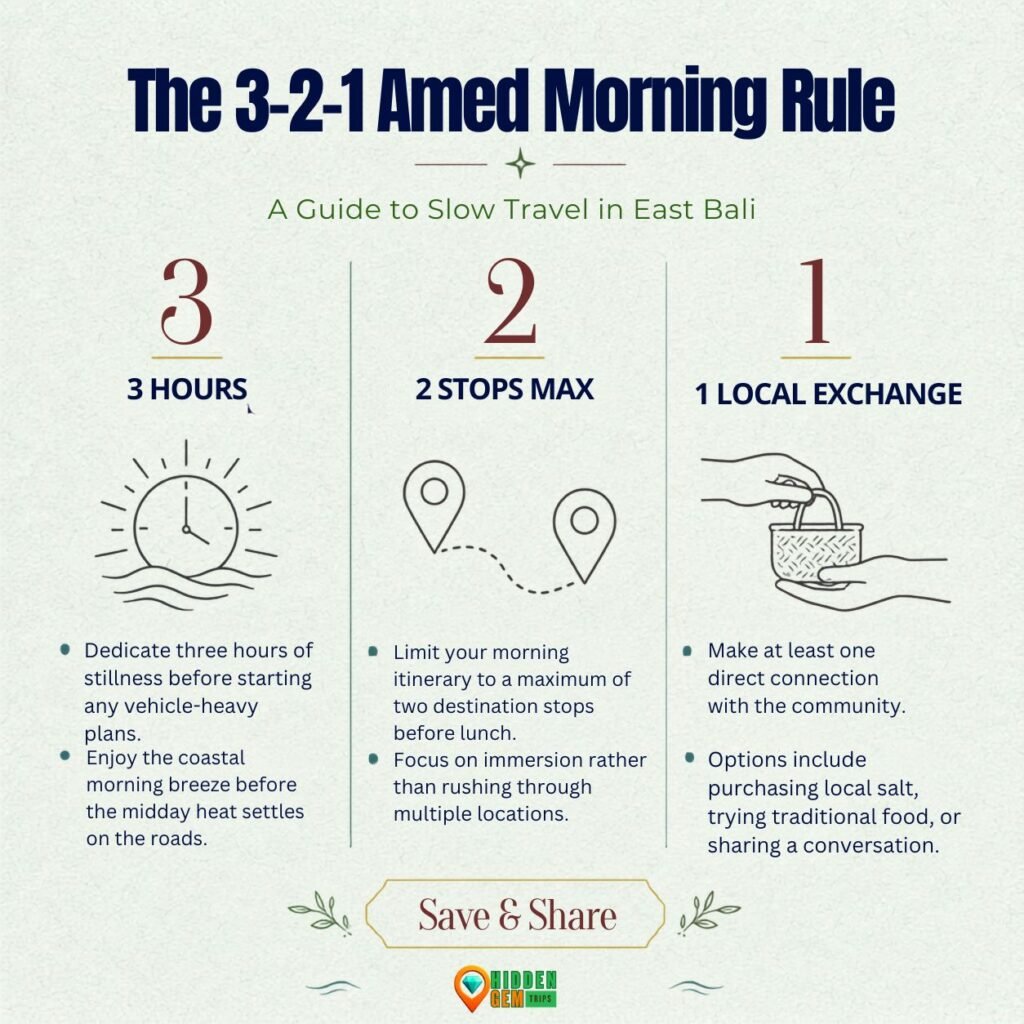
The 3-2-1 Amed morning rule
For a stay that actually feels different from southern Bali, try this simple editorial framework:
- 3 hours before you commit to a vehicle-heavy plan.
- 2 planned stops maximum before lunch.
- 1 direct local purchase or conversation that is not mediated by a large booking platform — breakfast at a family-run warung, salt from a producer, fruit from a roadside seller, or a boat arranged locally.
It is not about moral purity. It’s attention. Overscheduling makes every coast appear same.
2. Understand Amed Salt Before You Treat It as a Souvenir
It’s here that the piece changes from typical Amed travel advice into the salt narrative.
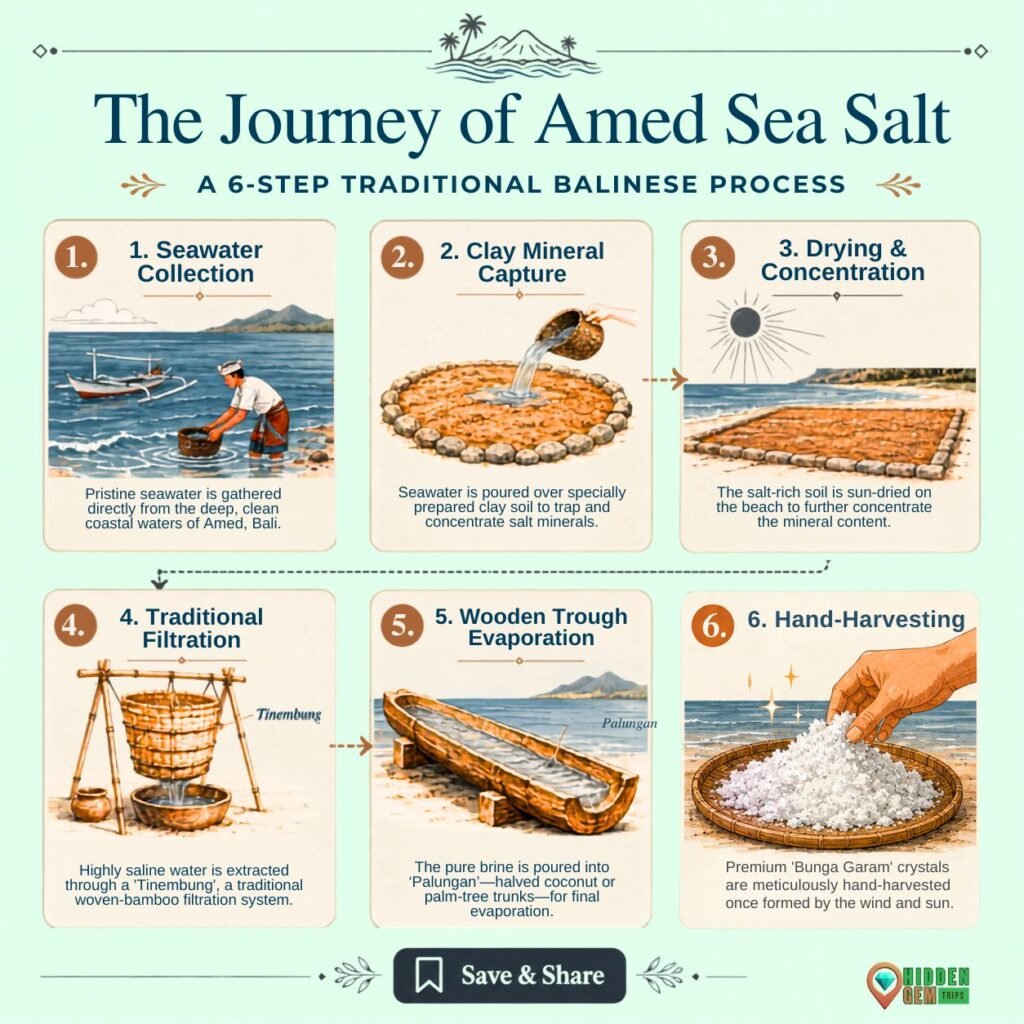
Garam Amed Bali is not “local sea salt.” The European Union’s documentation for Garam Amed Bali and Bunga Garam Amed Bali specifies a geographical production region in Amed and Lebah, in the village of Purwakerthi. It employs local seawater and clay soil to trap salt minerals. The brine is collected and filtered using a conventional technique, then crystallized in drying pans constructed from half coconut or palm trunks.
The same specification says production is carried out during the dry season from June through October and describes the method as a tradition practiced for more than 700 years.
That is a radically more interesting object than a jar labeled “Bali salt.”
What you may actually see
Salt making is weather-dependent and seasonal. In the productive months, you may see prepared earth, seawater being worked through the soil, filtering equipment, rows of long wooden troughs, white crystals, or producers tending different stages of the process. On another day, you may see very little activity.
Don’t expect a show just because a blog said there would be one.
Best is observational first visit. If you are given a formal explanation or tour by a producer or co-op, pay for it. But if salt is sold directly, it is possible to generate greater local value by buying a little salt than taking ten close-up shots, departing.
This is also a good example of how to judge whether a “hidden” place is ready for attention. HiddenGemTrips’ guide to checking whether a secret destination is actually ready for visitors applies neatly here: look for consent, access, local benefit, and signs that visitors are not obstructing the activity they came to admire.
Why the salt belongs in your Amed itinerary
Because it links landscape to livelihood.
The result is the signature of Amed’s arid seashore, clear sea, slim fertile strip, native trees, clay soil and hereditary knowledge. You are not going to a different “attraction.” What you’re seeing is a piece of place-making that before the modern tourist economy and now has to compete with it.
That’s the kind of detail that makes a slow trip unforgettable.
3. Drive the Coastal Road as a Sequence, Not a Shortcut
Amed’s road is no great thoroughfare. That’s why it’s successful.
As you head southeast from the center Amed/Jemeluk area toward Bunutan, Lipah, Selang, Banyuning and Aas, the road has a tendency to change character all the time. One bend is dotted with guesthouses and cafés; the next opens into a bay; another rises enough to give you a larger vista of sea and slopes; another tightens via settlement.
The coast is compact enough that travelers often underestimate it. They look at the distance and assume they can “do all of Amed” in an hour.
Technically, you can pass through quickly. Experientially, that defeats the point.
A better comparison is the logic used in the site’s guide to quiet coastal roads in New Zealand: the road is part of the trip only when you allow stopping time, weather time, and local traffic to matter.
Scooter or driver?
A scooter offers flexibility, but flexibility is not the same as suitability. The seaside road includes curves and hills and narrow spots and uneven edges and people and dogs and parked vehicles and times when the scenery wants to catch your eye. If you’re not already familiar riding a scooter in Indonesia, Amed is not the place to learn because the traffic looks quieter.
For many visitors a local driver is the lesser stress option, especially if you want to stop for photos without always worrying about parking and road position.
If you do bike, consider footwear and the quality of your helmet, the weather and amount of daylight as safety considerations, not accessories. Amed isn’t really remote, but the same rationale applies to bringing smart gear for remote and rough-road adventures.
Do not turn viewpoints into parking lots
The most lovely moments on the road are typically when there is least space to stop. If the shoulder is small, blind, private or already used by residents, move on. Your parking choice isn’t worth making everyone else solve your parking choice.
Pull over only where you can get fully out of the traffic line. Then walk to a safe viewing position if one exists.
That small habit is one of the differences between road-tripping and road-blocking. Bali has enough of the second one already.
4. Use Lipah and the Smaller Bays for Midday, Not Just Snorkeling
Often Lipah is seen thru its water: reef access, snorkeling and a more relaxed beach experience. But for a non diver it could be more of a pace break from the busier parts of the Amed strip.
Take lunch. Somewhere sitting in the shade. See the beach transform from morning action to lunchtime quiet. Read. Only swim when conditions are suitable for your ability. Then stay longer than your itinerary software suggests is effective.
That’s almost aggressively simple, which is why it works.
Amed rewards the traveler who knows that “nothing scheduled” doesn’t mean “nothing to do.” If your travels tend to devolve into a competition between saved pins, the site’s two-base itinerary strategy provides a helpful antidote: minimize transit, cluster experiences, and allow each base ample time to create a rhythm.
For Amed, I would go one step further. Build the day around one morning anchor and one afternoon anchor. Everything else is optional.
5. Follow the Jukung Rhythm Without Turning Fishing Life Into Content
The narrow outrigger fishing boats along the Amed coast are visually irresistible. They also exist for reasons that have nothing to do with your feed.
You will see boats pulled onto beaches, returning across calm morning water, being cleaned, repaired, loaded, or simply resting between uses. This is one of the easiest ways to understand Amed as a working coast rather than a resort zone.
The respectful approach to engage is boringly simple:
Ask before entering someone’s work area. Never sit on boats until asked. Don’t move gear for a crisper photo. Do not fly a drone low over houses or people working. Do not include close-up photographs of kids unless you have explicit permission from parents. If a fisherman offers paid morning tour or local boat ride, agree fee and length before leaving.
These are minor practices, but they are what distinguish cultural curiosity from extraction.
The site’s feature on river villages and local life around Tanjung Puting makes the same larger point for a broader Indonesian comparison: a destination becomes more legible when you pay attention to the communities around the main attraction.
Diving is the headlining attraction in Amed. The tale below that is the coast.
6. Let Breakfast Become Part of the Route
Slow mornings require food, rather than philosophy.
Amed’s breakfast scene extends from basic warungs to chic eateries affiliated to boutique resorts. You don’t have to pick an identity to stick with for the entire trip. Have nasi campur and local coffee one morning; sourdough and smoothie the next if that’s what you fancy.
The more useful travel habit is geographic: eat where you are already at.
Adding traffic and parking and time pressure to the calmest moment of your day, driving twenty minutes for a legendary breakfast. If your guesthouse serves breakfast, try it at least once. If it opens early, check a nearby warung. When you notice locally manufactured salt, inquire if the chef uses it instead of assuming.
This is where affordable travel meets travel with local value. Indonesia budget techniques HiddenGemTrips are most useful when “saving” means avoiding unnecessary transport and booking friction, not merely finding the lowest price.
A cheap brunch around the island is not inexpensive when you have spent 2 hours getting there.
7. Give Amed Two Mornings, Not One Packed Day
Amed is largely a one-night stop between Ubud and the Gilis, or a useful base for diving, and little else. Logistically, that works. Editorially it is weak.
If Amed is your destination beyond diving, then give the shore at least two mornings.
Why mornings? Why mornings? Because you can’t trade afternoons as much.” You have sunrise aspect, fishing activity, salt work in the right season, cooler road temps, breakfast rhythm, and first light on the volcanic coastline before a normal day tour truly gets going.
Here’s a 48-hour practical structure.
A 48-hour slow Amed plan
| Time | Day 1 | Day 2 |
| 05:45–07:00 | Sunrise walk near your accommodation; observe jukung activity | Repeat sunrise somewhere different; no need to chase a famous viewpoint |
| 07:00–09:00 | Breakfast nearby; salt-farm visit if seasonal and access is welcomed | Long breakfast, coffee, beach walk, or local market stop |
| 09:30–12:00 | Slow coastal road toward Lipah/Selang with one or two safe stops | Short inland or nearby cultural detour, or simply stay on the coast |
| 12:00–15:00 | Lunch + shade + rest | Lunch + swim/rest depending on conditions |
| 15:00–17:30 | Continue toward Banyuning/Aas or return slowly | Free block: massage, reading, cafe, photography, or no plan |
| Evening | Early dinner; walk only where road lighting and conditions feel safe | Final local dinner; pack for an early departure if needed |
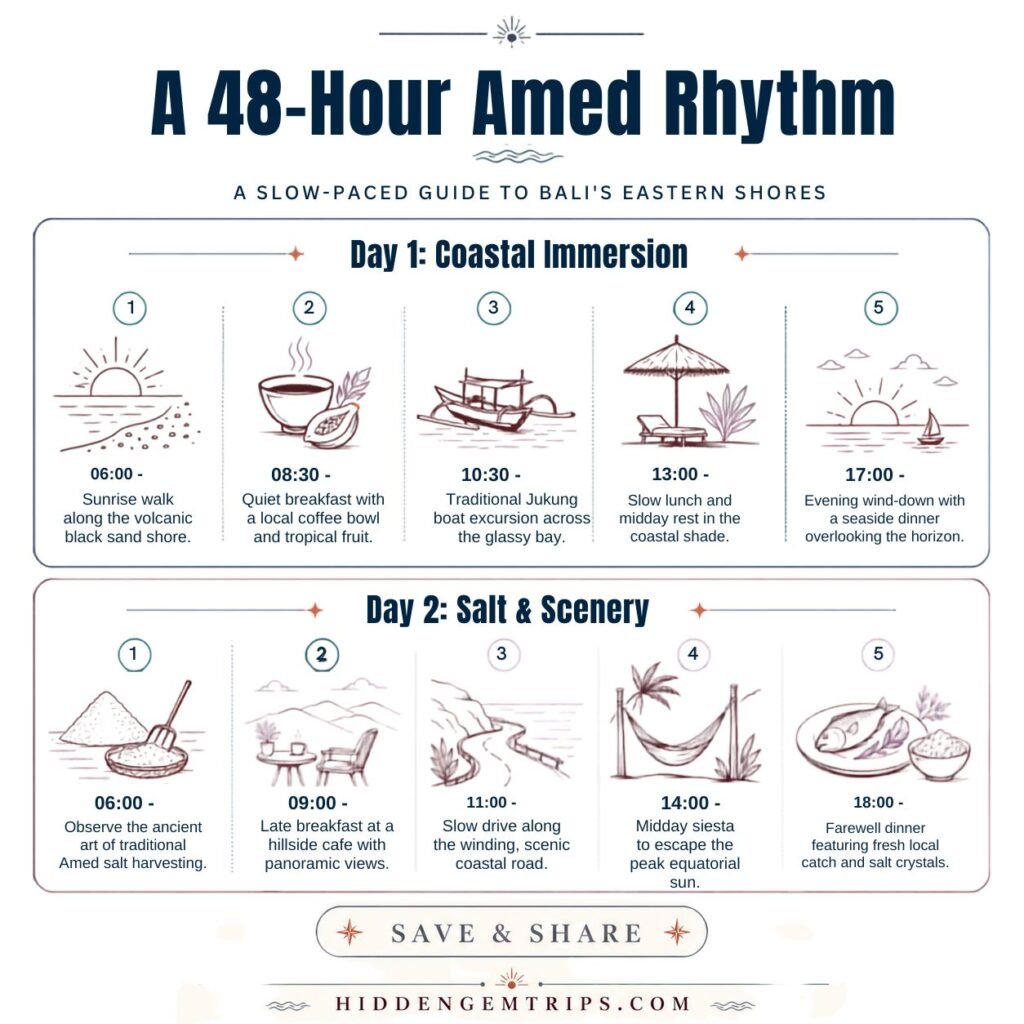
See what’s missing? Six temples, three waterfalls, a morning hike, a beach club, and a two hour detout for coffee.
That’s intentional.
If you only have seven days in Indonesia, the site’s rules for building a deeper seven-day itinerary can help you decide what to remove elsewhere so Amed is not reduced to a sleep-and-leave stop.
8. Time Your Visit Around Salt, Sea, and Weather — Not Just Hotel Prices
There is no single “best” month for every Amed traveler.
For the specific experience in this guide, the salt calendar matters. The EU product specification states that Garam Amed Bali production takes place during the dry season between June and October, when sun and moderate breeze support crystallization. That does not guarantee visible activity every day, but it gives you a far better planning window than a generic “Bali is great year-round” sentence.
Weather still varies. Before a road-heavy day or boat outing, check Indonesia’s official BMKG climate and weather information rather than relying only on a global weather app.
Dry season: better for the salt story
June through October is the strongest fit if the traditional salt process is central to your trip. You are also more likely to get long bright mornings and easier road conditions, though dry season does not mean zero rain or zero wind.
Wet season: greener, less predictable, but worth it all the same
Wet season in East Bali may look gentler and less hectic driving times, but requires extra caution with road surfaces, visibility, runoff and sea conditions. “Design a flexible day, don’t pay in advance for a series of weather dependent experiences.”
Amed is a particularly poor destination for weather denial because so much of its appeal is outdoors.
9. Plan the Practical Details Without Overengineering the Trip
Slow travel still needs logistics. The trick is solving the high-friction items early so the day itself can stay loose.
Getting there
Amed is in East Bali, Karangasem, distant enough from the southern tourism area that transfer time is real. Any map estimate should be treated as a best-case calculation, not a date. Bali traffic can vary greatly with ceremonies, weather, construction, events and time of day.
If you’re coming from Ubud or the south, a private driver is usually the easiest point-to-point choice. There may be shared shuttles but times and drop off sites vary, confirm immediately if relying on this.
For a bigger Indonesia trip, the site’s guide to finding hidden gems without wasting the journey is worth reading before you add Amed merely because it appears “off the beaten path.” Distance should earn its place in the itinerary.
Bali tourism levy
Foreign visitors are required to pay the official tourism tax of Bali. International tourists are charged IDR 150,000 per person, according to the provincial government’s Love Bali portal. Make payments thru the official portal or authorized means and retain your payment proofs.
Money and connectivity
But while card acceptance is becoming more frequent, there are still lots of little warungs, direct purchases, parking, contributions, and informal local services that are cash-first. Have smaller rupiah bills since not every merchant can break a huge bill.
Download offline maps to your phone ahead of your road day. Mobile data will usually operate along much of the tourist strip, but a map that works without signal costs nothing and takes away one additional reason to stop in a dangerous spot.
What to bring to Amed (other than diving)
No expedition gear is needed. You need heat, sun, dust, water and scooter/road practicality covered.
Bring breathable clothing, hat, reef-friendly UV protection, refillable water bottle, small first-aid kit, shoes with traction, and anything light that covers shoulders and knees when needed around religious spaces. Even if you never dive, a compact waterproof dry bag for phone, paperwork and photography gear is useful.
For a larger packing system, see HiddenGemTrips’ island packing technique and packing-light for remote adventures. Amed requires less gear than either, but the same concept applies: pack for the conditions you will actually meet, not for imagined emergencies in all categories.
Scooter Insurance and Reality
Travel insurance is not a substitute for a license, legal rental, helmet or good riding. If you are considering a coverage such as SafetyWing Nomad Insurance, please check the current policy wording and scooter/moped conditions yourself before purchasing.
Don’t assume travel insurance will cover scooters, as a sweeping statement. Things like licensing, engine size, helmet use, local law, exclusions and policy conditions can matter.
Amed Is Quiet, Not Empty — Travel Accordingly
The most damaging hidden-gem cliché is the idea that a place is valuable because there is “nobody there.”
There are people in Amed. People working. People going to school. People praying. People driving children to class. People making salt. People repairing boats. People running guesthouses, dive shops, restaurants, and minimarkets. Quiet for a visitor does not mean unused by everyone else.
That is why the best version of Amed beyond diving is not a scavenger hunt for secret beaches. It is a way of moving.
If you liked the quieter village logic of HiddenGemTrips’ North Bali village guide, Amed offers a useful contrast. North Bali spreads the experience across inland and coastal pockets; Amed compresses it into a thin line where tourism, fishing, salt heritage, housing, temples, and traffic share space.
The compression is what makes etiquette important.
Five rules that matter more here than another saved pin
- Do not block work. If somebody is moving a boat, salt, fish, supplies, or a scooter, your photograph waits.
- Ask before portraits up close. A grin is not an open invitation to publish a face.
- Dress for the occasion, not simply the weather. Beachwear is for the beach; roads and communities are mixed-use public space.
- Buy something when it is a good buy. Money is exchanged fairly, but the local explanation is more sustainable: food, salt, a boat ride, or a craft.
- Keep the volume down. Speakers, drones, yelling in cafés and the revving of rental scooters go further in compact settlements than outsiders appreciate.
- Not only Balinese rules these are. It’s travel literacy 101.
Who Will Love Amed Without Diving — and Who May Not
Amed is a strong fit if you enjoy mornings, photography, small food stops, road scenery, village observation, ocean views, short walks, and days with intentional empty space. It also works well for couples or mixed-interest groups where one person dives and another does not.
If you want intense nightlife, lots of shopping, shiny sidewalks, quick public transit, or a steady stream of big attractions, it’s not perfect. The road can feel repetitive if you just move from saved pin to saved pin. Not all beaches are soft white sand. Some parts are pebbly or volcanic. The midday heat will kill motivation rapidly.
That is not a flaw. It is a fit question.
The site’s broader guide to underrated destinations in Indonesia makes a useful distinction: “less famous” does not automatically mean “better for you.” Amed works when its pace matches yours.
A Simple Decision Table
| Traveler type | Amed beyond diving fit | Why |
| Slow traveler | Excellent | Linear coast, easy morning rhythm, small daily radius |
| Photographer | Excellent | Sunrise, jukung, volcanic coast, salt textures, road viewpoints |
| Food-first traveler | Good | Plenty of warungs and cafes, though not a major destination for high-end culinary variety |
| Non-diver traveling with divers | Excellent | Enough independent structure without needing separate long day trips |
| Family with very young children | Mixed | Calm stays exist, but road edges, heat, stairs, and beach surfaces require careful property choice |
| Nightlife-focused traveler | Poor | Amed is not built around late-night density |
| Nervous first-time scooter rider | Poor on scooter / Good with driver | Quiet-looking roads can still be technically demanding |
| Fast checklist traveler | Mixed | You can see the coast quickly, but the destination’s main non-diving value is lost |
Conclusion: The Best Amed Itinerary Leaves Space Between the Stops
Amed does not need to compete with Bali’s most famous attractions. It does not even need to compete with its own underwater reputation.
The Coast becomes more intriguing when you stop asking “What else is there to do?” and start asking “What is already happening here before I schedule anything?”
Get up early. Walk before you ride. Learn why the salt is particular to this portion of shoreline. Stop when the road allows safely. Eat around where you are. Don’t make men into props, watch boats. Allow yourself two mornings. Leave one half the afternoon clear.
That is Amed beyond diving: not a rejection of the sea but a larger reading of the shore.
If you come home with the shape of a wooden salt trough, the sound of outriggers on black sand and one breakfast that took far longer than expected, the trip undoubtedly worked.
FAQ About Amed Beyond Diving
1. Is Amed worth visiting without diving or snorkeling?
Yes, if you like slow coastline travel. Amed offers sunrise hikes, seasonal traditional salt manufacture, viewing fishing villages, gorgeous stretches of road, little beaches and bays, cafes and warungs, photography and easy access to other East Bali cultural landscapes. If you want intense nightlife or major ticket attractions every few hours, it may be too quiet.
2. How many days to stay in Amed if you don’t dive?
Such a vacation is practical for at least two nites as it provides you two mornings. Three nites is best if you want a low activity day, a seasonal salt visit, and a relaxing coastline drive without jamming it all into one loop.
3. When can I watch the traditional Amed salt making?
The EU specification for Garam Amed Bali mentions production during the dry season from June to October. Activity is still dictated by daily weather, labor and production schedules, so don’t assume that a farm will be functioning at a certain hour without local confirmation.
4. Am I going to require a scooter?
Nope. If you’re experienced, legal, and want to make numerous stops along the coast, a scooter is a convenient way to go, but a local driver can be safer and more pleasant. Walking is ok for short local stretches but the entire Amed strip is too spread out and car oriented to consider it as one continuous pedestrian promenade.
5. Is Amed still a secret gem in 2026?
Not in a literal sense. Amed is a prominent name on Bali’s tourist map, with plenty of lodging, diving, dining and transport activity. The attractiveness of its 2026 appeal is not about secrecy; it is a slower coastline structure, strong local identity and a distinct rhythm to Bali’s busiest southern regions.
Travel & Affiliate Disclaimer
Travel and access conditions, weather, business hours, prices, transport schedules and municipal regulations are subject to change without prior notice. Before you travel, check current circumstances with official sources and local providers. This article is basic travel information and not legal, medical, insurance, road safety or financial advice.
Some of the products we share are affiliate links, meaning we may earn a small commission if you purchase, but it won’t cost you anything extra. If you use affiliate links, HiddenGemTrips may earn a reward from qualifying purchases or bookings at no additional cost to the reader. Product and insurance mentions are not an assurance of suitability; readers should independently examine current terms, exclusions, licensing requirements and coverage.