
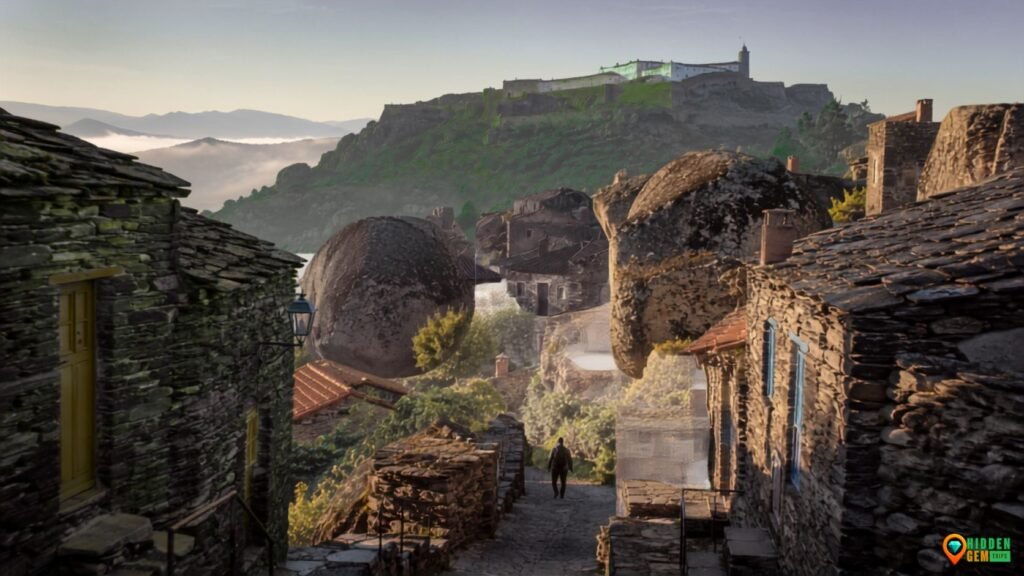
The Portugal inland villages are a less performed and more lived-in version of the country. Granite lanes warming in the morning sun, slate roofs disappearing into folds of mountains, tiny museums with no queue, cafés where lunch still follows the rhythm of the town rather than an international timetable. This guide connects seven unique stops in central and eastern Portugal – but it is not a list of “the prettiest.” It is a sensible way of determining where to stay, where to sleep and where a short visit will be enough.
| Affiliate disclosure This post includes affiliate links. If you buy or book through an approved tracking link, Hidden Gem Trips may receive a commission at no extra cost to you. |
The tourism industry in Portugal continues to flourish. The official Tourism Outlook 2025 counted 32.5 million guests and 82.0 million overnight stays in 2025. Yet that national achievement is countered by a different reality inland: an OECD analysis of population decline in Portugal found that more than two-thirds of municipalities lost citizens between 2011 and 2024, with aging advancing most steeply in smaller and non-coastal towns. Inland well visits do not mean “discovering” empty settlements. It is about harnessing the power of tourism in ways that respect residents, keep open businesses afloat and don’t turn vulnerable locations into photo setups.
The route below applies a practical slow-travel framework and a method for finding genuinely under-the-radar places. Each village gets an honest access note, an overnight verdict and one simple local-spend action. That structure matters because a place can be beautiful yet still be a poor match for your mobility, schedule or transport plan.
Quick answer: which 7 communities should you opt for?
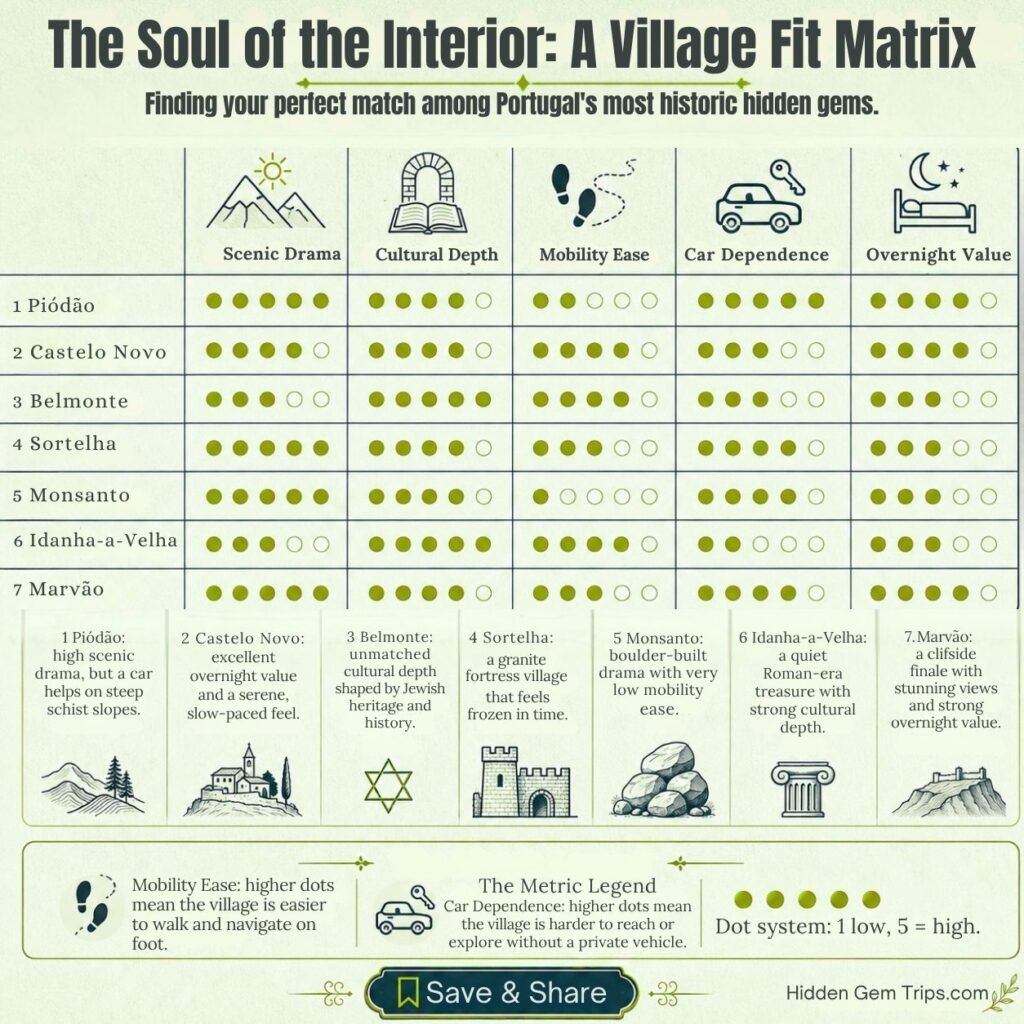
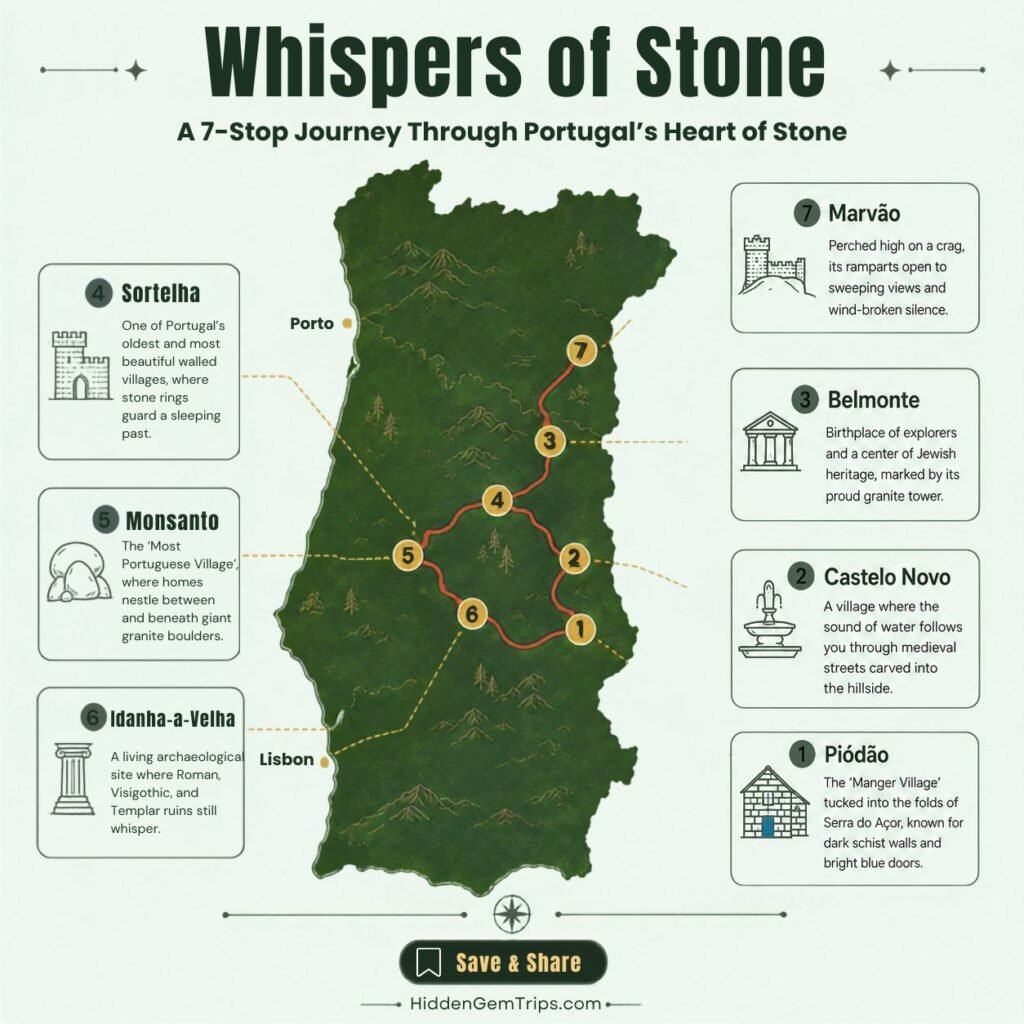
Take Piódão, Castelo Novo, Belmonte, Sortelha, Monsanto, Idanha-a-Velha and Marvão for the best balanced initial route. They cover all together: schist architecture, granite fortresses, Jewish legacy, Roman and Visigothic layers, mountain scenery and a strong last night on the Alentejo border. The best way to link them is by rental car. If you want to change hotels less often, the trip can be condensed to two regional bases.
| Village | Best for | Ideal time | Overnight verdict | Access reality |
| Piódão | Schist lanes and mountain atmosphere | 3–5 hours | Yes, for dawn or evening | Very car-dependent; steep lanes |
| Castelo Novo | Quiet square, manor houses, Gardunha foothills | 2–4 hours | Optional | Car easiest; limited local services |
| Belmonte | Jewish heritage, museums, practical base | Half day–1 day | Yes, as a base | Best services of the seven |
| Sortelha | Intact walled-village mood | 2–3 hours | Optional but rewarding | Car-dependent; uneven stone |
| Monsanto | Granite boulders and dramatic hilltop views | 3–5 hours | Yes, if crowds matter | Steep, exposed and car-dependent |
| Idanha-a-Velha | Archaeology and deep quiet | 1.5–3 hours | Stay nearby | Sparse services; combine with Monsanto |
| Marvão | Ramparts, sunrise and a strong final night | Half day–1 day | Strong yes | Car easiest; steep interior streets |
Before you decide to stay at each stop, learn how to determine if a quiet destination is ready for guests. In this location, “ready” is not city-level mobility or consistent opening hours. It means the visitor can come and not need a small settlement to be like Lisbon.
Why these Portugal inland villages are important in 2026
Portugal is not short of lists of villages. Most have the same visual language of stone walls, red roofs, a castle, a sweeping perspective. The tougher question is what follows the picture. Can you eat beyond 3:00 p.m. Is the legacy interpreted, rather than just labeled? If visitors are shooting, may the resident use the lane? Does over-nighting offer value or just move you into a village with very little in the way of nighttime services?
The demographic context makes those questions more than just editorial embellishment. Statistics Portugal’s demographic release for 2025 revealed an aging ratio of 188.8 older persons per 100 young people. That national figure is not a measure of tourism in each individual hamlet but it does point to a larger reality: many tiny places depend on a thin layer of residents, municipal services, family businesses and seasonal demand. Responsible visitors do not ‘save’ a village. But they can make better choices about where their money is going.
This is why the route is also resistant to speed. The site’s seven-day itinerary principles, which discourage rushed travels, are perfectly applicable here: fewer check-ins, earlier starts, margin for closures and time to buy lunch rather than surviving on petrol-station snacks. Map-wise, inland Portugal looks compact. Roads, grades and detours differ.
How to plan the route without making it a checklist
Don’t use 7 hotels, use 2 bases
The most efficient is Belmonte or Covilhã for the northern cluster and Monsanto/Idanha-a-Nova or Castelo Branco for the southern cluster. Make Marvão a final one night extension rather than cram it into a day trip. This is a nice, straightforward use of the two-base itinerary approach: protect your energy, reduce packing friction and spend more time in the communities that truly reward evening light.
Don’t guarantee, treat opening hours as a variable
Small museums, churches, tourist offices and family restaurants can close for lunch, run reduced hours in winter or modify their schedules around local events. Check official municipal pages the day before, and keep one outdoor backup: a rampart stroll, a viewpoint over the terrain or a gradual circle through the historic core. A flexible layout is not “under-planning,” but is the right reaction to a low density destination.
Select one economic activity in each village
A coffee by itself is better than nothing, but hardly the only game in town. Pay for a museum, engage a local tour, buy regional food from a business that is genuinely open year round, have lunch away from the coach arrival window, or stay in a locally managed guesthouse. This isn’t about performative generosity. It is to make your visit a little more helpful for the place that is hosting you.
1. Piódão: stay for the hours the day-trippers don’t see
Piódão is the outlier of this route. It is one of Portugal’s twelve Historical Villages yet it does not use a castle as an identity marker. The official page for Piódão reads: the village is nestled deep into the Serra do Açor, where dark schist buildings are stacked across the slope with pale blue doors and windows breaking through the stone. From a distance the settlement appears almost dramatic. At street level it turns steep and intimate.
Why it gets a night
Midday reduces Piódão into a visitor loop: arrival, central square, church facade, a few lanes, exit. The evening lends the place dimension. The temperature drops, the brightness disappears from the stone and the settlement is no longer a single viewpoint. Staying also eliminates the need to get around each lane quickly, which is important as hills and irregular paving can be taxing.
What to do slowly:
First walk the main pathways without looking for a particular picture. Note how the houses respond to the slope, how the water channels are laid out and how the yellow trim around the doors breaks up the otherwise somber palette. Then a shorter circuit around sunset. The second walk tends to be better since you’re not navigating anymore, you’re watching. If you add a nature stop nearby, make it a secondary stop. Piódão itself warrants leisurely time.
Local spend swing
Treat the stop as a free outdoor set rather than a staffed shop, and book dinner or breakfast in the hamlet and buy a regional product. Confirm meal times in advance – small kitchens may not work to the late dining pattern visitors expect elsewhere in Portugal.
Reality check
Piódão is not a good “quick detour” for every traveler. The approach is winding, public transport is limited and the village is not naturally accessible for people who struggle with steep, uneven surfaces. The honest alternative is to admire the setting from the most manageable parts of the village rather than forcing a complete climb.
2. Castelo Novo: the quiet reset of the big names
Castelo Novo is typically the breath you take in between Piódão and Belmonte. That’s exactly why it works. The settlement, backed by the Serra da Gardunha, is a blend of granite dwellings, historic civic architecture and a central square that looks to have been built rather than created. The official page of Castelo Novo refers to the manor houses, the historical Town Hall and jail, the Baroque fountain next to the façade and the remains of the castle over the square.
Why stop at this
Castelo Novo has what the headline villages sometimes lack: room to look. The fountain, the bell tower, the carved stone and the old municipal buildings are all close enough to allow for a compact tour, although the town does not require a definite circle. It’s a nice spot for a lunch and walk, especially if you want a quieter middle day on your trip.
What to watch out for
Walk up from the Largo da Bica to the castle ruins and look back often. The composition includes the foothills of the Gardunha, not only the background. If you have time, couple the settlement with nearby Alpedrinha rather than rush off to another famous castle. Here is one of the spots where the quiet-valley strategy employed in Slovenia translates well: one modest base, one landscape overlay, one noteworthy halt.
Shift in local spend
Pick a café, bakery or small producer and ask them what is local to the Gardunha area. Cherries are firmly linked to the region, but seasonality is key; if it’s not harvest season, preserves or honey or other shelf-stable items can be the more genuine buy.
Verdict overnight
Optional . Stay if you prefer a very calm evening or a rural property close by. Otherwise make Castelo Novo a half day stay and sleep in Belmonte or Covilhã where the broader choice of food and services lessens logistical stress.
3. Belmonte: the route’s most important cultural base
Belmonte is more expansive and utilitarian than the other sites, and easy to underestimate. Don’t. It’s not just about convenience, it’s one of the most important cultural stories on the route. The Belmonte Jewish Museum interprets the history and continuity of a Sephardic community that preserved rituals during long periods of seclusion and pressure. The town is also connected to Pedro Álvares Cabral, the castle, the Church of Santiago and a small network of museums.
Why it works as a foundation
The bigger settlements have more restaurants, accommodation and practical services than Belmonte. This way you can explore heritage in the morning, go back for a break and carry on to Sortelha or the Serra da Estrela area without having to repack. This is the stop for the stabilizing traveler who hates to arrive in tiny communities after nightfall.
Visit with cultural discipline
The Jewish legacy is not a matter of aesthetics. Dress and act properly in religious locations, ask before photographing individuals, and don’t boil the tale down to a ‘secret community’ hook. The museum is the best spot to get context before walking the old quarter. A guide can provide nuances that you will not get on a quick self led round.
Local spend shift
Pay for the museum network or a guided excursion and eat in town instead of using Belmonte as a bed. If you were going to spend money on one cultural event along the way, this is a good contender because the interpretation transforms the way the rest of the town is read.
Overnight verdict
Yes – especially for a first inland journey in Portugal. Belmonte isn’t the prettiest stop, but it may be the most practical. It cuts down on vehicle time, allows for a more in-depth heritage excursion and provides space for a slower next morning.
4. Sortelha: arrive late, leave before you rush it
Sortelha is located in a ring of protection at around 760 meters. Sortelha’s official page speaks of a medieval look that is surprisingly well kept. The settlement is small enough to be caught quickly: entrance, lanes, castle, walls, panoramas. Its seeming simplicity seduces travelers to make it a 45 minute halt. Fight! Resist!
The best pace
Come in the late afternoon when the stone is softer and the geometry of the settlement more obvious. Go through the gate, but don’t go directly to the tallest peak. Walk around the lower alleys, notice the intricacies around the pillory and the old houses and then walk towards the castle. Better that the walls are the conclusion of the revelation, not the first sprint.
Who will adore it
If you are a traveller who likes defensive architecture, uncluttered streets and wind-exposed perspectives, you will probably rate Sortelha quite well. It also works for photographers who can wait for the light rather than coming at midday. Those with small children and those with limited mobility should allow for a shorter, safer circuit; stone can be polished, uneven, and slippery.
Local spend shift
Buy a drink or a meal within or just around the old village and pay for any heritage access that is working. Often people who use the infrastructure but spend nothing visit little settlements. It’s not a big thing to buy something small, but it’s better than treating the location like a free film set.
Night verdict
Optional. Sortelha is wonderful at quieter times, although housing and dining options are limited. If atmosphere is your thing, stick around. Otherwise, head late and back to Belmonte or another service base before the country roads get tiresome.
5. Monsanto: A Granite Drama At Price Of Effort
Monsanto is the village that will most likely take over your camera roll. Monsanto’s official page outlines how dwellings use huge granite rocks as walls and in certain cases, roofs. Castle ruins and exposed rock line the pathways, making it seem less made than negotiated between people and geology.
Don’t underestimate the ascent
The payoff is great visually but the physical demand is high as well. The top route can be hot and exposed and rough. Bring water, start early, and know if you need the castle beforehand. There is no failure in stopping at the level where the village is still fun. A hasty peak in the heat of midday is no better a vacation experience.
The idea of one tile
Sometimes, locally, dwellings are described as “only one tile” (ie, a single slab of rock for a roof). Instead, Look for the wider pattern rather than developing one checklist. Boulders become corners, ceilings, retaining walls and visual anchors. Monsanto’s strength is in that cumulative link of home space to geology.
Local-spend move
Stay for a meal, book a local room or buy a craft with a clear connection to the village. The official heritage route notes traditional items such as tambourines and rag dolls; ask who made an item before buying. “Local style” and locally produced are not always the same thing.
Night verdict
Yes, if you prefer tranquil streets before the tour groups arrive. The morning in the upper village is a different experience than the noon circle. Book early as inventory is limited, then compare cancellation terms with your choice approved booking platform or flexible rural stays.
6. Idanha-a-Velha: the stop that fulfills the interest for the history
Monsanto can feel practically empty after Idanha-a-Velha. That is the point of the comparison. The official page for Idanha-a-Velha tells of multiple levels of settlement. A wider terrain lies inside the Naturtejo UNESCO Global Geopark, with a geological legacy that dates back more than 600 million years.
Why it’s different
This is not a village that has one intact castle silhouette playing out its history. The lure is archaeological: walls, reused stone, the cathedral complex and the remains of Roman, Suebi, Visigothic, Islamic and medieval Christian eras. Visitors looking for a single striking landmark can be done quickly. Layered settings can hold onto their loving visitors much longer than one might think.
How to visit well
Start with whatever understanding you have, no matter how little it may be. The stones are flattened into “old ruins,” with no context. The settlement becomes a sequence of political, religious and urban changes with context. In intense heat, keep your route short. Shade may be sparse, and services restricted.
Local spending shift
Bring all your requirements already acquired elsewhere. Use a local guide or combine the visit with a lunch or overnight stay in the municipality. Idanha-a-Velha is the perfect example of how to determine if a quiet place is prepared for tourists. The experience is better when expectations meet the size of the site.
Overnight verdict
Stay close but not in the village. Compare it with Monsanto, Idanha-a-Nova or Castelo Branco. That provides you time to do archeology without relying on a tiny settlement for every meal and service.
7. Marvão: End the night on top of Alentejo
Marvão is further south and belongs to a different family of landscapes. It is the correct ending. Per the official page for Marvão, the town is located on the high crest of the Serra de São Mamede, close the border with Spain, with the castle perched at around 843 meters. Here the dwellings are white, lime-washed, instead of the darker stone of the Beiras, and the view stretches further and is drier.
The importance of the final night
The walls of Marvão are stunning at any time, but a night stay affects the end of the journey. Day visitors come in, the temperature falls and the town is less about the panoramic proof-shot. The sunrise is as powerful as ever, especially when haze softens the plains below. And then the road stops being a line of monuments and becomes a space you live in for a while.
What to combine
Walk the walls, explore the castle and spend time on the streets below rather than the whole visit at the highest point . Nearby Roman Ammaia or Castelo de Vide could add to the historical element if the day is roomy. A mountain-route reality check from Albania is pertinent here: altitude, meandering access and viewing stops take longer than a flat chart indicates.
Local spend shift
Book the last dinner in town and choose for regional products such as chestnut, olive oil or local wine where the provenance is obvious. The autumn chestnut season really adds to the mood, but also means more demand at the weekends, so it is best to book rooms and meals rather than assume a quiet village implies infinite availability.
Overnight verdict
A strong yes. If you can only squeeze in two nights in the villages, consider one in the northern group (Piódão or Monsanto), and one in Marvão. When it’s clear, use a dark-sky trip planning checklist to include moon phase, cloud cover, safe viewing spots and warm clothing without suggesting the town is an official dark-sky reserve.
The most popular itineraries
Four days: first flavor compressed
Day 1: Lisbon or Porto to Piódão, sleep close to Piódão. Day 2: Castelo Novo to Belmonte, overnight at Belmonte. Day 3: Sortelha and Monsanto, overnight in Monsanto or Idanha-a-Nova. Day 4 – Idanha-a-Velha, then onto Lisbon. Skip Marvão. Adding it turns a tight ride into a driving lesson.
Seven days: the middle way
Day 1: Arrive in the center region and settle in Piódão or one of the local mountain bases. Day 2: leisurely morning in Piódão then Castelo Novo. Days 3-4: Belmonte as a base (Sortelha on one of the days). Days 5–6: Monsanto and Idanha-a-Velha, one full evening in village Day 7: Marvão, ideally overnight before heading back the next morning. This is consistent with the seven-day itinerary standards that guard against hasty travels by providing for one flexible half-day for closures, weather or just exhaustion.
Ten days: add landscape, not more checkmarks
Use the extra days for a Serra do Açor walk, the Serra da Gardunha, the Serra da Estrela area, Roman Ammaia or Castelo de Vide. Do not add three more villages just because they appear nearby. The deeper version should include a rest morning, a long lunch and at least one locally guided experience.
Best time to explore inland Portugal villages
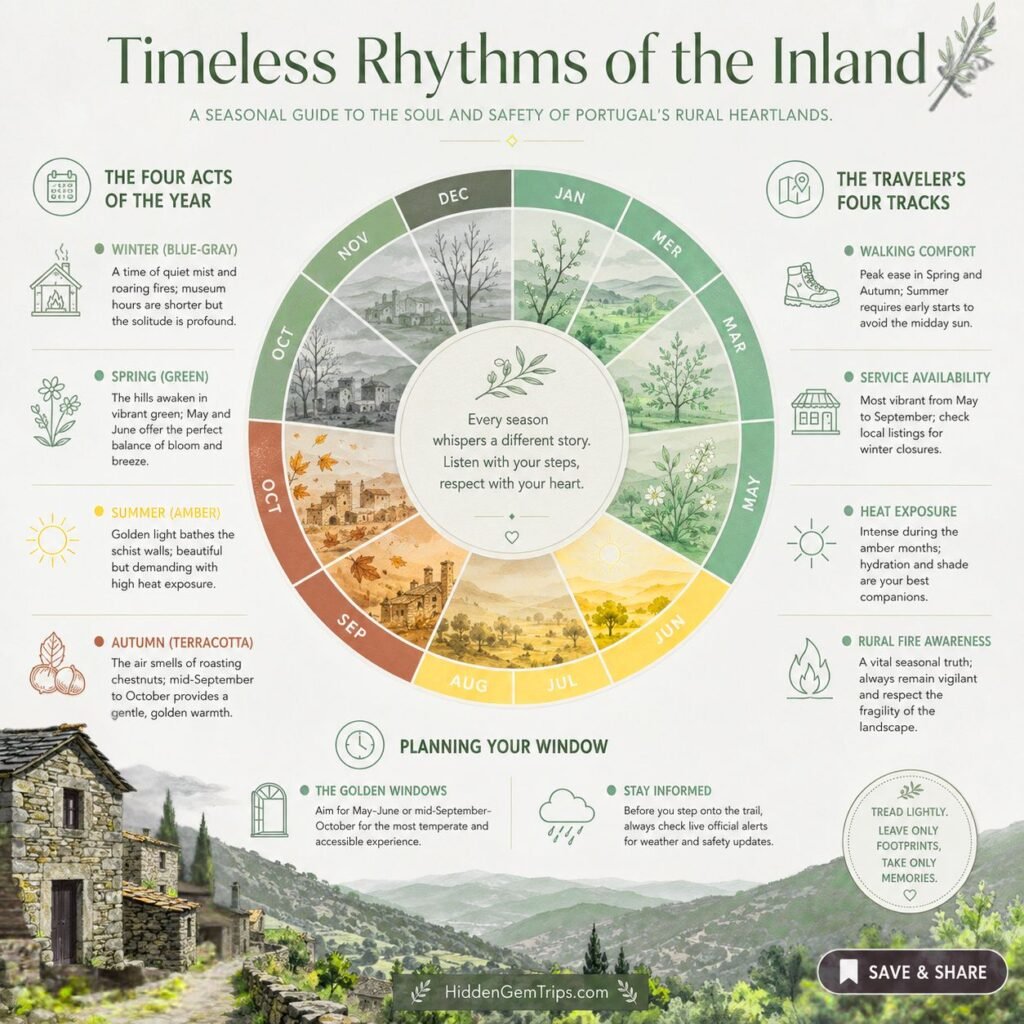
Late April to June and mid-September to October are generally the most forgiving for daylight hours, strolling temps and open services. Spring is for green slopes and flowers; early October for warmer stone, harvest products and, at Marvão, the energy of the chestnut season. Winter can be evocative but is cold, wet, and silent enough that closures become a major planning factor.
July and August require a different risk calculation. Inland Portugal can be intensely hot, and rural fire danger can change rapidly. Check Portugal’s Civil Protection warnings and local weather on the morning of travel, not only when you build the itinerary. If authorities close roads, trails or forest areas, do not improvise around barriers. A hidden-gem trip is not a heroic test of your ability to ignore public safety.
| Season | Strength | Main limitation | Best match |
| Spring | Green landscapes, mild walking weather | Rain and variable mountain conditions | First-time road trips |
| Summer | Long days and full visitor services | Heat, wildfire danger, exposed climbs | Early-start travelers with flexible plans |
| Autumn | Warm light, harvest food, chestnuts | Busy festival weekends; shorter days | Food, photography and village nights |
| Winter | Quiet streets and dramatic weather | Closures, cold interiors, slippery stone | Experienced slow travelers |
Transport reality in 2026
A car is still the simplest tool for this exact route. Rail can deliver you to regional cities and towns, but it does not solve the final village connection. The Beira Baixa corridor links places such as Castelo Branco, Fundão, Covilhã and Guarda; however, at the time this draft was fact-checked, CP’s current Beira Baixa service notice described replacement buses on sections affected by repair work. Recheck the journey planner immediately before publication and travel, because a “train-based itinerary” can quietly become a train-plus-bus-plus-taxi itinerary.
Travelers who do not drive should reduce the list rather than forcing all seven. Base in a regional center, book one or two private day trips, and choose the villages that match your priorities. Belmonte, Sortelha and Monsanto form a more realistic northern/eastern cluster than trying to combine Piódão and Marvão through public transport.
When renting a car, choose the smallest car that will fit people and luggage. Narrow entry, cramped village parking and uphill approaches are rewarded by small dimensions. Download offline maps, keep the gasoline tank over a quarter on remote stretches and carry a reliable small power bank so navigation does not disappear at the least suitable moment.
A realistic budget for the route
Inland does not automatically mean ultra-cheap. Rural rooms can offer excellent value, but limited inventory may push prices up on weekends, festivals and autumn event dates. Use the figures below as planning ranges, not live quotations. Compare total cost—including car, fuel, one-way fees, breakfast and cancellation terms—rather than celebrating a low room rate that creates two extra hours of driving.
| Item | Working range | Planning note |
| Simple guesthouse double | €65–€110 per night | Often best value outside event weekends |
| Rural boutique stay | €100–€180+ per night | Scarcity can matter more than star rating |
| Casual meal | €12–€22 per person | Lunch menus may be better value than dinner |
| Museum/heritage entries | Usually modest but variable | Carry a payment backup; check free days locally |
| Rental car and fuel | Highly date-dependent | Compare full insurance, deposit and one-way fees |
| Local guide | Variable by group and duration | Worth prioritizing in Belmonte or archaeological sites |
For the less obvious costs—parking, fuel detours, closed-kitchen backup meals, insurance excess and last-minute taxis—use the costs travelers often forget on remote trips. Travelers who want comfort without city-luxury pricing can also borrow a mid-range approach to affordable opulence: spend on the night or experience that changes the trip, then keep the transit nights simple.
Packing and mobility: stone villages are not neutral terrain
Wear shoes that have good grip. Polished cobbles, actual gradients and no certainty of rails on castle paths. If you currently use poles you may like tiny folding trekking poles for steep or uneven portions, but they are no alternative for choosing a shorter route when conditions are unfavorable.
Pack a small day pack with water, sun protection, light clothing, basic medication and a hard copy of lodging details. For a more methodical list, mix a lighter packing plan for isolated adventures with smart kit for rough roads and unreliable transport. The aim is not tactical cosplay. It is to carry enough so a closed café or a delayed transit is a nuisance, not a crisis.
Summer safety, insurance and flexibility
Check for heat and fire danger before leaving lodging in summer. When parking in isolated places keep the automobile facing an easy exit, don’t obstruct restricted access and respect police, fireman and municipal regulations. In Portugal the emergency number is 112. If smoke, ash or road closure shows, relocate the trip into a safe one, not content.
Travel insurance should be chosen for its actual terms, not because a logo appears in an article. Review medical coverage, rental-car exclusions, trip interruption, natural-disaster wording and the rules for government advisories. You can compare travel medical insurance options, but verify eligibility, territory, exclusions and benefit limits for your nationality, age and trip before purchase.
International visitors arriving tired should also avoid collecting a rental car immediately after a difficult overnight journey. The site’s a long-haul flight survival plan is relevant here: sleep, hydrate and begin rural driving when your attention is reliable. Solo travelers can cross-check the route against the under-the-radar solo female travel map, while remembering that no generalized safety list replaces current local judgment.
Rules for Responsible Travel That Work
- Do not take close-up photographs of residents without permission, particularly at doors, religious sites and places of employment.
- Park only in designated areas. A lane that appears to be deserted may be an emergency route, a delivery access or the only path home for a resident.
- Keep drones grounded unless you have checked Portuguese aviation rules, local restrictions, privacy, and protected-area conditions.
- Buy fewer, better local products and ask who made them. Avoid generic souvenirs dressed as village craft.
- Eat and sleep locally when the fit is good, but do not demand late-night services from a settlement with a tiny resident population.
- Share geotags thoughtfully. A public village is not a secret, but fragile paths, private corners and unsafe viewpoints do not need amplification.
The principle is simple: do not confuse low visitor volume with infinite capacity. The best hidden-gem behavior is often boring in the best way—arrive prepared, spend fairly, follow signs, keep noise down and leave without requiring the village to recover from your visit.
Final verdict: which Portugal hinterland communities are worth making a detour for?
All seven sites are worth visiting, but not by every traveler on the same trip. If you want mountain atmosphere, go to Piódão, for a peaceful reset, Castelo Novo, for cultural richness and services, Belmonte, for medieval consistency, Sortelha, for geological spectacle, Monsanto, for archaeology, Idanha-a-Velha, for the most intense overnight conclusion, Marvão.
The route works when you stop thinking of the villages as collectables. Better two well remembered stops than seven rushed ones. In 2026, that’s not just a better way to travel, it’s a more honest answer to regions dealing with tourism boom, aging populations, limited services and climate danger. Build margin into the plan, pay for interpretation, wait for the calm hours and allow one community surprise you enough to adjust the itinerary.
Frequently Asked Questions
1. Can I visit these inland Portugal villages without a car?
Partly, but not efficiently, on one continuous seven-village route. Trains and buses serve regional centers, although the final stretch is generally by taxi, private tour, or irregular local transport. Without a car, select two or three villages from a cluster and pre-arrange each transfer.
2. Which village is best for a first-time visitor?
Monsanto delivers the most immediate visual impact, while Belmonte offers the best balance of heritage, services, and base logistics. For atmosphere after day-trippers leave, Piódão or Marvão is the better overnight choice.
3. How many days do I need for all seven?
Allow at least seven days, and preferably eight if you are starting and ending in Lisbon or Porto. Four days can cover only six stops if you accept more driving and less evening time. A ten-day version is better for nature walks, museum closures, and rest.
4. What is the best month for the route?
May, June, late September, and October are usually the strongest planning windows. They tend to offer more comfortable walking conditions than peak summer. Always check current mountain weather, heat alerts, and rural fire warnings.
5. Are the villages accessible for travelers with limited mobility?
Accessibility varies and is generally limited in steep historic cores. Piódão, Monsanto, Sortelha, and Marvão include uneven stone and gradients. Belmonte is the practical base, but specific museums and streets should still be checked individually. A shorter adapted circuit is better than assuming the full heritage route is step-free.
Travel and Affiliate Disclaimer
This article is basic travel information and is not legal, medical, safety, or insurance advice. Operations, road access, museum hours, fees, weather, and wildfire restrictions are subject to change without notice. All facts should be confirmed with the official operators, municipalities and Portuguese authorities before travelling. Insurance products are subject to policy terms, eligibility, exclusions and limits, and location. This Hidden Gem Trips post contains affiliate links. If you purchase something via these links, we may receive a small commission at no extra cost to you.