

A cheap room can become an expensive choice when every meal needs a taxi. A discounted boat trip can lose its appeal if the price excludes the harbour transfer, landing fees, and equipment. The cost that matters is the amount you pay to complete the day you planned.
Compare full journeys rather than single discounts, and you’ll find Indonesia budget travel is better. Plan a route with time to savor it, know what each booking covers, and set aside funds for the connection that is most likely to wreck your plans.
This guide offers ten ways to make those decisions. It is designed for independent travellers considering quieter destinations, regional journeys, and small-island stays. It does not promise a universal daily budget: a town-based holiday and a boat-dependent island trip have different cost structures.
Guide Type: Research Based. Reviewed sources: 12 October 2026. This is a desk-researched planning resource, not a first-hand travel account. Comparisons and Worksheets are editorial tools of HiddenGemTrips. All numerical examples are hypothetical and are not indicative of any actual market prices. Check fares, facilities, access & booking conditions for your dates. Read our editorial standards.
Indonesia Budget Travel: Cost of the Entire Trip to Start
Break your budget into 3 parts: Booked, expected daily expenses and a buffer for fluctuations. Watch if a price is per person, accommodation, vehicle or boat; mixing up such units might make a comparison deceptive.
| Budget category | Include | What to check |
| Getting to the destination | Flights or other intercity transport, baggage, gateway stays | Full payable price and onward connection |
| Staying in the destination | Rooms, meals, local transport, activities | Inclusions and costs excluded from the quote |
| Leaving the destination | Return transfer, crossing, onward journey | Timing and consequences of a missed connection |
| Reserve for changes | Extra night, replacement transfer, changed booking | Your own plausible disruption scenario |
Entry documents, insurance, and other personal requirements also belong in your full holiday budget. This guide concentrates on route and destination spending rather than treating a daily allowance as the total cost of travelling.
For destination selection, start with our Indonesia beyond Bali comparison. Choose the place before trying to force it into a budget copied from a different region.
1. Choose a Compact Route Before Comparing Hotel Deals
Place your arrival point, accommodation, intended activities, and departure point on one map. Then count how many paid transfers the plan requires. This is a useful first test because a scattered itinerary can be expensive even when its individual bookings look modest.
Take a brief break and explore one base with a few neighboring excursions. If you want a second base, inquire if it means fewer return trips or more packing, transfers and another check-in.
Make a straightforward comparison: what do you get with the extra stop, and what does it cost in money and usable time? If you really want to do a particular trip then it may be worth taking the transfer. A stop included simply because it is on a familiar checklist warrants a second look.
Decision to make: Decide on the route structure first, then look for lodgings along that route. A discounted lodging should fit your agenda, not force an odd one.
2. Compare Accommodation Together With Local Spending
Read the room description and ask about the costs outside it. Is breakfast included? Can you walk to dinner? What transport is available at your arrival time? Are there stairs or access arrangements your group needs to plan around?
A guesthouse, homestay, hotel or apartment might all be good value for a particular vacation. The label alone does not determine quality, ownership, or pricing. Long-stay lodging also has to be checked for minimum stays, deposits, visitor rules, and included services; don’t assume every local rental permits short visits.
Here’s a sample daily comparison for one traveler:
| Item | Stay A | Stay B |
| Room | IDR 250,000 | IDR 330,000 |
| Local transport | IDR 120,000 | IDR 30,000 |
| Meals | IDR 120,000 | IDR 120,000 |
| Total | IDR 490,000 | IDR 480,000 |
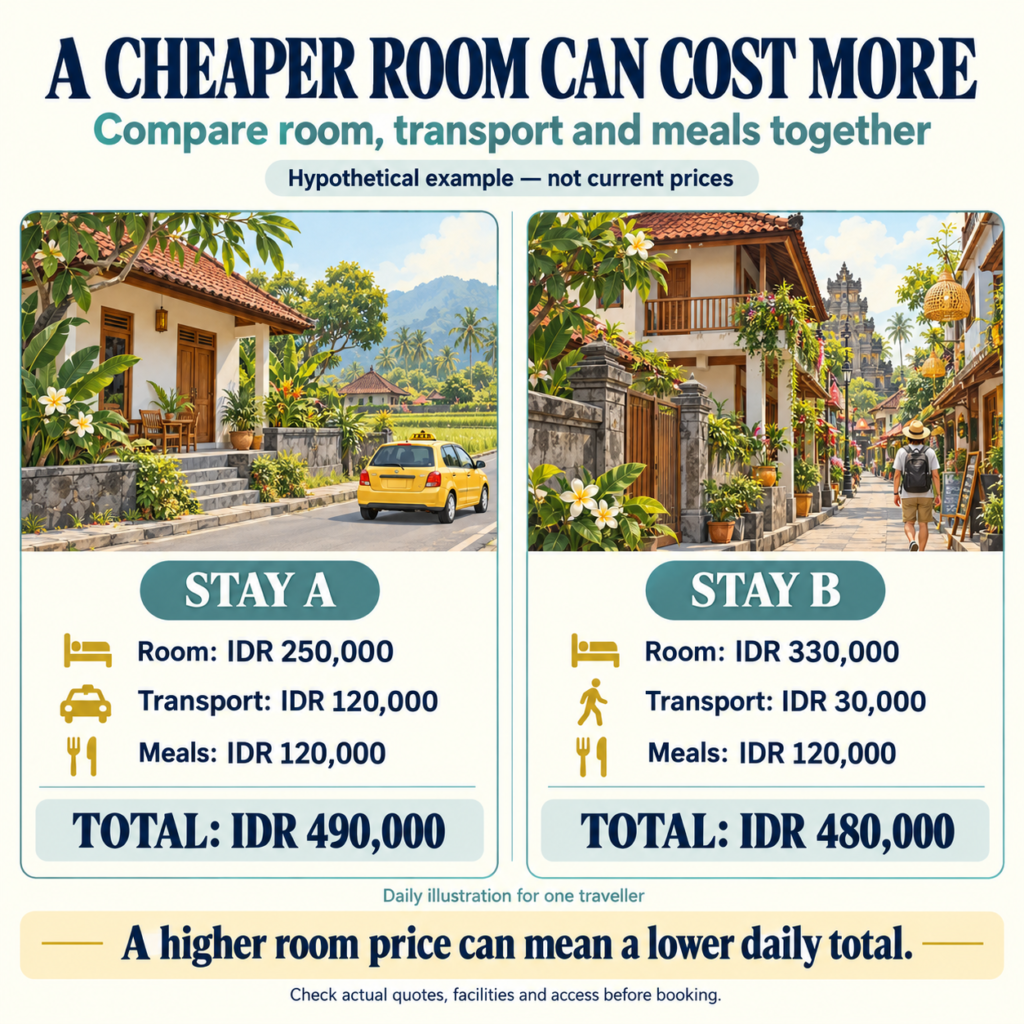
These are made up numbers, not quotes for accomodation. They explain why a greater hotel rate can nevertheless lead to a lower overall daily cost. Stay B is IDR 80.000 more expensive for the room, but IDR 90.000 cheaper for transport. Still, that IDR 10,000 differential is still weighed against facilities, comfort and accessibility.
3. Compare Door to Door Transport
Each choice is a complete experience including pickup, main service, arrival transfer, luggage and any overnight stay. Don’t assume the actual terminal is next to your accommodation, find out where it is.
KAI Access KAI’s official app for tickets and journey information when rail is available for your chosen route. Compare services on your dates by viewing current operator information. Don’t presume train links to every place.
Find the operator and booking channel for a ferry route. Ferizy’s rules are only valid for crossings that are listed in its booking services, it’s not a universal booking system for all Indonesian boats. Check passenger and vehicle classifications, port-entry timing and alter circumstances for the route you really need.
Overnight travel can save a nite in a hotel, but arriving early can cost you. Ask about luggage storage, early check-in and pick-up on departure. Now compare the final amount with how much of the next day you will comfortably use.
The Decision to make: buy the transport option that covers your whole route, not just the cheapest ticket shown.
4. Compare travel dates without giving a discount
Check the same route and accommodation type on two or three combinations of dates that would work for you. Ensure the comparison is valid – same baggage allowances, same number of travelers, same meals included and same refund terms.
A lower fare on one date is useful only if the rest of the trip still works. An additional gateway night can absorb the difference. A cheaper departure may also leave you too little time for a connection.
Check local event calendars and transport availability before accepting a seemingly calm period as a deal. The weather can affect the activity you are traveling for. For boat-dependent plans, check BMKG’s marine forecasts and high-wave warnings near departure, and operator and harbor directions.
Don’t use a claimed % savings nationwide to base your budget on. See what you get for that cheaper price . Notice the actual spread in the quotations you receive .
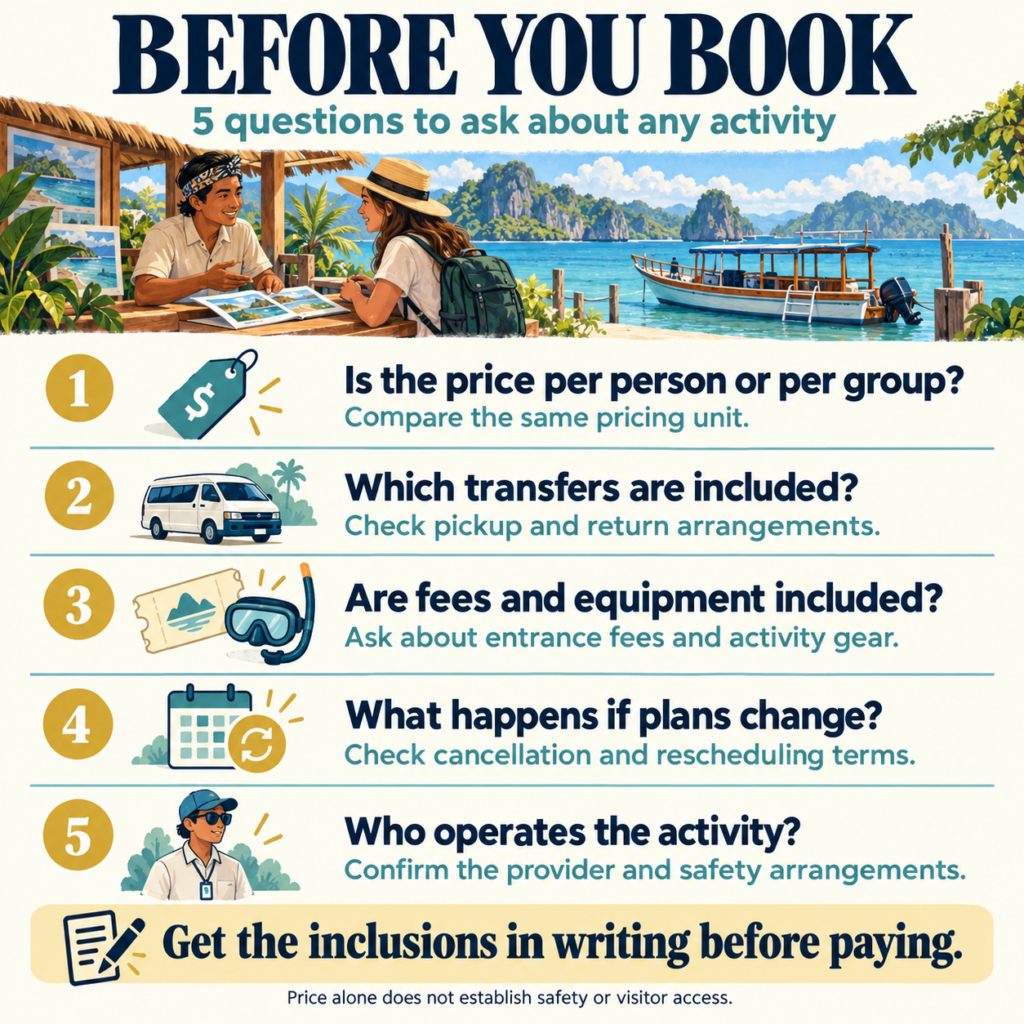
5. Ask for Written Inclusions Before Booking an Activity
Two excursion prices may describe different products. One might include accommodation pickup and equipment; the other might cover only the boat or guide. Send the same questions to each provider before deciding.
| Question | Why it helps |
| Is the quote per person or for the group? | Prevents comparing incompatible units |
| Which transfers are included? | Identifies costs before and after the activity |
| Are entrance fees and equipment included? | Reveals costs hidden by a short listing |
| What happens if conditions change? | Clarifies refunds, replacements, or rescheduling |
| Who operates the activity? | Identifies who is responsible for delivering it |
Ask safety and access questions as well as price questions. For a boat outing, confirm suitable life jackets and passenger arrangements. For a village visit, ask how host permission is obtained. A low quote does not answer either question.
Booking directly may be useful, but compare its payment and cancellation terms with other channels. There is no reason to assume direct booking is always cheaper or that a guided tour always represents poor value.
6. Set a Meal Budget That Matches Your Actual Days
Investigate what meals are available near your chosen base and whether the excursion includes lunch. Ask for current menus or meal arrangements where those details are important to your budget or dietary needs.
Local eateries, including warung, can be part of the trip you want, but their prices and facilities vary. Ask the price before ordering when no menu is available. Choose meals that suit your needs rather than assuming the smallest or most remote establishment is automatically the best choice.
Calculate food spending by day type. Arrival day may include an airport meal. A boat day may include lunch but require an earlier breakfast. A quiet day near your stay may involve no transport to eat. This produces a more realistic estimate than assigning the same amount to every day without looking at the plan.
If you want one special meal, budget for it deliberately. You can adjust a discretionary activity elsewhere instead of treating that meal as a failure to travel cheaply.
7. Spend on Interpretation Where It Improves the Visit
Decide which activities need a guide, which are appropriate to explore independently, and which require host permission. Ask accommodation staff and the relevant site or operator about those arrangements; recommendations from residents do not by themselves establish legal access or safety.
A paid local guide may add introductions, translation, cultural context, and help with an unfamiliar route. Compare the service being offered, including its duration, transport, and group size. Avoid assuming that all of those elements are covered by one fee.
Keep independent plans within your experience and present conditions. This essay does not suggest that you should utilize a scooter as a general way to save money or an unregulated boat just because it is cheaper. Check the required regulations and select transport that you can utilize effectively.
Decision to make: protect the spending that makes an activity manageable and meaningful. If the budget is too tight, reducing the number of activities may be a better choice than stripping essential support from each one.
8. Get Offline Information Ready and Compare Connectivity Options
Keep your booking confirmation, addresses of accommodations, pickup details and operator contact details before you travel. Post the original instructions as well . A screenshot of the fare alone can leave out a key condition.
Google Maps’ official offline guidance explains both downloads and limitations. Offline maps do not provide every feature available online; walking, cycling, and public-transport directions are unavailable offline. A downloaded map also cannot confirm that a path is open, public, or appropriate for your group.
Compare the possibilities of connectivity by total price, amount of data, validity, compatibility, registration requirements & coverage for the places you will be. Find out what current providers are working there, don’t make a broad statement that one service operates everyplace in distant Indonesia.
Choose what your route requires. If your accommodation and drivers need contact by phone, make arrangements for that communication. Downloading information is useful preparation, but it should not be mistaken for guaranteed connectivity or navigation in every situation.
9. State prices clearly and stick to fixed rates
Clarify the total price and payment unit before accepting a service. Ask the driver if it includes waiting time, parking, petrol and a return trip. As a guide, check to see if the price is inclusive of the complete group.
If the seller is willing to negotiate, gently discuss it before you agree. Fixed entry costs and posted prices are not automatically open to bargaining. varying visitor categories can legitimately have varying rates. Don’t assume every variance is a rip-off: check your category.
Useful questions include “Berapa totalnya?” for the total price and “Sudah termasuk apa saja?” for what is included. Language helps you communicate; it does not entitle you to a discount.
Keep a written confirmation of consequential arrangements. If a quote exceeds your budget, ask whether there is a shorter route or simpler service that meets your needs. Adjusting the scope can be more constructive than demanding the same work at an unsustainable price.
10. Save Money for a Plan B
Work out which inconvenience will cost you most – be it a changed border, an extra night’s lodging or a replacement road transfer. Estimate such scenario based on current quotes and booking conditions.
For example, let’s say your confirmed destination bookings are IDR 4,000,000. It would cost an additional IDR 800,000 for an extra nite (IDR 350,000), meals (IDR 150,000) and a replacement transfer (IDR 300,000). That’s 20 percent of the confirmed amount. All values are hypothetical and are for illustration of the computation and not a recommendation of a universal reserve.
Check the conditions for bookings that are difficult to modify. If the link is unknown, a refundable option might be worth looking at, but balance the extra price against your actual exposure. Separate the reserve from your discretionary activity allowance.
For a broader list of expenses to investigate, read our remote-trip budget guide. This article focuses on controlling spending; that guide expands the checklist of costs a remote journey can introduce.
Build a Five Night Budget With Your Own Quotes
Use this worksheet to turn the ten decisions into one total. The example is for one traveller and is entirely hypothetical. It excludes transport to and from the destination, international travel, entry documents, and insurance; add those before calling it your full holiday budget.
| Destination expense | Example calculation | Example amount |
| Accommodation | 5 nights at IDR 300,000 | IDR 1,500,000 |
| Food | 6 days at IDR 150,000 | IDR 900,000 |
| Arrival and departure transfers | Two quoted transfers combined | IDR 400,000 |
| Local transport | Allowance for planned outings | IDR 500,000 |
| Activities and guiding | Selected activities combined | IDR 700,000 |
| Connectivity and incidental costs | Separate allowance | IDR 200,000 |
| Planned destination spending | Sum of the six categories above | IDR 4,200,000 |
| Reserve for a defined disruption | Your additional scenario | IDR 800,000 |
| Destination allocation | Spending plus reserve | IDR 5,000,000 |
The five nites and six days format eliminates a common counting mistake: the days of arrival and departure still need meals and transport. Enter your dates, party size, quotes and inclusions for every line. Split a shared room or vehicle only when your traveling mates have agreed to it.
Shorten
If your timetable hinges on perfect connections or the lodging has not been confirmed or there is no money left for an additional nite, think again. You can remove a destination to save the experiences you love the most and not have to repeat transfers.
For a boat-dependent stay, build the return plan around your next fixed commitment. For a highland journey, allow enough time to make the transfer worthwhile. If you have only a few days, a closer base may give you more usable holiday time than a remote destination with an attractive room rate.
Budget planning is a sequence of choices. Once the essential route and accommodation work, decide which optional activities are worth adding. A longer list does not necessarily make the trip better.
Frequently Asked Questions
1. Can I use one daily budget for all of Indonesia
Use a daily allowance only as part of a route-specific calculation. Include transfers, activities, and change costs separately. A figure from a city stay should not be applied unchanged to a small-island holiday that needs boat transport.
2. Is a homestay always the cheapest choice
Compare the full stay, including location, meals, transfers, and facilities. A lower room rate can be outweighed by the spending required to use that location. Accommodation labels are a starting point for research rather than a price guarantee.
3. Should I book everything independently
Compare independent and arranged options for the activities you want. A guide or package can be worthwhile when it includes useful support and clear conditions. Ask for an itemised comparison rather than assuming either approach always wins.
4. How much can I save by changing my dates
Calculate the difference between live quotes for equivalent bookings. No saving percentage is promised here. Include any extra night, transfer, or altered inclusion that comes with the cheaper date.
5. Should volunteering be part of my accommodation budget
This guide does not treat work exchanges as ordinary holiday accommodation. If you are considering one, separately investigate applicable immigration requirements, duties, fees, safeguarding, and host arrangements before committing. Do not rely on an unconfirmed exchange to make an otherwise unaffordable trip work.
Plan your trip with the budget
Pick a sensible strategy, get full quotations, and set some money aside for a potential change. Then spend thoughtfully on the lodging, activities and local support that is important to you.
You may find that a simpler itinerary gives you both a clearer budget and more time in the places you came to see. Browse our article directory when you are ready to match that budget to a destination.
Notes on Sources and Planning
Sources 12 October 2026 – Access by KAI KAI Ferizy Ferizy Terms and Conditions BMKG Maritime Information and High Wave Warning Google Maps Offline Help Google Maps Offline Help Relevant info is above, and direct links are beside. They provide booking-channel context, forecast availability and offline functionality. They do not support the hypothetical prices in the workbooks.
Editorial proposals include route choices, comparison questions and budget structures We do not pretend to do a statewide price study, live accommodation quote exercise, first-hand operator test or guarantyd savings computation. Use the illustrated figures and substitute with current quotes for your own dates and requirements.
Travel Disclaimer
This page gives travel planning information based on research and does not represent that it has visited or verified on-site. The numerical examples are fictitious and do not represent advertized rates or guaranties of affordability. Fares, availability, access, weather and booking conditions are subject to change. Verify important information with the applicable provider, operator, site authority or official service before you pay or travel. Choose activities and transport to suit your experience and situation. This guidance is not a substitute for legal, immigration, medical or insurance advice when applicable.