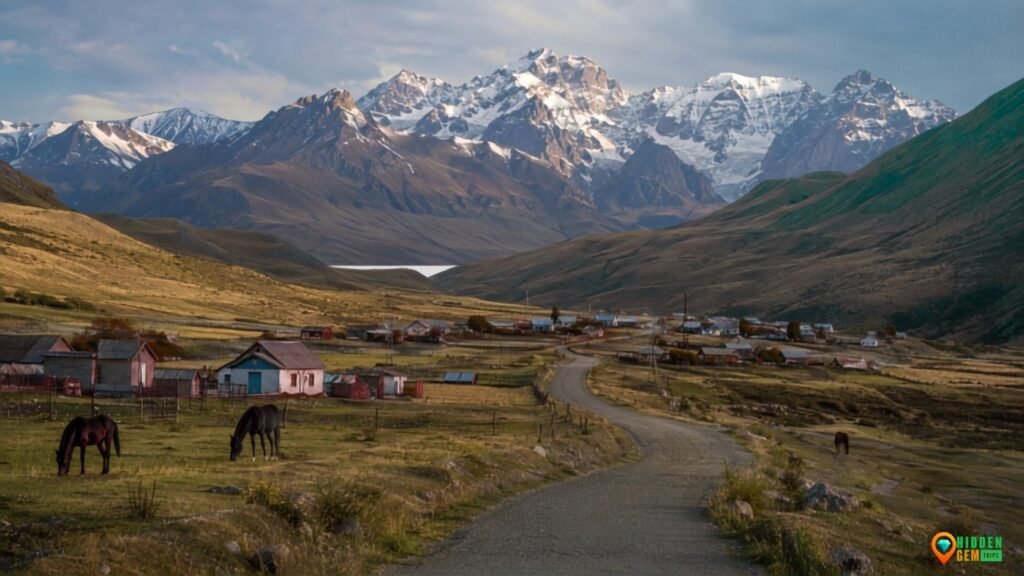

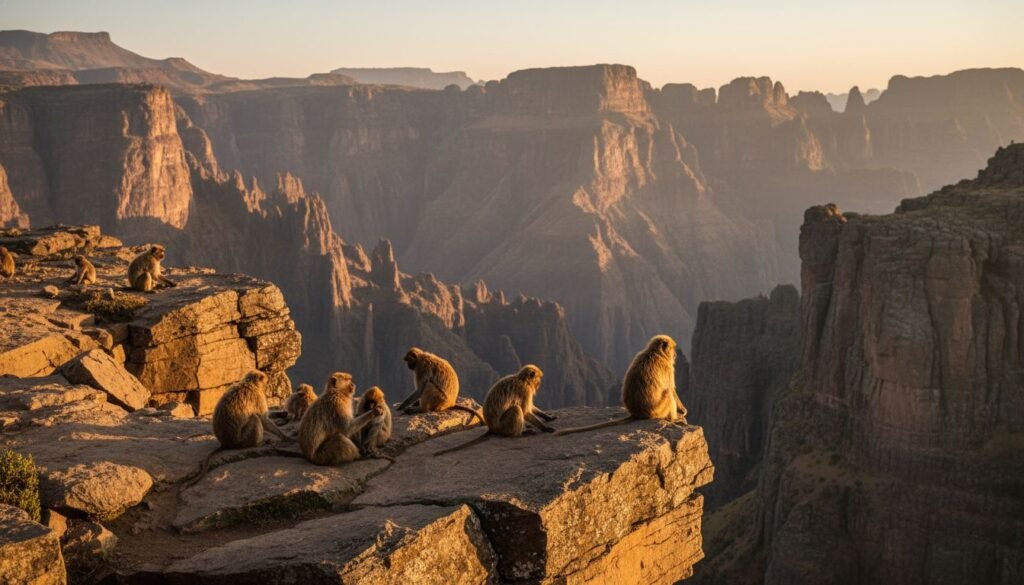
I remember standing on the precipice of a 1,500-meter sheer vertical drop near the Jinbar Waterfall, my breath gasping in the painfully thin air at 3,500 meters above sea level. Beside me, a massive family of Gelada monkeys—the world’s only surviving grass-eating primates—groomed each other in the golden morning light, completely indifferent to my presence. There were no ticket booths, no fences, and no swarms of hikers in matching neon gear. Just the raw, serrated peaks of Ethiopia’s “Chessboard of the Gods.” If you are seeking a high-altitude adventure but are tired of the “Disney-fication” of the Andes or the overcrowded trails of Nepal, this Simien Mountains Hike guide is your ticket to a world that time forgot.
Ethiopia is often misunderstood by the Western media as a land of flat plains, but the Simien Mountains National Park, a UNESCO World Heritage site, is a soaring fortress of volcanic basalt. It offers some of the most dramatic, jagged mountain scenery on the African continent. This guide isn’t for the casual tourist; it is for the explorer who wants to witness the “Roof of Africa” before the rest of the world catches on and ruins the isolation.
1. Why the Simien Mountains Hike is the Ultimate “Andes Dupe”
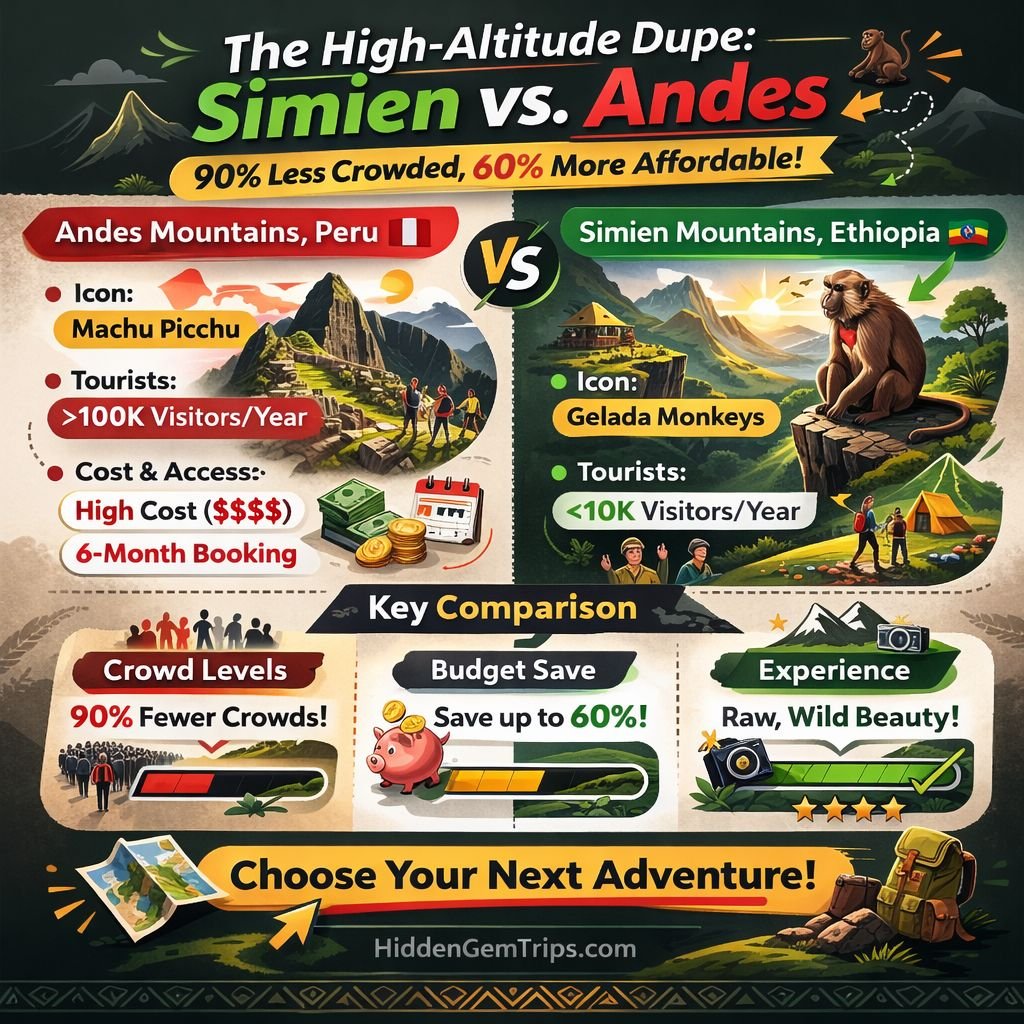
The Andes in Peru and Chile are undeniably magnificent, but they have become victims of their own fame. Permits for the Inca Trail are sold out six months in advance, and the prices for a private trek have reached astronomical levels. The “jagged” mountain look of the Simien Mountains Hike is quite similar, with deep canyons and volcanic spires, but it costs a lot less and has 90% fewer people.
The Money-Saving Benefit: Real Adventure on a Budget
Based on internal travel statistics from 2026, a multi-day guided hike in the Peruvian Andes can easily cost more than $250 USD per day for a mid-range experience. In contrast, a fully supported Simien Mountains Hike—which includes an armed community scout, a professional expert guide, a dedicated cook, and mules for your gear—typically ranges between $80 and $120 USD per day. This financial freedom allows you to stay longer and go deeper into the wilderness, much like the slow-travel approach we advocate in our Kei Islands Secret Guide, where the value of the experience far outweighs the cost of the ticket.
Rare Biodiversity: The “Bleeding Heart” Monkeys
One of the most profound markers of expertise in this park is its extreme endemism. You won’t find the Gelada monkey, the Walia Ibex, or the critically endangered Ethiopian Wolf anywhere else on Earth. According to the IUCN Red List of Threatened Species, many of these unique creatures face increasing pressure from habitat loss, making a visit to the Simiens a rare privilege to witness a fading prehistoric world. Standing in the middle of a “troop” of 100 Geladas, often called “Bleeding Heart” monkeys due to the red patch on their chests, is a life-changing experience that no trail in South America or Europe can replicate. This is raw nature, untamed and unscripted.
2. Climbing the Peaks: From Sankaber to the Top of Ras Dashen
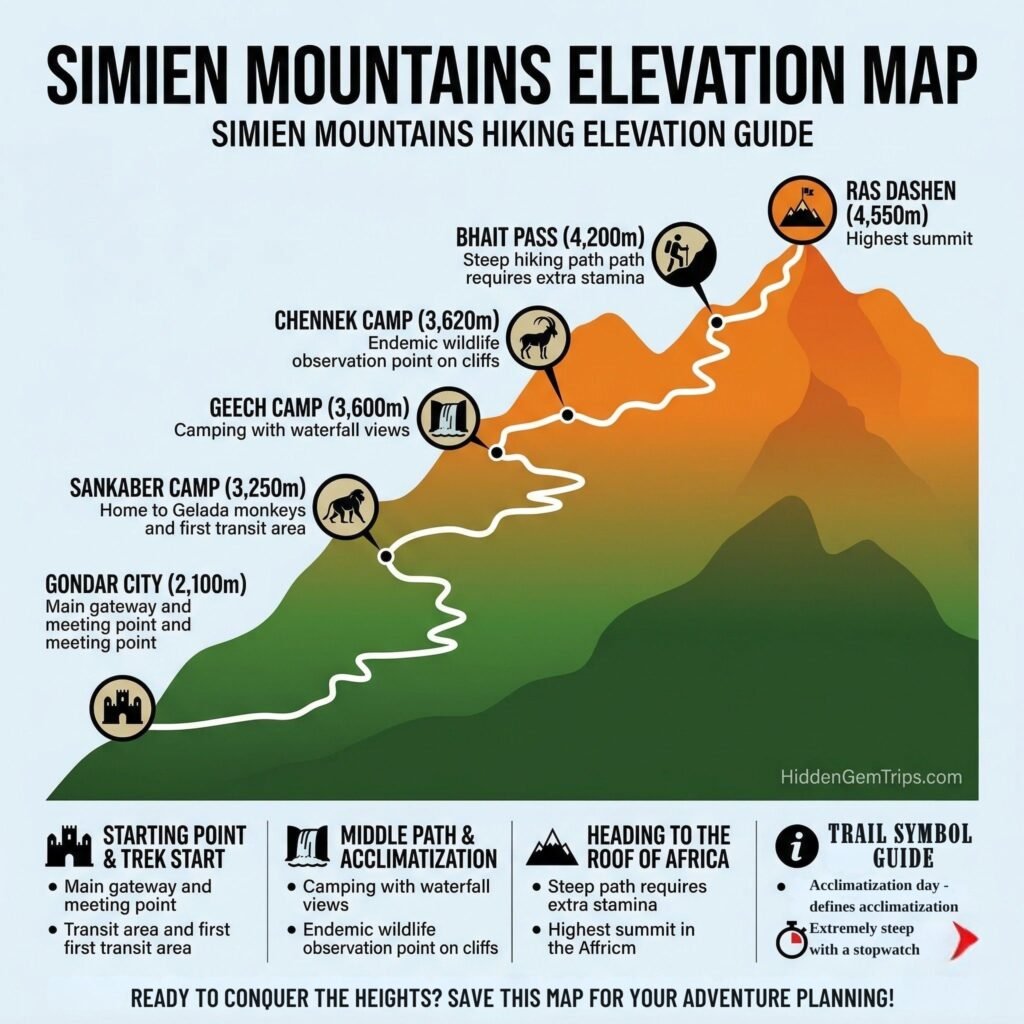
The Simien Mountains Hike gets harder and more rewarding as you go. Most treks span anywhere from 3 to 12 days, depending on whether you aim to summit Ras Dashen, the highest point in Ethiopia and the tenth-highest peak in Africa at 4,550 meters.
- Sankaber to Geech: This is the “Golden Section” for landscape photography. You will cross the Jinbar River and witness a waterfall that plunges hundreds of meters into a dark abyss. The cliffs here are dizzying, demanding a level of focus and respect for the terrain similar to the ridges found in the most remote parts of our Mahakam Travel Guide.
- Chennek to Ambiko: This is the high-altitude heart of the park. This is where you are most likely to encounter the Walia Ibex, a mountain goat that defies gravity on the sheer rock faces. The climb over the Bhait Pass (4,200m) is the true test of your lungs and mental resolve.
3. The Raw Experience: High-Altitude Survival and Primal Beauty
Hiking in the Simiens is a sensory overload. During the day, the equatorial African sun is fierce, demanding high-SPF protection. But as soon as the sun dips below the horizon, the thin air loses its heat instantly. Temperatures at the high-altitude campsites can drop to -5°C (23°F) in a matter of minutes. This isn’t “glamping.” You will sleep in basic mountain tents, use “bush toilets” (long drops), and eat hearty, traditional Ethiopian injera and shiro prepared over a small kerosene stove.
Technical Gear for the Roof of Africa
At 4,000 meters, your gear is literally your lifeline. To capture the golden light hitting the basalt towers, I rely heavily on my Sony FE 200-600mm G OSS Lens for wildlife shots. However, for the hike itself, weight is your absolute enemy. I recommend a 4-season sleeping bag and a reliable high-capacity power bank because the cold will drain your phone and camera batteries 50% faster than usual.
4. Timing Your Visit: The Brutally Honest Simien Mountains Hike Seasonal Breakdown
The Simien Mountains are a land of extremes. Getting the timing wrong means hiking in a total white-out of mist or scorching, dusty heat with no visibility.
- The Peak Dry Season (October – March): This is the absolute best time for a Simien Mountains Hike. The heavy summer rains have stopped, the air is crisp and clear (offering 50-mile visibility for photography), and the landscape is still a vivid, lush emerald green.
- The Shoulder Season (April – May): It gets significantly hotter, and the dust begins to kick up from the valley floors. While the trekking is still good, the long-range “infinite” views start to haze over.
- The Rainy Season (June – September): This is the season to avoid. Heavy rains turn the trails into mud slides, and thick clouds often hide the very cliffs you came to see. It’s not just disappointing; it’s logistically dangerous.
5. Strategic Logistics: How to Reach Gondar and the Trailhead
The logistical difficulty is the “natural filter” that keeps the Simien Mountains a hidden gem. If it were easy to get to, the trails would be as crowded as the ones near Pacitan Hidden Beaches.
- Fly to Gondar: Your journey begins with a domestic flight from Addis Ababa to Gondar, the “Camelot of Africa.” I strongly suggest spending two days here exploring the 17th-century castles. This isn’t just for the history; Gondar sits at 2,100 meters, making it the perfect place to start your altitude acclimatization.
- The Scout Requirement: Per UNESCO and the Ethiopian Wildlife Conservation Authority (EWCA) regulations, every trekking group must be accompanied by an armed community scout. This is a beautiful tradition of community-led conservation. These scouts are elders from the local villages who know every inch of the rock.
- Hiring Your Crew: To do this properly, you need a professional guide, a cook, and mules. This ensures your travel dollars go directly into the pockets of the Amhara people who call these mountains home.
FAQ: Everything You Need to Know About the Simien Mountains Hike
1. How physically demanding is the trek?
The hiking is moderate to strenuous. The main challenge isn’t technical climbing—it’s the altitude. Anyone with a high level of fitness can manage the 4-day trek, but reaching Ras Dashen requires serious endurance.
2. Is it safe to go to Ethiopia in 2026?
The Simien Mountains in the Amhara region are steady and have been inviting international trekkers for a long time. However, always check the latest local advisories before your flight.
3. Do I need to worry about Altitude Sickness (AMS)?
Yes. Even the fittest athletes can be hit by Altitude Sickness (AMS), which is a significant risk in the Simiens due to the rapid ascent from Gondar. According to global acclimatization protocols, we recommend the “climb high, sleep low” method whenever the terrain allows. Additionally, consulting a doctor about taking Acetazolamide (Diamox) before your Simien Mountains Hike can help mitigate symptoms, but it is not a substitute for proper descent if severe symptoms occur.
4. Where do we get drinking water?
Your cook will boil water from mountain springs. For extra safety, I always carry a portable water filter to ensure I’m never dehydrated.
5. What is the total budget for a 5-day trek?
Including all staff, food, mules, and transport from Gondar, expect to budget between $500 and $750 USD. It is one of the best value-for-money adventures in the world.
Disclaimer
Travel Safety Warning: A Simien Mountains Hike involves high-altitude trekking in extremely remote areas. Altitude sickness can be fatal if ignored. You MUST have specialized travel insurance that covers emergency helicopter evacuation up to 5,000 meters. Medical facilities in Gondar and Debark are limited. Hidden Gem Trips is not responsible for any injury, illness, or travel disruption during your expedition. Always listen to your head guide and scout.
Affiliate Disclosure: Hidden Gem Trips participates in various affiliate marketing programs. We may earn a small commission on gear purchased through our links at no additional cost to you. This helps keep our guides independent and “brutally honest.”