

This Socotra 2.0 ethical travel guide is not written to sell you a dream. It is written to ask whether one of the strangest, rarest, and most fragile islands on Earth can survive the new wave of travelers who want to see it before it changes forever. Socotra is still breathtaking, still strange, and still capable of making experienced travelers feel as if they have stepped onto another planet. But in 2026, visiting it responsibly means understanding the island’s biodiversity, its limited infrastructure, its conservative culture, its complex political context, and the real cost of turning remote places into social media trophies.
Socotra has always attracted big language. People call it alien, prehistoric, untouched, mythical, lost, and sometimes the Galapagos of the Indian Ocean. Some of those labels are useful; most are lazy. The archipelago is not a fantasy stage built for our bucket lists. It is a living home for Socotri communities and one of the planet’s most unusual evolutionary laboratories. UNESCO’s World Heritage description of Socotra’s biodiversity notes that the archipelago is globally important for conservation, especially because of its remarkable plant diversity and endemism. That alone should change the way we speak about it. A rare place is not automatically a place we are entitled to consume.
The uncomfortable truth is simple: hidden gems become less hidden the moment we publish them, film them, tag them, geolocate them, and package them as the next big thing. HiddenGemTrips exists because overlooked places deserve better storytelling, but better storytelling has to come with better restraint. A reader who wants a broader way to find hidden places without turning them into trophies must also accept that some destinations demand more than curiosity. Socotra is one of them.
This guide keeps the existing article direction, but expands it into a full ethical travel analysis. It covers why Socotra matters, how access changed, what tourism can help, what tourism can harm, how to prepare, when not to go, and how to think before making the island your next reel backdrop. Because yes, the view is surreal. But if the only thing we bring back from Socotra is proof that we went there, we have missed the entire point.
Why This Socotra 2.0 Ethical Travel Guide Matters in 2026
The phrase Socotra 2.0 is not just a catchy label. It describes a turning point. For years, Socotra was logistically difficult, politically complicated, and largely outside the normal tourism machine. That difficulty acted like accidental protection. It limited visitor numbers, slowed infrastructure demand, and kept the island from becoming a standard beach-and-adventure product. In the last few years, however, charter flights, operator packages, increased online visibility, and the global appetite for extreme-looking destinations have changed the island’s exposure. The gate has not fully opened, but it is no longer locked the way it once was.
This matters because Socotra is not built like a mature tourism destination. It does not have the waste systems of Singapore, the medical infrastructure of Dubai, the tourism regulations of New Zealand, or the easy supply chains of Bali. Even those places struggle with overtourism. Socotra faces similar pressures with far fewer buffers. When a traveler lands with plastic bottles, drone batteries, wet wipes, imported snacks, and expectations shaped by luxury travel videos, the island absorbs more than a visitor. It absorbs the visitor’s logistics.
A normal travel guide asks how to get there, what to see, where to sleep, and what to pack. An ethical guide asks another layer of questions: who benefits, who carries the cost, what happens after the traveler leaves, and whether the destination is being made better or simply made marketable. That question is especially urgent for anyone drawn to slower, less performative travel rhythm, because slow travel without responsibility can still become extraction in softer clothing.
The goal is not to shame every person who wants to visit Socotra. Curiosity is not a crime. Travel can create jobs, reward local knowledge, and build international attention around conservation. But curiosity without humility becomes appetite. Appetite without limits becomes pressure. And pressure on a fragile island can move faster than the island’s ability to heal.
The Alien Biodiversity That Makes Socotra Irreplaceable
To understand why Socotra cannot be treated like just another remote island trip, you have to understand the biological stakes. Socotra’s landscapes look strange because they are the result of long isolation, harsh climate, and evolutionary specialization. The archipelago separated from ancient landmasses over geological time, and many of its plants and animals evolved in ways that make them feel visually impossible to outsiders. The famous Dragon’s Blood Tree, with its umbrella canopy and red resin, is not a prop. It is a survival design shaped by mist, drought, wind, and time.
UNESCO records Socotra as having 825 plant species, with 307 of them, or 37 percent, found nowhere else on Earth. UNESCO’s Man and the Biosphere profile for Socotra also highlights the island’s importance for birds and other species. That 37 percent figure is not just trivia for a caption. It means damage here cannot simply be repaired by replacing one tree with another from a nursery somewhere else. When endemic life disappears, the loss is not local decoration. It is global biological history deleted.
This is why the common comparison to the Galapagos is both helpful and misleading. It helps because it signals global rarity. It misleads because Socotra has its own ecological personality, cultural reality, and political vulnerability. It should not have to borrow another island’s brand to be taken seriously. Socotra’s value is not that it looks like somewhere else. Its value is that it looks like nowhere else.
Dragon’s Blood Trees and the Problem of Slow Regeneration
The Dragon’s Blood Tree, Dracaena cinnabari, is the visual icon of Socotra. It is also a warning sign. The trees can live for a very long time, but the presence of old trees does not automatically mean the forest is healthy. In several areas, conservation discussions have focused on weak regeneration, grazing pressure, soil stress, and climate-related changes. A landscape can look majestic in photos while quietly failing to renew itself. That is the brutal part: a dying forest can still be photogenic.
The tree’s umbrella shape is adapted to collect moisture and reduce evaporation. Its red resin has been valued historically, and its silhouette has become a global symbol of the island. But symbolism can be dangerous. Once a tree becomes a backdrop, travelers start chasing the angle instead of respecting the organism. They step closer, move off informal paths, and encourage guides or drivers to reach viewpoints that were not meant for repeated foot traffic. One person may do little harm. A thousand people repeating the same “just one photo” behavior can become an ecological habit.
The lesson is bigger than Socotra. Many remote places become famous through one iconic feature: a beach, a mountain, a village, a rock arch, a reef, a tree. Then tourism pressure concentrates around the exact feature that made the destination special. The result is a contradiction: the thing people most want to see becomes the thing most likely to be damaged by being seen. Travelers heading to other island chains such as island chains facing the same hidden-gem dilemma should recognize the pattern before it becomes a crisis.
Why Socotra’s Isolation Made It Both Unique and Vulnerable
Isolation built Socotra’s wonder, but isolation also makes it fragile. Species that evolve in unusual conditions often become highly specialized. They may not respond well to sudden changes in grazing intensity, invasive species, construction, vehicle routes, visitor behavior, or climate stress. The same isolation that protected Socotra from mass development also limited the systems that could manage mass tourism if it arrived.
This is why phrases like untouched paradise can be misleading. Untouched does not mean invincible. In fact, many lightly developed ecosystems are more vulnerable because they lack infrastructure, enforcement, and buffers. A destination can be remote and still overwhelmed. A beach can look empty and still be ecologically sensitive. A mountain plateau can feel endless and still have soil thin enough to be damaged by repeated off-road driving.
That should change the tone of trip planning. Socotra is not a place for “how much can I fit into seven days?” energy. It asks for a different question: how little impact can I create while still supporting local people? That mindset is closer to a last-wilderness mindset than to a standard vacation checklist.
How Socotra Became More Accessible to Travelers
For a long time, Socotra’s remoteness was not just geographic. It was logistical and political. Getting there could involve complicated routes, limited flights, shifting permissions, and a security context tied to Yemen’s wider instability. That difficulty discouraged casual tourism. The traveler who reached Socotra was usually highly motivated, prepared for discomfort, and often connected to specialist operators.
The more recent version of Socotra tourism looks different. Social media visibility has increased demand. Specialist operators promote packages. Charter-style access has made the island feel more reachable than it used to be. Regional influence and infrastructure changes have also shaped how travelers enter and move around the island. Yet easier access should not be confused with ordinary access. Socotra remains part of Yemen, and many governments continue to advise against travel to Yemen, including Socotra.
Flights, Visas, and the New Tourism Pipeline
The most important practical point is that Socotra is not a destination where travelers should expect normal commercial flexibility. Flights can be limited, seasonal, chartered, delayed, changed, or disrupted by political and logistical conditions. Visas usually require operator support. Independent travel is difficult in practice because public transportation, signage, accommodation, emergency support, and route information are limited. A local guide is not just a convenience; in many cases, it is the difference between a trip that functions and a trip that becomes someone else’s burden.
This is where the new tourism pipeline becomes ethically complicated. When foreign demand rises faster than local governance and infrastructure, a destination can be pulled into a market before it has the ability to shape that market. Camps appear. Drivers are hired. Supplies are imported. Prices shift. Waste increases. Some locals gain income, others face higher costs or cultural disruption, and the ecosystem absorbs the physical footprint. That is not unique to Socotra, but Socotra’s fragility makes the stakes sharper.
Travelers who are tempted by the remote work fantasy around untouched islands need to be especially careful. Socotra is not a plug-and-play digital nomad base. It is not designed for laptop lifestyle content, daily cafe work, reliable calls, or high-bandwidth convenience. Treating it as a productivity backdrop misunderstands both the island and the privilege required to reach it.
Why Access Does Not Mean Socotra Is an Easy Destination
Access is a door, not a guarantee. A destination can be reachable and still be demanding. Socotra has limited medical facilities, limited supplies, rough roads, conservative social norms, changing security considerations, and a climate that can be harsh. Visitors should be honest about their fitness, risk tolerance, insurance, medication needs, and ability to handle discomfort without outsourcing every inconvenience to local staff.
That last point matters. Ethical travel is not only about big conservation ideas. It is also about emotional behavior. Do you become impatient when the road is rough? Do you complain when the Wi-Fi fails? Do you expect imported comfort in a place where every imported item has a cost? Do you treat a guide as a fixer for your content schedule or as a professional whose local knowledge deserves respect? Socotra will reveal what kind of traveler you are. Cute caption, harsh mirror.
Preparing for the journey begins before the airport. Travelers should study flight realities, weather windows, high-risk insurance, cultural expectations, medical evacuation limitations, and government advisories. The same preparation mindset used for brutally honest long-haul flight preparation should be applied more seriously here, because the consequences of being unprepared are higher on a remote Yemeni island than they are during a normal transit day.
The Ethical Dilemma of Visiting Socotra
The lazy answer is to say “tourism is bad” or “tourism saves communities.” Socotra requires a better answer than either slogan. Tourism can bring income to local families, support guides, create alternatives to more damaging livelihoods, and give global visibility to conservation needs. Tourism can also create waste, inflate prices, concentrate power in outside operators, disturb wildlife, damage fragile terrain, and turn local culture into content. Both truths can exist at once. Pretending otherwise is how travelers avoid responsibility.
The ethical dilemma is not whether travel has impact. It always does. The real question is whether the impact is proportionate, transparent, locally beneficial, and managed with humility. A traveler cannot control everything about geopolitics, governance, or infrastructure. But a traveler can control choices: operator, group size, packing, water, waste, clothing, photography, drone use, route behavior, tipping, and whether to post geotags that send more people to fragile spots.
Tourism as an Economic Lifeline
Socotra is part of Yemen, a country deeply affected by conflict and economic hardship. For many households, tourism income can matter. Tourism can also benefit drivers, guides, cooks, boat operators, campsite workers, translators, shop owners and the families who provide food or services. If money from tourism is fairly distributed to local people, it can reward conservation knowledge and reduce pressure on other livelihoods that may harm the environment.
This is the strongest argument for responsible tourism. If local communities see that protected landscapes create stable income, they may have more incentive and capacity to protect those landscapes. A skilled guide who knows where visitors should and should not walk is not just delivering an experience. They are part of the island’s conservation interface. Paying that person fairly is not generosity. It is the cost of entering a fragile place without behaving like a liability.
Travelers who care about value should not confuse cheapness with ethics. Budget options that keep access to hidden gems are helpful when they cut waste, avoid middlemen and benefit local providers. They become harmful when they pressure local workers to absorb costs, cut corners, or compete on unsustainable prices. A cheap trip can still be expensive for the destination.
Tourism as an Environmental Pressure
The environmental counterargument is equally real. Socotra’s systems are not ready for careless growth. Waste management is limited. Fresh water is precious. Roads are rough. Sensitive sites can be damaged by repeated vehicle access and foot traffic. Coastal areas can be damaged by poor sanitation and campsite pressure. Plastic, anchors, overfishing and careless behavior can affect marine environments. The island may look vast, but tourism pressure usually concentrates in the same famous places.
The IUCN technical evaluation warning about tourism and invasive species identified unsustainable tourism and invasive species as future threats requiring monitoring. That warning should not be treated as a footnote. Invasive species, unmanaged development, and visitor pressure can change island ecosystems quickly. Islands are especially vulnerable because their species often evolved without the same defensive capacity found in more connected environments.
The tragedy is that tourism pressure often arrives wrapped in admiration. People do not visit Socotra because they hate it. They visit because they are amazed by it. But admiration does not cancel impact. A traveler can love a place and still harm it through convenience, ignorance, or performance. That is the central paradox of Socotra 2.0: the island is being loved into danger by people who believe their love is harmless.
The Biggest Threats Facing Socotra Tourism
The threats facing Socotra are not abstract. They show up in bottles, tires, camps, photos, roads, imported goods, and repeated visitor behavior. The challenge is that each individual action can look small. One plastic bottle. One drone flight. One off-road detour. One photo too close to a tree. One campsite with weak sanitation. One group that leaves waste behind because “someone local will handle it.” The problem is repetition. A fragile destination is rarely damaged by one villain. It is damaged by ordinary habits scaled up.
| Threat | Why It Matters | Responsible Traveler Response |
| Plastic waste | Non-biodegradable waste can remain on the island, be burned, buried, or blown into marine areas. | Bring reusable systems, avoid single-use packaging, and pack out what you bring in. |
| Off-road driving | Thin soils and fragile roots can be damaged by repeated vehicle tracks. | Stay on established routes and refuse unnecessary viewpoint chasing. |
| Water pressure | In arid environments, tourism demand can compete with local needs. | Use water wisely and don’t have extravagant expectations that require too much supply. |
| Culture intrusion | Photography, clothing and behaviour can be disrespectful to conservative communities. | Ask permission, dress appropriately, don’t make people comfortable. |
| Drone disturbance | Drones can disturb wildlife, silence, privacy, and security-sensitive areas. | Leave drones at home unless clearly legal, safe, and appropriate. |
Plastic Waste and Limited Recycling
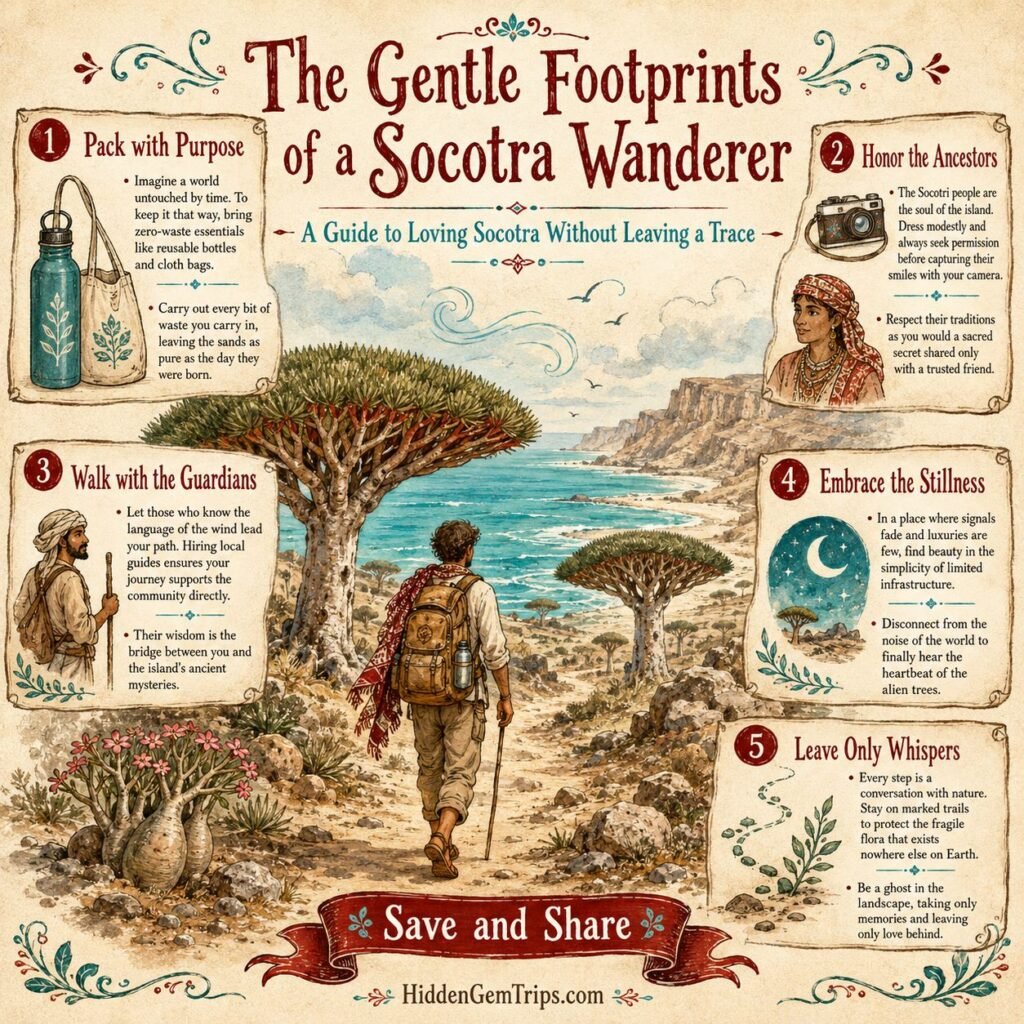
Plastic is the most visible sign that a destination is receiving more visitors than it can process. In a city with strong waste systems, a traveler may never see the consequences of a water bottle. On Socotra, the consequences are harder to hide. Imported drinks, snack packaging, wet wipes, broken gear, batteries, and camping waste do not disappear because a bin exists. In many remote places, bins are not solutions. They are waiting rooms for pollution.
This is why “leave no trace” is not enough. The better standard is pack-in, pack-out. If you bring non-biodegradable waste to Socotra, you should be prepared to carry it back out. That may sound extreme until you remember that the island did not ask for your convenience packaging. Ethical travel begins with the boring stuff nobody wants in the hero shot: bottles, wrappers, filters, soap, batteries, and toilet paper.
A practical island checklist helps, but only if used seriously. Start with a practical island packing strategy, then remove anything disposable that exists only for convenience. The most responsible item is often the thing you choose not to bring.
Off-Road Driving and Habitat Damage
Socotra’s roads and tracks are part of the travel experience, but they are also part of the environmental pressure. The temptation is obvious: the best viewpoint is slightly farther, the sunset angle is slightly better, the group wants a more dramatic shot, and the driver may feel pressure to deliver. Over time, those small detours create scars. Tire tracks compact soil, damage vegetation, and encourage future drivers to follow the same route.
This matters most in fragile highland and plateau environments where soils can be thin and plant regeneration slow. The Dragon’s Blood Tree groves are visually powerful, but the surrounding ground is not an infinite stage. A traveler who asks for a closer vehicle approach to save a ten-minute walk may be asking the landscape to pay for their laziness. Brutal? Yes. Accurate? Also yes.
The responsible response is simple: stay on established routes, accept walking, do not pressure drivers into risky or damaging shortcuts, and choose operators with clear rules around protected areas. If a guide says a place should not be entered, believe them. A local boundary is not an obstacle to your content plan.
Water Pressure, Campsites, and Fragile Coastal Areas
Water is another hidden cost of tourism. Visitors often notice beaches, cliffs, and trees before they notice the supply chain that supports their trip. But every camp meal, shower, laundry request, and bottle refill depends on systems that may already be limited. The more travelers expect comfort, the more pressure falls on local resources. This is where “eco-luxury” can become a contradiction if the comfort is imported, resource-heavy, and poorly regulated.
Coastal campsites require special care. Beaches and lagoons may look durable because sand seems endlessly renewable, but sanitation, greywater, food waste, vehicle access, and repeated camping can affect marine life and local cleanliness. Detwah Lagoon, for example, is more than just a pretty curve of water for the drone shots. It is a sensitive coastal environment where crowding, waste, and poor facilities can create real problems.
Travelers interested in mid-range luxury without extraction should ask harder questions before booking: Who owns the accommodation? Where does the water come from? How is waste handled? Are staff local and fairly paid? Is the camp placed in a sensitive area? What happens to trash after checkout? If the answer is vague, that vagueness is data.
Social Media, Drones, and the Performance of Remoteness
Social media has changed the life cycle of hidden destinations. A place no longer becomes popular slowly through guidebooks and word of mouth. It can become globally desirable through a handful of viral videos. Socotra is particularly vulnerable because it photographs like fantasy: umbrella trees, white dunes, turquoise lagoons, caves, cliffs, camels, and emptiness. It is algorithm candy. And algorithm candy attracts people who may care more about proof than place.
The performance of remoteness is one of modern travel’s weirdest habits. Travelers fly through complex routes, hire local support, rely on imported gear, and then caption the experience as “off the grid.” Socotra exposes the contradiction. You are not outside the system if an island’s limited resources and local labor are supporting your escape from the system. That does not mean you cannot enjoy the silence. It means you should stop pretending the silence exists for your brand.
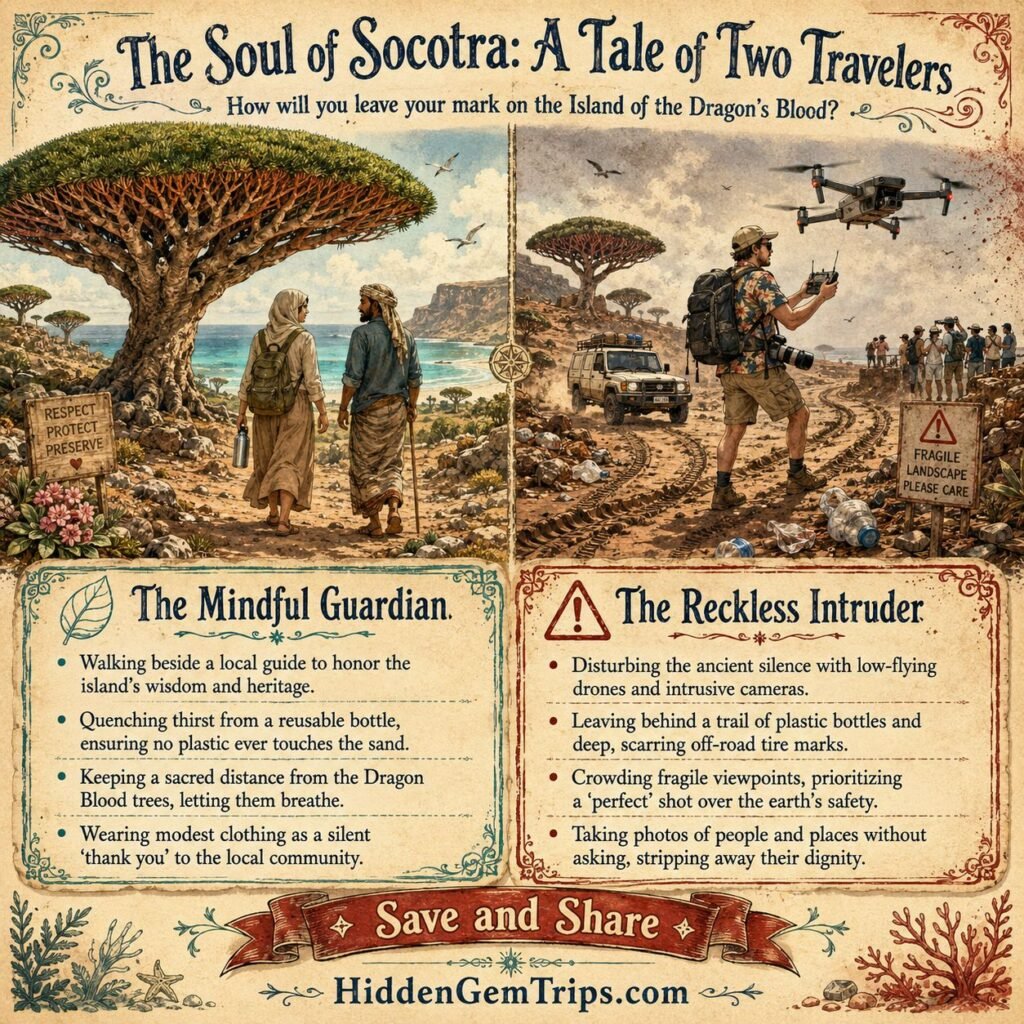
Drones deserve special caution. Even when rules are unclear, responsible use is not only a legal question. Drones can disturb wildlife, invade privacy, irritate other travelers, and create security risks in politically sensitive places. In Socotra, the safest ethical default is simple: do not bring one unless your operator confirms it is legal, appropriate, and necessary. Even then, ask whether the shot is worth the disturbance. Most of the time, it is not.
How to Visit Socotra Responsibly
Responsible travel to Socotra is not about perfection. It is about reducing avoidable harm and refusing the entitlement that often comes with expensive, difficult trips. The harder a place is to reach, the more some travelers feel they have earned the right to consume it fully. That mindset is backwards. Difficulty does not grant ownership. It increases responsibility.
A responsible Socotra trip begins with three decisions: whether to go, whom to pay, and what to bring. Everything else grows from those. If you cannot accept limited comfort, shifting logistics, modest clothing expectations, pack-out waste habits, and the need to listen to local guidance, you should choose another destination. There is no shame in that. In fact, staying away can be the most ethical choice when your travel style does not match the place.
Choose Local Guides and Local Operators
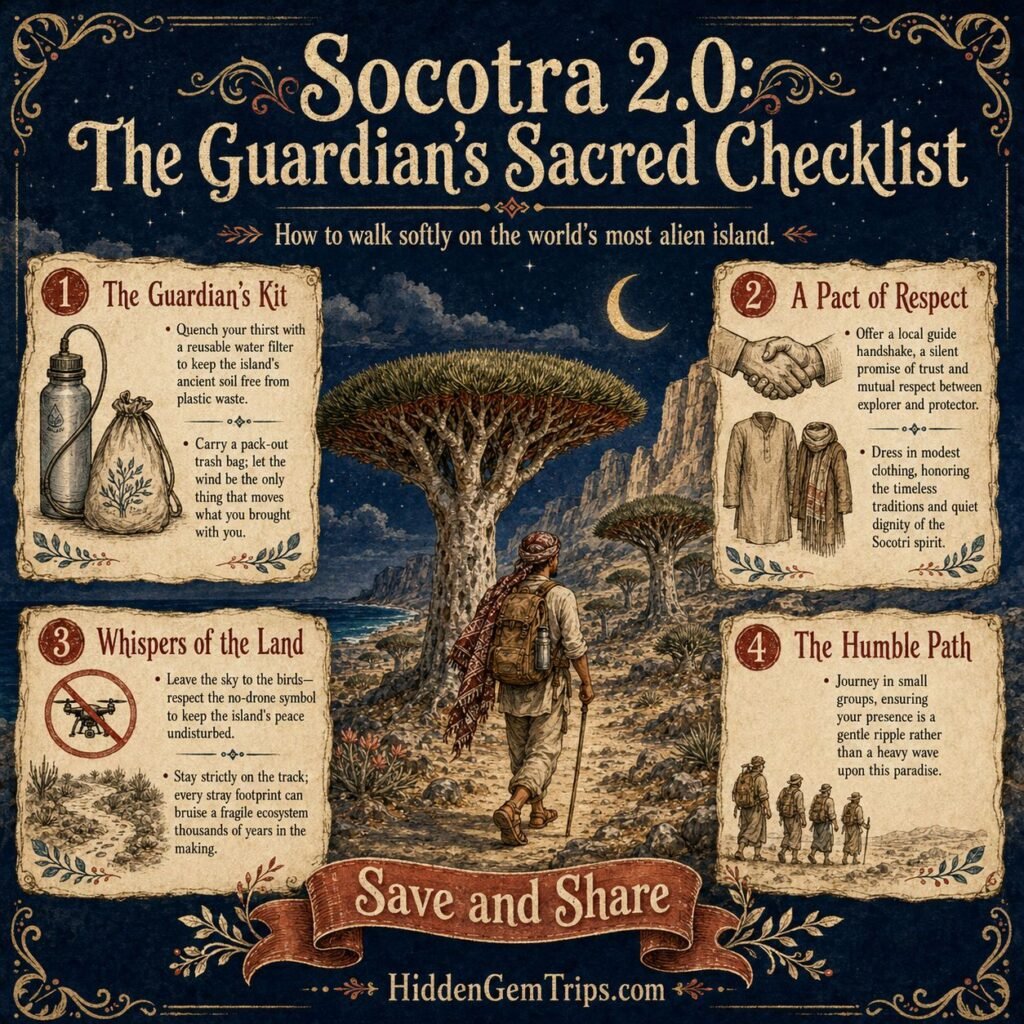
The first practical rule is to keep money as local as possible. That does not always mean every booking step can be fully local, because visa and flight logistics may involve outside coordination. But travelers should still ask who owns the company, who guides the trip, who drives, who cooks, where supplies are sourced, and how local staff are paid. The more money stays with Socotri people, the stronger the argument that tourism can support the island rather than simply extract from it.
A good operator should also have standards, not just itineraries. They should explain waste practices, cultural rules, route limits, drone policies, group size, water use, and what happens if flights change. If the sales pitch is all beaches and zero responsibility, keep looking. A guide who says “no” to a damaging request is not being difficult. They are doing the job properly.
This is also where travelers should be careful with bargain hunting. In fragile destinations, very cheap packages may hide costs that someone else pays later: underpaid staff, poor waste handling, rushed itineraries, unsafe vehicles, or pressure to cut environmental corners. Ethical value is not the same as the lowest price.
Pack Out Your Waste
The pack-out rule is the simplest test of whether someone is serious. Bring reusable water capacity. Bring a proper filter or purification method. Minimize wrappers. Avoid wet wipes unless you can carry them out. Bring a small dry bag or sealable waste bag for personal trash. Do not leave batteries, broken gear, toiletries, or plastic behind. If that sounds inconvenient, good. Convenience is the exact thing remote places cannot always afford.
Travelers planning Socotra should study packing light for remote expeditions before finalizing gear. The goal is not to bring every possible survival object. The goal is to bring fewer, better, reusable items that reduce pressure on the island. A heavy bag full of disposable convenience is not preparation. It is future trash with zippers.
There is also a psychological benefit to packing lightly and responsibly. You stop expecting the destination to solve your comfort problem. You become more aware of what you use, what you waste, and what you actually need. That awareness is one of the quiet gifts of remote travel when done properly.
Respect Socotri Culture and Privacy
Socotra is not only an ecosystem. It is a homeland. Socotri people have their own language, traditions, religious values, and social norms. Visitors should wear conservative clothing in the villages and public places. Swimwear should be used with caution and context. Photography of people, particularly women, should require clear permission. A smile from a distance is not permission. A child laughing near your camera is not permission. A market scene is not automatically public content for your feed.
For solo women and anyone traveling in conservative settings, it helps to understand broader cultural safety patterns before arrival. The conservative destination safety context covered in HiddenGemTrips’ solo female travel resources can support better preparation, even though Socotra has its own unique reality. Modesty is not about becoming someone else. It is about entering someone else’s home without making your self-expression the center of the room.
Cultural humility also means resisting the urge to romanticize poverty, isolation, or simplicity. Socotra is not “pure” because it has fewer conveniences. Local people deserve infrastructure, healthcare, education, opportunity, and choice. Ethical travel should never require communities to remain frozen in an aesthetic past so visitors can feel transformed.
Avoid Drone-First Travel
A drone-first traveler sees the destination from above before understanding it from the ground. Socotra does not need more of that. The island’s silence, scale, and intimacy are part of its value. Drones can flatten those qualities into spectacle. They can also disturb birds, annoy residents, expose private spaces, and create legal or security problems. In a sensitive region, “I did not know” is not a strong defense.
If your main reason for visiting Socotra is aerial footage, pause. Ask what the footage is for, who benefits from it, and what behavior it encourages in the next traveler. Some places need fewer angles, not more. The most respectful image may be the one you choose not to take.
Travel Smaller, Slower, and Less Performatively
Small groups are not automatically ethical, but they are easier to manage responsibly. They create less waste, less noise, less pressure on guides, and less crowding at fragile sites. Slower itineraries also help. Rushed trips encourage aggressive driving, overloaded schedules, and a checklist mentality. When the goal is to see everything, the destination becomes an obstacle course. When the goal is to understand enough, restraint becomes part of the experience.
Less performative travel means reducing the pressure to prove every moment. Do not geotag fragile micro-sites. Do not frame local people as exotic accessories. Do not create “last paradise before it disappears” content that accelerates the disappearance. If you publish about Socotra, publish the responsibilities with the beauty. Make the boring ethics as visible as the cinematic view.
This same principle applies to why overlooked destinations need better traveler behavior. The future of hidden-gem travel will not be decided only by where people go. It will be decided by whether visitors can mature faster than the algorithm.
Practical Socotra Travel Tips for 2026
Practical planning for Socotra should begin with humility. Information changes. Flights change. Safety conditions change. The quality of the operators varies. The rules may be unclear or inconsistently enforced. The smartest traveler is not the one with the most dramatic itinerary. It is the one with the most realistic expectations and the fewest avoidable demands.
Best Time to Visit Socotra
The usual tourism window is roughly October to April, when weather conditions are more manageable. The monsoon period, often from June to September, can bring strong winds and difficult sea conditions. This is not a small seasonal inconvenience. Weather can affect access, comfort, safety and the range of activities that are possible. Travelers should confirm timing with experienced operators rather than assuming a generic climate chart is enough.
Even within the better season, conditions can vary. Remote islands do not operate on the same predictability as city breaks. Build flexibility into your schedule before and after the trip. Do not plan an important meeting, wedding, or tight international connection immediately after returning from a place where flights may shift. That is not adventure. That is calendar gambling.
What to Pack for Socotra
Pack for self-sufficiency, modesty, and low waste. Essential items include a reusable water system, purification method, sun protection, modest lightweight clothing, sturdy footwear, personal medication, basic first-aid supplies, power bank, headlamp, dry bags, reef-safe toiletries where applicable, and sealable bags for waste. Avoid single-use plastics, over-packaging, unnecessary electronics and fragile gear you can’t repair or carry out if it breaks.
Think in systems instead of products. How will you drink water without creating plastic waste? How will you protect yourself from sun without leaving chemical or packaging mess behind? How will you manage personal hygiene without wet wipes becoming island trash? How will you charge devices without demanding constant generator use? This is the difference between packing for yourself and packing with the destination in mind.
Internet, Money, and Medical Reality
Connectivity may exist in some areas, especially around Hadibo or certain camps, but travelers should not rely on Socotra for stable remote work. Treat the trip as a digital detox rather than a mobile office. Carry enough cash as advised by your operator, because card access and ATM reliability can be limited. Bring needed medication and copies of prescriptions. Be aware that serious medical problems may require evacuation, which can be complicated, expensive and delayed.
This is one reason comprehensive travel insurance is non-negotiable. Standard policies may exclude Yemen or high-risk destinations. Read the fine print. Ask specifically about Yemen, Socotra, medical evacuation, political disruption, charter flight issues, and adventure activities. If coverage is not clear in writing, assume it is not covered. Vibes do not pay evacuation bills.
Safety and Travel Advisory Checks
The safety section needs blunt language. Socotra may feel separate from mainland Yemen in many travel narratives, but it is still part of Yemen, and official advisories matter. The UK FCDO Yemen travel advice advises against all travel to Yemen. Australia Smartraveller Yemen advice including Socotra specifically includes Socotra in its do-not-travel warning. The US Department of State Yemen travel advisory also warns against travel to Yemen. Travelers should read the advisory from their own government before making any decision.
This does not mean nobody goes. It means going carries serious responsibility and risk. Government advisories can impact insurance coverage, consular assistance, evacuation possibilities and safety arrangements. A beautiful island does not cancel geopolitical reality. If your risk tolerance is low, your passport has limited support in Yemen, your insurance excludes the country, or you cannot afford disruption, the responsible decision may be not to go.
Travelers should also stay in close contact with their operator, monitor conditions near the departure date, and avoid relying on old blog posts for current logistics. Socotra information ages quickly. What worked last season may not work now. What one traveler experienced smoothly may become complicated for the next group. Plan with humility, not certainty.
A Responsible Socotra Decision Framework
Before booking, use a decision framework instead of pure desire. Desire asks, “Do I want to see this?” Responsibility asks, “Can I visit in a way that makes sense for the place?” Those are different questions. The second question is harder, but it produces better travelers.
| Question | Green Flag | Red Flag |
| Why do I want to go? | To learn, support local expertise, and experience the island with restraint. | To prove I visited somewhere exotic before everyone else. |
| Who gets paid? | Local guides, drivers, cooks, and suppliers are clearly involved and fairly compensated. | Most money appears to stay with foreign intermediaries. |
| How is waste handled? | Operator explains pack-out or low-waste systems clearly. | Waste answer is vague or treated as someone else’s problem. |
| How big is the group? | Small, manageable, low-impact group size. | Large groups chasing the same viewpoints on a rushed schedule. |
| What happens if plans change? | There is a realistic contingency plan for delays, illness, and flight changes. | The itinerary is sold like a guaranteed resort package. |
This framework is useful beyond Socotra. It applies to the Banda Islands lesson on history, isolation, and fragility, to remote desert routes, to wild coastlines, and to any destination marketed as the next untouched paradise. The more powerful the word “untouched” becomes in a sales pitch, the more suspicious the traveler should be.
Should You Visit Socotra at All?
This is the question most travel articles avoid because it may reduce clicks. But it is the question Socotra deserves. Should you go? The honest answer is: not automatically. Socotra is not a casual escape, not a normal island vacation, and not a simple adventure badge. It is a fragile place inside a high-risk national context. Some travelers can visit responsibly with the right operator, preparation, humility, insurance, timing, and expectations. Others should admire it from afar, support conservation awareness, and choose a destination with stronger infrastructure.
You should strongly reconsider visiting Socotra if your main goal is content, if you are unwilling to pack out waste, if you need reliable internet, if you expect luxury comfort, if you dislike conservative social norms, if you are not covered by insurance, if your government advisory invalidates your travel support, or if you cannot handle delays. None of that makes you a bad traveler. It makes you honest about fit.
You may be a better fit if you have experience with remote travel, respect local guidance, accept discomfort, keep groups small, pay fairly, minimize waste, avoid drones, dress modestly, and treat the island as a living place rather than a personal achievement. Even then, the burden is on you to reduce harm, not on Socotra to accommodate your dream.
The same self-check applies to other remote adventures, from shipwreck destinations where curiosity needs restraint to isolation that is beautiful but demanding. The more remote the destination, the less room there is for main-character travel behavior. Nobody needs your “lost paradise” monologue if the paradise has to clean up after you.
Final Thoughts: Socotra Is Not a Backdrop
Socotra is one of those rare places that can make language feel inadequate. The trees look impossible. The coastlines feel unreal. The silence can be enormous. But the island’s beauty is not the most important thing about it. Its vulnerability is. The future of Socotra will not be shaped only by governments, conservationists, operators, or local communities. It will also be shaped by thousands of small traveler decisions that either add pressure or reduce it.
The old travel fantasy said: go before it changes. The better ethic says: do not be the reason it changes for the worse. That shift may feel less romantic, but it is more honest. Socotra does not need more people rushing in to collect proof of wonder. It needs visitors, if they come at all, who understand that wonder creates obligation.
This Socotra 2.0 ethical travel guide is ultimately a challenge. If you go, go smaller. Go slower. Pay local. Pack out waste. Listen more than you perform. Keep drones away. Respect culture. Read advisories. Accept discomfort. Share responsibility as loudly as you share beauty. And if you cannot do those things, choose somewhere else. The island will not miss the version of you that only came for the shot.
Socotra has survived for millions of years through isolation, adaptation, and luck. It should not have to survive our carelessness too.
Frequently Asked Questions About Socotra 2.0 Ethical Travel Guide
Is Socotra safe to visit in 2026?
Travelers often describe Socotra as a more relaxed version of mainland Yemen, but it is still Yemen and it is still part of a complicated regional situation. Several governments currently advise against travel to Yemen, including Socotra in some advisories. Read your own government’s advice, confirm insurance coverage, and speak with experienced local operators before making any decision.
How do travelers usually get to Socotra?
Travelers generally need operator support for visas, flights, and local logistics. Access can involve limited or charter-style flights that may change by season and political conditions. Do not assume Socotra can be booked like a normal commercial beach destination.
Can I visit Socotra independently?
Independent travel is not realistic for most visitors. Infrastructure, permits, transport, safety context, language, and route access make local guides essential. Responsible tourism also means using local support, reducing knowledge and income leakage back to the community.
Is Socotra a good place for digital nomads?
No, not in the usual sense. Internet may exist in some areas, but Socotra should not be treated as a remote work base. It is better approached as a demanding, low-connectivity, high-responsibility destination rather than a laptop lifestyle backdrop.
What is the most responsible way to visit Socotra?
Use a reputable operator with local staff, travel in a small group, avoid unnecessary plastic, pack out your waste, dress modestly, ask before photographing people, avoid drones, stay on established routes, conserve water, tip fairly, and share the island’s responsibilities along with its beauty.
Disclaimer
The information in this article is for educational and editorial purposes only. Socotra is part of Yemen, and travel conditions, visa rules, flight availability, security risks, insurance coverage, and local regulations can change without notice. Travelers should conduct independent research, consult official government travel advisories, speak with qualified local operators, obtain appropriate high-risk travel insurance, and understand the limits of medical and consular support before planning any trip. Hidden Gem Trips is not liable for any injuries, losses, cancellations, legal issues or any other repercussions that may result from travel choices taken after reading this article.