
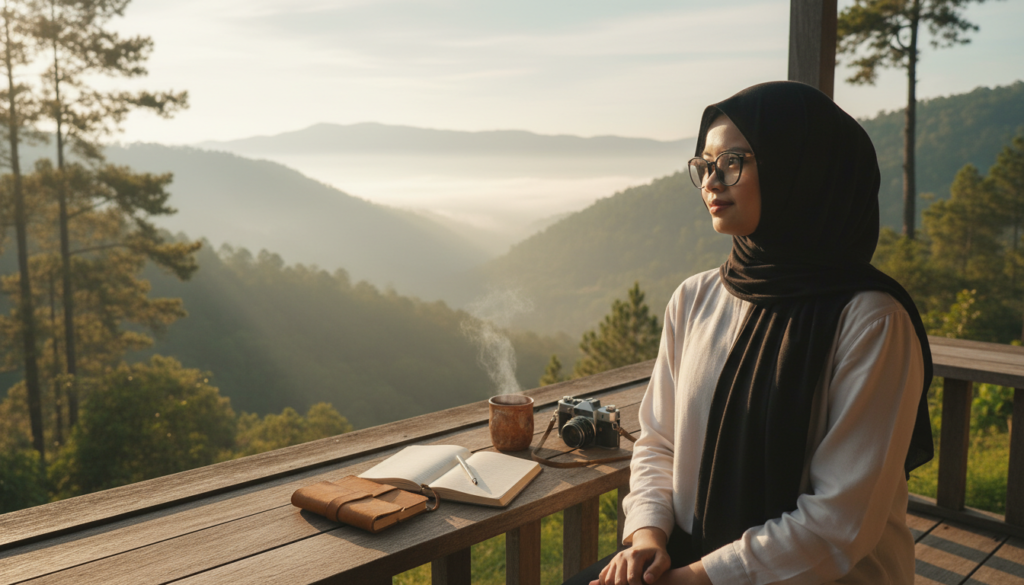
I can still remember the exact moment that tourism crushed my heart. In the summer of 2023, I was in a tight alley in a famous European city that everyone should see. I found myself surrounded by hundreds of sweaty strangers. Everyone was holding up a smartphone, desperately trying to capture a photo of a landmark they weren't even looking at with their own eyes.
I had spent thousands of dollars and flown across an ocean, only to feel completely disconnected, exhausted, and empty. I wasn't traveling; I was checking boxes on an invisible, socially mandated to-do list.
That was my breaking point. And if you are reading this on Hidden Gem Trips, I am willing to bet you have reached yours, too.
Welcome to the fight. The slow travel movement of 2026
This isn’t just another travel trend; it is a fundamental unlearning of everything the modern tourism industry has taught us. It is a protest against itineraries that take you to 10 destinations in 14 days. It prioritizes depth over distance, connection over consumption, and the understanding that time is the ultimate hidden treasure.
As we navigate this new era of exploration, this manifesto serves as your master guide to mastering 2026 slow travel.
The Breaking Point: Why “Checking Boxes” is Dead
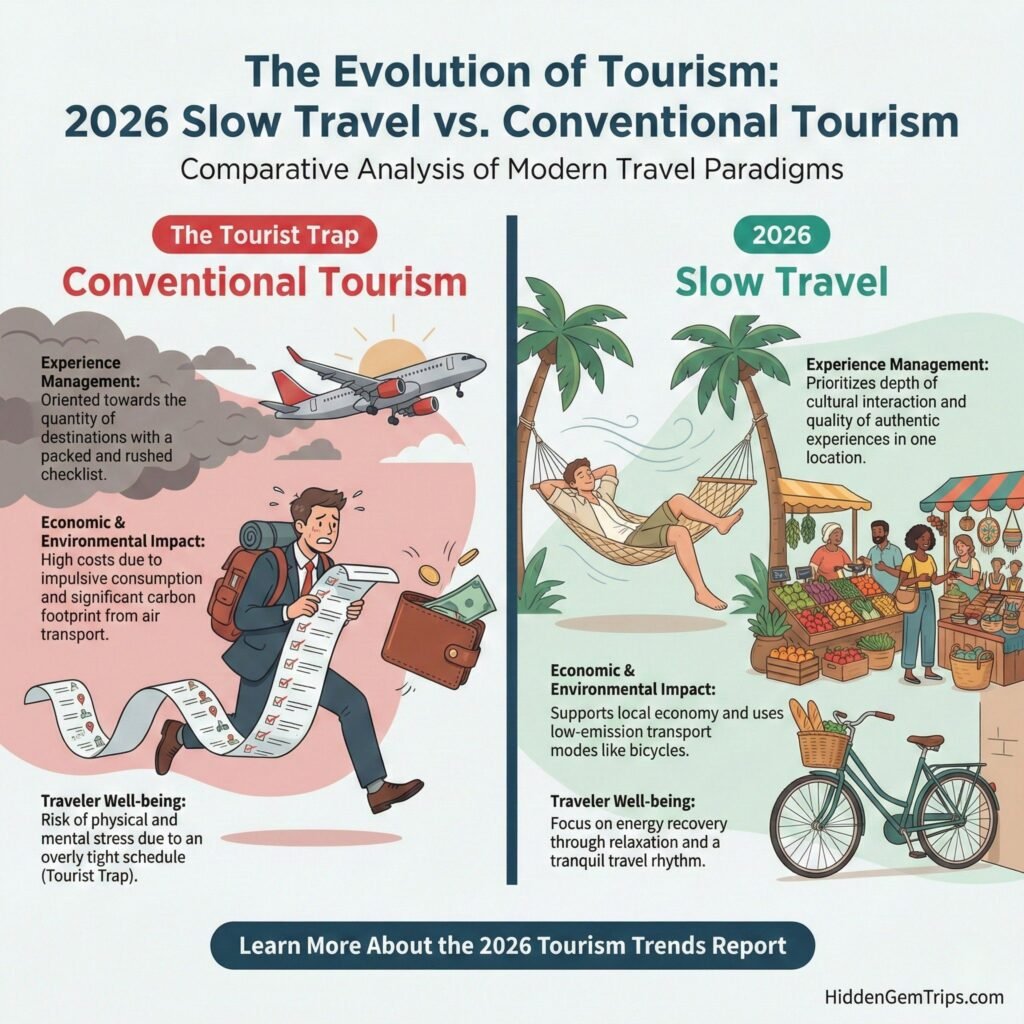
The concept of “revenge travel” following the pandemic has left destinations devastated, and travelers burned out. We saw places like Venice implementing entry fees and Mount Fuji erecting barriers to block the views of unruly crowds. Mass tourism has become a machine that erodes authentic experiences and leaves behind cheap, mass-produced goods.
We realized that flying halfway across the world to stand in line for three hours isn't a vacation—it's an unpaid internship in crowd management.
2026 slow travel is the antidote. It is a conscious decision to spend three weeks in one region rather than visit three countries in one week. It’s about renting an apartment in a quiet neighborhood, shopping at the local market, and actually learning how to say “thank you” in the native tongue.
What Exactly is 2026 Slow Travel? (More Than Just Staying Longer)
A common misconception is that you need months of free time to be a slow traveler. That is not true. You can practice 2026 slow travel on a seven-day trip. It is a mindset, not a timeframe. It rests on two main pillars:
1. Depth Over Distance
Instead of skimming the surface of a country, you dive into its ecosystem. You don't just see the famous temple; you learn about the civilization that built it. You don't just eat the local dish; you ask the chef where the ingredients were grown. This deep immersion naturally steers you away from overcrowded hotspots and toward the hidden gems we advocate for here at Hidden Gem Trips.
2. Ethical and Economic Immersion
When you rush through a city, your money usually goes to multinational hotel chains and airline conglomerates. When you slow down, your economic impact changes. According to the UN World Tourism Organization (UNWTO), community-based tourism directly empowers local economies, reduces carbon footprints, and preserves cultural heritage. In 2026, slow travel means your travel budget buys groceries from the farmer down the street and pays an independent guide who knows the secret trails.
The 4 Pillars of the 2026 Slow Travel Movement
To truly understand how this philosophy is reshaping the examined world, we must look at how it intersects with how we live, work, and explore. At Hidden Gem Trips, we have identified four core areas where the 2026 slow travel ethos is making the biggest impact.
Pillar 1: The Rise of the “Slow-mading” Professional
The era of the frantic digital nomad—hopping borders every two weeks just for the passport stamps—is fading. It’s exhausting and terrible for productivity. Today, remote workers are choosing to settle in one hidden gem for months at a time. They integrate into the community, learn the city's rhythm, and contribute meaningfully to the local micro-economy.
If you are looking to blend your career with this mindful pacing, I highly recommend reading our comprehensive Digital Nomad 2.0 Guide: Master the Best Slow-mading Peaks. It outlines exactly how to choose destinations that support deep work and deeper living.
Pillar 2: Reclaiming the Night with Astro-Tourism
When you aren't rushing to wake up at 5:00 AM for a crowded tour bus, you reclaim your evenings. One of the most beautiful byproducts of 2026 slow travel is the resurgence of looking up. Far away from the light pollution of over-touristed capitals, hidden gems offer spectacular night skies.
Astro-tourism forces you to slow down, literally. You cannot rush stargazing. For a deeper dive into this magical experience, explore our Star-Gazing Passports: The Ultimate Guide to 2026 Dark Sky Reserves.
Pillar 3: The Ethical Explorer's Dilemma
With great discovery comes great responsibility. As we seek untouched landscapes, we must ensure our wanderlust doesn't destroy the very pristine nature we seek. 2026 slow travel demands a strict adherence to “Leave No Trace” principles and an honest evaluation of our presence in fragile ecosystems.
We explored this profound ethical challenge in our polarizing piece, Socotra 2.0: Is Our Wanderlust Destroying Earth's Last Alien Landscape?. It’s mandatory reading for anyone venturing into the world's last wild frontiers.
Pillar 4: Empowerment Through Pacing
Safety is often the biggest concern for travelers, particularly women exploring solo. Interestingly, rushing makes you a target. When you are stressed, confused, and staring at a map with your luggage in the middle of a crowded train station, you are vulnerable.
2026: Slow travel enhances safety. By staying longer in one place, you learn which neighborhoods to avoid, build a network of trusted locals, and blend in. For women navigating the globe on their own terms, we have mapped out the best and most secure hidden havens in The 2026 Solo Female Travel Map: 10 Safest “Under-the-Radar” Cities.
Hard Numbers: The Real Cost and Benefit of Slowing Down
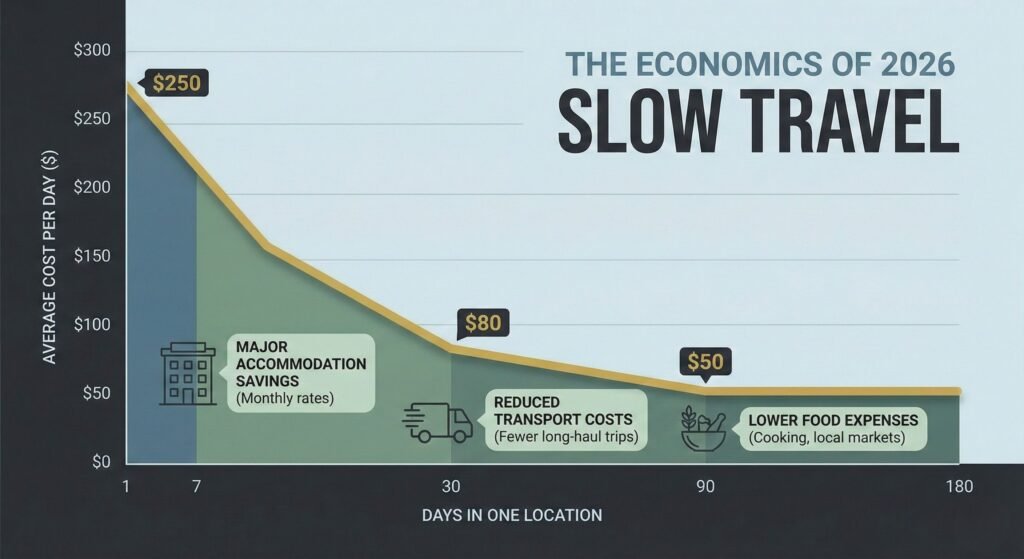
Let’s talk economics. A widespread misconception is that traveling for a month is four times as expensive as traveling for a week. The math of 2026 slow travel proves otherwise.
When you rush, you pay “convenience taxes.” You pay for fast trains, airport expresses, overpriced meals near monuments, and premium central hotels.
The $40/Day Reality Check
When you embrace 2026 slow travel, your daily cost drops dramatically.
- Accommodation: Platforms offer significant discounts (typically 30%-50%) on weekly or monthly stays.
- Food: You gain access to a kitchen. Buying fresh ingredients at a local market in Oaxaca or a village in the Balkans costs a fraction of what eating out three times a day would.
- Transport: You rent a bicycle or buy a monthly local transit pass instead of paying for high-speed intercity trains every other day.
According to a study by the Global Sustainable Tourism Council (GSTC), travelers who adopt a slow-paced itinerary can reduce their daily expenditures by up to 45% compared to traditional tourists, while paradoxically leaving more money in the hands of the local community rather than foreign-owned corporations.
How to Transition to 2026 Slow Travel: A Practical Guide
Transitioning from a manic tourist to a mindful explorer takes practice. Here is your blueprint for implementing 2026 slow travel on your next journey.
Rule #1: Halve Your Itinerary (Then Halve It Again)
Look at your current travel plan. Are you visiting four cities in two weeks? Cut it in two. Better yet, cut it to one region. Permit yourself to do absolutely nothing for an entire afternoon. The magic of a destination rarely happens in front of a famous monument; it happens at a corner cafe when you have nowhere to be.
Rule #2: Talk to Strangers (Safely)
Algorithms are great, but the best hidden gems aren't on Google Maps. The essence of slow travel in 2026 is human connection. Ask the barista where they go on their day off. Ask the taxi driver about their favorite childhood beach. The locals are the true curators of a destination's soul.
Rule #3: Ditch the “Must-See” Lists
The fear of missing out (FOMO) is the enemy of slow travel in 2026. Accept that you will not see everything at this time. And that is perfectly fine. The Louvre will still be there in ten years. But what about the impromptu conversation you might have with a local artisan if you aren't rushing to the museum? That is a once-in-a-lifetime occurrence.
Rule #4: Embrace the Mundane
Go to a local grocery store. Use the public laundromat. Ride a commuter bus at 10:00 AM. These seemingly boring activities are where the true culture of a destination reveals itself. You learn more about a country by observing what kind of snacks they sell in a minimart than by walking through a crowded tourist museum.
Conclusion: Your Time is the Ultimate Hidden Gem
At the end of our lives, we won't remember the times we rushed to get a selfie before the sun went down. We will remember the long, lingering sunsets we watched in complete silence. We will remember the taste of the bread baked by the woman who invited us into her home.
The world is too vast, too beautiful, and too fragile to be sprinted through. 2026 slow travel is our pledge to treat the globe with the respect it deserves, and to treat our own minds with the grace they need.
Stop rushing. The world's hidden gems are waiting, but they only reveal themselves to those who take the time to look closely.
Frequently Asked Questions (FAQ) About 2026 Slow Travel
I only get 10 days of vacation a year. Can I still practice 2026 slow travel?
Is 2026 slow travel more expensive?
How do I find destinations suitable for slow travel?
Won't I get bored staying in one place for so long?
Disclaimer
The information provided in this article is for inspirational and educational purposes only. Travel conditions, visa regulations, and local economics are subject to change. Hidden Gem Trips encourages all travelers to conduct their own independent research and consult official government travel advisories before embarking on any journey. This article contains internal links to other Hidden Gem Trips guides to assist in your planning. We are committed to ethical travel and urge all our readers to respect local communities and natural habitats.
